As I discussed previously, oak will enhance the flavour of wine. Much of that flavour imparted by the oak occurs naturally from the raw wood but ‘toasting’ the inside of an oak barrel will further enhance these flavours.
Photo credit: vinethos.com
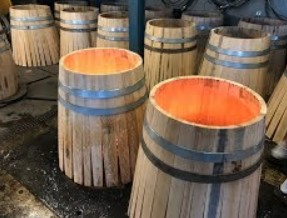
After a barrel is made its inside can be exposed to fire in order to toast it. This is done either over an open flame or by using a hand-held torch. The fire caramelizes the wood’s natural sugars and brings out complex compounds. From this, the wine will take on flavours that are toasty, charred, spicy and sweet depending on the amount of time the wood is toasted.
A lightly toasted barrel will be exposed to flame for about 25 minutes while a heavily toasted barrel may get up to one hour of flame exposure. Generally, the heavier the toast, the stronger and more varied are the revealed flavours.
Light toasting will impart flavours of subtle vanilla, coconut, caramel, clove and cinnamon. Medium toasting provides stronger vanilla, honey, caramel, toast, coffee and cocoa flavours. Finally, heavy toasting provides vanilla, espresso, smoke, crème brûlée, butterscotch, toffee, coffee and molasses flavours.
Oak will interact with wine differently depending on the grape variety. Oak may provide hints of chocolate to a Merlot or vanilla or coconut to a Zinfandel. White wines aged in oak typically develop flavours of vanilla, baked apple, caramel, honey, toasted marshmallow, or buttered toast.
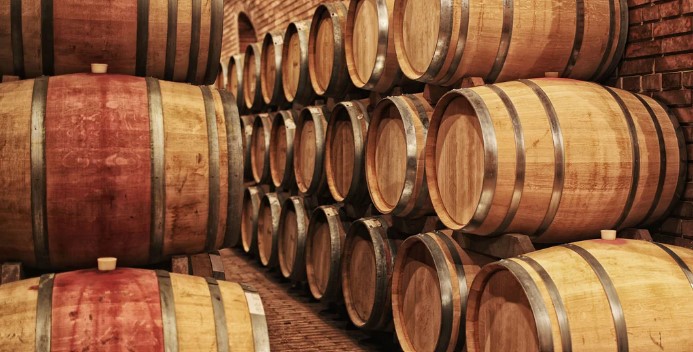
Oak has a major impact on the flavour of the wines we drink; whether it is absent or present; and if it is present, whether it be new oak, old oak or neutral oak. When wine remains in contact with wood during the fermentation and aging process, changes take place due to extractable organic compounds. These biochemistry effects translate into the wine’s aroma and flavour.
Photo credit: profilewinegroup.com
All oak wine barrels are toasted when they are made. Toasting is when the inside of the barrel is exposed to a flame for a specific time and temperature depending on the style of barrel. I will talk more about the toasting process in an upcoming post.
The impact of the toasting process declines as barrels age with use. New oak creates aromatic and flavour complexity in the wine whereas old oak becomes more neutral year after year. Some winemakers use a mix of new and old oak throughout the cellar in order to achieve their desired wine characteristics.
New oak influences red wines differently than white wines. In reds it will adjust the tannic structure while in whites it will open the aromatics of the wine.
The use of a high percentage of new oak barrels can create flavours of toast, vanilla, baking spices, coffee, caramel, maple or smoke. Neutral barrels no longer generate these flavours or aromas. New oak is also used to accelerate the softening of high tannin wines like Cabernet Sauvignon. They can produce a more rounded wine at a younger age.
While neutral oak barrels no longer provide flavour, they still play an important role as they introduce oxygen to the wine. This oxygen seepage has a big impact on the natural chemical conversions that wine undergoes during maturation. Neutral barrels help maintain the fruit qualities of more delicate wines and soften wines that have a high amount of tannin.
The size of the barrel affects the oak’s impact on the wine. The larger the barrel, the less oak lactones and oxygen that are transferred into a wine. Thus, there is less impact on the flavour and aroma. Barrels are normally 225 litres but can be as large as 1,000 to 20,000 litres.
The typical winemaking lifespan of a properly maintained barrel is around five years. However, this may vary depending on the appellation, the type of wine and whether the winemaker is using the barrel for profile influence, oxygenation or storage.
Maintaining enough new oak on hand can be a challenge as there are only a limited number of new barrels available for purchase each year. As well, the cost can be prohibitive as the price of one barrel can range from a few hundred to a few thousand dollars.
This is the first of a three-part series on the use of oak in the wine-making process.
Photo credit: wordonthegrapevine.co.uk
It’s a well-known fact that oak has become the most accepted way to affect the taste of a wine. When added to wine, oak combines with the flavours of the grapes to create a wide variety of incredible tasting wines.
Most the world’s finest wines are aged in oak barrels, with French and American oaks being most commonly used. However, Russian and Eastern European oak are also used, especially in Europe. All wine barrels are made from white oak but the characteristics of the barrels vary greatly depending on the source of the oak.
French Oak
French oak is historically found in the forests of eastern and central France. It has more tannin than the other oaks so lighter grape varieties, such as Pinot Noir, are well suited to tannin-rich French oak. French oak has a tighter-grained wood structure which exposes subtler tastes like aromatic spices, cocoa and coffee. French oak grain is less coarse, contributing to wines with subtle, spicy and smooth, satiny or silky qualities.
American Oak
American oak is twice as dense as French oak, bringing greater spice and wood sugar compounds that slowly extract and fill out a wine’s body. American Oak has a loose grain and is heavy in lactones, which creates flavours like coconut and banana to finished wines. It can also provide an impression of a bit of creaminess and a hint of vanilla in wine. American oak contains a lot of hemicellulose1, which when charred will break down into wood sugars, allowing for some caramelization.
American oak is widely used in Spain to make Tempranillo. American oak barrels can weigh twice as much as French oak barrels but cost about half the price to purchase.
Russian and Eastern European Oak
Eastern Europe has a vast supply of oak trees. Hungarian oak is richer in eugenols, which impart spice, and tends to create a slightly richer mouthfeel with substantial tannin. Caucasian oak, on the other hand, releases less tannin and aromatics, which is better for lighter wines desiring a straight-up expression of the grape itself.
Russian oak is used widely throughout Europe. Slavonian oak is used in a variety of Italian wines. It is known for providing less tannin and more sweetness to the wine.
1 According to ScienceDirect.com, “Hemicelluloses are typically defined as components that can be precipitated by ethanol after extraction from the cell wall by dilute alkali. In such procedures they are extracted after depletion of the pectin content of the walls by aqueous solvents and calcium chelators”.
The western half of Scotland has its roots based in the Gaelic language and given that many whisky distilleries are situated in Gaelic lands, it should be no surprise that their names are often Gaelic as well. Even some of us who were raised with a Scottish Gaelic parent have difficulty deciphering and pronouncing the names correctly.
I have come up with a list of the distilleries that sport Gaelic names and export their whisky regularly to the Canadian marketplace. The list is presented in alphabetical order.
AnCnoc Distillery
AnCnoc Distillery, founded in 1894, is situated in Knock, Aberdeenshire. It was originally known as Knocdu (“nock-doo”) from the Gaelic Cnoc Dubh which means ‘black hill’. It later became AnCnoc which simply means ‘the hill’. And is pronounced “ah-nock”.
Auchentoshan Distillery
Auchentoshan Distillery was established in 1823 and is located at the foot of the Kilpatrick hills, close to Clydebank. In Gaelic its name translates to ‘Achadh an Oisein’ which means ‘corner of the field’. It is pronounced as “ock-un-tosh-un”. The distillery’s motto is “Challenging to say, easy to drink”.
Bruichladdich Distillery
Bruichladdich is located on the wild Rhinns, located on the west side of the Isle of Islay. It was originally founded in 1881. The name is derived from the Gaelic words ‘brudhach’ and ‘chalddich’ which together translate to ‘brae by the shore’. The name is pronounced as “broo-ick-laddie”.
Bunnahabhain
Bunnahabhain Distillery, founded in 1881, is located near Port Askaig, on the north side of the Island of Islay. Its name is derived from the Scottish Gaelic for ‘mouth of the river’, Bun na h-Abhainn. It is pronounced “bu-na-ha-venn”.
Caol Ila Distillery
Caol Ila Distillery is located on the northeastern shore of Islay. It was founded in 1846. The name derives from the Gaelic ‘Caol Ìle’ which means ‘sound of Islay’ and is pronounced as “cull – eela”.
Cragganmore Distillery
Cragganmore is in the Speyside region near the village of Ballindalloch. It has been in existence since 1869. The Gaelic form of its name is creagan mór, which translates as ‘great rock’. Cragganmore is pronounced as “kra-guhn-more”.
Glenfiddich Distillery
Glenfiddich was founded in 1886, in the Highland community of Dufftown, Banffshire. Glenfiddich is Gaelic for valley of the deer and is pronounced “glen-fidd- ick”.
Glenmorangie Distillery
Established in 1843, Glenmorangie is located in the Highlands, about 60 kilometres north of Inverness. There is debate as to whether the name was derived from Gleann Mòr na Sìth, which means ‘valley of tranquility’ or Gleann Mór-innse, which refers to ‘valley of big meadows’. In either event, Glenmorangie is pronounced “glen-muh-ran-jee”.
Lagavulin Distillery
Lagavulin, founded in 1816, is located at Laguvulin Bay on Islay. Its name is an anglicization of the Gaelic lag a’mhuilin which means ‘hollow by the mill’. Lagavulin is pronounced “lagga-voolin”.
Laphroaig Distillery
The name Laphroaig means ‘beautiful hollow by the broad bay’, which makes sense as the distillery, which was founded in 1815, is situated along the south shoreline on Islay. Laphroaig is pronounced as “la-froyg”
Tamdhu Distillery
Established in 1897, Tamdhu Distillery is located in the Highlands in the village of Knockando. Its Scottish Gaelic name translates to ‘little dark hill’ and is simply pronounced “tam – doo”.
Tomintoul Distillery
Tomintoul Distillery is located in the Speyside whisky region, inside the Glenlivet estate. The distillery is named after the nearby village of Tomintoul, which is the highest village in the Highlands of Scotland. Tomintoul is by far the youngest distillery in the group, established in 1964. The Gaelic translation of its name means ‘the hill of the barn’ and is pronounce “tom-in-towel”.
In Closing
I think I now have a better understanding as to why my father always drank Glenlivet; it was very easy to pronounce, even for a Scotsman!



 A Layman's Wine Musings