Fortified Wines

Photo credit: thewinedream.wine

Fortified wine is wine that has had a distilled spirit added during the winemaking process. There are several types of fortified wines, each classified by its own unique set of regulations. These regulations include the type of base wine, type of spirit that is added to the wine, the amount of alcohol by volume (ABV), the amount of sugar and the period that it is aged.  While fortified wines can be made anywhere, specific geographic regions are often regulated for a distinct category. For example, Madeira is only produced in Portugal’s Madeira Islands.

The basic process for making fortified wine involves fermenting the wine and adding distilled spirits, such as brandy. The winemaker determines the amount of sweetness in the fortified wine depending at which stage of the process the distilled spirits are added. If the spirit is introduced before fermentation is complete, the resulting wine will be sweet.  However, it the spirits are added after fermentation is complete, the resulting fortified wine will be dry.

Wine fermentation occurs when yeast breaks down sugar molecules in grapes and produces ethyl alcohol. Adding a spirit during the fermentation process reduces the yeast content and results in a sweeter fortified wine because a larger amount of residual sugar is left behind. On the other hand, if fermentation ends before the spirit is added, the yeast will break down a higher percentage of the sugar, resulting in a drier fortified wine.

Both sweet and dry varieties are often served as aperitifs or digestifs before or after meals to help stimulate appetite and digestion.  Some types of fortified wines are also used in cooking to add a delicious twist to a favourite recipe.

The regulations for making fortified wine vary by region. Here are some of the most popular types presented alphabetically:

Commandaria

Commandaria comes from Cyprus and is predominately a sweet dessert wine. It’s made with only two types of grapes, Xynisteri and Mavro, which are indigenous to the island. The maximum alcohol content is 20 percent ABV.  Commandaria is rich and sweet with a fruity taste.

 Madeira

This type of fortified wine derives its name from Portugal’s Madeira Islands. Brandy is added at different times during fermentation causing variations in flavours.  Types of Madeira range from dry wines served as an aperitif to sweet wines served with dessert.  An aging process known as estufagem is used to create the wine and give it its unique taste. Madeira can be produced in two ways: either over a period of months with hot water tanks or steam, or naturally over a period of decades.

Marsala

Marsala is a fortified wine from the Italian island of Sicily. It is available in both dry and sweet varieties and is produced using white Italian grapes and depending on its type, contains between 15 and 20 percent alcohol by volume. The various types of Marsala are determined based on their sweetness, age and colour.

Styles of Marsala range from dry aperitivos to sweet dessert-style wines.  Marsala is a common cooking wine that’s fortified after fermentation, giving it a distinct dry flavour. It’s also sometimes sweetened, making it a great addition to dessert recipes.

Moscatel de Setúbal

This a Portuguese fortified wine that comes from the municipality of Setúbal. It must be made with at least 85 percent white Muscat grapes and contain between 16 and 22 percent ABV. Moscatel de Setúbal is one of the sweeter fortified wines and frequently has notes of apricot and orange zest.

Port

Port wine comes from the Douro Valley region of Portugal. Grapes must be grown and processed in the region to be considered as Port.  Unaged brandy is added to the wine before it has finished fermenting, resulting in a sweeter flavour.  The ABV will be in the 20 percent range.

There are many styles of Port, but its most popular form is a sweet red wine, such as Ruby Port or Tawny Port. Those seeking a different type of dessert wine might consider a White Port or Rosé Port.

Sherry

This fortified wine is produced in from Palomino, Muscat or Pedro Ximénez grapes in the Jerez region of Spain. Sherry production is unique in that the winemaker intentionally exposes the wine to oxygen, which imparts nutty and briny flavours. Before bottling, entire barrels are blended with portions of older wines. This process is referred to as the solera method and is almost entirely exclusive to the production of sherry.

Sherry is fortified with brandy and will contain between 15 to 18 percent ABV. Like any wine, after opening it should be refrigerated but will retain its freshness about four times as long as a typical wine. There are many styles of sherry, ranging from the lighter Fino style to the darker Oloroso style.

Vermouth

Vermouth is fortified wine that is aromatized with flavours of fruits, herbs, spices and florals. Dry Vermouth, also referred to as French Vermouth, has a distinctly crisp and floral character. Dry Vermouth is produced by blending white wine with herbs and spices before adding brandy for fortification. Sweet Vermouth, also known as Italian Vermouth, has a heavier mouthfeel and a more caramelized, fruity character than Dry Vermouth. It doesn’t have to be made from red wine, although some producers insist on it.

Where Dry Vermouth is often the basis for a Dry Martini, sweet vermouth is used to create cocktails such as Manhattan and Negroni. However, Sweet Vermouth can also be enjoyed on its own with a bit of ice or soda.

In Closing…

Many people are either unfamiliar or intimidated by fortified wines.  They should not be feared and the best way to become familiar with them is to try them.  I would suggest starting with a mid-priced Tawny or Ruby Port, or a sweet or dry Sherry.

Sláinte mhaith
The World’s Biggest Wine Producers

Here’s some information that may be of help on trivia night or for those of you who simply have an enquiring mind.  Below are 2022’s wine production statistics measured in million hectolitres.  I have included production numbers for the top 30 countries; however, the complete list is available at http://www.visualcapitalist.com.  A hectolitre contains 100 litres.  The information was gathered by the International Organization of Vine and Wine (OIV).

 Rank              Country        ContinentQuantity
(million hl)
% of Total
Production
1ItalyEurope49.819.3
2FranceEurope45.617.7
3SpainEurope35.713.8
4United StatesNorth America22.48.7
5AustraliaOceana12.74.9
6ChileSouth America12.44.8
7ArgentinaSouth America11.54.4
8South AfricaAfrica10.23.9
9GermanyEurope8.93.5
10PortugalEurope6.82.6
11RussiaEurope4.71.8
12ChinaAsia4.21.6
13New ZealandOceana3.81.5
14RomaniaEurope3.81.5
15BrazilSouth America3.21.2
16HungaryEurope2.91.1
17AustriaEurope2.51.0
18GeorgaEurope2.10.8
19GreeceEurope2.10.8
20MoldovaEurope1.40.5
21SwitzerlandEurope1.00.4
22North MacedoniaEurope0.90.4
23JapanAsia0.80.3
24PeruSouth America0.80.3
25UruguaySouth America0.80.3
26BulgariaEurope0.70.3
27CanadaNorth America0.70.3
28UkraineEurope0.70.3
29TürkiyeEurope0.60.2
30Czech RepublicEurope0.60.2

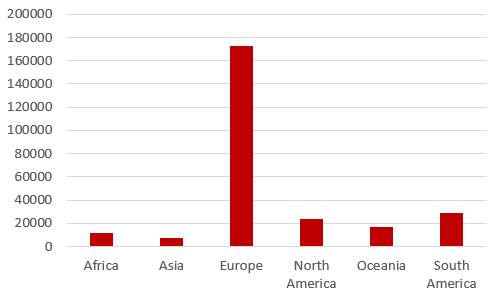
Just for fun I did some number crunching to determine the ratio of world production by continent. Because I rounded the individual country totals the overall total percentage added up to 101%, not 100. However, the continental totals will give you a fairly accurate perspective of world wine production.

 Rank            ContinentQuantity
(million hl)
% of Total
Production
1Europe172,70667
2South America28,66111
3North America23,4739
4Oceana16,5756
5Africa11,1364
6Asia7,3073
2022 wine production by continent

It is incredible that Europe controls two thirds of the world’s wine production.  I was surprised to see that overall, North America’s wine production was greater than Oceana (Australia and New Zealand),and was very surprised to see that Canada’s production was ranked as only 27th.  I imagined it would be somewhere closer to that of Hungary and Greece. However, quality outranks quantity. It would be interesting to know whether a quality scale could ever be devised to compare countries..

Sláinte mhaith

Crus in Germany and Italy

Back on March 18, 2023, I talked about France’s use of the term cru for identifying wines. In France the label is used to identify geographic terrain, specifically the soil type, climate and altitude where the grapes are grown.  The term cru is also used in Germany and Italy but there are additional variations in how the name is applied, as well as its meaning.

In Germany, the Verband Deutscher Prädikatsweingüter (VDP), an association of elite German wine estates, has its own vineyard classification system, similar to the one used in Burgundy, France. In Germany the top tier is VDP.Grosse Lage (grand cru). This is followed by VDP.Erste Lage (premier cru), then by VDP.Ortswein (village) and finally VDP.Gutswein (regional).

In Italy, cru is used in several regions, but the application between regions is not exactly the same. Piedmont and Sicily are probably the best known regions using it. In Piedmont, Barolo and Barbaresco have mapped out their grand crus by geographic area, and those vineyard explanations are part of the bylaws of their Denominazione di Origine Controllata e Garantita (DOCGs).

Wine producers in Sicily’s Etna DOC are identifying crus that follow old lava flows and the soil and elevation changes along Mount Etna. At this point there is no formal classification system but it is anticipated to be ratified in the future.

So, if there is one thing that can be concluded regarding the use of the term cru in the labeling and description of wine, it’s that there is no consistency in its use within a country let alone between nations.

Sláinte mhaith

From One Passion to the Other

People sometimes look at me funny when I tell them I periodically write about whiskey in my wine blog.  However, here is an excellent example of how the world of one is in many ways very similar to that of the other.

Photo credit: thedrinksbusiness.com

Raimonds Tomsons, who is from Latvia, won the ASI (Association de la Sommellerie Internationale) Best Sommelier of the World competition earlier this year in Paris, France.  Prior to winning the championship, Tomsons had already made a name for himself due to his work in wine, being a board member of the Latvian Sommelier Association and having worked with several high-end restaurants and importers in Latvia.

He is now going to be the global brand ambassador for The Craft Irish Whiskey Co. of Dublin, Ireland.  Tomsons will now be applying his expertly trained nose and palate in his new role.  He sees this new endeavor as giving him the opportunity to further enhance his learning by exploring the diverse world of spirits and other beverages.

Tomsons sees that by joining Jay Bradley and his team at The Craft Irish Whiskey Co., he will have an opportunity to explore fine Irish whiskey in depth, and work on innovative whiskey and food pairings.  Bradley feels that Tomsons’’ knowledge and ability to detect nuances and layers of flavour compliments the way he makes whiskeys, each bottle of which offers a unique complexity of flavours.

The Craft Irish Whiskey Co. was founded by Bradley in 2018.  The distillery creates rare and ultra-rare Irish whiskeys, including The Emerald Isle, worth an incredible $2 million US, making it one of the most expensive whiskeys in the world.

Craft Irish Whiskey is made only in a pot still and with hand-selected barrels.  They craft whiskey as it was once made before the rise of blends and mass-production techniques. They are proud to be reviving the art of crafting whiskey.  The Craft Irish Whiskey Co.  considers themselves as being rooted in tradition but with an eye on the future, a modern expression of a historic craft.

It is now also a marriage between the world of wine and that of whiskey.

Sláinte mhaith