No Corkscrew, No Problem

What do you do when you find yourself in the predicament of desperately needing to open a bottle of wine and you don’t have a corkscrew, and the bottle is not a screw top?  Several of the major wine publications have invested time and effort to find reasonable solutions to this problem. I will present those that I feel are not too farfetched, are fairly safe and hold a realistic chance of success.   However, none of these methods are as reliable as using a corkscrew and could result in breaking the cork, chipping the wine bottle, or in a worst-case scenario, breaking the wine bottle.

This list of potential solutions is presented in no particular order.

Screw, Screwdriver and Hammer

Take a screw (minimum 1 ½ inches long) and screw it into the cork with a screwdriver until there is about an inch or so left showing. Then, you take the claw side of the hammer, lock it under the screw, and pull the cork out.

Push the Cork into the Bottle

Using the handle of a wooden spoon, Sharpie, highlighter or other object that is slightly smaller in diameter than the cork, push the cork down into the bottle of wine. Unfortunately, it is almost impossible to remove the cork from the bottle once you push it in. If the bottle of wine is old, the cork may crumble and shed into the wine once pushed in. If this happens, use a strainer, coffee filter or sieve and pour the bottle of wine through it into a decanter to remove the cork pieces.

Wire Clothes Hanger

This method is relatively easy as long as you have an unused wire hanger taking up space in your closet.  However, in our house the wire hangers were replaced with plastic hangers years ago.   

To begin, bend the tip of the hanger about 30 degrees back so that it looks similar to a fishhook. Next, slide the wire down through the cork slowly until the hook is past the cork and into the wine. Rotate the wire 90 degrees so that the hook is underneath the cork. Then pull the wire up and the cork should release. Pliers can be used instead of your fingers to tug at the hanger.

Keys, Scissors or a Serrated Knife

This method is somewhat similar to the first option where a screw and hammer are used. However, this time plunge your keys, scissors or serrated knife into the cork at a 45-degree angle and move the top of the item in a circle, essentially twisting the cork out slowly. After several rotations the cork should come out. Make sure you really get the tool well into the cork otherwise the cork may crumble.

The Sole of a Shoe

Wrap the bottom of the wine bottle in a towel and place it upside down in between your legs while sitting and slap it with the sole of a shoe. Stop before the cork comes all the way out or the wine may end up all over you and the floor.

Tire Pump and Sports Ball Needle

Take a bike pump that has a needle attached that is used to inflate a basketball, football or volleyball and push it all the way through the cork where the needle reaches the air space between the cork and the wine. Then pump air into the bottle. As air is pumped in, the cork should slowly move out of the bottle due to the air pressure.

Final Thoughts

As long as you are careful and take your time, any of these alternatives should work.  However, in my opinion nothing is better than a tried and true corkscrew, if one is available.

Sláinte mhaith
It’s Not Just About the Number

When searching for the ideal bottle of wine to compliment a meal, for a special occasion, or simply to lounge with in front of the television, many people rely on the wine’s rating number or score, as it’s often referred.

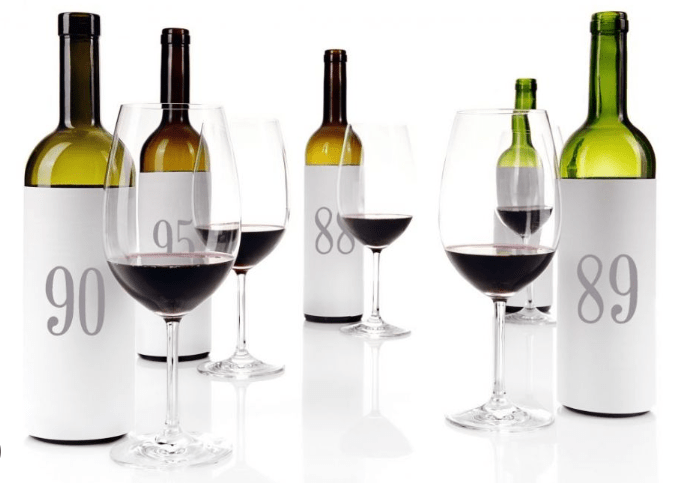
Photo credit: vivaavida.r7.com

The most commonly used scoring system is what is referred to as the 100-point scale, which was created by James Suckling in the 1980s. Wines with a score between 89 to 91 are considered good; a score between 92 and 94 is great; a score between 95 and 97 is excellent; and a score from 98 to 100 is considered outstanding.

It is important to realize however that every bottle of wine with a score of 98 is not necessarily better than every bottle of wine with a score of 92. Other factors, such as price to quality, must also be considered.  Therefore, it is important to take into account other factors of a wine review before making the ultimate decision as to which bottle you are taking home.

If you see the name of a winery whose wine you have enjoyed in the past, there is a good probability that you will like other wines produced by that winery as well. 

Noting the type of grapes contained in the wine is an excellent indicator as to whether you may like a wine or not.  If you favour certain grape varietals, for example Riesling or Merlot, chances are wines containing those grapes will be more enjoyable for you.

Many countries, including Canada, have a quality standards system that will indicate on the bottle whether the wine has met the appellation of origin standards.  These standards ensure that certain agricultural criteria are met.  In Canada we have the VQA (Vintner’s Quality Alliance) system.  For more information regarding quality standards see the following posts from 2019: Selecting Canadian Wines, France’s Standards of Quality, Germany’s Quality Standards and Italian Quality Standards.

A wine’s place of origin is one factor in determining its characteristics. The region where a wine comes from will indicate the style of wine as well as flavour characteristics.  So, if you find you favour the flavour of a wine from a particular region, chances are you will enjoy other wines from that same region.

Not all wines are intended to be consumed right away. Although the majority of wines may be enjoyed when you take them home, some wines are best drunk after they have been laid down for a few years. The vintner’s notes or the wine store will often indicate whether a wine is intended to be enjoyed now or is best to be cellared.  Drinking a wine too soon may leave you with unpleasant thoughts about that wine.

Happy wine shopping.

Sláinte mhaith

Rhine River Cruise

My wife and I recently returned from a Rhine River cruise where we had the opportunity to sample wines from Switzerland, France and Germany during our travels. I was most anxious to try some Swiss wines as I had never had the opportunity of tasting any. These wines are not often available outside of Switzerland (see The Wines of Switzerland from May 1, 2021). 

The first Swiss wine we tried was a 2022 Weinbau Ottiger Pinot Noir. The wine is very similar in character to a French Pinot Noir.  The second sampling was a red blend from Château Constellation sa 1950 Sion, called “Humagne Rouge”.  It has a spicy bouquet characterized by notes of pine and cinnamon. It has accents of black fruit aromas balanced by silky tannins. It was very enjoyable.

We ventured through Strasbourg, France and the Alsace wine region. World-renowned for its viticulture, Alsace has a dry mild climate, favourable soils and ideal exposure to the sun for its vineyards. The white wines produced here rival the Rieslings created in neighbouring Germany.

While in Breisach, Germany, the tour offered a wine tasting at Domaine Albert Seltz, Alsatian Vineyards.  There they follow a rigorous process to preserve the authenticity of their wines, respecting traditional techniques while integrating the most recent advances in technology. Sustainable viticultural practices are followed that promote biodiversity and respect for nature.

The area surrounding Breisach, the capital of Alsatian wines, has the third largest wine co-op in the world, following California and South Africa. Twelve million litres of wine are produced there each year, taking advantage of being the sunniest place in all of Germany.

We also visited Rüdesheim, which is a German winemaking town in the Rhine Gorge, and part of the UNESCO World Heritage Site. It is in the heart of the Rheingau wine region.

Close to Speyer, Germany lies the Roter Hang wine area.  It is considered to be one of the most important vineyard sites in the world, sitting to the south of Mainz, not far from Nierstein and Nackenheim. The soil is red, the result of red slate that exists throughout the region, providing the perfect conditions for outstanding wines that are characterised by unmistakeable flavour.

Further north at the intersection of the Rhine and Moselle Rivers is the town of Koblenz.  Koblenz is a principal seat of the Mosel and Rhenish wine trade. Mosel is best known for growing some of the finest Riesling grapes in the world. 

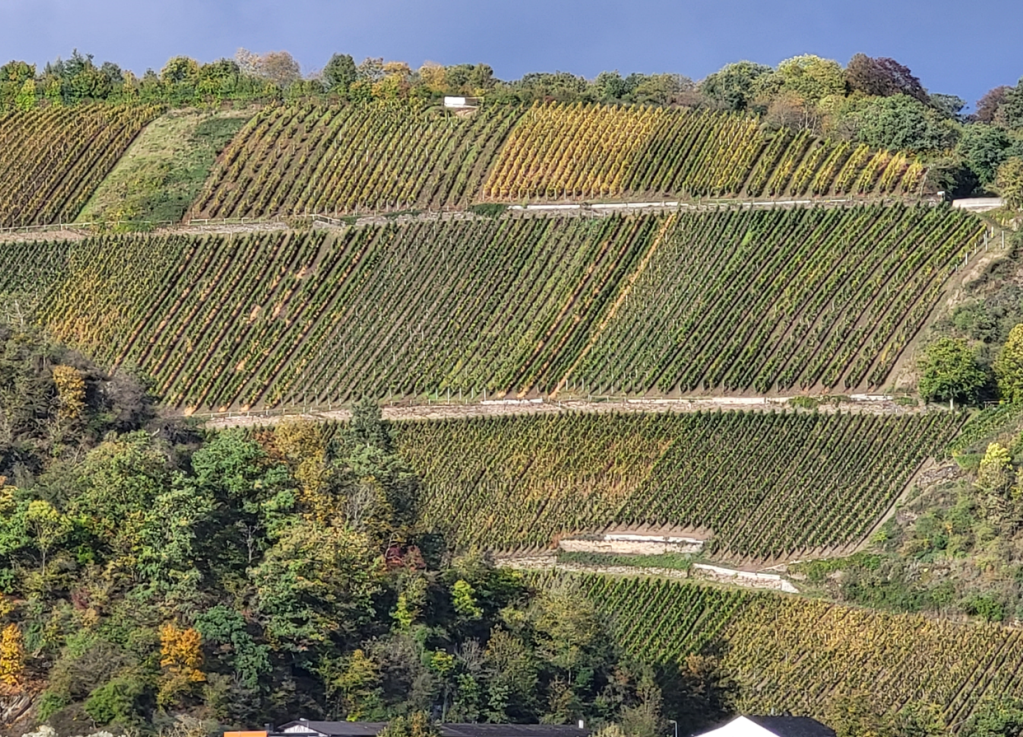
The vineyards are found tiered along the hillsides of the Moselle River. The steepest vineyard slopes in all of Europe are found here. Some of the grape vines are planted in vertical rows while others are in horizontal rows. The grapes planted vertically are machine groomed vines while those planted horizontally are generally on the steepest slopes and are maintained totally by manual labour.

Along the Moselle River in Winningen we visited the Weingut Rüdiger Kröber winery where we sampled four different Riesling wines ranging from dry to sweet; the 2022 “Kröber Weingut Steinig Riesling” dry, the 2022 “Kröber Weingut Uhlen Laubach” dry, the 2022 “Kröber Weingut Winninger Brückstück Riesling Feinherb” semi dry and the 2021 “Kröber Weingut Winninger Röttgen Kahimer Riesling Alte Reben” sweet. I found the Uhlen Laubach to be my favourite as it was robust with character and full of flavour.

The winery’s vineyards are up to 28 terraces in height along the slope of the hills. Weingut Rüdiger Kröber grows 90% Riesling, 5% Pinot Blanc and 5% Pinot Noir varietals. The vines range from 50 to 80 years in age.  The winery produces 60,000 bottles of wine per year and like many of the wineries in the region, it is all sold locally to individuals and restaurants.

Now that we have returned home from the Rhine, my wife and I are in the midst of planning our next wine excursion, which will be along the Rhone River in France during the spring of 2024.

Sláinte mhaith

Storing Your Whiskies

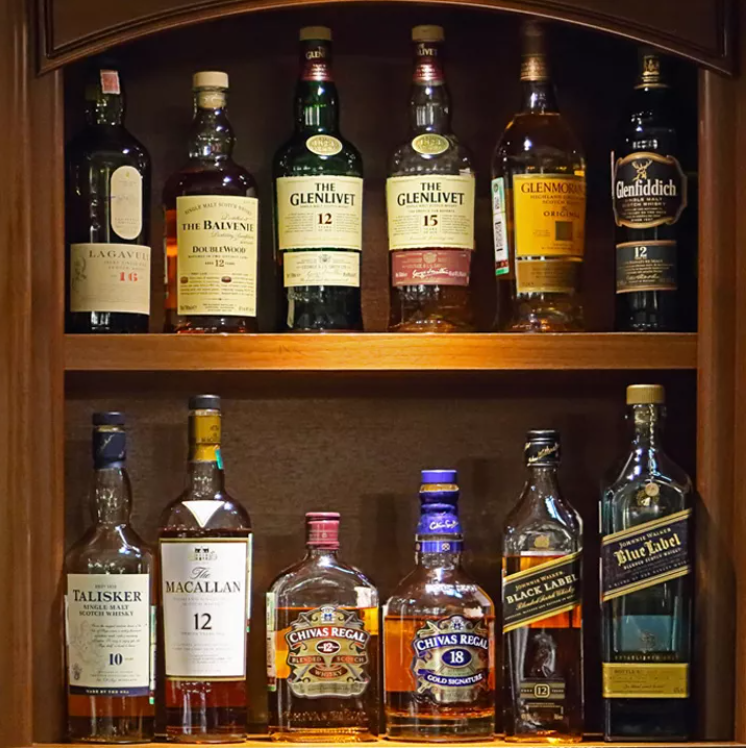
With the price of whisky ever increasing, ranging from $50 to $500 or more for a standard bottle to well into the thousands of dollars for rarer offerings, it is becoming more important to be sure that the whisky does not deteriorate after you purchase it.  There are a variety of factors to take into consideration when storing whisky; heat, evaporation and alcoholic content.

Photo credit: liquor.com

Rare collectable whiskies are best stored in a cold storage facility.  However, for most whiskies, storing it in a cool location in your house is often sufficient.  This will help to ensure that no evaporation occurs. 

Unlike wine, whisky bottles should be stored in an upright position. If a bottle is stored on its side, the high alcohol content will weaken the cork, resulting in the whisky leaking out of the bottle.  Be sure to keep an eye on the condition of the cork. Constant contact with the high strength alcohol can degrade the cork, causing it to disintegrate or transfer unpleasant flavours into the whisky. Turn the bottles upside down a couple times a year to help ensure the cork does not dry out or oxidate.

It’s best to keep the whisky in a consistently cool, but not cold location.  If the liquid becomes too cold, it can cause it to become cloudy. Experts recommend storing whisky at a temperature of between 15° and20° Celsius (59° to 68° Fahrenheit). If you’re collecting both whisky and wine, like I do, you may not want to store them together, as the ideal temperature for keeping whisky is higher than for wine, which is 13° to 14° Celsius (55° to 57° Fahrenheit).

Like wine, the bottles should be kept away from sunlight as the sun can affect the delicate flavours and desired colour of the spirit, as well as cause evaporation.   Darkness will also help preserve the labels from fading, maintaining them in mint condition.

It is important to maintain consistent temperature and humidity. Fluctuating temperatures and humidity can cause the liquid to expand and contract, destabilizing it. Excess humidity can cause damage to the labels and degrade the cork.

Sláinte mhaith