A Whiskey Tasting Party

This is a good time of year to have a whiskey tasting party. A whiskey tasting can be done in a couple of different ways. The simplest method is to just get a few bottles together and let everyone help themselves while they sit around and chat about the ways of the world. However, it can be more interesting if everyone is tasting together and there’s a progression of styles to sip from. This technique is similar to that of a wine tasting party.
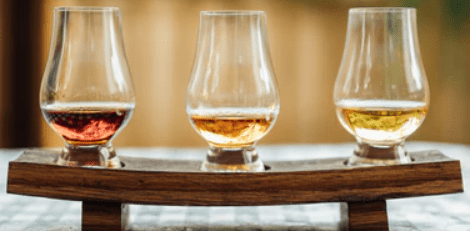
Photo credit: southerndrinkingclub.com

If following the second approach, first determine how many people will attend and then how many whiskies you want to sample.  If everyone is tasting the same whiskey at the same time it is probably best to keep the number of attendees to under a dozen. This will make it easier to keep organized and maintain a well-structured group conversation about each sample.

When deciding on which whiskies to try, you could follow a specific theme or make your selections based on ones you personally enjoy. The experts suggest that the number of whiskies should range from five to eight with each pour being about ½ an ounce. Following this guideline, you will only require one bottle of each whiskey. Depending on your approach, you can either provide the whiskies yourself or ask each guest to bring a bottle.

Regarding the number and type of glasses to use, some enthusiasts only use snifter or Glencairn style glass but white wine glasses with small to medium bowls work equally as well. Your guests only need a glass or two at a time, so you can either dispose or finish the remains after each tasting, rinse out the glass and proceed to the next. This saves on glassware plus the clean-up time afterwards.

Allow people to taste each sample first without adding any water. Then give them the option to add a couple of drops of water to see if that affects the taste. It is a good idea to provide a pitcher of filtered or bottled water served at room temperature and liquid droppers, which can be obtained from most pharmacies. When adding water, it is important not to dilute the whiskey, thus no more than a teaspoon should be added. Whiskey flavours are easier to identify as you lower the relative alcohol content, thus diluting your whiskey a few drops at a time helps open up new flavours to experience.

On the topic of water, each participant should be provided with drinking water to cleanse the palate between tastings, as well as to keep themselves hydrated. Crackers or plain bread, such as a baguette are also good ways to cleanse the palate between tastings.

It is a good idea to have a container available for your guests to pour out whiskies they don’t care for. The goal here is to experience a range of whiskies, not encourage anyone to drink something they don’t like.

The best way to progress through a tasting is to sip the lightest whiskey first and end with the richest and/or most heavily flavoured/smokiest one. As host, it’s a good idea to taste everything yourself prior to the event in order to know which order the whiskies should be served in. Keep in mind that lighter coloured whiskey doesn’t necessarily mean it is lighter in flavour.

If you decide to select your whiskies using a theme, options include selecting by country, such as all American, all Irish, all Scottish, all Japanese, etc. Another option is selecting all single malts, whether from Scotland or a selection from different parts of the world.  Comparing whiskies of the same age or from a single region are a couple of other options.

When it comes time to sample each whiskey, begin by “nosing” or smelling the whiskey. When it comes to tasting, hold the first sip in your mouth for several seconds before swallowing. On subsequent sips, concentrate on discovering the flavours and aromas. Then after adding a few drops of water explore the flavours again.

With all the discussions, nosings, water additions and subsequent re-tastings, you can expect to spend at least a couple of hours exploring your selections. Most importantly, the experience should be enjoyable for everyone. It’s a bonus if either you or your guests discover a new favourite whiskey along the way.

Sláinte mhaith

Pinot Gris or Pinot Grigio

Pinot Gris and Pinot Grigio are made from the same grape and are obviously both white wines, but it can be argued that the similarity ends there.

Photo credit: vinomofo.com

Pinot Gris originates in France and is believed to be a mutation of Pinot Noir. It’s mainly grown in the Alsace region of France. The grape is thought to have reached Italy during the 1300s where the variety was called Pinot Grigio.  The Italian version is primarily grown in the Alto Adige region of northwestern Italy.

Gris is the French word for gray and grigio is gray in Italian. The gray describes the grayish-purple skin of the grapes.

Both Pinot Gris and Pinot Grigio will appear on wines produced in countries other than France or Italy. There is an abundance of Pinot Gris grapes produced in countries such as Canada, the United States, Australia and New Zealand.

So what determines why some are labelled Pinot Gris while others are referred to as Pinot Grigio? Winemakers have the choice of selecting which name they use. There is no hard and fast rule, however most will base the name on the style of the wine they produce. You can usually tell the style by the colour. Pinot Gris style wines are typically darker and more yellow in colour, whereas Pinot Grigio wines are very light yellow, almost clear.

Pinot Gris wines are rich, full-bodied and accompanied by higher alcohol content. Made with fully ripe grapes that are occasionally barrel fermented, Pinot Gris often has extra sweetness and a creamy feel. The darker grape skins tend to produce a golden colour.

By contrast, Pinot Grigio is harvested early, resulting in a light-bodied, crisper wine with a lower level of alcohol. The aromas are primarily of fresh fruit and florals.

Pinot Gris embodies complex flavours such as cinnamon and lemon, with a tingly aftertaste. Late harvest French-style Pinot Gris is a rather sweet wine. This is due to noble rot, which creates honeylike undertones.

Pinot Grigio tends to be a lighter, crisp, dry style of wine with flavours of citrus and green apple, pear, lime and lemon, with a refreshing spark of acidity. Some Italian-style Grigio wines also have a floral aroma of honeysuckle.

The Pinot Gris style pairs well with roast pork, creamy pasta, and dense cheeses like Comté or Gruyère, seared scallops, or creamy mushroom risotto. Off-dry versions go well with spicy Asian or Indian dishes like chicken tikka masala or Thai green curry.

The lighter Pinot Grigio is a great apéritif but, also goes well with grilled shrimp, salads or fruit platters and sushi.

Now it is up to you to decide whether you prefer Pinot Gris or Pinot Grigio.

Sláinte mhaith

Old Vines Versus New Vines

Old vines or new vines; does it make a difference when it comes to making wine? The simple answer is yes, but there are some things to take into consideration. The main sticking point is finding common ground for the definition of ‘old’. The definition is not industry controlled so depending on where you ask, the meaning changes.

Photo credit: lastbottlewines.com

In France, New Zealand and Canada, ‘old’ can mean 30 years. In Australia, California and Spain, the vines are not considered ‘old’ until they are 50 or 60 years of age. A few Californian producers who have vines as old as 80 to 100 years have adopted the designation ‘ancient vines’. If 80 years is considered ancient then by comparison there are several Australian vineyards with vines of such an age they would be considered prehistoric, dating back more than 150 years, the upper limit of longevity. Without a true international standard for identifying the relative maturity of vines from one country to the next, the consumer must beware and take into consideration where the wine was produced.

The lifespan of a vine is determined by several factors. The vines of France and other European nations were destroyed during the 1800s and early 1900s by a sap-sucking root pest called phylloxera that destroyed the plants and necessitated replanting on resistant North American rootstocks. Also, in the relatively rainy parts of Europe, such as much of France, the vines die decades before they tend to in the hot dry regions of South Australia, California, Chile and much of Spain. Harsh winters in countries such as Canada led to vines having only a 30 to 35 year lifespan.

Young grape vines, though productive, deliver variable quality wine from year to year. When the sun shines, they grow a great amount of foliage which can produce bitter grapes. When it rains, these vines bloat with water. The vines require massive pruning to reduce the amount of foliage and encourage ripening. By contrast, old vines are constant, their reduced sap flow naturally yields smaller berries with a higher ratio of solids to liquid.

The deep roots of old vines are a big asset. They tap moisture in drought conditions and guard against bloating during rainy times. Old vines also tend to ripen earlier, a great benefit to growers in cooler climates where cool autumn temperatures reduce the growing season.

Old vine wines provide richness and more complex flavours that build rather than trail off after the up-front fruit fades away.  Young vines produce nice, aromatic wines but lack the complexity of flavour of wine produced from older vines. Wines produced from old vines will often cellar longer than wines produced from young vines.

Wine produced by old vines is generally more expensive than similar young vine wines. Because of the rarity, lower yields and perceived enhancement of wine quality, old vines have become increasingly sought after and valued by both the wine industry and consumers. As a result, old vine grapes typically demand a higher price per tonne. This combined with consumer demand, has resulted in old vine wines being more expensive to purchase in the stores.

It has been said that the appreciation of an old vine wine can be a way to connect with the past and to celebrate an enduring art form, similar to listening to the music of a great composer, reading literature or observing at the art of past masters. Wine made from old vines can reveal the distinctive character of a specific historic place and the artistry of the vintner, both past and present.

Sláinte mhaith

Sauternes Wine

Sauternes is a sweet wine from France’s Bordeaux region.  It is made from Sémillon, Sauvignon Blanc and Muscadelle grapes that have been affected by Botrytis cinerea, also known as noble rot. Sauternes is one of the few wine regions where infection with noble rot is a frequent occurrence. The noble rot causes the grapes to partially shrivel like raisins, resulting in concentrated and distinctively flavoured wines.

Sauternes is a full-bodied, sweet, late-harvest white wine that is an exceptional dessert wine. It is well complimented by aging in oak barrels and will keep for several decades.

Wine production is not consistent from one year to the next as harvests vary widely.  The wines produced from Sauternes can be very expensive, largely due to the very high cost of production.

Sauternes are characterized by sweetness with the zest of acidity. Some common flavour notes include apricot, butterscotch, caramel, coconut, mango, marmalade and citrus, as well as honeysuckle and toasted baking spices. The finish may remain on the palate for several minutes. A Sauternes typically starts out with a golden yellow colour that darkens as it ages.

Most Sauternes are sold in half bottles of 375 ml. The wines are typically served chilled at 10 °C, but wines older than 15 years are often served a few degrees warmer.

Sauternes is a great dessert wine but it may also be served with several food pairings. Consider cheesecake of all kinds, almond tart, lemon tart, meringues and custards. As well, it may be served along side something savory such as Roquefort or Livarot cheese and foie gras or terrine with caramelized onions.  Mains such as herb-roasted poultry or spicy Asian fare are recommended as well.

Sláinte mhaith