Do Big Wine Exporters Import Wine?

Photo credit: therealreview.com

Enquiring minds want to know whether the top wine producers of the world only export wine or do they import it as well?  And if they do obtain wine from elsewhere, what are their countries of choice?

Let’s begin by identifying who the top 10 wine exporters are. Based on the latest world wine export statistics, the top wine exporters are:

  1. France, which exported the equivalent of $11.9 billion U.S.
  2. Italy, which exported the equivalent of $7.7 billion U.S.
  3. Spain, which exported the equivalent of $2.9 billion U.S.
  4. Chile, which exported the equivalent of $1.9 billion U.S.
  5. New Zealand, which exported the equivalent of $1.3 billion U.S.
  6. Portugal, which exported the equivalent of $780.4 million U.S.
  7. Argentina, which exported the equivalent of $780.2 million U.S.
  8. Australia, which exported the equivalent of $779.1 million U.S.
  9. South Africa, the fastest growing export market in the world, shipped the equivalent of $646 million U.S.
  10. Georgia, which exported the equivalent of $247.8 million U.S.

These same countries also posted the highest positive net exports of wine. Net exports are defined as the value of a country’s total wine exports minus the value of its total wine imports.  

It is interesting to note that the 5 biggest exporters of wine collectively supplied 70.1% of globally exported wine in terms of dollar sales.

So, how much wine do each of these countries import? Beginning with France, in 2022 it imported around 628 million litres of wine at a value of about $600 million U.S. Those imports came from Spain with a share of 23% ($251 million), Italy with a share of 21% ($233 million) and the U.S. with a share of 10.8% ($115 million).

Italy imported $500 million of wine. Those imports came mainly from France ($353 million), Spain ($75.2 million), Germany ($12.5 million), Portugal ($10.1 million) and United Arab Emirates ($7.66 million).

Spain imported $332 million in wine, mainly from France ($196 million), Italy ($61.6 million), Portugal ($21.6 million), Germany ($7.83 million) and the United Kingdom ($7.06 million).

Chile imported $19.8 million of wine, making it the 83rd largest importer of wine in the world. Chile imports wine primarily from: Italy ($6.98 million), Argentina ($3.9 million), United Arab Emirates ($3.36 million), France ($1.92 million) and Spain ($1.81 million).

Domestic wine consumption in New Zealand accounts for an estimated 49.2 million litres of the 90.2 million litres currently sold there each year. The remaining 41 million litres (45.5 per cent) was imported. The total import market was valued at $236 million.

Portugal’s wine imports amounted to over $50 million.

Argentina imported $12.9 million of wine, making it the 103rd largest importer of wine in the world. Wine imports came primarily from: France ($4.47 million), United Arab Emirates ($3.82 million), Chile ($2.17 million), Spain ($728 thousand) and Italy ($568 thousand).

Australia’s total wine imports have increased over the past few years, rising to 106 million litres. This is a compound average annual growth rate of just under 3 per cent.

South Africa imported $53.4 million of wine, making it the 53rd largest wine importer in the world.

Georgia imported $15.3 million of wine, becoming the 94th largest wine importer. Wine was the 179th most imported product in Georgia.

So, what does all this show? Even the great wine producers of the world like to have variety in the wines they drink.

Sláinte mhaith

Scotch – A Doberman?

I recently read an article where wine and spirits were likened to various breeds of dogs. Cute idea? Well maybe. Wine, Rum and Vodka were all associated with golden retrievers, being referred to as friendly, comfortable and universally liked. Scotch, on the other hand, was compared to a Doberman Pincher, considered as being beautiful and refined but aloof and requiring a great amount of effort to tame. A fair analogy? Not necessarily so. In my opinion not all Scotch is the same. There are several types, some being peated, others being smooth and silky. As a result, all Scotch should not be universally tarred with the same brush.

Photo credit: etsy.com

I have been told that Scotch is an acquired taste and that only a limited percentage of drinkers will in fact learn to like it. This may be true, but in my opinion, the same can be said about any other liquor. A person who appreciates Scotch is often perceived as being a snobby, upper-class intellectual with a certain knowledge and understanding of the dram. However, reality is that no special knowledge or perspective about Scotch is required to appreciate it. You just need to be willing to try it and not let the aura intimidate you.

In fact, if you love wine, you are already a great candidate for appreciating Scotch.  Anyone who enjoys a variety of flavour profiles like those found in wine, should feel comfortable exploring the world of Scotch and its many varieties (although my wife would disagree).

You don’t need to spend a lot of money or purchase an aged Scotch to find a delightful drink. Although older Scotches tend to seem like the highest quality, that is not always the case. Neither older nor expensive necessarily means it is better. The best Scotch for you is simply the one you like the best.

Another common misconception is that it should be drunk straight or ‘neat’ as they say. In fact, drinking it straight is not necessarily best. It has been proven that by adding an ice cube or a splash of water (no more than a teaspoon full), will release all of the true flavours of the whisky, making it even more enjoyable.

It is often recommended to introduce yourself to the world of Scotch by trying a blended variety. These Scotches are created to be very approachable. If you like it, then find out what malt whiskies the blend consists of and use that as a guide to gravitate toward exploring other varieties or single malts.

Regardless of the age of your Scotch, or whether you enjoy it straight, on ice, with a splash of water or even soda water, most importantly enjoy your whisky your way. Don’t put so many rules around it that it prevents you from enjoying your dram.

Sláinte mhaith

Winemaking Chemistry

The natural method of winemaking is the result of a series of biochemical transformations caused by the action of several enzymes. Many of these enzymes originate from the grapes themselves. However, the enzymes found in the grapes, yeasts and other microorganisms are often not sufficient so commercial enzymes are often added to supplement winemaking requirements.

Enzymes are used in winemaking to break down certain components in the grape juice, such as pectin and proteins, which help clarify the wine and improve its flavour, as well as improve the quality and efficiency of the fermentation process. Enzymes are also used to remove unwanted substances such as tannins.

To accomplish all this several different types of enzymes are used.

Pectinases are enzymes that break down pectin, which is a complex carbohydrate found in the cell walls of the plants.  The result is simpler sugars that can be fermented by yeast.

Beta-glucanases break down beta-glucans, which are complex sugars found in the cell walls of yeast and can cause problems during fermentation.

Proteases are enzymes that break down proteins into smaller peptides and amino acids, which can also be utilized by yeast during fermentation.

Glucosidases help to release aromatic compounds from the grape juice, which can enhance the flavour and aroma of the wine.  The selection of active yeast, fungal and bacterial glycosidases enhance the wine aroma.

Lipases are enzymes that break down fats and lipids, which can improve the clarity, filtration and stability of the wine.  They also assist with improving the pressing efficiency and juice extraction.

Anthocyanins contribute greatly to red wines because these molecules and their interactions with other compounds are responsible for the colour and the stability of red wine during ageing.

Exogenous enzymes are often used to accelerate the extraction of anthocyanins from the berry skin increasing the colour intensity of the wine.

The diagram below demonstrates where enzymes may be injected into the wine making process.  It is an excellent illustration as to why vintners require a strong biology or bio-chemical background.

Photo credit: creative-enzymes.com

Sláinte mhaith

Arterra Wines Canada

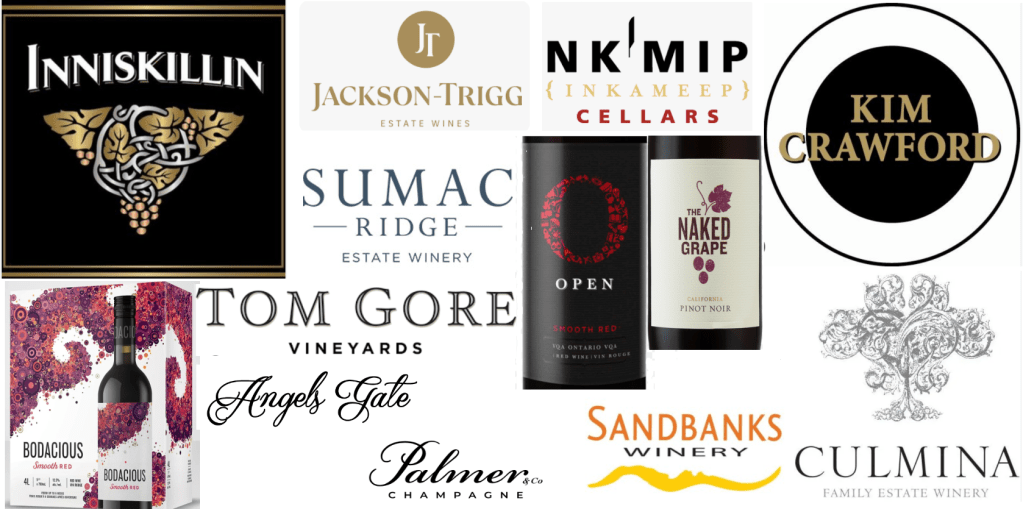
The name Arterra Wines has come up in discussion in a couple of my blog posts in the past regarding their acquisitions within the wine industry. So, it seems to be a good time to investigate and find out more about Arterra Wines.

According to the Arterra Wines Canada website, their mission is, “To build wine brands people love”. Their origins date back to 1874 when the Niagara Falls Wine Company was founded. In 1994 they became known as Vincor International. In 2006, Vincor was acquired by Constellation Brands, a U.S.-based company that is both a leading international producer and marketer of beer, wine and spirits. Finally, in 2016, the Canadian branch of Constellation Brands was acquired by the Ontario Teachers’ Pension Plan and became Arterra Wines Canada.

With many iconic and recognized wine brands, Arterra is developing and expanding their wine portfolio to provide Canadians from coast-to-coast with the opportunity to enjoy and experience wines made both in Canada and from renowned wine-making regions around the world.

Arterra owns and operates Wine Rack retail stores in Ontario, as well as sells wine kits and products for winemaking at RJS Craft Winemaking.

Here is the timeline of important events that have taken place throughout the life of Arterra Wines:

1874

  • Niagara Falls Wine Company was founded.

1911

  • Niagara Falls Wine Company renamed T.G. Bright & Co. Limited.

1975

  • Inniskillin is given the first Canadian winery license since 1929 in Ontario, making it the first estate winery in Canada.

1986

  • T.G. Bright & Co. Limited acquires Jordan & Ste-Michelle Cellars Limited.

1989

  • Don Triggs and Alan Jackson, with a group of employees and investors, purchase Cartier Wines from John Labatt Limited.

1992

  • Cartier Wines acquires Inniskillin.

1993

  • Jackson-Triggs brand launches.

1994

  • T.G. Bright & Co. changes its name to become Vincor International Inc.

2000

  • Acquisition of Sumac Ridge, one of B.C.’s first wineries, and See Ya Later Ranch (formerly Hawthorne Mountain Vineyards) in the Okanagan, B.C.

2001

  • NK’Mip Cellars Inc. in B.C. becomes first Aboriginal winery thanks to the joint venture with Osoyoos Indian Band and Vincor International.
  • Jackson-Triggs Niagara Estate Winery opens.

2003

  • Acquisition of Kim Crawford Wines of Auckland, New Zealand.

2005

  • Naked Grape brand launches.

2006

  • Vincor International is acquired by Constellation Brands.

2009

  • Open Wine brand launches in Ontario (and later in B.C. in 2011).

2012

  • Vincor International starts operating under the Constellation Brands name.

2013

  • Bodacious brand wine launches.

2016

  • Constellation Brands is acquired by the Ontario Teachers’ Pension Plan.

2017

  • The name is changed to Arterra Wines Canada.

2019

  • Acquisition of Culmina Family Estate Winery in B.C.s Okanagan Valley. 
  • After stopping production in 2016, Jordan, Ontario’s Le Clos Jordanne wines were re-established.

2020

  • Acquisition of Sandbanks Winery, Prince Edward County, Ontario (see March 8, 2020 post, The Shifting of Sandbanks).
  • Acquisition of Tom Gore Vineyards and the trademark rights to Paso Creek, Revolution, Vintage Ink and R.H. Phillips.

2021

  • Acquisition of Vin First, a Canadian canning and Tetra™ packaging company, specializing in the beverage alcohol industry. 

2023

  • New location for Le Clos Jordanne on Niagara’s Beamsville Bench.
  • Acquisition of Angels Gate Winery and Kew Winery, Niagara, Ontario.
  • Acquisition of Champagne Palmer of Champagne, France.

How long Arterra Wines remains under the control of the Ontario Teachers’ Pension Plan and a Canadian corporation remains to be seen. Should ownership become non-Canadian in the future, a significant portion of the Canadian wine industry will hang precariously in the balance; a sobering thought.

Sláinte mhaith