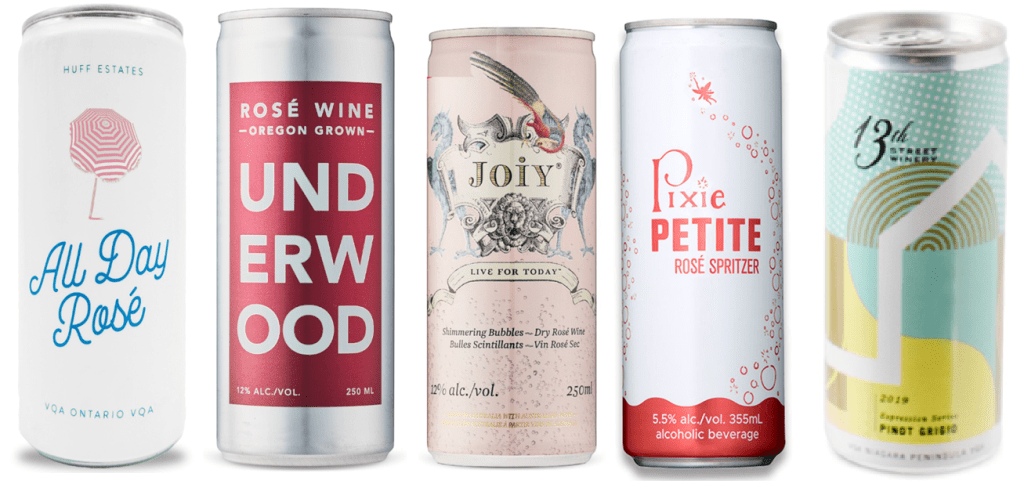
Since I first wrote an introduction to the canned wine market in a post from November 5, 2022, the market has continued to expand. Just as a reminder, canned wines are wines packaged in aluminum can, that provide convenience, portability and freshness. Cans offer a modern alternative to traditional glass bottles, catering to the needs of today’s fast-paced, on-the-go lifestyles of the Millennial and Gen Z consumer segments in particular.
Aluminum cans have enabled a surge in market share within the broader alcoholic beverage industry and has permitted expansion into new international markets and emerging regions. With cans being very adaptable for use at special events and outdoor activities, their popularity continues to grow.
This has all lead to growth in the premium and higher-priced canned wine sectors and encouraged investment from both major and niche wine producers. Strategic partnerships are driving industry growth resulting in innovative can designs to help improve consumer appeal and expand distribution channels into more diverse retail formats.
Wineries have been working to enhance their flavour profiles for canned wines by incorporating flavours such as fruit-infused, botanical and exotic blends. The trend toward moderation and portion control is driving the popularity of single-serve canned wines. Consumers realise the convenience, affordability and reduced environmental impact associated with single use cans.
Canned wines seem to be here to stay and are not just a passing fad.
Given all of the recent tariff talk and the renewed patriotism that has come as a result of it, some interesting points have come to light regarding wine sales between provinces. Many Canadians are now avoiding U.S. made products, including wine. As a result, there are now signs of an increased need to support Canadian wineries and renewed calls to open inter-provincial trade in alcohol. However, there are inter-provincial trade barriers standing in the way.
Photo credit: LCBO
Until June 2019, federal legislation prohibited inter-provincial shipment of alcohol directly to the consumer. This then allowed the provinces the opportunity to pass legislation to permit direct purchase to consumers. Unfortunately, most provinces chose not to allow this, leaving only British Columbia, Manitoba, Nova Scotia and Saskatchewan who permit direct-to-consumer alcohol shipments. Ontario has recently amended its laws to prohibit the possession of wine that has been imported from other provinces unless the transaction was handled via the Liquor Control Board of Ontario (LCBO). There are now calls to have this ban lifted.
Ontario wine consumers cannot support small local wineries in another province. Ironically, living in Ontario and purchasing wines produced in another province, the LCBO charges the purchaser the same import duties as if the wine came from a foreign country.
The wine growers of B.C., as well as the B.C. government are advocates of opening provincial borders to enable wine to move east and west across this country. There is a great deal of regulatory burden making it difficult for small and medium-sized wineries. The process needs to be simple and streamlined.
The time has come for Canadian provinces to eliminate inter-provincial trade barriers.
Anti-alcohol messaging is going to continue and it will be increased during this upcoming year. The World Health Organization (WHO) is now warning against the consumption of any alcohol. Cancer warning labels are now being proposed and will no doubt soon be applied to all alcohol packaging. These warnings will no doubt be accompanied by a reduction in alcohol consumption. However, there are several other factors that will impact alcohol sales.
To begin with, many Millennial and Gen Z consumers are focused on their physical and mental state and how they portray themselves on social media. They have come to associate alcohol with vulnerability, loss of control, anxiety and abuse. For these reasons they have reduced their alcohol consumption.
The increase in popularity of anti-obesity drugs is also having an impact. Glucagon-like peptide 1 (GLP-1), anti-obesity Semaglutide, Liraglutide, as well as Tirzepatide drugs like Saxenda, Ozempic, Wegovy and Mounjaro are now very popular. GLP-1 works by trigging the release of insulin from the pancreas, reducing glucose from entering the bloodstream, slowing digestion and increasing the ‘full’ sensation people feel after eating.
So, how does this impact wine consumption? Studies revealed that Semaglutide reduced binge-like alcohol drinking. The drugs moderated GABA, the gamma-aminobutyric acid receptors in the brain responsible for the ‘buzz’ associated with moderate consumption of alcohol.
There is growing evidence that many users of these drugs feel less inclined to drink any form of alcohol. If GLP-1 becomes as affordable and as widely used as many predict, the effect on the food and drink industries may be dramatic.
Alcohol-free beverage alternatives are becoming more popular as the quality of these products continues to improve and they gain more market acceptance. Our own kids, who are all adults, are into alcohol free alternatives, especially beer. And now with many craft breweries and estate wineries expanding their offerings to include alcohol free options, the quality of these products maintains the same standard as their alcohol-based options. If nothing else, these beverages will provide lunchtime beverage alternatives to soda or mineral water.
Some countries, such as Great Britain, are imposing a different level of excise tax based on alcohol level. For example, beginning February 1, 2025, the duty and tax on a 13.5% Alcohol by Volume (ABV)bottle of wine will be £3.59, whereas an 8.5% ABV bottle will be taxed at just £2.05.
Finland has just reduced its alcohol distribution rules. Beverages with ABVs of 8% or less can now be sold in supermarkets. Traditionally, once one Nordic nation changes the rules, the others, such as larger Sweden, tend to soon follow.
Public attitudes toward alcohol are changing. The social licence to encourage a guest to have another glass of wine or to finish off the bottle are becoming less acceptable behaviours and are being widely revoked.
As Bob Dylan wrote, “The Times They Are a-Changin”.
According to the Scottish government, about eighty percent of Scotch whisky includes some amount of peat in the production process. Peat creates the smoky and medicinal flavour of the whisky. When burned during the malting process, the peat releases compounds called phenols. The phenols are measured in parts per million (ppm) which infuse the spirit with its earthy, charred character.
In general terms, the greater the phenol level the smokier the whisky. However, all the phenols are not necessarily transferred from the barley to the final product. The quantity of phenols in the liquid can often be much less than what is measured in the barley, and the smoke’s influence can be reduced during the maturation process.
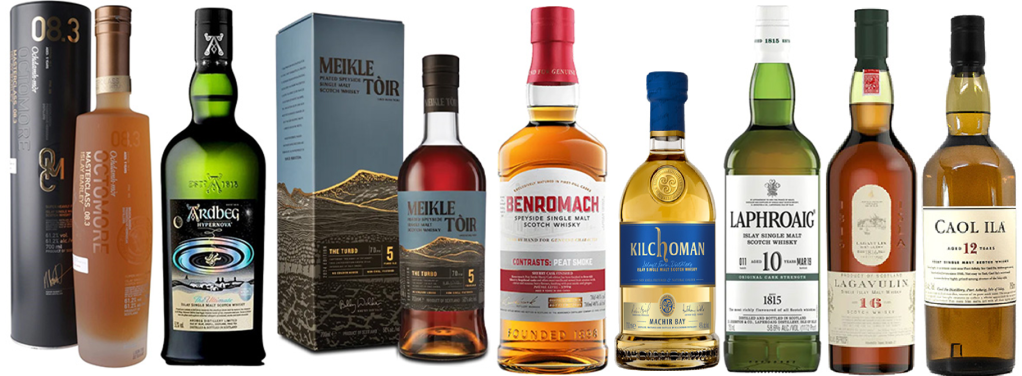
Those Scotches with the highest concentrations of phenols generally range between 35 and 55 ppm and will have flavours and aromas of campfire smoke, tar, leather and earthiness. However, some distilleries have created whisky that far exceeds those levels. Here is a sampling of those whiskies below. Unless you are a really big fan of highly peated whiskies, many of these offerings are probably not for you.
Bruichladdich Octomore 8.3
It is no surprise that Bruichladdich Distillery is on Islay, the island renowned for its peated whisky. Phenol levels in Octomore consistently exceed 100 ppm. The brand releases three or four distinct expressions every year, each using different aging techniques. The 2017 collection included the most heavily peated Scotch ever made. The whisky was bottled at 61.2 percent ABV (Alcohol by Volume) and contained a whopping 309 ppm. Unfortunately, this whisky is not available in Ontario.
Ardbeg Hypernova
Ardbeg, another Islay distillery, is famous for its peated whiskies. Hypernova has a phenol level of 170 ppm. It was bottled at a level of 51 percent ABV. This non-age-statement expression is the smokiest Ardbeg released. It is available in liquor stores at a price of about $375 CDN.
The GlenAllachie Meikle Toir The Turbo
Distilled in Speyside, GlenAllachie’s whiskies are usually unpeated. That changed in 2023 when the distillery announced Meikle Toir, a new brand of heavily peated whiskies. The Turbo, which is a limited edition, annual release, is the peatiest, being distilled from malts with 70 ppm of phenol. The 2024 expression was matured in a combination of American oak and oloroso hogshead casks and bottled at 50 percent ABV. It is not currently available in Ontario.
Benromach Distillery is a Speyside distillery that generally produces only lightly peated whisky at around the 12 ppm level. However, this expression pushes the envelope to a level of 55 ppm. Exclusively distilled in small batches and aged solely in first-fill sherry hogshead casks, the whisky provides a delicate balance of smoke and rich fruit flavours. This particular offering from Benromach is not available in Ontario.
Kilchoman Machir Bay
Being located on Islay, Machir Bay is Kilchoman’s flagship whisky having the tone for Islay’s signature style. Intensely smoky, the single malt Scotch is distilled from barley peated at 50 ppm before it’s laid down to mature in a combination of bourbon and sherry casks. It is available in liquor stores for $100 CDN.
Laphroaig 10 Year Cask Strength
Islay’s Laphroaig Distillery has been exclusively producing peated whisky since its birth in 1815. The smokiest expression in the Laphroaig lineup is Laphroaig 10 Year Cask Strength, which is peated at around 45 ppm of phenol. It is available in liquor stores at a price of $110 CDN.
Lagavulin 16 Year Old Single Malt Scotch Whisky
The most popular offering from Islay’s Lagavulin distillery is one of my personal favourites, the 16 Year Old Single Malt. It is a 43-percent ABV whisky that has been aged in ex-bourbon and ex-sherry casks. The whisky is distilled from malts peated at 35 ppm and contains flavours of caramel, vanilla and saltwater. It is available in liquor stores for $175 CDN.
Caol Ila 12 Year Single Malt Scotch
Another Islay distillery that has been described by some as providing the best peated Scotches for beginners, Caol Ila delivers a sweeter smokiness than some of the more heavily peated Scotches on this list. Distilled from barley at approximately 35 ppm, the whisky carries citrus and potpourri notes combined with subtle peat influence. It is available in liquor stores for $100 CDN.


 A Layman's Wine Musings