Based on the most recent statistics among continents, European countries sold the highest dollar value of wine exported with shipments worth $30.3 billion U.S. or 76.2% of the world’s total wine exports. Oceania’s international wine sales were led by Australia and New Zealand and came in at 7.4%. Latin America, excluding Mexico but including the Caribbean was at 7%. North America exporters provided 3.9% of worldwide wine exports, while Asia shipped 3.7% and African suppliers provided 1.9% of wine sales.
Below are the world’s largest wine conglomerates. Shown within parentheses is the country where the company is headquartered. These names may not be familiar to you but most of their wine brands will be.
Accolade Wines (Australia)
Casella Wines (Australia)
Concha y Toro (Chile)
Constellation Brands (United States)
E. & J. Gallo (United States)
Pernod Ricard Winemakers (France)
The Wine Group (United States)
Treasury Wine Estates (Australia)
Trinchero Family Estates (United States)
The following list identifies some of the world’s most popular wine brands. You will find most, if not all of these brands in your local wine store. Each brand is owned by the wine-producing conglomerate shown in parentheses.
Barefoot (E & J Gallo Winery, United States)
Gallo (E & J Gallo Winery, United States)
Concha y Toro (Concha y Toro, Chile)
Robert Mondavi (Constellation Brands, United States)
Sutter Home (Trinchero Family Estates, United States)
Yellow Tail (Casella Wines, Australia)
Hardy’s (Accolade Wines, Australia)
Lindeman’s (Treasury Wine Estates, Australia)
Beringer (Treasury Wine Estates, United States)
Jacob’s Creek (Pernod Ricard Winemakers, France)
Does this mean that these are the best wines in the world? No. It only signifies that they produce the highest volumes of wine. Big doesn’t make it better, especially in the case of wine. Small production estate wineries generally produce a better, more consistent product at a similar price point.
Enquiring minds want to know whether the top wine producers of the world only export wine or do they import it as well? And if they do obtain wine from elsewhere, what are their countries of choice?
Let’s begin by identifying who the top 10 wine exporters are. Based on the latest world wine export statistics, the top wine exporters are:
France, which exported the equivalent of $11.9 billion U.S.
Italy, which exported the equivalent of $7.7 billion U.S.
Spain, which exported the equivalent of $2.9 billion U.S.
Chile, which exported the equivalent of $1.9 billion U.S.
New Zealand, which exported the equivalent of $1.3 billion U.S.
Portugal, which exported the equivalent of $780.4 million U.S.
Argentina, which exported the equivalent of $780.2 million U.S.
Australia, which exported the equivalent of $779.1 million U.S.
South Africa, the fastest growing export market in the world, shipped the equivalent of $646 million U.S.
Georgia, which exported the equivalent of $247.8 million U.S.
These same countries also posted the highest positive net exports of wine. Net exports are defined as the value of a country’s total wine exports minus the value of its total wine imports.
It is interesting to note that the 5 biggest exporters of wine collectively supplied 70.1% of globally exported wine in terms of dollar sales.
So, how much wine do each of these countries import? Beginning with France, in 2022 it imported around 628 million litres of wine at a value of about $600 million U.S. Those imports came from Spain with a share of 23% ($251 million), Italy with a share of 21% ($233 million) and the U.S. with a share of 10.8% ($115 million).
Italy imported $500 million of wine. Those imports came mainly from France ($353 million), Spain ($75.2 million), Germany ($12.5 million), Portugal ($10.1 million) and United Arab Emirates ($7.66 million).
Spain imported $332 million in wine, mainly from France ($196 million), Italy ($61.6 million), Portugal ($21.6 million), Germany ($7.83 million) and the United Kingdom ($7.06 million).
Chile imported $19.8 million of wine, making it the 83rd largest importer of wine in the world. Chile imports wine primarily from: Italy ($6.98 million), Argentina ($3.9 million), United Arab Emirates ($3.36 million), France ($1.92 million) and Spain ($1.81 million).
Domestic wine consumption in New Zealand accounts for an estimated 49.2 million litres of the 90.2 million litres currently sold there each year. The remaining 41 million litres (45.5 per cent) was imported. The total import market was valued at $236 million.
Portugal’s wine imports amounted to over $50 million.
Argentina imported $12.9 million of wine, making it the 103rd largest importer of wine in the world. Wine imports came primarily from: France ($4.47 million), United Arab Emirates ($3.82 million), Chile ($2.17 million), Spain ($728 thousand) and Italy ($568 thousand).
Australia’s total wine imports have increased over the past few years, rising to 106 million litres. This is a compound average annual growth rate of just under 3 per cent.
South Africa imported $53.4 million of wine, making it the 53rd largest wine importer in the world.
Georgia imported $15.3 million of wine, becoming the 94th largest wine importer. Wine was the 179th most imported product in Georgia.
So, what does all this show? Even the great wine producers of the world like to have variety in the wines they drink.
I recently read an article where wine and spirits were likened to various breeds of dogs. Cute idea? Well maybe. Wine, Rum and Vodka were all associated with golden retrievers, being referred to as friendly, comfortable and universally liked. Scotch, on the other hand, was compared to a Doberman Pincher, considered as being beautiful and refined but aloof and requiring a great amount of effort to tame. A fair analogy? Not necessarily so. In my opinion not all Scotch is the same. There are several types, some being peated, others being smooth and silky. As a result, all Scotch should not be universally tarred with the same brush.
Photo credit: etsy.com
I have been told that Scotch is an acquired taste and that only a limited percentage of drinkers will in fact learn to like it. This may be true, but in my opinion, the same can be said about any other liquor. A person who appreciates Scotch is often perceived as being a snobby, upper-class intellectual with a certain knowledge and understanding of the dram. However, reality is that no special knowledge or perspective about Scotch is required to appreciate it. You just need to be willing to try it and not let the aura intimidate you.
In fact, if you love wine, you are already a great candidate for appreciating Scotch. Anyone who enjoys a variety of flavour profiles like those found in wine, should feel comfortable exploring the world of Scotch and its many varieties (although my wife would disagree).
You don’t need to spend a lot of money or purchase an aged Scotch to find a delightful drink. Although older Scotches tend to seem like the highest quality, that is not always the case. Neither older nor expensive necessarily means it is better. The best Scotch for you is simply the one you like the best.
Another common misconception is that it should be drunk straight or ‘neat’ as they say. In fact, drinking it straight is not necessarily best. It has been proven that by adding an ice cube or a splash of water (no more than a teaspoon full), will release all of the true flavours of the whisky, making it even more enjoyable.
It is often recommended to introduce yourself to the world of Scotch by trying a blended variety. These Scotches are created to be very approachable. If you like it, then find out what malt whiskies the blend consists of and use that as a guide to gravitate toward exploring other varieties or single malts.
Regardless of the age of your Scotch, or whether you enjoy it straight, on ice, with a splash of water or even soda water, most importantly enjoy your whisky your way. Don’t put so many rules around it that it prevents you from enjoying your dram.
The natural method of winemaking is the result of a series of biochemical transformations caused by the action of several enzymes. Many of these enzymes originate from the grapes themselves. However, the enzymes found in the grapes, yeasts and other microorganisms are often not sufficient so commercial enzymes are often added to supplement winemaking requirements.
Enzymes are used in winemaking to break down certain components in the grape juice, such as pectin and proteins, which help clarify the wine and improve its flavour, as well as improve the quality and efficiency of the fermentation process. Enzymes are also used to remove unwanted substances such as tannins.
To accomplish all this several different types of enzymes are used.
Pectinases are enzymes that break down pectin, which is a complex carbohydrate found in the cell walls of the plants. The result is simpler sugars that can be fermented by yeast.
Beta-glucanases break down beta-glucans, which are complex sugars found in the cell walls of yeast and can cause problems during fermentation.
Proteases are enzymes that break down proteins into smaller peptides and amino acids, which can also be utilized by yeast during fermentation.
Glucosidases help to release aromatic compounds from the grape juice, which can enhance the flavour and aroma of the wine. The selection of active yeast, fungal and bacterial glycosidases enhance the wine aroma.
Lipases are enzymes that break down fats and lipids, which can improve the clarity, filtration and stability of the wine. They also assist with improving the pressing efficiency and juice extraction.
Anthocyanins contribute greatly to red wines because these molecules and their interactions with other compounds are responsible for the colour and the stability of red wine during ageing.
Exogenous enzymes are often used to accelerate the extraction of anthocyanins from the berry skin increasing the colour intensity of the wine.
The diagram below demonstrates where enzymes may be injected into the wine making process. It is an excellent illustration as to why vintners require a strong biology or bio-chemical background.
The name Arterra Wines has come up in discussion in a couple of my blog posts in the past regarding their acquisitions within the wine industry. So, it seems to be a good time to investigate and find out more about Arterra Wines.
According to the Arterra Wines Canada website, their mission is, “To build wine brands people love”. Their origins date back to 1874 when the Niagara Falls Wine Company was founded. In 1994 they became known as Vincor International. In 2006, Vincor was acquired by Constellation Brands, a U.S.-based company that is both a leading international producer and marketer of beer, wine and spirits. Finally, in 2016, the Canadian branch of Constellation Brands was acquired by the Ontario Teachers’ Pension Plan and became Arterra Wines Canada.
With many iconic and recognized wine brands, Arterra is developing and expanding their wine portfolio to provide Canadians from coast-to-coast with the opportunity to enjoy and experience wines made both in Canada and from renowned wine-making regions around the world.
Arterra owns and operates Wine Rack retail stores in Ontario, as well as sells wine kits and products for winemaking at RJS Craft Winemaking.
Here is the timeline of important events that have taken place throughout the life of Arterra Wines:
1874
Niagara Falls Wine Company was founded.
1911
Niagara Falls Wine Company renamed T.G. Bright & Co. Limited.
1975
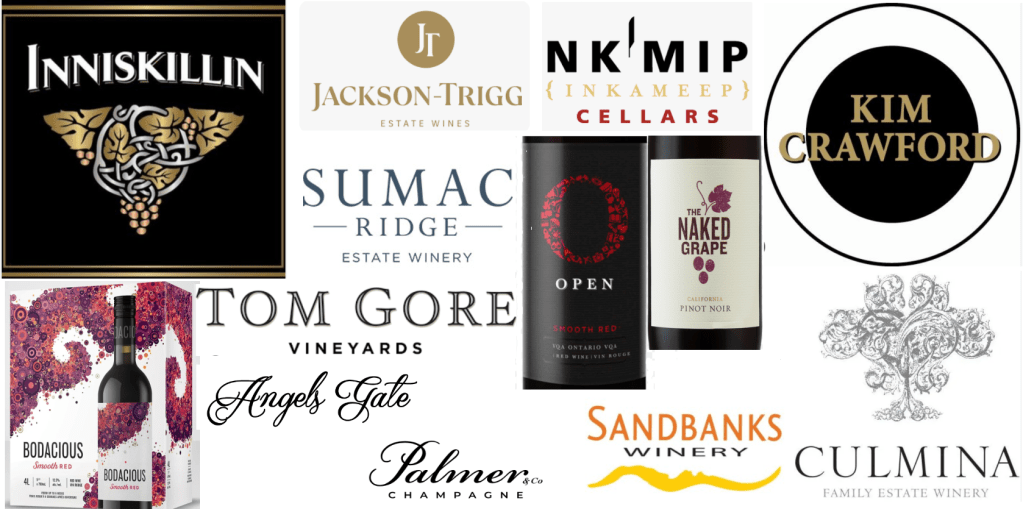
Inniskillin is given the first Canadian winery license since 1929 in Ontario, making it the first estate winery in Canada.
Don Triggs and Alan Jackson, with a group of employees and investors, purchase Cartier Wines from John Labatt Limited.
1992
Cartier Wines acquires Inniskillin.
1993
Jackson-Triggs brand launches.
1994
T.G. Bright & Co. changes its name to become Vincor International Inc.
2000
Acquisition of Sumac Ridge, one of B.C.’s first wineries, and See Ya Later Ranch (formerly Hawthorne Mountain Vineyards) in the Okanagan, B.C.
2001
NK’Mip Cellars Inc. in B.C. becomes first Aboriginal winery thanks to the joint venture with Osoyoos Indian Band and Vincor International.
Jackson-Triggs Niagara Estate Winery opens.
2003
Acquisition of Kim Crawford Wines of Auckland, New Zealand.
2005
Naked Grape brand launches.
2006
Vincor International is acquired by Constellation Brands.
2009
Open Wine brand launches in Ontario (and later in B.C. in 2011).
2012
Vincor International starts operating under the Constellation Brands name.
2013
Bodacious brand wine launches.
2016
Constellation Brands is acquired by the Ontario Teachers’ Pension Plan.
2017
The name is changed to Arterra Wines Canada.
2019
Acquisition of Culmina Family Estate Winery in B.C.s Okanagan Valley.
After stopping production in 2016, Jordan, Ontario’s Le Clos Jordanne wines were re-established.
2020
Acquisition of Sandbanks Winery, Prince Edward County, Ontario (see March 8, 2020 post, The Shifting of Sandbanks).
Acquisition of Tom Gore Vineyards and the trademark rights to Paso Creek, Revolution, Vintage Ink and R.H. Phillips.
2021
Acquisition of Vin First, a Canadian canning and Tetra™ packaging company, specializing in the beverage alcohol industry.
2023
New location for Le Clos Jordanne on Niagara’s Beamsville Bench.
Acquisition of Angels Gate Winery and Kew Winery, Niagara, Ontario.
Acquisition of Champagne Palmer of Champagne, France.
How long Arterra Wines remains under the control of the Ontario Teachers’ Pension Plan and a Canadian corporation remains to be seen. Should ownership become non-Canadian in the future, a significant portion of the Canadian wine industry will hang precariously in the balance; a sobering thought.
Millesime was a sparkling wine company in Niagara that was originally established by Frenchman Alain Girerd. He saw Niagara’s potential as a wine producing region and developed his export business from France to service Canadian winemaker’s needs. Millesime provided comprehensive solutions for traditional method sparkling wine production services such as consulting, riddling, disgorging, and packaging.
Len Pennachetti, Harald Thiel, and Philip Dowell
In December 2023, Millesime was purchased by two of the Niagara’s key winery owners and a veteran winemaker. Hidden Bench Winery owner Harald Thiel, Cave Spring co-founder Len Pennachetti and winemaker Philip Dowell purchased Millesime and have renamed it Niagara Sparkling Wine Service.
By acquiring Millesime and providing Ontario craft winemakers with a scalable traditional method for producing sparkling wine, they feel they can ensure and expand the growth of premium sparkling wine production in Ontario. Winemaker Dowell, the operating partner of Niagara Sparkling Wine Service, has been crafting benchmark traditional method sparkling wine for more than 20 years and provides sparkling wine consulting services to the industry on an as needed basis. Dowell was most recently the winemaker at Kew Vineyards and Angels Gate prior to their being purchased by Arterra Wines Canada.
Millesime was originally sold by its founder, Alain Girerd to John Young, who was then president at Angels Gate Winery. Dowell and Young operated the company as the full-service facility as it was envisioned by Girerd until Arterra purchased Angels Gate Winery and left Millesime dormant. The purchase by Thiel, Pennachetti and Dowell from Young got the idle sparkling wine production facility back in operation to the relief of wineries who had their wines tied up during the transition.
Ireland, the former whiskey capital of the world which dominated whiskey sales into the early 20th Century, quickly fell from grace due to several reasons. First, people were starting to prefer blended whiskies rather than the traditional single malts and single pot varieties. The Irish, however, chose to ignore this market trend and saw reduced sales as a result. Second, the American Prohibition negatively impacted sales, given that 60% of U.S. whiskey sales came from Ireland. Finally, internal conflict in the 1920s within Ireland itself and the subsequent trade war with Britain a few years later left the Irish Whiskey trade in a dismal state. By the 1970s the number of whiskey distilleries had been reduced to just two – Bushmills and New Midleton, which were both owned by the same company.
Fast forwarding to the period between 1990 and 2010, the Irish Whiskey industry experienced a resurgence, making it the fastest growing liquor industry. Today there are more than 40 distilleries throughout Ireland and more being added; the choices are becoming overwhelming. So today I will take you through a list of what many experts agree are many of the best Irish whiskeys on the market. Included are a couple of my personal favourites.
Before reviewing the list, it’s important to keep in mind that there are four styles of Irish Whiskey: Single Pot Still, Single Malt, Single Grain and Blended. Keep in mind that “Single” in the title refers to a single distillery, it is not a descriptor for the words following after.
SINGLE POT STILL
This was once the most common way to make whiskey but had become almost nonexistent by the end of the 20th Century. There has been somewhat of a resurgence in recent years. The single pot still variety originally came about during the 1700s as a way to avoid taxes imposed on malted barley.
The classification states that the whiskey must be made from a single distillery, distilled in pot stills from a mashbill that contains at least 30% malted barley and 30% unmalted barley, with up to 5% of other cereal grains. Pot still whiskey is noticeably spicier and creamier than other styles.
Recommended single pot style whiskies include:
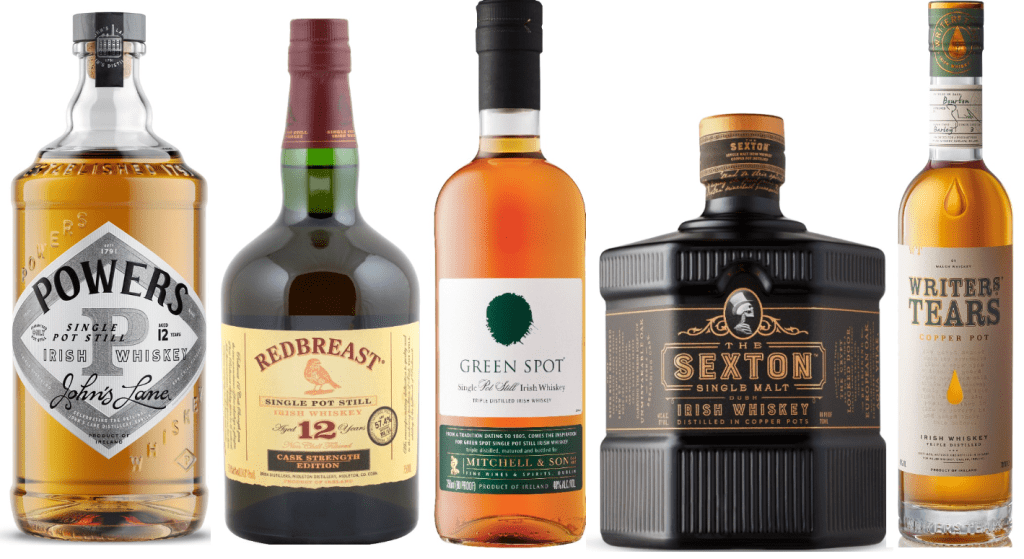
Powers John’s Lane
$76 at LCBO
Because of its 200 year history, Powers has a reputation for being mainstream though it is actually a lesser-known label. It is named after the location of its old distillery, where it held production beginning in the early 1800s until 1975. The whiskey is aged in bourbon barrels and finished in Oloroso sherry casks creating flavours of leather, tobacco, wood, dark chocolate and toffee.
Redbreast 12 Year Old Cask Strength
$120 at LCBO
Redbreast has several popular expressions, but the 12 Year Old Cask Strength is arguably its most popular. At 116 proof, this whiskey provides flavours of oak, buttery pears, cinnamon apple, baking spices, caramel and vanilla.
I have tried Redbreast but I personally have never found it too endearing.
Green Spot
$88 at LCBO
Not appearing on the experts’ list, but one of my own personal favourites is Mitchell and Sons Green Spot. The whiskey has matured in a combination of first and second fill bourbon casks as well as sherry casks. It has flavours of green apples, honey and cinnamon spice. To me this whiskey provides good value for the price.
SINGLE MALT
Single malt Irish whiskey must be made in a single distillery, distilled in pot stills from a mashbill composed entirely of malted barley. Single malt is noticeably smoother than the single pot still style.
Recommended single malt style whiskies include:
The Sexton
$50 at LCBO
Contained within a unique hexagonal bottle, The Sexton single malt has the appearance and taste of a good quality spirit even though it has a very affordable price; the least expensive in this list. Aged for four years in casks previously used for Oloroso sherry, the whiskey has a silky profile of oak, fruit, honeycomb and a hint of spice.
Overall, I like The Sexton although I often favour a whiskey with a little more complexity in flavour. If I am looking for a mindless dram to relax with, this is a good one.
Bushmills 21 Year
$264 at LCBO
Bushmills is the oldest licensed distillery in the world, successfully enduring the near extinction of Irish whiskey in the 1970s as one of two remaining distilleries. The 21 Year single malt is Bushmills’ premier expression, triple distilled and aged for 19 years in either former Oloroso sherry casks or bourbon barrels and then finished for an extra two years in Madeira casks. The result is a big flavour profile of fig, mango, caramel, cherry and apricot, all ending with a sweet finish.
SINGLE GRAIN
Single grain whiskey refers to any whiskey distilled in a column still rather than a pot still. Its mashbill can also be no more than 30% malted barley. The result is something with higher alcohol content, yet is less flavourful. As a result, single grain whiskey is largely used for blended varieties rather than bottled by itself, although there are some exceptions.
Recommended single grain style whiskies include:
Teeling Single Grain
Opening in 2015, Teeling is the first new distillery in Dublin in 125 years. However, Teeling was originally opened in 1782, closing in 1923. The current owners possess the Teeling family name. They put out one of the most versatile ranges of Irish whiskeys, including the rare single grain, which I unfortunately could find no reference to at the LCBO. It is made with a corn-dominant mashbill where it’s then aged in former Cabernet Sauvignon wine barrels creating a profile that ranges from cranberries to butterscotch to the typical sweetness of bourbon whiskey.
Method & Madness Single Grain
Method & Madness is part of the micro-distillery offshoot at New Midleton Distillery. It was launched a few years ago and has an outside the box approach to the aging process. The brand came up with a single grain spirit that’s aged in first-fill bourbon barrels and finished in virgin Spanish oak. The result is a flavourful single grain whiskey with hints of oak, spice and grapefruit. Unfortunately, this whiskey is not available for sale in Ontario.
BLENDED
The driving force behind blended whiskey is that it is a good way to produce the spirit while keeping costs lower. Blended whiskey combines two or more of the previous styles, usually a higher quality liquor with a lower quality one. Most mainstream Irish Whiskeys, such as Jameson and Tullamore Dew, are of the blended variety.
Writers’ Tears
$60 at LCBO
Writers’ Tears is produced by Walsh Whiskey. This blended spirit combines single pot still and single malt varieties. Aged in American bourbon barrels, the whiskey possesses flavours of lemon, honey, black pepper and floral notes.
I have tried Writers’ Tears a few times and have found the flavour to be light and subtle. It is a good choice for anyone new to the whiskey scene.
Jameson Bow Street 18 Year Cask Strength
Jameson, one of Ireland’s most renowned distilleries, put out its rarest release in 2018 and has done so once a year since. The historic Bow Street distillery operated for nearly 200 years until it closed in 1976 and was later turned into a museum, which I have visited. Jameson’s Bow Street 18 Year Cask Strength is claimed to be the king of all blended whiskies, combining both pot still and grain varieties. This expression has flavours of toffee, oak, vanilla and sherry, as well as notes of leather.
This particular Jameson rendition is unfortunately not available in Ontario.
Historically, the Romans are famous for their love of wine. It is ironic that the wine Roman Emperors consumed was nothing like the wonderfully delicious wines that the world enjoys today. During Roman times, what was referred to as wine was actually vinegar with honey and spices added, or sometimes garlic. Despite this, it was considered very good compared to other wines of the time.
Photo credit: disholicioussite.blog
Recently, three historic, yet little-known indigenous grape varieties, Bellone, Nero Buono and Cesanese are making a comeback in Italy’s ever changing wine market.
Bellone
Bellone is an ancient white grape variety that is referred to as ‘uva pantastica or pane d’uva’, meaning a ‘grape as good as bread’ or a ‘grape that goes well with bread’, depending on the source. The white grape often brings bright, fruity characteristics of stone fruit, melon and citrus fruits. Some bottles also have flavours of herbs, tropical fruits and toast. It still grows on the original roots of ancient times.
Casale del Giglio wine estate, located 50 kilometres south of Rome, has spent years reintroducing the native grapes of Lazio. In 2022, its work was recognized by Gambero Rosso magazine when the winery’s Anthium Bellone, which is produced using ungrafted vines, was awarded the coveted Italian award for wine excellence, Tre Bicchieri.
Nero Buono
The black or red grape variety, Nero Buono, almost exclusively grows in the volcanic soil of Monte Lepini. Insects do not thrive in its cool, windy climate, thus alleviating one risk to this finicky grape. The deeply coloured wine brings flavours of dark-skinned fruits, rhubarb and black pepper.
Nero Buono is difficult to grow so there are no clones. It is very wild and produces many leaves which must be thinned out several times per year. The berries are tight and close together making the vines susceptible to disease.
Producers are committed to supporting native grape production, even when there is minimal demand for the grapes. Winemaker Marco Carpineti now makes wine only with sustainably grown fruit that is native to the area. Today Carpineti is one of the best-known winemakers of Lazio. He devotes 25 percent of his production to Nero Buono and Bellone-based sparkling wine made in the traditional method.
Cesanese
Originally called Latium, the Lazio region of Italy borders Tuscany to the north, Abruzzo to the east, Umbria to the northeast and Campania to the south. Rome is in this region, making it the primary winemaking region of the Roman Empire.
Cesanese is the signature red wine of Lazio. Cesanese refers to one of two sub-varieties: Cesanese Comune or Cesanese di Affile. Both are used to make high-quality wines, which were highly prized in ancient times. There are three Cesanese appellations which include Cesanese del Piglio DOCG, Cesanese di Olevano Romano DOC and Cesanese di Affile DOC. All are within a 50-kilometer vicinity.
Cesanese is a red wine that contains flavours of dark-skinned berries, herbs, cedar and cooking spices. It’s ruby in colour and has high acidity and tannin, with the ability to age for a long time.
The Campania Region
Modern winemaking in Campania, a southern region referred to as ‘the ankle of the boot’, is closely identified with the Mastroberardino family, specialists in the wines of ancient times. The family’s involvement in winemaking can be traced back to the late 1500s. However, today, brothers Antonio and Walter, along with sons Piero and Carlo, run the winery which is 60 kilometres northeast of Naples.
The family’s extensive library of ancient viticulture books has enabled the Mastroberardinos to grow grapes that were popular centuries ago.
Homemade pizza and wine are the standard Friday night fare at our house. The topping choices are numerous, ranging from veggies to savoury cured meats and cheese. The options seem to be only limited by the imagination.
Photo credit: vinointeriano.wordpress.com
No matter what type of pizza you enjoy there will be a suitable wine to complement it. Here are some suggestions to pair with your pizza whether you create it yourself or order it from your favourite restaurant.
Let’s start with the simple Cheese pizza. This straightforward pie goes well with a light red wine, such as Pinot Noir or Chianti.
Building on that foundation we progress to the Pepperoni pizza. Pepperoni is the culmination of cured meats and spices such as cayenne, anise and garlic. It pairs well with either two of my favourite wines, Cabernet Franc or Sangiovese. These bold, spicy reds complement the flavours of the pepperoni.
The combination of veggies and assorted meats creates an assortment of flavour found in the Supreme pizza. It may seem strange but Prosecco makes a great pairing as it won’t overpower the delicate flavours of the veggies but can still balance the taste of the savory ham, sausage and pepperoni.
Speaking of meat, the Meat Lovers pizza needs to be matched with a bold and robust wine, such as a Cabernet Sauvignon or Malbec. These wines have a bold richness, as well higher tannins and acidity to offset the fattiness of the meat.
Tangy, sweet BBQ Chicken pizza pairs well with a fruity Malbec or Pinot Noir. The wine will complement the tangy notes of the barbeque sauce in the pizza.
Heading in the opposite direction is the Veggie pizza. This type of colourful pizza needs a light, chilled red or full-bodied white to let the taste of the vegetables be revealed. A sparkling red wine, such as Lambrusco, or a Chenin Blanc or a Chardonnay would be a good match.
During my Italian adventure last year, I enjoyed a Margherita pizza on several occasions. A Margherita is a light pie consisting of tomato sauce, fresh mozzarella and fresh basil. It pairs well with a light wine, such as a dry Rosé or Prosecco.
If pineapple on pizza is your thing, then Hawaiian pizza is for you. The sweet and salty flavours will be complemented by a German Riesling or a New World Sauvignon Blanc. The wine’s acidity and sweetness will complement the sweetness of the pineapple.
No matter what your choice of pizza is, there is a wine to go along with it.
I recently enjoyed a bottle of Barolo with dinner one night followed by a Barbaresco the following night. Having the two bottles back-to-back reminded me how different the two wines are despite being made from the same Nebbiolo grapes and being produced in the Piedmont region of Italy.
Photo credit: pinterest.co.kr
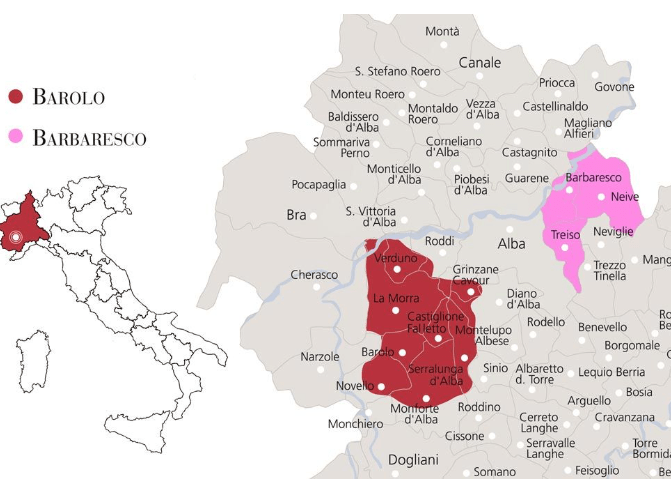
Production of both Barolo and Barbaresco occur in the Langhe hills near the town of Alba. The Barbaresco zone is northeast and the Barolo zone is southeast of the town. In accordance with Italy’s governing body, the DOCG (denominazione di origine protetta or Denomination of Controlled Origin.) Barolo may only be produced in the comuni or townships of La Morra, Castiglione Falletto, Serralunga d’Alba, Barolo and Monforte d’Alba. Barbaresco wine is produced in Treiso, Neive, San Rocco Seno d’Elvio and Barbaresco.
There are differences in the two sub-regions. The Barolo area is located at a slightly higher altitude and has more south-facing vineyard exposures. This results in slower ripening grapes than those of the Barbaresco area to the north. The northern region it is warmer, due to the lower altitudes and warm sea winds. As a result, the grapes ripen faster.
The soils of the two area are different as well. The soils of Barbaresco are slightly sandier, less compact, and have more nutrients. As a result, the wines have a softer character. The firmer soils of Barolo create bolder, more tannic wines.
According to DOCG regulations, Barbaresco must be aged a minimum of 26 months, with at least 9 of those months in oak. Barbaresco Riserva must be aged a minimum of 50 months with at least 9 months in oak.
Barolo wines are aged a minimum of 38 months, with 18 months being in oak. Barolo Riserva needs to age 60 months with 18 months in oak. The longer aging requirements are necessary because of the more intense tannins that are in Barolo wines.
When it comes to flavour, Barolo is the bigger, bolder and more structured. It may have an array of aromas of plums, sour cherries, tobacco or truffles.
Barbaresco is generally a lighter wine with flavours of ripe fruit. Barbaresco is strongly influenced by the soil, vineyard location and the winemaker’s techniques.
As to which wine is better, that is up to you to decide. Personally, I like both equally. My preference is determined in the moment, whether it be a dinner pairing or simply my mood.





 A Layman's Wine Musings