Redbreast 12 Irish Whiskey

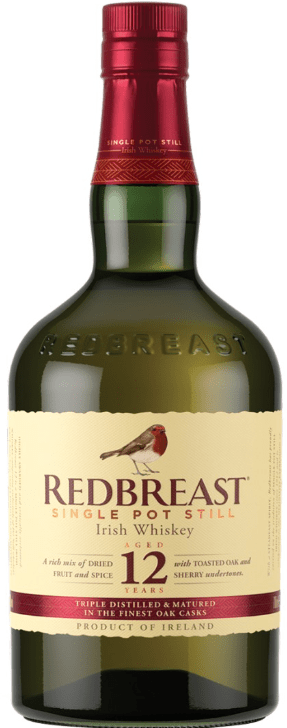
While visiting the Jameson Bow Street Distillery in Dublin, Ireland over a decade ago, I was told that the difference between Jameson whiskey and Redbreast whiskey was that Redbreast was distilled in the traditional way whereas Jameson was made in a more contemporary style. Being a novice at the time, I favoured the less complex flavour of the Jameson’s. It took me several years before I gained a full appreciation for single pot whiskey, which is now my Irish whiskey of choice.

The history of Redbreast goes back to the late 1800s in London, England, where a company by the name of W & A Gilbey began selling wines and distilling spirits. By 1875 they were distilling nearly a million bottles of whiskey a year. After experimenting with many whiskey types and labels, in 1912 the company released the first batch of Redbreast 12.

The political and economic turmoil of the 1980s resulted in a stoppage in production. The whiskey was reintroduced in 1991 by The Midleton Distillery that has been making single pot still Irish whiskey in County Cork, Ireland for over 200 years.

Redbreast is now distilled in top quality sherry and bourbon casks that contribute to the complex flavour of this pot still whiskey. With notes of spice, it has a grainy quality and depth that doesn’t exist in a single malt.

A lot goes into making Redbreast a great whiskey. The mash bill is made of a mix of malted and unmalted barley that is locally grown. The unmalted barley creates a unique creamy mouthfeel and spiciness. Water is sourced directly from the Dungourney River, part of which runs through a system of cooling underground caves. The whiskey is distilled in a copper pot still before being matured in a combination of bourbon seasoned American Oak barrels and Oloroso Sherry seasoned Spanish oak casks.

Being the most modestly priced of the Redbreast line, at $96 CDN, Redbreast 12 has great appeal. This is one of the best buys amongst Irish whiskies.

Its colour is clear gold and has the aroma of dried orange peel and toasted nutmeg. It is complex, fruity and spicy, with a hint of toasted wood notes. It finishes with notes of pepper and grass, with a lingering warmth.

After originally trying Redbreast in my “youth” of whiskey drinking years, and not truly appreciating what it truly had to offer, I have since revisited it and gained a new appreciation of this Irish standard.

Sláinte mhaith

Dessert Wine Trends

As the name suggests, dessert wine is a sweet wine that is intended to be served alongside dessert. These wines are often rich in flavour and have a high sugar content.

Photo credit: varuninamdar.wordpress.com

There has been a growing demand for premium dessert wines aimed at satisfying consumer demand for high-quality and unique flavours. This has driven market growth by enticing wineries to improve and enhance their product offerings and release new artisanal options, which in turn command higher price points and increased revenue.

There is rising interest in low-alcohol dessert wines by health-conscious Millennials and the Gen Z population who desire lighter wines. These wines also appeal to a broad range of wellness seekers, thus enhancing market growth.

Again, health-conscious and ethically driven drinkers are creating demand for vegan and allergen-free wine alternatives. By excluding animal-derived fining agents, which are added to wine to alter its colour, flavour, texture, and clarity, new dessert wine markets become available. These agents include additives such as casein or gelatin.

There are generally five types of dessert wine. Thirty percent of the market is made up of fortified wines, consisting of Port, Sherry, Madeira and Marsala.

Late harvest wines are next, consisting of twenty-five percent of the dessert wine market. Included in this category are Late Harvest Riesling, Late Harvest Sémillon and Late Harvest Gewürztraminer.

Controlling twenty percent of the market is Ice Wine. Included are Eiswein and Ice Cider.

Botrytized Wines, also referred to as Noble Rot, consist of fifteen percent of the market. For an explanation of this type of wine, refer to my post, Dessert Wines from April 18, 2020. Wines in tis group include Sauternes and Tokaji Aszú.

The “Other” wine category make up the remaining ten percent of the dessert wine market. Included in this catch-all category is Recioto della Valpolicella, Vin Santo and Muscat / Moscato.

Sláinte mhaith

Portugal’s Douro Valley Wine Region

The Douro Valley is the oldest established wine region in the world, dating back to 1756. It was first renown for its Port production. However, from a tourism perspective, it has only been popular for the past couple of decades, after being declared as a UNESCO World Heritage site in 2001.

Photo credit: portugalbywine.com

The Douro Valley region is no longer just know for its Port, but also for an increasing number of dry red wines often made from the same native grape varieties. A much smaller number of quality white wines are also now produced.

The viticultural zone covers the steep slopes along the banks of the lower ranges of the Douro River. The river flows from northern Spain, where it is called the Duero. The river finally reaches the Atlantic Ocean at Oporto. The vineyards stretch up the steep, dry slopes on either side of the river.

There are three subregions in the Douro, each covering its own section of the river.  Of these, the Douro Superior region is the furthest inland. It is covered in terraced vineyards and takes up about 20 percent of available vineyard land in Douro.

The central part of the Douro region, centered around the village of Pinhão, is the Cima Corgo region. It is where most of the prestigious Vintage Port originates from.

Cima Corgo is the largest subregion, accounting for almost half of the valley’s total wine production. The vineyards are steep with the vines nearer the river generally ripening much earlier than those at higher elevations. For this reason, the harvest is often completed in multiple sweeps of the same vineyard.

Nearest Oporto and the coast is the Baixo Corgo subregion. This area is best suited to produce table wines. The area is cooler and wetter than the other regions and more accessible, easily enabling bulk-wine operations to function.

Both the Douro’s still and fortified wines can be made from more than 80 different grape varieties. However, the vineyards are dominated by five key varieties: Touriga Nacional, Touriga Franca, Tinta Barroca, Tinto Cao and Tinta Roriz (Tempranillo). Of these, aromatic Touriga Nacional is the most highly regarded, but Touriga Franca is the most planted.

As recently as twenty years ago, Portugal produced very little quality still wine. However, since then it has become world renowned not only for Port but also for its DOC Douro still wines

There are several international varieties of grapes grown in the Douro valley, particularly to produce table wines. The most common of these are Cabernet Sauvignon, Sauvignon Blanc and Gewürztraminer.

Sláinte mhaith

In Response to Donald Trump

During the past six years that I have been writing this blog I have always steered away from political issues. However, today I feel compelled to speak out against Canada’s one time ally, the United States. With the return of Donald Trump to the White House’s Oval Office, Canada’s economy was placed under direct attack by Trump when he decided to impose twenty-five percent tariffs on Canadian imports to the U.S., without just cause. Similar sanctions have been imposed on Mexico and China and are being threatened against the European Union.

Photo credit: Manitoba Liquor Mart

In response to these bullying tactics by Trump, and as a proud Canadian, I will no longer purchase or write about American wine until such time as Trump refrains from his attack on Canada.

Canada has been the top export market for U.S. wines and Ontario’s provincial liquor board (the LCBO) has been among the largest purchasers of U.S. alcohol. In Ontario, imported wines are primarily sold through provincially owned and operated retail outlets, although recent regulatory changes have authorized 157 private grocery retail locations to distribute wine and beer.

The first phase of Canada’s response to the U.S. imposed tariffs includes tariffs on wine and spirits, in addition to many other products. Ontario is banning American liquor and the LCBO is removing American wine, spirits and beer from its shelves. This will represent about a billion dollars worth of American alcohol.

British Columbia, Alberta, Saskatchewan, Manitoba, Nova Scotia and Newfoundland are also removing U.S. liquor from their store shelves. At last word Quebec is considering the idea. On the bright side these bans will serve to enhance the sale of Canadian wines in Canada, as well as European, Australian, South American and South African wines.

Hopefully the American people will convince Trump that the imposition of his tariffs will not only hurt international economies but his own economy as well. It is a sad situation.

Sláinte mhaith

Ardbeg Whisky

On the small remote Hebridean island of Islay (pronounced ‘eye-lah’), that lies off the western Scottish mainland, is where you will find the 200 year old Ardbeg distillery. The abundance of soft water, fertile soil and acres of precious peat makes Islay a place of pilgrimage for the single malt whisky faithful. I must admit that I have visited the island on two separate occasions and would love to return.

Photo credit: ardbeg.com

Ardbeg claims to produce the most peated of all the Islay malts and having tried it I would not disagree. It achieves this by using the most phenolic malt in the industry. Phenols are a class of organic compounds that contribute to the aroma and taste of whisky. They are often associated with smokiness and medicinal notes commonly found in peated whiskies. Ardbeg’s malt is peated to a level of 50 ppm (parts per million).

The casks used to mature the whisky come from a variety of sources. The vast amount of whisky matures in ex-Bourbon oak barrels. However, there is ongoing experimentation with different types of oak casks.

During the maturation process only 1st and 2nd fill casks are used. All of the new first fill Bourbon casks come from suppliers in the United States. Other casks come from Speyside Cooperage, and Craigellachie in Scotland.

As with many of the Islay distilleries, Ardbeg is situated next to the ocean. As a result, the whisky receives a certain salty, iodine character while it matures.

Here are the stats on Ardbeg’s three main whiskies:

Ardbeg 10 Year Old

  • Alcohol by Volume (ABV) = 46%
  • Appearance = Light Gold
  • Details = Revered for its balanced smoke and fruit character. Shows aromas of lemon, smoke, peat and brine with a kiss of sweet cereal. On the palate, it is warm and smoky with bold, yet balanced flavours that resonate with the aromas. The finish is long, sweet and smoky. Serve neat or with a few drops of pure water.
  • Price = $120 CDN

Ardbeg Uigeadail

  • ABV = 54.25
  • Colour = Deep gold
  • Details = With special vatting, this Ardbeg combines deep traditional smoky notes with sweet, raisiny tones of old, ex-Sherry casks. Rich and weighty with aromas of warm Christmas cake, fresh ocean spice, cedar and pine. Sweet and spicy with deep, smoky flavours, lingering raisins and smoke on the lengthy well-integrated finish.
  • Price = $190 CDN

Ardbeg Corryvreckan

  • ABV = 46.2%
  • Colour = Light gold
  • Details = Expect an intense nose of cedar, brine, and creosote, with caramel, smoky bacon, vanilla and clove; very complex aromas. The palate is also intense, but it is round and finely balanced with outstanding length. The lingering finish shows smoky, black tarry coffee with chocolate. Not for the fainthearted.
  • Price = $238 CDN

If you have a liking for peaty Scotch Whisky, and you haven’t done so already, you should try one or more of Ardbeg’s offerings.

Sláinte mhaith

The Canned Wine Market

Since I first wrote an introduction to the canned wine market in a post from November 5, 2022, the market has continued to expand. Just as a reminder, canned wines are wines packaged in aluminum can, that provide convenience, portability and freshness. Cans offer a modern alternative to traditional glass bottles, catering to the needs of today’s fast-paced, on-the-go lifestyles of the Millennial and Gen Z consumer segments in particular.

Aluminum cans have enabled a surge in market share within the broader alcoholic beverage industry and has permitted expansion into new international markets and emerging regions. With cans being very adaptable for use at special events and outdoor activities, their popularity continues to grow.

This has all lead to growth in the premium and higher-priced canned wine sectors and encouraged investment from both major and niche wine producers. Strategic partnerships are driving industry growth resulting in innovative can designs to help improve consumer appeal and expand distribution channels into more diverse retail formats.

Wineries have been working to enhance their flavour profiles for canned wines by incorporating flavours such as fruit-infused, botanical and exotic blends. The trend toward moderation and portion control is driving the popularity of single-serve canned wines. Consumers realise the convenience, affordability and reduced environmental impact associated with single use cans.

Canned wines seem to be here to stay and are not just a passing fad.

Sláinte mhaith

Inter-Provincial Wine Sales

Given all of the recent tariff talk and the renewed patriotism that has come as a result of it, some interesting points have come to light regarding wine sales between provinces. Many Canadians are now avoiding U.S. made products, including wine. As a result, there are now signs of an increased need to support Canadian wineries and renewed calls to open inter-provincial trade in alcohol. However, there are inter-provincial trade barriers standing in the way.

Photo credit: LCBO

Until June 2019, federal legislation prohibited inter-provincial shipment of alcohol directly to the consumer.  This then allowed the provinces the opportunity to pass legislation to permit direct purchase to consumers.  Unfortunately, most provinces chose not to allow this, leaving only British Columbia, Manitoba, Nova Scotia and Saskatchewan who permit direct-to-consumer alcohol shipments.  Ontario has recently amended its laws to prohibit the possession of wine that has been imported from other provinces unless the transaction was handled via the Liquor Control Board of Ontario (LCBO). There are now calls to have this ban lifted.

Ontario wine consumers cannot support small local wineries in another province.  Ironically, living in Ontario and purchasing wines produced in another province, the LCBO charges the purchaser the same import duties as if the wine came from a foreign country.

The wine growers of B.C., as well as the B.C. government are advocates of opening provincial borders to enable wine to move east and west across this country. There is a great deal of regulatory burden making it difficult for small and medium-sized wineries. The process needs to be simple and streamlined.

The time has come for Canadian provinces to eliminate inter-provincial trade barriers.

Sláinte mhaith

Health and Lifestyle Changes

Photo credit: wp.stolaf.edu

Anti-alcohol messaging is going to continue and it will be increased during this upcoming year. The World Health Organization (WHO) is now warning against the consumption of any alcohol. Cancer warning labels are now being proposed and will no doubt soon be applied to all alcohol packaging. These warnings will no doubt be accompanied by a reduction in alcohol consumption. However, there are several other factors that will impact alcohol sales.

To begin with, many Millennial and Gen Z consumers are focused on their physical and mental state and how they portray themselves on social media. They have come to associate alcohol with vulnerability, loss of control, anxiety and abuse. For these reasons they have reduced their alcohol consumption.

The increase in popularity of anti-obesity drugs is also having an impact. Glucagon-like peptide 1 (GLP-1), anti-obesity Semaglutide, Liraglutide, as well as Tirzepatide drugs like Saxenda, Ozempic, Wegovy and Mounjaro are now very popular. GLP-1 works by trigging the release of insulin from the pancreas, reducing glucose from entering the bloodstream, slowing digestion and increasing the ‘full’ sensation people feel after eating.

So, how does this impact wine consumption? Studies revealed that Semaglutide reduced binge-like alcohol drinking. The drugs moderated GABA, the gamma-aminobutyric acid receptors in the brain responsible for the ‘buzz’ associated with moderate consumption of alcohol.

There is growing evidence that many users of these drugs feel less inclined to drink any form of alcohol. If GLP-1 becomes as affordable and as widely used as many predict, the effect on the food and drink industries may be dramatic.

Alcohol-free beverage alternatives are becoming more popular as the quality of these products continues to improve and they gain more market acceptance. Our own kids, who are all adults, are into alcohol free alternatives, especially beer. And now with many craft breweries and estate wineries expanding their offerings to include alcohol free options, the quality of these products maintains the same standard as their alcohol-based options. If nothing else, these beverages will provide lunchtime beverage alternatives to soda or mineral water.

Some countries, such as Great Britain, are imposing a different level of excise tax based on alcohol level. For example, beginning February 1, 2025, the duty and tax on a 13.5% Alcohol by Volume (ABV)bottle of wine will be £3.59, whereas an 8.5% ABV bottle will be taxed at just £2.05.

Finland has just reduced its alcohol distribution rules. Beverages with ABVs of 8% or less can now be sold in supermarkets. Traditionally, once one Nordic nation changes the rules, the others, such as larger Sweden, tend to soon follow.

Public attitudes toward alcohol are changing. The social licence to encourage a guest to have another glass of wine or to finish off the bottle are becoming less acceptable behaviours and are being widely revoked.

As Bob Dylan wrote, “The Times They Are a-Changin”.

Sláinte mhaith

The Peatiest Scotches

According to the Scottish government, about eighty percent of Scotch whisky includes some amount of peat in the production process. Peat creates the smoky and medicinal flavour of the whisky. When burned during the malting process, the peat releases compounds called phenols. The phenols are measured in parts per million (ppm) which infuse the spirit with its earthy, charred character.

In general terms, the greater the phenol level the smokier the whisky. However, all the phenols are not necessarily transferred from the barley to the final product. The quantity of phenols in the liquid can often be much less than what is measured in the barley, and the smoke’s influence can be reduced during the maturation process.

Those Scotches with the highest concentrations of phenols generally range between 35 and 55 ppm and will have flavours and aromas of campfire smoke, tar, leather and earthiness. However, some distilleries have created whisky that far exceeds those levels.  Here is a sampling of those whiskies below. Unless you are a really big fan of highly peated whiskies, many of these offerings are probably not for you.

Bruichladdich Octomore 8.3

It is no surprise that Bruichladdich Distillery is on Islay, the island renowned for its peated whisky. Phenol levels in Octomore consistently exceed 100 ppm. The brand releases three or four distinct expressions every year, each using different aging techniques. The 2017 collection included the most heavily peated Scotch ever made. The whisky was bottled at 61.2 percent ABV (Alcohol by Volume) and contained a whopping 309 ppm. Unfortunately, this whisky is not available in Ontario.

Ardbeg Hypernova

Ardbeg, another Islay distillery, is famous for its peated whiskies. Hypernova has a phenol level of 170 ppm. It was bottled at a level of 51 percent ABV. This non-age-statement expression is the smokiest Ardbeg released. It is available in liquor stores at a price of about $375 CDN.                                                                     

The GlenAllachie Meikle Toir The Turbo

Distilled in Speyside, GlenAllachie’s whiskies are usually unpeated. That changed in 2023 when the distillery announced Meikle Toir, a new brand of heavily peated whiskies. The Turbo, which is a limited edition, annual release, is the peatiest, being distilled from malts with 70 ppm of phenol. The 2024 expression was matured in a combination of American oak and oloroso hogshead casks and bottled at 50 percent ABV. It is not currently available in Ontario.

Benromach Contrasts: Peat Smoke Sherry Cask Matured

Benromach Distillery is a Speyside distillery that generally produces only lightly peated whisky at around the 12 ppm level. However, this expression pushes the envelope to a level of 55 ppm. Exclusively distilled in small batches and aged solely in first-fill sherry hogshead casks, the whisky provides a delicate balance of smoke and rich fruit flavours. This particular offering from Benromach is not available in Ontario.

Kilchoman Machir Bay

Being located on Islay, Machir Bay is Kilchoman’s flagship whisky having the tone for Islay’s signature style. Intensely smoky, the single malt Scotch is distilled from barley peated at 50 ppm before it’s laid down to mature in a combination of bourbon and sherry casks. It is available in liquor stores for $100 CDN.

Laphroaig 10 Year Cask Strength

Islay’s Laphroaig Distillery has been exclusively producing peated whisky since its birth in 1815. The smokiest expression in the Laphroaig lineup is Laphroaig 10 Year Cask Strength, which is peated at around 45 ppm of phenol. It is available in liquor stores at a price of $110 CDN.

Lagavulin 16 Year Old Single Malt Scotch Whisky

The most popular offering from Islay’s Lagavulin distillery is one of my personal favourites, the 16 Year Old Single Malt. It is a 43-percent ABV whisky that has been aged in ex-bourbon and ex-sherry casks. The whisky is distilled from malts peated at 35 ppm and contains flavours of caramel, vanilla and saltwater. It is available in liquor stores for $175 CDN.

Caol Ila 12 Year Single Malt Scotch

Another Islay distillery that has been described by some as providing the best peated Scotches for beginners, Caol Ila delivers a sweeter smokiness than some of the more heavily peated Scotches on this list. Distilled from barley at approximately 35 ppm, the whisky carries citrus and potpourri notes combined with subtle peat influence. It is available in liquor stores for $100 CDN.

Sláinte mhaith

Name That Size

Photo credit: jerseymanmagazine.com

Ignoring cardboard and aluminum packaging options, did you know that there are seventeen glass bottle packaging sizes available for holding your favourite white or red wine? Now every wine is not available in every size as that would be cost prohibitive, but producers have lots of options for packaging their wine, depending on the market for packaging their wines.

The vessels from smallest to largest include:

Split or Piccolo – ¼ the size of a standard bottle or one glass. This is the size often served on trains and airplanes.

Half or Demi – ½ standard bottle or two glasses. This size bottle is also commonly served on trains and airplanes.

Half-litre or Jenni – 2/3 standard bottle or three glasses. This is a common size served in restaurants.

Standard – 1 standard 750 ml. bottle or five glasses. This is the most common size sold in wine stores.

Litre – 1 1/3 standard bottles or 7 glasses. This size is often produced in countries that use the metric system of measure. It is a size commonly sold to venues serving significant quantities of wine.

Magnum – 2 standard bottles or ten glasses. Some wines are available in this size at local wine stores.

Jeroboam or Double Magnum –4 standard bottles or twenty glasses.

Rehoboam – 6 standard bottles or thirty glasses.

Methuselah or Imperial – 8 standard bottles or forty glasses.

Salmanazar – 12 standard bottles or sixty glasses.

Balthazar – 16 standard bottles or eighty glasses.

Nebuchadnezzar – 20 standard bottles or one hundred glasses.

Melchior – 24 standard bottles or one hundred twenty glasses.

Solomon – 26 standard bottles or one hundred thirty glasses.

Sovereign – 35 standard bottles or one hundred seventy-five glasses.

Primat or Goliath – 36 standard bottles or one hundred eighty glasses.

Melchizedek or Midas – 40 standard bottles or two hundred glasses.

As you can now see, there are many sizes of bottles available for supplying your wine.

Sláinte mhaith