Millesime was a sparkling wine company in Niagara that was originally established by Frenchman Alain Girerd. He saw Niagara’s potential as a wine producing region and developed his export business from France to service Canadian winemaker’s needs. Millesime provided comprehensive solutions for traditional method sparkling wine production services such as consulting, riddling, disgorging, and packaging.
Len Pennachetti, Harald Thiel, and Philip Dowell
In December 2023, Millesime was purchased by two of the Niagara’s key winery owners and a veteran winemaker. Hidden Bench Winery owner Harald Thiel, Cave Spring co-founder Len Pennachetti and winemaker Philip Dowell purchased Millesime and have renamed it Niagara Sparkling Wine Service.
By acquiring Millesime and providing Ontario craft winemakers with a scalable traditional method for producing sparkling wine, they feel they can ensure and expand the growth of premium sparkling wine production in Ontario. Winemaker Dowell, the operating partner of Niagara Sparkling Wine Service, has been crafting benchmark traditional method sparkling wine for more than 20 years and provides sparkling wine consulting services to the industry on an as needed basis. Dowell was most recently the winemaker at Kew Vineyards and Angels Gate prior to their being purchased by Arterra Wines Canada.
Millesime was originally sold by its founder, Alain Girerd to John Young, who was then president at Angels Gate Winery. Dowell and Young operated the company as the full-service facility as it was envisioned by Girerd until Arterra purchased Angels Gate Winery and left Millesime dormant. The purchase by Thiel, Pennachetti and Dowell from Young got the idle sparkling wine production facility back in operation to the relief of wineries who had their wines tied up during the transition.
Ireland, the former whiskey capital of the world which dominated whiskey sales into the early 20th Century, quickly fell from grace due to several reasons. First, people were starting to prefer blended whiskies rather than the traditional single malts and single pot varieties. The Irish, however, chose to ignore this market trend and saw reduced sales as a result. Second, the American Prohibition negatively impacted sales, given that 60% of U.S. whiskey sales came from Ireland. Finally, internal conflict in the 1920s within Ireland itself and the subsequent trade war with Britain a few years later left the Irish Whiskey trade in a dismal state. By the 1970s the number of whiskey distilleries had been reduced to just two – Bushmills and New Midleton, which were both owned by the same company.
Fast forwarding to the period between 1990 and 2010, the Irish Whiskey industry experienced a resurgence, making it the fastest growing liquor industry. Today there are more than 40 distilleries throughout Ireland and more being added; the choices are becoming overwhelming. So today I will take you through a list of what many experts agree are many of the best Irish whiskeys on the market. Included are a couple of my personal favourites.
Before reviewing the list, it’s important to keep in mind that there are four styles of Irish Whiskey: Single Pot Still, Single Malt, Single Grain and Blended. Keep in mind that “Single” in the title refers to a single distillery, it is not a descriptor for the words following after.
SINGLE POT STILL
This was once the most common way to make whiskey but had become almost nonexistent by the end of the 20th Century. There has been somewhat of a resurgence in recent years. The single pot still variety originally came about during the 1700s as a way to avoid taxes imposed on malted barley.
The classification states that the whiskey must be made from a single distillery, distilled in pot stills from a mashbill that contains at least 30% malted barley and 30% unmalted barley, with up to 5% of other cereal grains. Pot still whiskey is noticeably spicier and creamier than other styles.
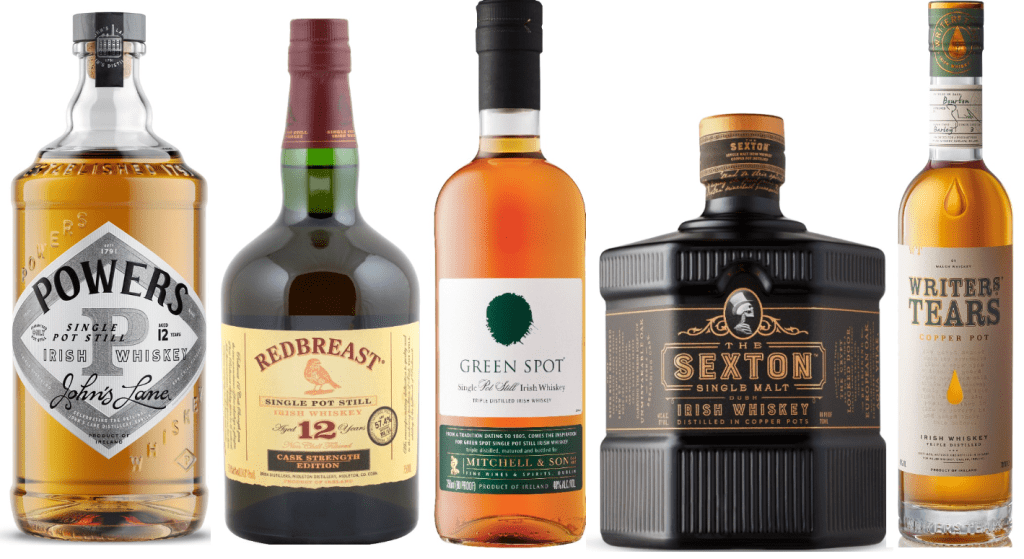
Recommended single pot style whiskies include:
Powers John’s Lane
$76 at LCBO
Because of its 200 year history, Powers has a reputation for being mainstream though it is actually a lesser-known label. It is named after the location of its old distillery, where it held production beginning in the early 1800s until 1975. The whiskey is aged in bourbon barrels and finished in Oloroso sherry casks creating flavours of leather, tobacco, wood, dark chocolate and toffee.
Redbreast 12 Year Old Cask Strength
$120 at LCBO
Redbreast has several popular expressions, but the 12 Year Old Cask Strength is arguably its most popular. At 116 proof, this whiskey provides flavours of oak, buttery pears, cinnamon apple, baking spices, caramel and vanilla.
I have tried Redbreast but I personally have never found it too endearing.
Green Spot
$88 at LCBO
Not appearing on the experts’ list, but one of my own personal favourites is Mitchell and Sons Green Spot. The whiskey has matured in a combination of first and second fill bourbon casks as well as sherry casks. It has flavours of green apples, honey and cinnamon spice. To me this whiskey provides good value for the price.
SINGLE MALT
Single malt Irish whiskey must be made in a single distillery, distilled in pot stills from a mashbill composed entirely of malted barley. Single malt is noticeably smoother than the single pot still style.
Recommended single malt style whiskies include:
The Sexton
$50 at LCBO
Contained within a unique hexagonal bottle, The Sexton single malt has the appearance and taste of a good quality spirit even though it has a very affordable price; the least expensive in this list. Aged for four years in casks previously used for Oloroso sherry, the whiskey has a silky profile of oak, fruit, honeycomb and a hint of spice.
Overall, I like The Sexton although I often favour a whiskey with a little more complexity in flavour. If I am looking for a mindless dram to relax with, this is a good one.
Bushmills 21 Year
$264 at LCBO
Bushmills is the oldest licensed distillery in the world, successfully enduring the near extinction of Irish whiskey in the 1970s as one of two remaining distilleries. The 21 Year single malt is Bushmills’ premier expression, triple distilled and aged for 19 years in either former Oloroso sherry casks or bourbon barrels and then finished for an extra two years in Madeira casks. The result is a big flavour profile of fig, mango, caramel, cherry and apricot, all ending with a sweet finish.
SINGLE GRAIN
Single grain whiskey refers to any whiskey distilled in a column still rather than a pot still. Its mashbill can also be no more than 30% malted barley. The result is something with higher alcohol content, yet is less flavourful. As a result, single grain whiskey is largely used for blended varieties rather than bottled by itself, although there are some exceptions.
Recommended single grain style whiskies include:
Teeling Single Grain
Opening in 2015, Teeling is the first new distillery in Dublin in 125 years. However, Teeling was originally opened in 1782, closing in 1923. The current owners possess the Teeling family name. They put out one of the most versatile ranges of Irish whiskeys, including the rare single grain, which I unfortunately could find no reference to at the LCBO. It is made with a corn-dominant mashbill where it’s then aged in former Cabernet Sauvignon wine barrels creating a profile that ranges from cranberries to butterscotch to the typical sweetness of bourbon whiskey.
Method & Madness Single Grain
Method & Madness is part of the micro-distillery offshoot at New Midleton Distillery. It was launched a few years ago and has an outside the box approach to the aging process. The brand came up with a single grain spirit that’s aged in first-fill bourbon barrels and finished in virgin Spanish oak. The result is a flavourful single grain whiskey with hints of oak, spice and grapefruit. Unfortunately, this whiskey is not available for sale in Ontario.
BLENDED
The driving force behind blended whiskey is that it is a good way to produce the spirit while keeping costs lower. Blended whiskey combines two or more of the previous styles, usually a higher quality liquor with a lower quality one. Most mainstream Irish Whiskeys, such as Jameson and Tullamore Dew, are of the blended variety.
Writers’ Tears
$60 at LCBO
Writers’ Tears is produced by Walsh Whiskey. This blended spirit combines single pot still and single malt varieties. Aged in American bourbon barrels, the whiskey possesses flavours of lemon, honey, black pepper and floral notes.
I have tried Writers’ Tears a few times and have found the flavour to be light and subtle. It is a good choice for anyone new to the whiskey scene.
Jameson Bow Street 18 Year Cask Strength
Jameson, one of Ireland’s most renowned distilleries, put out its rarest release in 2018 and has done so once a year since. The historic Bow Street distillery operated for nearly 200 years until it closed in 1976 and was later turned into a museum, which I have visited. Jameson’s Bow Street 18 Year Cask Strength is claimed to be the king of all blended whiskies, combining both pot still and grain varieties. This expression has flavours of toffee, oak, vanilla and sherry, as well as notes of leather.
This particular Jameson rendition is unfortunately not available in Ontario.
These are the wineries from British Columbia that particularly caught my attention this past year. My impressions are based on several factors: the winery’s performance at both the National Wine Awards and the All Canadian Wine Championships, environmental and sustainability practices of each winery and my own thoughts.
I have listed the wineries in alphabetical order and have included several of their 2023 award winning wines.
Corcelettes Estate Winery
Corcelettes was ranked as the second best performing small winery at this year’s National Wine Awards. It is located on 150 acres in British Columbia’s Similkameen Valley. Charlie and Jesce Baessler blend passion, precision and science to craft their expressive, small lot premium wines. No short cuts are taken in finding balance between viticulture, the environment and winemaking.
Corcelettes first vintage was in 2011, consisting of 200 cases. They currently craft 8,200 cases of wine per year, with plans of each future vintage growing in production size.
Their portfolio includes predominantly Syrah and Pinot Noir, crafted from Similkameen grown grapes. There is also a small selection of premium wines from the Micro Lot Series; wines crafted from specially selected grapes available only in limited quantities.
In addition to this year, Corcelettes was among the Top 10 Small Wineries at the 2018, 2019 and 2021 National Wine Awards of Canada.
This year’s Platinum and Gold award winning wines included:
Deep Roots was awarded Best Performing Small Winery at this year’s National Wine Awards where they earned 1 Platinum, 4 Gold, 1 Silver and 4 Bronze medals.
Their Platinum and Gold winners included:
Deep Roots 2020 Reserve Chardonnay
Deep Roots 2020 Parentage Red
Deep Roots 2022 Gamay
Deep Roots 2020 Syrah
Deep Roots 2022 Sauvignon Blanc
Deep Roots is a family owned and operated winery situated on the clay cliffs above Okanagan Lake on the Naramata Bench, where beginning in 2003 the Hardman family began switching their 100-year-old family farm from an apple orchard to a vineyard. Today they have 19 acres of grape vines spread between two Naramata vineyards, using almost exclusively estate fruit.
Initially the grapes were all sold to CedarCreek and Lake Breeze, among others. However, that all changed in 2012 when Will Hardman broke ground to create his own winery. There are two vineyards at two sites on the Naramata Bench where they grow Muscat, Gamay, Merlot, Chardonnay, Pinot Gris, Malbec and Syrah grapes.
All the vineyard work is done by hand, as the Hardmans are passionate about producing grapes that are the best expressions of each varietal.
Road 13 Vineyards
At Road 13 in Oliver, B.C., they farm to protect the land. Their philosophy is that by taking care of the dirt, the dirt then can take care of the roots of the vines, thus producing the best fruit possible. Doing things right means going the extra mile, in both the vineyard and in the cellar. Winemaker, Barclay Robinson and his crew farm organically to produce the best wine possible.
Road 13’s Platinum and Gold award winning wines included the following:
Road 13 2020 Select Harvest GSM
Road 13 2013 Jackpot Sparkling Chenin Blanc
Road 13 2020 John Oliver Cabernet Franc
Road 13 2021 Viognier
Road 13 2020 John Oliver Petit Verdot
Road 13 2022 Honest John’s Rose
SpearHead Winery
SpearHead Winery of Kelowna, B.C, appears on my list of British Columbia’s list of movers and shakers for the second straight year.
Their focus is on premium quality wine which is produced from grapes grown in their estate vineyard and from selected Okanagan Valley vineyards. The hand harvested grapes are sorted at the winery and fermented in small lots.
SpearHead produces Pinot Noir, Chardonnay and Riesling varietals. Approximately 80% of the 15 acres of vines is comprised of Pinot Noir including four different Dijon clones, 2 California heritage clones and Pommard. This combination of plantings enables the wine maker to select from the different characteristics of these clones to create a complex Pinot Noir from their home vineyard. They also draw from several other vineyards in the Okanagan including Golden Retreat in Summerland and Coyote Vineyard in West Kelowna.
Their 2023 Platinum and Gold award winning wines include the following:
SpearHead 2020 Club Consensus Pinot Noir
Spearhead 2020 Golden Retreat Pinot Noir
SpearHead 2021 Saddle Block Pinot Noir
SpearHead 2021 Cuvée Pinot Noir
SpearHead 2021 Golden Retreat Pinot Noir
SpearHead 2022 Pinot Gris
Wild Goose Winery
It all began in early 1983 when founder Adolf Kruger purchased a piece of land east of Okanagan Falls.
Kruger first planted Riesling and Gewürztraminer with the intention of selling the grapes. Over the following few years, outstanding wines were produced by purchasers of the grapes leading him to the decision to make his own wine.
Wild Goose Winery became the seventeenth winery in British Columbia and was established in June 1990. The winery started producing Riesling, Gewürztraminer and Maréchal Foch. Over time Wild Goose established itself as a premium small producer of VQA wines.
In July of 2021, the Wyse family of Burrowing Owl Vineyards purchased Wild Goose Vineyards & Winery. Wild Goose’s approach to winemaking has been to grow the highest quality fruit and then transform it into premium wines.
It has become a bit of a tradition that as the year draws to a close that I share my thoughts as to which wineries are stepping forward to be noticed. As usual I have based my opinions on each winery’s performance at both the National Wine Awards and the All Canadian Wine Championships, environmental and sustainability practices and my own personal impressions.
The number of wineries on my list varies from year to year as I prefer to highlight wineries that I feel have excelled. This is not to suggest that these are the only great wineries in the province; they are merely the ones that especially caught my attention this year. The wineries are presented in alphabetical order and I have included several of each winery’s 2023 award winning wines.
Broken Stone Winery
Having been introduced to this winery this past summer I have become a big fan. I then did some research to see what I could find out about it.
Broken Stone began in 2009 when Tim and Micheline Kuepfer purchased three hayfields along a backroad near Hillier, in Prince Edward County. At the time, the acre of newly planted grape vines that came with the land was almost an afterthought. The first harvest was in 2010 when two tonnes of quality Pinot Noir grapes were picked. An additional four acres of grapes were then planted with a vague notion that someday maybe a winery may be developed.
In 2012 a small building was constructed and the necessary licensing to make wine was obtained. Broken Stone Winery was born. Since then, the Kuepfers have been balancing the busy lifestyle of raising a family in Toronto with their passion for growing vines and making wine in Prince Edward County.
The result has become a dynamic boutique winery in the heart of the Prince Edward County wine region. Their mission is to grow the highest quality grapes and craft world-class wines. They believe that great grapes make great wine, and they strive to ensure that each great vintage is a little better than the last. Broken Stone continually strives to improve the vineyard biodiversity and soils. They strive to live in harmony with the earth and leave a legacy for future generations.
Colchester Ridge Estate Winery
Colchester Ridge is a relatively new winery located in Harrow, which is in the Lake Erie North Shore wine region. The wine labels display the acronym CREW.
I was first introduced to CREW wines by a friend who brought my wife and I a bottle of Meritage when they came to stay with us for a weekend just prior to the pandemic. From then until this past July, my search for another bottle had been fruitless (no pun intended). Then finally I was able to order several bottles of their most recent release, the CREW 2020 Meritage.
CREW was established in 2001 by the husband and wife team of Bernie and Nancy Gorski. The Gorski’s planted twelve acres of vines on their family land in 2001 and produced their first vintage in 2004. Then in 2006 they opened their shop. After years of continual growth, the Gorski’s launched the new CREW Winery & Gallery in November 2019.
Their award-winning wines include the following:
CREW 2020 Barrelman’s Blend
CREW 2020 Meritage
CREW 2018 Grand CREW Cabernet Sauvignon
Hidden Bench Estate Winery (ranked 1st at National Wine Awards)
Hidden Bench was recognized as the 2023 Winery of the Year at the National Wine Awards of Canada. Hidden Bench has come close to top Awards before, previously competing in the small winery category. However, the winery has grown to produce now over 10,000 cases of wine each year, allowing it to qualify for the top prize. Owner Harald Thiel is committed to being an estate winery using only Beamsville Bench fruit. By controlling his own fruit, he can control the quality as well.
Hidden Bench has emerged as the signature property among several highly regarded wineries on Niagara’s Beamsville Bench, an area of gently sloping, north-facing, limestone-laced sites and maturing vineyards and wineries. All of the wines of Hidden Bench are sourced from the Beamsville Bench and are produced using a comprehensive sustainable approach.
Hidden Bench also appeared in my 2022 and 2020 Ontario lists.
Hidden Bench’s 2023 award winning wines include 2 Platinum, 5 Gold and 5 Silver winners. The platinum and gold winning wines included the following:
Hidden Bench 2020 Pinot Noir Felseck Vineyard
Hidden Bench 2020 Chardonnay Tête de Cuvée Rosomel Vineyard
Hidden Bench 2020 Estate Riesling
Hidden Bench 2017 Natur Zero Dosage
Hidden Bench 2020 Chardonnay Felseck Vineyard
Hidden Bench 2021 Nuit Blanche Rosomel Vineyard
Hidden Bench 2021 Chardonnay Beton
Tawse Winery (Ranked 2nd at National Wine Awards)
Tawse Winery adheres to a non-interventionist philosophy and a firm belief that the start of every great wine begins in the vineyard. Their wines reflect their unique terroir near Vineland, in the heart of the Niagara wine Region.
Healthy vines yield quality fruit which allows for the creation of terroir-driven wines of great elegance, depth and character. Promoting the health of the vines and vineyards requires a labour-intensive and hands-on approach. Yields are kept low by cluster-thinning to ensure that all the energy of the vine is focused to ripen fewer, higher-quality grape clusters.
Organic farming feeds the vines and controls diseases without the use of synthetic insecticides, fungicides and fertilizers. They strive to create a diversified balanced ecosystem that generates health and fertility from the vineyard itself. Healthy vines mean less need for outside substances to control diseases and promote growth.
The architecture of the winery was created to be environmentally friendly. The wines are aged in underground cellars, which keeps the ambient temperature between 10 and 16 degrees Celsius, with a natural humidity of approximately 85%. The modern geo-thermal energy system has reduced the use of traditional forms of energy by 80%. There is also a wetland bio-filter which allows them to re-use all their sanitary and winery process water.
Tawse earned 2 Platinum, 4 Gold, 8 Silver and 5 Bronze medals this year at the National Wine Awards. The Platinum and Gold award-winning wines include the following:
People sometimes look at me funny when I tell them I periodically write about whiskey in my wine blog. However, here is an excellent example of how the world of one is in many ways very similar to that of the other.
Photo credit: thedrinksbusiness.com
Raimonds Tomsons, who is from Latvia, won the ASI (Association de la Sommellerie Internationale) Best Sommelier of the World competition earlier this year in Paris, France. Prior to winning the championship, Tomsons had already made a name for himself due to his work in wine, being a board member of the Latvian Sommelier Association and having worked with several high-end restaurants and importers in Latvia.
He is now going to be the global brand ambassador for The Craft Irish Whiskey Co. of Dublin, Ireland. Tomsons will now be applying his expertly trained nose and palate in his new role. He sees this new endeavor as giving him the opportunity to further enhance his learning by exploring the diverse world of spirits and other beverages.
Tomsons sees that by joining Jay Bradley and his team at The Craft Irish Whiskey Co., he will have an opportunity to explore fine Irish whiskey in depth, and work on innovative whiskey and food pairings. Bradley feels that Tomsons’’ knowledge and ability to detect nuances and layers of flavour compliments the way he makes whiskeys, each bottle of which offers a unique complexity of flavours.
The Craft Irish Whiskey Co. was founded by Bradley in 2018. The distillery creates rare and ultra-rare Irish whiskeys, including The Emerald Isle, worth an incredible $2 million US, making it one of the most expensive whiskeys in the world.
Craft Irish Whiskey is made only in a pot still and with hand-selected barrels. They craft whiskey as it was once made before the rise of blends and mass-production techniques. They are proud to be reviving the art of crafting whiskey. The Craft Irish Whiskey Co. considers themselves as being rooted in tradition but with an eye on the future, a modern expression of a historic craft.
It is now also a marriage between the world of wine and that of whiskey.
In June, Séverine Pinte, French born viticulturist and managing partner at both LaStella and Le Vieux Pin wineries, was awarded the Knight of the Order of Agricultural Merit. The award was presented in Oliver, British Columbia by the Consul General of France, Nicolas Baudouin.
Photo credit: en.wikipedia.org
The Order of Agricultural Merit (Ordre du Mérite agricole) is presented by France for outstanding contributions to agriculture. It is the highest distinction given in France to individuals, both French and foreign, who have made significant contributions in the fields of agriculture and the food and wine industry, whether in public duties or in the practice of agriculture. It also rewards people who have distinguished themselves in scientific research or in related publications.
Severine Pinte came to LaStella and Le Vieux Pin in 2010 with 14 harvests of international winemaking experience along with 8 years of vineyard management. She is a graduate of the infamous ENSAM (Ecole National Superior Agronomic of Montpellier) where she acquired her Masters in viticulture and oenology, and her National Diploma of Oenology. After graduating from ENSAM she apprenticed at the Cave de Tecou in the AOC Gaillac before coming for the first time to British Columbia to work for Domaine de Chaberton as an assistant winemaker. In 1999 she returned to France and worked a year in Bordeaux under the direction of Andre Lurton in Pessac-Leognan. For nine years Severine was head winemaker and viticultural council for ‘Le Vignoble des 2 terres’ in the Terrasse du Larzac terroir.
In 2003 Severine worked at Frankland Estate winery in Australia and learned about the Australian way of making Cabernet Sauvignon and other Bordeaux originated varieties. Curiosity and the pursuit of new challenges lured Severine to British Columbia’s Okanagan.
Severine is an active member of British Columbia’s wine industry as a board member of the B.C. Wine Grape Council. She is a leading advocate of sustainable viticulture practices and was instrumental in launching the Sustainable Winegrowing B.C. certification program.
She has proven to be a true steward of the land, making some of the finest, most sought-after wines in B.C. at both Le Vieux Pin and LaStella wineries. The wines produced by the two wineries may be purchased online through their respective websites, www.levieuxpin.ca and www.lastella.ca .
During the first week of August my wife Valerie and I made our first post pandemic adventure to Prince Edward County. I came prepared with a selection of wineries that I felt deserved a closer look, each having caught my attention for a variety of reasons.
The wineries are not presented in any particular order.
Hinterland Wine Company is a boutique winery specializing in wines made using the traditional method. Hinterland uses minimal intervention in their winemaking process, allowing the unique terroir to shine through.
I was particularly impressed with their 2021 L’Imparfait Seneca, which is classified as an orange wine, though it is very much red in colour. It is a blend of 67% Pinot Noir, 26% Marquette and 7% Savagnin grapes. If you like a sweet wine this one is definitely not for you; it has distinct earthy tones.
From Closson Chase we came away with some of their 2022 Estate Unoaked Chardonnay and 2021 Churchside Pinot Noir.
The unoaked Chardonnay was sourced entirely from their South Clos vineyard. It was whole cluster pressed, then cool fermented in stainless steel at 14 C.
The Pinot Noir is sourced entirely from their Churchside vineyard. Destemmed with no crushing and cold soaked for 3-5 days. The juice was then fermented in oak tonneau and aged for 18 months in French oak barrels, 20% new. The wine has five to seven years of cellaring potential.
Rosehall Run, 1243 Greer Rd, Wellington, Ontario
At Rosehall Run we found a 2021 Chardonnay Musque, a wine that not many wineries seem to produce. It is an unoaked variety that contains Chardonnay Musque grapes, rather than the more common Chardonnay. The wine is 100% estate grown and bottled.
Another find was their 2019 Cabernet Merlot which is a blend of 49% Merlot, 43% Cabernet Franc and 8% Cabernet Sauvignon grapes that were sourced from select vineyards in the Niagara Peninsula. This wine has a cellaring potential of a minimum of ten years. It has been consistently rated as a 92 out of 100 by several wine critics.
Grange of Prince Edward Vineyards and Estate Winery, 990 Closson Rd, Hillier, Ontario
At Grange I had to go with one of my favourite varietals, Cabernet Franc. In this case it was their 2020 Cabernet Franc, which contains 100% estate grown grapes. This is unusual for Prince Edward County given the slightly cooler climate and shorter growing season than either Niagara or the North Shore of Lake Erie.
Broken Stone Winery, 524 Closson Rd., Hillier, ON
This find I must credit my brother for as he happened by it when he was touring the County earlier this summer. He brought me back a bottle of each of their 2018 Intensity Meritage Blend Niagara Peninsula and 2021 Gamay Noir Barrel Reserve. Both were delightful.
In addition to purchasing these two wines, I also picked up some of their 2021 Chardonnay Sans Chene.
Karlo Estate Winery, 561 Danforth Rd, Wellington, Ontario
I am pleased to report that Karlo is back in full swing with a complete lineup of both red and white wines, including their unique red blend Quintus. Winemaker, Derek Barnett, has recreated this work of founder Richard Karlo using a blend of the classic noble grape varieties, Malbec, Petit Verdot, Merlot, Cabernet Franc, and Cabernet Sauvignon.
The Old Third Vineyard, 251 Closson Rd, Hillier
The Old Third produces unfiltered Pinot Noir, Cabernet Franc and Chardonnay. Unfortunately, the tasting room is inside a barn that can only be entered by climbing steps consisting of some uneven precariously strung planks with no handrail. This proved too much of an obstacle for my post-stroke climbing ability so I had to pass on going inside.
Stanners Vineyard, 76 Station Rd., Hillier
Stanners locally grown Cabernet Franc has always been one of my favourite Prince Edward County wines but given the small quantity produced, it is often difficult to obtain and this year is no exception. The 2020 Cabernet Franc VQA Prince Edward County is already sold out, as well as the 2020 Pinot Noir VQA Prince Edward County and the 2020 Pinot Noir VQA Prince Edward County. However, I was still able to obtain the 2020 Cabernet Franc VQA Lincoln Lakeshore. The grapes for this Cabernet Franc came from a single vineyard in the Lincoln Lakeshore sub-appellation of the Niagara Peninsula. The grapes were hand harvested then destemmed to whole berries with no crushing. The wine was aged in mostly older French oak barrels for 19 months and was not fined or filtered in order to preserve its fine fruit flavours. This wine is likely to age gracefully for quite a few years.
Devils Wishbone, County Road 7, Prince Edward County, Ontario
In the past I always enjoyed several of Devil Wishbone’s red varietals. When I last visited the County in 2020 the winery was temporarily closed. I anticipated a return visit there this summer but was saddened to learn that the owner, Jennifer Baldini, passed away in June of 2021 after suffering from a two-year illness. The retail operations of the Devils Winery had been closed since the onset of her illness in 2019 but the vineyards were maintained in anticipation of her successful recovery. Sadly, this didn’t prove to be the case and Devils Wishbone is now closed permanently.
This year was the 22nd addition of the WineAlign National Wine Awards of Canada (NWAC), which took place in Penticton, British Columbia. There were 1,930 entries from 255 wineries. All entries to the competition are 100 percent grown and produced in Canada.
Photo credit: winealign.com
The National Wine Awards presents four major awards: The Canadian Winery of the Year, The Best Performing Small Winery, Icewine of the Year and Cider of the Year. Within each of the 37 categories, wines are eligible to compete for Gold, Silver or Bronze medals, all topped by Platinum medals, which are presented to the highest one percent of wines across all competition categories.
The major award winners and the Platinum and Gold medal winners from the top 25 wineries are presented below:
The Winery of the Year is Hidden Bench Estate Winery in Beamsville, Ontario. Being one of the most respected Niagara wineries since its inception 20 years ago, Hidden Bench has finally won Winery of the Year honours by earning 12 medals – two Platinum, five Gold and five Silver. Congratulations to proprietor Harald Thiel and his team, including winemaker Alex Baines and viticulturalist Joel Williams.
The Platinum and Gold winning wines were:
Platinum
Hidden Bench Pinot Noir Felseck Vineyard 2020
Hidden Bench Chardonnay Tete De Cuvée Rosomel Vineyard 2020
Peller Estates Niagara 2021 Andrew Peller Signature Series Rieslin
The 2023 Best Performing Small Winery of the Year was presented to Deep Roots Winery of Naramata, British Columbia. Deep Roots had the best-scoring top five wines in the competition among wineries producing fewer than 10,000 cases. Their 2020 Reserve Chardonnay earned a platinum medal, one of only three Chardonnays to do so, as well as four gold medals for:
Deep Roots Parentage Red 2020
Deep Roots Gamay 2022
Deep Roots Syrah 2020
Deep Roots Sauvignon Blanc 2022
British Columbia wineries dominated the Small Winery category, claiming nine of the top ten rankings. The remaining top 10 small wineries are as follows:
2. Corcelettes Estate Winery, British Columbia
3. SpearHead Winery, British Columbia
4. Township 7 Vineyards & Winery, British Columbia
5. Painted Rock Estate Winery, British Columbia
6. Van Westen Vineyards, British Columbia
7. Orofino Vineyards, British Columbia
8. River Stone Estate Winery, British Columbia
9. Moon Curser Vineyards, British Columbia
10. The Organized Crime Winery, Ontario
Note: A minimum of five wines must have been entered to be eligible for Winery of the Year and the Top Wineries lists. Ranking was determined by the total score of their top five wines, not total number of medals.
The complete listing of all the winning wines from this year’s event is available on the Canadian Wine Awards website, www.winealign.com/awards.
According to new guidelines from the Canadian Centre on Substance Use and Addiction (CCSA), which were published earlier this year, consuming more than six alcoholic drinks a week leads to high health risks, including cancer, especially for women.
The CCSA led the initiative to update Canada’s Low-Risk Alcohol Drinking Guidelines (LRDGs). This Health Canada initiative was initiated in July 2020. The result of this project was the creation of Canada’s Guidance on Alcohol and Health, which now replaces the LRDGs.
The CCSA states that no matter the kind of alcohol, whether it is wine, beer, cider or spirits, even a small amount is damaging, regardless of age, sex, gender, ethnicity, tolerance for alcohol or lifestyle. Thus, if you drink, it’s better to drink less.
According to the CCSA, the guide provides people with the information necessary to make well-informed and responsible decisions about their alcohol consumption. The guidelines state that there is a continuum of risk associated with weekly alcohol use.
No risk = 0 drinks per week — Not drinking has benefits, such as better health and better sleep.
Low risk = 2 standard drinks or less per week — Most likely to avoid alcohol-related consequences.
Moderate risk = 3 to 6 standard drinks per week — There is risk of developing several types of cancer, including breast and colon cancer.
Increasingly high risk = 7 standard drinks or more per week — The risk of heart disease or stroke increases significantly at this level.
Each additional standard drink radically increases the risk of alcohol-related consequences.
In addition, consuming more than 2 standard drinks on any occasion is associated with an increased risk of harms to oneself and others.
As with the previous guidelines, alcohol should not be consumed when pregnant or while breastfeeding.
On the other hand …
Contradicting at least a portion of the new Guidance on Alcohol and Health is another study, also published this year, this time in the Nutrients Journal where researchers completed a study aimed at understanding the association between wine consumption and cardiovascular mortality, cardiovascular disease (CVD) and coronary heart disease (CHD).
This investigation states that wine consumption has an inverse relationship to cardiovascular mortality. According to the journal, “Researchers performed a systematic review and meta-analysis using longitudinal studies, including cohort and case-control studies retrieved from multiple databases which they searched from their inception to March 2023”.
The researchers stand by the belief that light to moderate alcohol consumption positively affects general health; for instance, it acts on high-density lipoprotein cholesterol to prevent atherosclerosis, lowers the incidence of ischemic heart disease (IHD) and helps with the prognosis of people at higher risk of coronary complications leading to myocardial infarction.
However, these researchers agree that excessive drinking causes over 200 diseases, which makes it a leading cause of deaths globally. They also warn that alcohol interacts with multiple drugs, altering its metabolism. Decreased alcohol metabolism could lead to increased blood alcohol levels. For example, a component in wine, resveratrol, interacts with certain drugs and modifies their metabolism.
Polyphenols in red wine, such as tannins, provide multiple cardiovascular health benefits. It is also an anti-inflammatory, antioxidant and antimutagenic thus reducing potentially harmful chemicals from the body. Nonetheless, all cardiologist agrees that light to moderate alcohol consumption has a positive effect on cardiovascular health, whereas excessive alcohol drinking elevates the risk of CHD mortality, cancers, etc. At least both studies agree on this point.
The participant’s age, sex or smoking status apparently had no effect on the study’s results. Both red and white wines displayed positive affects but the impact varied by the type of wine.
Though health benefits were noted with both red and white wine, the variations in the strength of this association were attributable to the different concentrations of some components. Red wine, in particular, has phenolic compounds such as gallic acid, catechin, and epicatechin (flavonols), which gives it antioxidant properties. These wines also reduce low-density lipoprotein (LDL) oxidation, thrombosis risk, plasma and lipid peroxide.
Alcoholic components of wine reduce the risk of thrombosis and levels of fibrinogen, as well as induce collagen and platelet aggregation. Thus, higher consumption of red wine is more beneficial for combating CVDs than white wine other alcoholic beverages.
The study concluded that moderate wine consumption is good for cardiac health. However, researchers should interpret these findings with caution. Increasing wine consumption could harm patients susceptible to alcohol due to age, preexisting pathologies or medications.
In closing …
I leave it to you to make your own decision with regards to the merits of both studies. Complete information regarding Canada’s Guidance on Alcohol and Health is available at https://ccsa.ca/. The complete study, Association between Wine Consumption with Cardiovascular Disease and Cardiovascular Mortality: A Systematic Review and Meta-Analysis, is available at https://www.mdpi.com/2072-6643/15/12/2785.
The 2023 Canadian wine award season began in early June with the Ontario Wine Awards. There were 558 entries from 77 Ontario wineries.
Receiving the honour of the Winemaker of the Year was Peller Estates Winery’s Katie Dickieson. She earned more gold medals than any other winemaker in Ontario.
The Niagara region’s Domaine Queylus attained the Red Wine of the Year award for its 2020 Cabernet Franc Tradition. This wine is only available directly from the winery but at a very affordable price of $33.50 CDN.
The White Wine of the Year award was presented to Prince Edward County’s Norman Hardie for their 2017 Semi-Dry Riesling. This wine comes at a price of $21.00 CDN and is available from either the winery or select LCBO stores.
This year Gold medals were awarded in the following categories:
Sparkling Wine Award (Traditional Method)
Gold medals were presented to:
Malivoire Wine Bisous Rose NV
Megalomaniac Bubblehead Limited Edition Brut NV
Niagara College Teaching Winery, Balance Brut NV
Thirty Bench Wine Makers, Sparkling Riesling NV
Trius Winery, Showcase Blanc de Blancs NV
Sparkling Wine Award (Cuve Close)
The gold medal was awarded to Greenlane Estate Winery for their Saffron Sparkling Rose 2021
Riesling Award (Semi-Dry)
The gold medal was awarded to Megalomaniac Winery for their Narcissist Riesling 2021