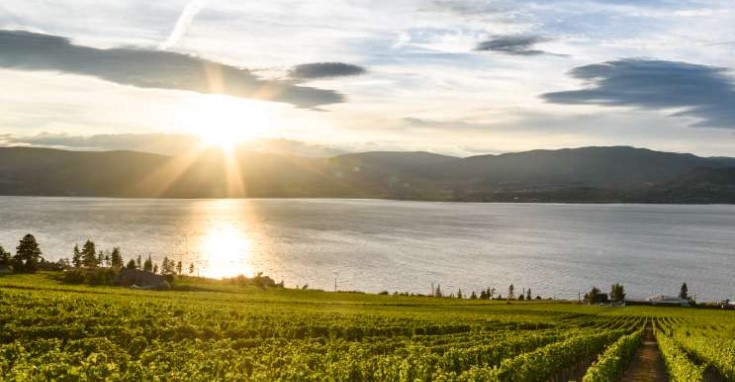
2021 presented lots of challenges for British Columbia’s vintners. The spring was one of the driest on record with very little rain from late May to the end of June. Temperatures in June climbed up to 47 degrees Celsius. The combination of these things resulted in the grapes maturing faster and earlier than normal. The grape yields were low but the quality was good, producing small, very ripe fruit bursting with flavour. It is hoped that this high concentration of flavour will translate into an excellent, though a low yield vintage.
Photo credit: TourismKelowna.com
The wild fires also wreaked havoc on the harvest in some areas, particularly the Thompson and Okanagan Valleys. Fortunately, the worst of the smoke exposure occurred before the grapes began to ripen so the impact is believed to be minimal.
The recent flooding in B.C. has affected all residents either directly or indirectly. With major transportation routes being blocked or damaged, supply chains and mobility have been severely restricted. At this point it is still too early to know what additional burden will be felt by B.C.’s wine industry as a whole because of the flooding.
This year was without a doubt a season with its challenges because of the smoke, heat and floods. However, early indications suggest that the 2021 vintage of British Columbia wines will be very flavourful. Unfortunately for consumers the prices will most likely be higher due to the smaller than normal yields produced. These are some things to keep in mind when the 2021 B. C. vintages begin hitting the store shelves in a year or two.
Ontario had 79 wineries enter this year’s National Wine Awards competition, second only to B.C. With such a strong field of competitors, earning a position in the top 10 is truly an accomplishment.
The wines were presented to the judges without displaying the producer, origin or price. The wines were identified and organized by grape variety or style. The top medalists were tasted in multiple rounds by many different judges.
All ten wineries were from the Niagara region. There were no winners from Prince Edward County, the North Shore of Lake Erie, Norfolk County, Georgian Bay, Huron Shores or the Toronto Wine Region.
The wineries identified in green periodically have their wines available for sale in local liquor stores. The award winning wines identified in blue are available in Ontario through the LCBO.
1. Malivoire Wine Company, Beamsville, ON (1st overall)
Malivoire Wine Company is the National Wine Awards Winery of the Year as a result of their earning 3 Platinum, 1 Gold, 8 Silver and 5 Bronze medals. This was the first year that a winery has received 3 Platinum medals. Malivoire’s wines may be purchased from their website at www.malivoire.com.
Platinum Medal Winners
2020 Le Coeur Gamay – Category: Gamay – $27.95
N/V Bisous Rose – Category: Sparkling Pink – $29.95
2020 Analog Demo Series – Category: Red Blend – $27.95
Gold Medal Winner
2020 Small Lot Chardonnay – Category: Chardonnay – $19.95
N/V Che Bello, Ontario – Category: Sparkling Wine – 17.95
2020 Ladybug Rosé – Category: Rosé – $16.95
2020 Vivant Rosé – Category: Rosé – $19.95
2. Trius Winery, Niagara-on-the-Lake, ON (4th overall)
Trius Winery was awarded 2 Platinum, 1 Gold, 7 Silver and 5 Bronze medals at this year’s event. Their wines may be purchased from their website at www.triuswines.com.
Platinum Medal Winners
2019 Showcase Late Harvest Vidal – Category: Late Harvest – $29.95
Brut Rose – Category: Sparkling Pink – $29.95
Gold Medal Winner
2019 Showcase Riesling Ghost Creek – Category: Riesling – $29.75
3. Peller Estates, Niagara-on-the-Lake, ON (5th overall)
Peller Estates received 2 Platinum, 2 Gold, 5 Silver and 3 Bronze medals at this year’s awards. Their wines are available at retailers across Canada, as well as from their website at www.peller.com.
Platinum Medal Winners
2019 Private Reserve Cabernet Franc – Category: Cabernet Franc – $23.75
2019 Signature Series Riesling – Category: Riesling – $29.95
Gold Medal Winners
2018 Andrew Peller Cabernet Franc Icewine – Category: Icewine – $108.90
2019 Winemaker’s Blend Red – Category: Red Blend – $24.95
2019 Small Lot Riesling Triangle Vineyard – Category: Riesling – $29.75
2018 Effervescent Riesling – Category: Sparkling White – $38.95
5. 13th Street Winery, St. Catharines, ON (15th overall)
13th Street was awarded 1 Platinum, 1 Gold, 5 Silver and 14 Bronze medals. Their wines are available at retailers in Ontario, as well as from their website at www.13thstreetwinery.com.
Platinum Medal Winner
2015 Premier Cuvee – Category: Sparkling White – $39.95
Gold Medal Winner
2020 Cabernet Franc June’s Vineyard – Category: Cabernet Franc – $24.95
Silver Medal Winners
2013 Grande Cuvee Blanc de Noir – Category: Sparkling White – $59.95
2019 Gamay – Category: Gamay – $19.95
2019 Blanc de Blanc – Category: Sparkling White – $29.95
7. Fielding Estate Winery, Beamsville, ON (22nd overall)
Fielding achieved 3 Gold, 5 Silver and 12 Bronze medals this year. Their wines are available at retailers across Ontario, as well as from their website at www.fieldingwines.com.
Gold Medal Winners
2018 Estate Bottled Cabernet Franc – Category: Cabernet Franc – $39.95
2019 Cabernet-Syrah – Category: Red Blend – $29.95
N/V Sparkling Brut – Category: Sparkling White – $37.15
Tawse received 2 Gold, 12 Silver and 7 Bronze medals at this year’s awards. Their wines are available from their website www.tawsewinery.ca and from retailers across Ontario.
This year was the twentieth anniversary of the WineAlign National Wine Awards of Canada (NWAC). The country’s largest competition of Canadian wines is usually held in June each year but this year the event was moved to October due to COVID-19 and took place in Penticton, British Columbia. The final results were not released until November 12th.
The judges’ panel consisted of 14 men and 12 women who tasted 2,075 wines from more than 260 wineries.
This year’s Winery of the Year is Niagara’s Malivoire Wine Company. Malivoire earned 17 medals at this year’s Nationals, including 3 Platinum, 1 Gold, 8 Silver and 5 Bronze.
It is the first time in NWAC history that a single winery has won three Platinum Medals at the Nationals. Equally incredible is that the medals were won in three different wine categories.
The NWAC top 10 wineries for 2021 are listed below, including their Platinum and Gold winning wines. The lion’s share of this year’s awards went to British Columbia.
In order to be considered for inclusion on the list, the winery must enter a minimum of five wines. The five top-scoring entries (not including Icewine) from each winery are used to determine the order.
Malivoire Wine Company, whose awards included 3 Platinum, 1 Gold, 8 Silver and 5 Bronze. The winning Platinum and Gold wines included:2020 Le Coeur Gamay (Platinum Award)
No Vintage (N/V) Bisous Rose (Platinum Award)
2020 Analog Demo Series (Platinum Award)
2020 Small Lot Chardonnay (Gold Award)
B.C.’s La Frenz Estate Winery was awarded Best Performing Small Winery of the Year. They earned 2 Platinum, 6 Gold and 5 Silver awards. The Platinum and Gold award winning wines included:
Over 800 of B.C.’s finest wines from more than 120 B.C. wineries were judged by a panel of 15 judges at the 2021 B.C. Lieutenant Governor Wine Awards. The results were released earlier this month.
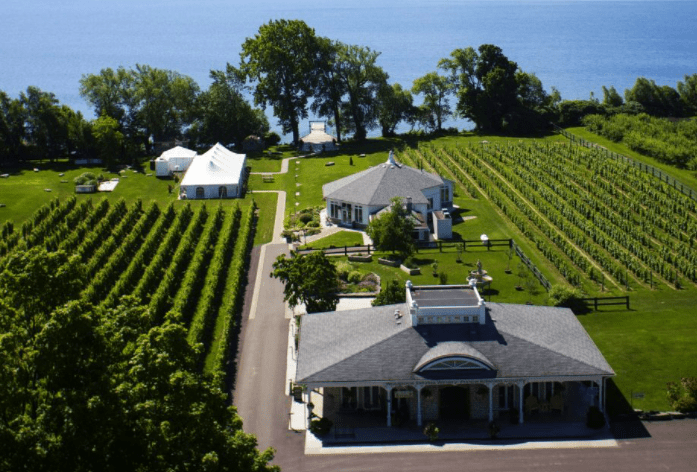
The top honour went to the Tantalus Vineyards’ 2018 Old Vines Riesling. The wine was produced from Riesling grape vines first planted in 1978. The vineyards and winery are situated on the eastern shores of Lake Okanagan overlooking the lake and the City of Kelowna.
CedarCreek Estate Winery, 2019 Platinum Cabernet Franc
Church & State Wines, 2019 Marsanne
Church & State Wines, 2019 Trebella
Unfortunately from what I can tell, none of this year’s winners are presently available outside of British Columbia. I have indicated in green those wineries that do have products that are occasionally found east of the Rockies. Even though the winners may never travel beyond B.C., other wines from these vineyards would be well worth trying.
Many Canadian vintners and wineries are working to reduce both our carbon footprint and reduce negative environmental impact. They are finding ways to reduce energy consumption, lessen dependency on pesticides, herbicides and chemical fertilizers, as well as lessen the need for water.
Stratus Vineyards and Tantalus Vineyards
In the past I have discussed the impacts of climate change on the wine industry but today I will talk about the actual buildings and their design. Leadership in Energy and Environmental Design or LEED, is the most widely-used green building rating system in the world, available for virtually all building, community, and home-project types. In Canada LEED is a proven path to addressing climate change, and to creating buildings that are more resource-efficient, healthy and resilient.
LEED certification provides independent, third-party verification that a building was designed and built using strategies aimed at achieving high performance in key areas of human and environmental health. This includes location and transportation, sustainable site development, water savings, energy efficiency, materials selection and indoor environmental quality.
There are two wineries in particular that have been leaders in adapting change.
Stratus Vineyards, Niagara-on-the-Lake, Ontario
Stratus was the first winery in Canada to earn LEED certification. In order to qualify for LEED certification, the winery had to meet numerous criteria that reduced the negative impact on the environment both during construction and on a permanent, operational basis.
The facility was designed in a way to minimize the amount of equipment needed and where possible it is designed in a way where it can be reconfigured in response to the need. Even the table where the grapes are sorted can be set up in at least 17 different ways.
The winery was built using recycled materials where possible. The building also includes a super-insulated roof and geothermal heating and cooling. There is a resource and energy efficient electrical and plumbing system as well as a toxin-free waste management program.
They also chose native plants and flowers for the landscaping because they can thrive without the use of chemical fertilizers or pesticides. Even the pavement for the parking lot was made of stone that reduces light-reflected heat.
Tantalus Vineyards, Kelowna
Tantalus takes great care in everything they do, from farming to winemaking. Riesling is the real focus but their Pinot Noir shines as well.
Being a successful winery and needing to increase production, Tantalus found themselves in a situation where they needed to replace their original building. The new facility earned them the distinction of being British Columbia’s first LEED-certified winery.
The building is environmentally friendly and energy efficient. There are natural sky lights, an unpaved driveway and parking area to avoid heat reflection and a highly efficient dual-exchange heating and cooling system. The wine shop features custom handcrafted wooden cabinetry sourced from native Alder and the landscaping surrounding the winery has been planted with bee-friendly flowers and shrubs.
The wastewater treatment system processes the winery’s effluent and domestic sewage. It is the first of its kind for a British Columbia winery and allowed them to be completely non-reliant on municipal or private waste disposal providers.
Final Thoughts
LEED certifications is just one way of helping preserve and protect our environment. Both of these wineries, along with many others, are also following sustainability practices and some are even aiming to convert to dry-farming. One thing for certain is that the wine industry is helping to lead the way to improve our environmental health.
Sustainability is defined from an environmental perspective as “the avoidance of the depletion of natural resources in order to maintain an ecological balance”. The objectives include a desire to improve environmental performance, improve the quality of wine growing and winemaking in an environmentally responsive manner, provide information to consumers and add value to the wine industry and the community.
Because of climate change, people are more willing than ever to go “green” with their eating habits, from going more plant-based to cutting back on food waste. Many people have become interested in making their beverages more eco-friendly, including drinking sustainable wine.
Wine Growers Canada (WGC) supports a selection of appropriate environmental sustainability programs for both winery and vineyard operations, underlining a widespread awareness of environmental sustainability and a commitment to implementation. WGC’s Environmental Sustainability Principles were developed in cooperation with FIVS, a worldwide organization designed to serve the alcohol beverage industry. FIVS also collaborates with the International Organization of Wine and Vine (OIV) on sustainability, and both have been adopted by the World Wine Trade Group. These principles ensure flexibility in achieving environmental sustainability objectives, while preserving the programs of individual wineries and providing an ability to achieve success within a company’s particular operating environment.
Vineyards
The vineyards are where sustainable practices are the most obvious. The main objective is to reduce the need for the use of chemicals and create a healthy viable biodiversity where the vineyard can survive.
Some vintners are using sheep to mow and fertilize their vineyards. Sheep along with ducks work to control pests and weeds.
Cover crops such as grasses, legumes, mustard and radishes may be planted between the rows of vines to assist with soil fertility, enhance microbial activity and protect against soil erosion. These plants attract desirable predatory insects that can help control the species that can damage the vines and fruit.
Use of alternative energy sources such as solar panels are also helpful.
Wineries
The proximity of the vineyard to the winery can have a sustainable impact. The closer the two are together the less physical stress the grapes will have between harvesting and wine making.
A winery having a significant portion underground reduces heating and cooling energy requirements. Underground cellars naturally maintain a consistent level of temperature and humidity.
Geothermal heating and cooling systems, as well as using gravity rather than pumps to transport the wine from crushing to fermentation and cellaring are also effective practices.
Sustainable Wine
In order to become a certified sustainable winery, it must be evaluated by a credited independent third party. This helps insure that a sustainability symbol or logo (usually found on the back label) truly indicates that a wine is produced using sustainable methods.
These standards include composting waste to make fertilizer, conserving water and reducing energy consumption and pesticide use. To qualify, wineries must provide records of energy use and greenhouse gas emissions as well as water management and employee health and safety.
Sustainable wine-grape growing is a journey, not a destination.
Identifying Sustainable Wine
If you want to choose good-quality sustainable wine, take time to learn more about where the wine came from and how the grapes are produced. The easiest way to do this is to look for third-party labels, such as EMS, LIVE or SWO (Sustainable Wines Ontario) on bottles of wine when you shop.
Canadian Wineries Practicing Sustainability
Ontario
Many Ontario wineries have chosen to become a Sustainable Winemaking Ontario Certified Winery (SWO). To be certified, the wineries are audited annually to ensure they are adhering to environmentally sustainable practices in their winemaking operations. Best practices include conservation of water, reduction in waste and wastewater and implementation of energy efficiency programs, including the use of sustainable power sources.
Certified Ontario wineries must also produce VQA wines, which are made from 100% locally grown grapes. Local wines inherently have a smaller carbon footprint and also play a vital role in preserving local economies. They are an integral part of a community’s economic health.
SWO Certified wineries must also cultivate positive relationships within their community. They must be leaders in social responsibility and be committed to producing authentic regional wines.
SWO wineries and wines can be identified by the green leaf icon found on labels and in the Wine Country Ontario Travel Guide.
Participating SWO wineries are listed below:
SWO Winery & Vineyard Certified
Cave Spring Vineyard
Château des Charmes
Flat Rock Cellars
Henry of Pelham Family Estate
Hidden Bench Estate Winery
Malivoire Wine Company
Pelee Island Winery & Pavilion
Southbrook Organic Vineyards
Stratus Vineyards
SWO Winery Certified
Reif Estate Winery
Strewn Winery
Vineland Estates Winery
Some wineries also have additional certifications:
Certified Organic wineries use 100% grapes grown without the use of chemical pesticides, herbicides or synthetic fertilizers. Instead, they fertilize with compost, compost teas, green manure and cover crops;
Biodynamic wines are generally certified through the Demeter Farm Standard, which reflects the biodynamic principle of the farm as a living organism: self-contained and self-sustaining, following the cycles of nature; and
Leadership in Energy and Environmental Design (LEED) is a green building rating system. It promotes global adoption of green building and development practices through the implementation of universal performance criteria. It is administered in Canada by the Canada Green Building Council (CaGBC).
British Columbia
The first wines certified under a new made-in-BC sustainability program should be on shelves this year. The certification process, Sustainable Winegrowing BC (SWBC), was originally scheduled to launch in April 2020, but was delayed by COVID-19. With the program up and running, BC vineyards and wineries are now able to apply for a third-party audit, receive certification and describe their wine as “made from grapes grown in a certified sustainable vineyard” or “made in a certified sustainable winery.”
Program development began more than 10 years ago, driven mostly by industry volunteers under the auspices of the BC Wine Grape Council. The wineries involved include large wineries such as Arterra and Andrew Peller, medium-size wineries like Quails’ Gate and Hillside Estate, as well as some boutique wineries like Tantalus and Le Vieux Pin/La Stella. Vineyard owners, consultants and Summerland Research and Development Centre scientists round out the membership.
To date, 68 vineyards and 37 of the province’s 280 wineries have completed the self-assessments.
In Closing
Sustainability is the way of the future. Supporting these wineries is an investment in our own future and well-being. The quality and flavour of these wines is equal to, or superior to non-sustainable wines. Here’s to the future!
With COVID seeming to be lessening its grip, life as we used to know it is once again beginning to slowly return. Part of that are the various wine competitions. The 40th edition of the All Canadian Wine Championships was held from July 6th to 8th. In total, 208 wineries submitted 1,327 wines to assess.
Assessments and awards were based as follows:
Trophies : “All Canadian Best Wines of the Year”
All wines are judged using the 100-point system. Trophies are awarded for each of the following categories:
Best Red table wine
Best White table wine
Best Dessert wine
Best Sparkling wine
Best Fruit wine
The award for Best Red Wine of the Year went to BC’s Dark Horse Vineyard for their 2016 Red Meritage ($60.00).
The Best White Wine of the Year was the 2020 Gewürztraminer ($20.69) from BC’s Wild Goose Vineyards and Winery.
The Best Dessert Wine of the Year went to Ontario’s Peller Estates Winery for their 2019 Andrew Peller Signature Series Riesling Icewine ($89.85).
BC’s Forbidden Fruit Winery won the Best Fruit Wine of the Year award for their 2020 Flaunt Organic Sparkling Plum ($22.00).
Finally the Best Sparkling Wine of the Year award went to BC’s Gray Monk Estate Winery for their 2018 Odyssey Rose Brut ($29.90).
Double Gold medals / Best of Category were awarded to the single highest rated wine (using an average of the aggregate judges’ scores) from each of the categories. These wines were all submitted for the Trophy round.
Medals of Merit: Gold, Silver, Bronze were awarded in the following manner:
Gold awards were awarded to those wines scoring in the top 10 percentile.
Silver awards of merit were issued to those wines scoring in the second 10 percentile.
Bronze awards of merit were given to those wines scoring in the third 10 percentile.
I have put together my 2021 list of British Columbia wineries to watch for. Not all of these wines will be available at your local wine store; some are available in British Columbia wine stores, but most may be purchased online or directly from the winery.
My selections are based on my interpretation of recent trends, the wineries successes and the quality of their wine, their wine-making practices and what makes them stand out above their competitors at the present time. My list is presented in no particular order.
Mission Hill Family Estate Winery, West Kelowna
Mission Hill uses sustainable organic farming practices with the use of modern technology. Their wines are carefully aged with new and Old World techniques. They employ the use of bees, falcons, and chickens in lieu of pesticides and insecticides. Cover crops, earthworms, and compost are used in place of chemical fertilizers.
Their winemakers’ practices are fundamentally rooted in Old World techniques that are supported with modern technology. Drones provide a high-level view of the vineyard’s health. Soil science pinpoints the areas where best to plant the vines.
The winemaking team strives to be continually innovative, combining fermentation and maturation vessel traditions with future trends. The equipment and processes are designed to best serve the wines.
Mission Hill has 3 collections of wines: the Reserve Collection, Terroir Collection and the Legacy Collection.
Reserve Collection
The Reserve Collection expresses hand-selected blocks of grapes, extreme viticulture management, longer barrel time, and increased lees stirring, which is a process to handle the yeast during the fermentation process.
Terroir Collection
Only the top 3% of all of the winery’s fruit is hand-selected for these wines and each individual lot is carefully tasted throughout the winemaking process to ensure its quality level before the final blend.
Legacy Collection
The grapes are hand-harvested and hand-sorted, consisting of the top 1% of the harvest from all of their vineyards. They benefit from extended barrel aging which is followed by a 24-month period in-bottle prior to release.
These wines are small lot and limited production collectibles. Cellar-worthy, they may be aged for decades. The collection includes Compendium, Quatrain, Prospectus, Perpetua and their flagship wine, Oculus.
Covert Farms Family Estate, Oliver
Covert Farms Family Estate practices organic farming with minimal intervention winemaking. Regenerative agriculture offers many benefits to the farming ecosystem such as increasing soil organic matter, greater water holding capacity, improved nutrient cycling, pest and disease suppression through enhanced soil biology, and ultimately higher nutrient density in the vines.
They hope to introduce Dry Farming to the vineyards within the next few years which would provide such benefits as enhanced resiliency to climate change and potential increase in wine quality attributes.
They practice regenerative farming, which is based on five principles that need to be implemented together: no-till or minimal tillage, keeping the ground covered, species diversity, keeping living roots in the soil as much as possible and integrating livestock.
Regenerative agriculture offers many benefits to the ecosystem such as increasing soil organic matter, carbon capture, greater water holding capacity, improved nutrient cycling, pest and disease control through enhanced soil biology, and ultimately higher nutrient density within their crops.
Minimizing tillage is challenging in organic agriculture as this is one of the only means to manage weeds. They have been adapting their systems and processes and have had good success in the vineyards. Interestingly, the longer the soil is undisturbed, the fewer weeds there are.
Tantalus Vineyards, Kelowna
Tantalus Vineyards put incredible care into everything they do, from farming to winemaking and including the winery being Leadership in Energy and Environmental Design (LEED) certified. It is also LIVE certified. LIVE has independently certified the sustainable practices of winegrowers in the Pacific Northwest, using the latest in university research and internationally accredited standards.
Riesling is the major focus at Tantalus; it is an Okanagan icon. However, their Pinot Noir is very good as well.
Final Thoughts
Obviously these are far more than just 3 good wineries in British Columbia. In fact I have purposely excluded some of my personal favourites from this list as they were not what I consider as the innovative leaders this year. Included in that list would be Osoyoos Larose, Quails Gate and Gray Monk.
Unfortunately, it is unlikely that you will find many of the wines produced by these wineries outside of British Columbia. However, lucky for us many of the wineries offer online ordering.
With COVID-19 finally starting to loosen its grip over the country and the hopes that people will be able to begin moving more freely again, I have put together my 2021 list of wines to watch for. Not all of these wines will be available at your local wine store; some can only be purchased online or directly from the winery.
One significant indicator of which wineries are making an impact is usually the Ontario Wine Awards. However, COVID-19 caused the 2021 awards to be cancelled. The 2020 awards were conducted virtually but the organizers decided to forego the 2021 awards with the exception of the ‘Winemaker of the Year Award, which will be announced sometime during the summer. A second indicator is the National Wine Awards, which for 2021 has been deferred from June to October.
Selecting a list of top wineries is very subjective. Depending on the reviewer, ratings may be based on any or all of:
Customer visit experience at the winery
Overall service of the winery
The winery facility and amenities
The variety of wines offered for sale
Price point
The quality of the wine
For the purposes of this review I have based my opinions on my interpretation of recent trends, the wineries successes, and the quality of their wine, their wine-making practices and what makes them stand out above their competitors at the present time. My list is presented in no particular order.
Rosehall Run Vineyard, Prince Edward County
Having won the 2020 Ontario Wine Awards “Red Wine of the Year” for its 2018 ‘JCR Pinot Noir Rosehall Vineyard’ I am looking forward to seeing what Rosehall Run will do this year. I was fortunate enough to visit The County last fall and taste this prize winner, as well as bring a few bottles home. Based on last year’s performance, I would think that this year’s Pinot Noir release will be worth getting a hold of.
2020 was not the first time Rosehall Run has received an award. Their recognized achievements go back to 2006 and they have even had their wine included on the menu for a Royal visit.
Angels Gate Winery, Niagara
Winemaker Philip Dowell was named 2020’s ‘Winemaker of the Year’ at the Ontario Wine Awards. Dowell has a simple philosophy on winemaking; it’s all about balance both in the vineyard and in the actual wine. It’s about bringing together the ‘terroir’, ‘elevage’ and ‘typicity’ of wine. The ‘terroir” is the character of the grape from a specific vineyard site; ‘elevage’ is the progress the wine takes through the cellar during its maturation; and ‘typicity’ is the distinctive vinous character each wine has.
Karlo has rebounded after some struggles following the 2014 death of its founder and winemaker, Richard Karlo. Karlo has redeveloped its vision, which is to promote sustainability and show that it is possible to be respectful of the planet while producing award-winning wines. Karlo was the first certified vegan wine in the world. Not only is the wine in the bottles certified vegan but all the vineyard practices are vegan as well.
Personally, I am a big fan of both the Van Alstine white and red Port, as well as their Quintus which is made using Malbec, Petit Verdot, Merlot, Cabernet Franc, and Cabernet Sauvignon grapes.
The Picone Vineyard, Niagara
The Picone Vineyard was a complete mystery to me prior to their winning the White Wine of the Year award at the 2020 Ontario Wine Awards for their 2017 ‘Charles Baker Riesling’. The vineyard is small, only 10 acres.
In addition to the Riesling, they produce Fogolar Cabernet Franc, which is made from a one-acre block with prized vines that are 30+ years old.
Being committed to enhancing the environment by using sustainable practices in their winery and vineyard, the Wine Council of Ontario has certified Picone for sustainability management of their vineyard.
Interestingly, the owner, Mark Picone, is an internationally trained chef. As well as owning the winery, Mark is a Chef Professor at the Canadian Food and Wine Institute. What better way to showcase his wine than by pairing them with his own food creations.
Picone Vineyard may be small but it seems to have great future potential to become mighty.
Final Thoughts
Obviously these are not all the good wineries in Ontario, in fact far from it. However, these are the ones that caught my attention this past year. Unfortunately, it is unlikely that you will find any of their offerings in your local wine or liquor store. However, if you find yourself in either the Niagara region or The County, visiting these wineries could be a fruitful (no pun intended) experience. Most of the wineries offer online ordering as well.
This week I conclude my review of the grape varietals grown in British Columbia, Ontario and Nova Scotia. The focus is on red wine grapes grown in these 3 provinces.
Baco Noir
Baco Noir is a hybrid red wine grape variety created by Francois Baco. In 1951 the variety was brought to the cooler viticulture regions of North America, such as British Columbia, Ontario, Nova Scotia, New York, Michigan, Mississippi, Wisconsin, Pennsylvania and Oregon.
Cabernet Franc
Cabernet Franc is one of the major black grape varieties worldwide. It is principally grown for blending with Cabernet Sauvignon and Merlot in the Bordeaux style, but can also be vinified alone. In addition to being used in blends and produced as a varietal in all 3 Canadian provinces and the United States, it is sometimes made into ice wine in these regions.
Cabernet Franc is lighter than Cabernet Sauvignon making a bright, pale red wine that contributes finesse and lends a peppery perfume to blends with more robust grapes. Depending on the growing region and style of wine, additional aromas can include tobacco, raspberry, bell pepper, cassis, and violets.
Cabernet Sauvignon
Cabernet Sauvignon is one of the world’s most widely recognized red wine grape varieties. It became internationally recognized through its prominence in Bordeaux wines where it is often blended with Merlot and Cabernet Franc. From France and Spain, the grape spread across Europe and to the New World where it found new homes in places like California’s Santa Cruz Mountains, Paso Robles, Napa Valley, New Zealand, South Africa, Australia, Chile, British Columbia and Ontario.
The classic profile of Cabernet Sauvignon tends to be a full-bodied wine with high tannins and noticeable acidity that contributes to the wine’s aging potential. In cooler climates like Canada, Cabernet Sauvignon tends to produce wines with blackcurrant notes that can be accompanied by green bell pepper notes, mint and cedar which will all become more pronounced as the wine ages. In more moderate climates the blackcurrant notes are often seen with black cherry and black olive notes while in very hot climates the currant flavours can veer towards the over-ripe and “jammy” side.
Castel
The grape was created in 1953 by Ollie A. Bradt, at what is now the Vineland Research and Innovation Centre. Today the grape is widely planted in Nova Scotia with some plantings in Ontario. The grape is hardy, early-ripening and disease resistant.
De Chaunac
De Chaunac is a French-American hybrid wine grape variety used to make red wines. The grape was named after Adhemar de Chaunac, a pioneer in the Ontario wine industry.
De Chaunac is known to have a very vigorous growth habit and good resistance to mildew. It is grown in varying amounts for wine production across northeastern North America, especially in the winegrowing regions of New York, Pennsylvania, Nova Scotia, Ontario, Michigan and Ohio.
Gamay
Gamay is a purple-coloured grape variety used to make red wines, most notably grown in Beaujolais and in the Loire Valley of France. It has often been cultivated because it makes for abundant production. It is grown in all 3 of the Canadian wine provinces.
Leon Millot
Léon Millot is a red variety of hybrid grape used for wine. The variety was named after the winemaker and tree nursery owner Léon Millot. The grapes are grown in Nova Scotia.
Lucie Kuhlmann
This is a Kuhlmann hybrid variety, with growing and ripening characteristics similar to Leon Millot and Marechal Foch, though less widely grown. The wine, like Leon Millot, is capable of deep colour with a pronounced berry-like fruitiness. Wines made from Lucie Kuhlmann tend to have a slightly firmer tannic structure compared to Leon Millot. These grapes are grown in Nova Scotia and Ontario.
Malbec
Malbec is a purple grape variety that creates a dark red intense wine with robust tannins. In addition to being bottled on its own it is also commonly blended with Merlot and Cabernet Sauvignon to create the red French Bordeaux blend or is blended with Cabernet Franc and Gamay. Other wine regions use the grape to produce Bordeaux-style blends.
In addition to France, Malbec has become an Argentine varietal but is also becoming popular in British Columbia and Ontario.
Marechal Foch
Marechal Foch is a hybrid French red wine grape variety. It was originally known as Kuhlmann 188-2. The vines were imported to North America in the mid 1940s, where it was subsequently renamed Marechal Foch in honour of Marshall Ferdinand Foch, Supreme Allied Commander during the First World War.
Marechal Foch ripens early and it is cold-hardy and resistant to fungal diseases. The quality of wine produced is dependent on the age of the vines, and the flavour profile associated with many new-world hybrid varietals is much reduced in comparison to wine made from older vines.
Today Marechal Foch is grown in British Columbia, Nova Scotia and Ontario.
Marquette
Marquette is a blue/black-berried variety introduced in 2006 by the University of Minnesota in the United States. Marquette is the cousin of Frontenac, a well-known French-American hybrid.
Marquette is promising for cold-climate producers in North America, and a number of plantings have been established in Minnesota, Vermont, New York and Nova Scotia.
The grape has high sugar levels and moderate acidity. Marquette wines are typically medium bodied, with aromas of cherries, blackcurrants and blackberries. In some cases more complex aromas such as tobacco and leather may also be exhibited, with spicy pepper notes on the finish.
Merlot
Merlot is a dark blue wine grape variety that is used by itself, as well as a blending grape and for varietal wines. Its softness and fleshiness, combined with its earlier ripening, makes it a popular grape for blending with Cabernet Sauvignon, which tends to be higher in tannin.
Along with Cabernet Sauvignon, Cabernet Franc, Malbec and Petit Verdot, Merlot is one of the primary grapes used in Bordeaux wine, and it is the most widely planted grape in the Bordeaux wine regions. Merlot is also one of the most popular red wine varietals.
While Merlot is made around the world, there tends to be two main styles. There is the International style that produces inky, purple coloured wines that are full in body with high alcohol and lush, velvety tannins with intense, plum and blackberry fruit. The second style is the Bordeaux style where the harvesting of the grapes takes place earlier to maintain acidity. This style produces more medium-bodied wines with moderate alcohol levels that have fresh, red fruit flavours of raspberries and strawberries.
In Canada Merlot is grown in British Columbia and Ontario.
Mischurnitz
This vine is from Eastern Europe but is now being grown in the Finger Lakes region of New York State, British Columbia, and Nova Scotia. In 1983 a wine from Nova Scotia was voted the ‘best wine of Canada’ in a blind competition to supply the Canadian Embassies around the world. More recently two other Nova Scotia wineries, Jost Vineyards and Sainte Famille, are making notable wines with Michurinetz.
This extremely cold-hardy and vigorous vine typically produces red wines with tannic strength. The grapes also typically have extremely high natural acidity, and low sugar levels.
Petit Verdot
Petit Verdot is a variety of red wine grape that is mainly used in classic Bordeaux blends. It adds tannin, colour and flavour, in small amounts, to the blend. Petit Verdot has attracted attention among winemakers in the New World, where it ripens more reliably and has been made into a single varietal wine. It is also useful in ‘stiffening’ the mid palate of Cabernet Sauvignon blends. It is grown in British Columbia and Ontario.
Pinot Noir
Pinot Noir is a red wine grape that is grown around the world, mostly in the cooler climates. It is chiefly associated with the Burgundy region of France. Pinot noir is now used to make red wines around the world. Regions that have gained a reputation for red Pinot Noir wines include Oregon, California, South Africa, Australia, New Zealand and the wine regions of Canada.
When young, wines made from Pinot Noir tend to have red fruit aromas of cherries, raspberries and strawberries. As the wine ages, there is the potential to develop more vegetal and barnyard aromas that can contribute to the complexity of the wine.
Syrah
Syrah, also known as Shiraz, is a dark-skinned grape variety grown throughout the world and used primarily to produce red wine.
The style and flavour profile of Syrah wines are influenced by the climate where the grapes are grown. Moderate climates tend to produce medium to full-bodied wines with medium-plus to high levels of tannins and notes of blackberry, mint and black pepper. In hot climates, Syrah is more consistently full-bodied with softer tannin, jammier fruit and spice notes of licorice and earthy leather.
Syrah is used as a single varietal, as well as in blends. It can be found all over the world from France to Chile, South Africa, New Zealand, Australia, California, Washington, British Columbia and Ontario.
Zweigelt
Widely planted in Austria, Zweigelt vines have made inroads in Washington and the Canadian wine regions of Ontario and British Columbia. There are some plantings in Hungary. In the Czech Republic it is known as Zweigeltrebe and is the third-most widely planted red-grape variety, comprising approximately 4.7% of total vineyards. It grows in most of the wine regions in Slovakia and now in Belgian and Polish vineyards.