Gift for the Host

Good Housekeeping magazine now suggests to their readers that a bottle of olive oil is a much more appropriate hostess gift than a bottle of wine. Personally, I am not about to change my behaviours simply on the advice of a magazine or trends in office parties. If I am hosting or attending a social gathering, it is most likely with my friends who, like me, still enjoy a well-crafted alcoholic beverage, whether it be wine, beer or spirits.

Photo credit: cwocorp.com

I am right at home, literally, when I select a bottle of wine from the cellar to take to a dinner party. What I choose will vary based on the occasion, whether I am pairing the wine to a dinner menu, or the host’s personal wine preferences of white versus red, the grape varietal, or country of origin.

On the other hand, I would have no clue as to what olive oil I should purchase for a hostess gift. I feel that I would need to go to a food specialty store as making the purchase at my local Food Basics or No Frills grocery store seems to lack thought and character. Then comes the question – do you get regular olive oil, extra virgin olive oil, or cold pressed extra virgin olive oil? Is one better? Does the use matter? Is Italian olive oil better or different from Greek or French olive oil? Is one brand better than another?

After dealing with the stress of trying to select the most suitable oil, I would then have to witness the expression on my host’s face as the bottle is pulled from the package and the realization is made that this is not something to be poured into a glass, sipped on and enjoyed. I would be met with a polite smile and eyes of bewilderment.

During these changing times the most important thing is to understand your host’s preferences. Don’t change your gift giving practices just to correspond with current trends but match your gift giving to the preferences of your host.

Sláinte mhaith

The Office Holiday Party

Drinking one’s face off at a party or social gathering is becoming a less acceptable behaviour. The younger generations, Millennials and Gen Z, are now the most likely groups to attend holiday parties. They tend to find alcohol less desirable and thus, its use in social settings is changing. Getting into the holiday spirit no longer requires spirits, with mocktails and alcohol-free bars now becoming very popular. 

Photo credit: homrest.com

Gen Z and Millennials are also the ones most likely to make an early exit from the party. About 28% of Gen Z say they stay just long enough for the food, while 39% of millennials admit to quietly slipping away without even saying goodbye.

Zero-proof cocktails and menus featuring gluten-free, vegetarian and vegan options are reflective of a broader focus for these events. However, for those that continue to provide alcoholic options, cocktail menus are more curated and upscale and aim to incorporate local ingredients or have a more direct relationship with the company or event. 

A poll conducted in Great Britain suggested that over twenty percent of office Christmas parties in 2024 were alcohol-free events. This is an increase of two percent over just one year previous, suggesting that this is an increasing trend.

For me, being retired, gone are the days of attending work-related events steeped in their traditions and corporate politics that were often fueled by alcohol, especially during the later hours. Having emceed one of these events attended by a couple of hundred people, I appreciate the benefits of the alcohol-free approach. It can be entertaining to sometimes watch the alcohol fueled antics of some attendees and stressful to see others say or do something totally inappropriate and potentially career-limiting. It can be both tragic and embarrassing for these individuals after they sober up and realize what they had done.

Gatherings are becoming smaller as well. Less companies are hosting single large gatherings attended by all employees. Instead, they are opting for smaller intimate settings pertaining to the interests of specific groups. The events tend to focus more on food and less on spirits.

Gone are the days of wearing lampshades at a party.

Sláinte mhaith

Returning Wine to a Vendor

I came across an article recently that asked the question, under what circumstances is it acceptable to return wine, whether it be purchasing it from a wine shop or while dining in a restaurant?

Photo credit: crushwinexp.com

Except in situations where wine is suspected to be contaminated or unsafe for consumption, most jurisdictions do not have regulations regarding the return of wine and liquor to the vendor for refund or exchange. Therefore, it is the decision of individual retailers to determine whether they will accept returns. Most require a receipt, and some may charge a restocking fee.

The most obvious situation is when you open a bottle of wine, pour a glass and then discover an unpleasant aroma, appearance or taste. This could be the result of the wine being stored in a warm location, tainted with TCA (cork taint) or gone bad in some other way, such as being exposed to oxidation. However, it is important to keep in mind that individual flavour profiles, tartrates (wine crystals or wine diamonds), natural sedimentation and tannin deposits are not considered to be wine defects.

In situations where the wine is not spoiled but is just not to your liking or expectation, results may greatly vary. Purchasing wine and not liking it doesn’t automatically make it returnable. For example, being unfamiliar with the nuances of the effects of an aged bottle of wine may result in an individual unfairly judging it, especially if they are unaccustomed to the secondary and tertiary aromas and flavours that can develop over time. Whether such a wine may be returned varies from one establishment to another. Having a conversation with staff prior to selecting a wine you are unfamiliar with will help you manage expectations and avoid disappointment. Whether you have a legitimate right to return a wine comes down to judgment, experience and hospitality. Customers should feel taken care of, but they also need to be realistic and fair.

Many retailers have a 30-day return or exchange policy; most require a receipt and some charge a restocking fee. If you’re returning a bottle because you believe it is flawed, you should bring the mostly full bottle back to the shop with you.

Returns to a winery may be the most stringent. Other than for spoiled wine, returns must be unopened and in saleable condition (label and capsule intact), be of the current vintage and accompanied by the original receipt, indicating that it was purchased within the previous 14 days. The product may then be exchanged for an item at the original purchase price shown on the receipt. Personalized wines are a final sale.  In that case, unopened bottles cannot be returned for a refund or exchange.

A faulty product must be returned for assessment immediately upon discovery. If most of the product has been consumed, the return may not be accepted.

For online purchases, in addition to the regulations above, the purchaser will be required to pay for any additional applicable shipping charges.

Hopefully it doesn’t happen but if you ever find yourself in a position where it becomes necessary to return wine, you now have the information necessary to make this transaction as easy as possible.

Sláinte mhaith

2025: A Much Better Year

As an update to my November 9, 2024, post “2024: A Year to Remember”, I am pleased to report that the devastation resulting from the environmental disasters that plagued the 2024 growing season in British Columbia have had a reduced impact on this year’s grape harvest.

Photo credit: decanter.com

The vines that survived the destruction have recovered significantly, contrary to expectations. Most growers are now expecting a substantial crop; something that seemed unimaginable last year. The vines have proven to be much more resilient than expected. Some wineries project this year to be their largest harvest ever.

Indications are that the 2025 vintage will be of high quality as the weather has been consistently warm but without extreme heat spikes and wildfires. However, some vineyards still have crop yields of questionable quality.

Grape prices have returned to more reasonable levels, similar to what existed before the environmental challenges of the past couple of years. This will be a relief for the wineries and consumers.

Only a small number of wineries will continue to need to source grapes again from the U.S. Thus, the replacement wine program has been extended for another year. Many producers have replanted vineyards that will not be in full production for another several years.

The effects of the 2024 disaster will continue to linger for the foreseeable future. but the impact is proving not to be as devastating as first thought.

Sláinte mhaith

Impact of Tariffs on the Canadian Wine Industry

Tariffs and retaliatory measures significantly hurt Canada’s wine industry by increasing the cost of U.S. grape must and juice needed by many winemakers, while also indirectly harming wineries through higher costs for imported packaging and equipment. On the other hand, provincial bans on U.S. wine improved sales for domestic Canadian wines. However, should this increased demand continue, wineries may need to enhance their operations.

Photo credit: tbnewswatch.com

Wine production costs have increased for wineries that purchase grape must (crushed grapes) from the U.S.  Tariffs on steel and aluminum from the U.S. have increased the cost of barrels, equipment and cans.

However, it’s not all doom and gloom for the Canadian wine industry. There have been increased sales of domestic wine due to the removal of American wines from liquor and wine store shelves in most provinces.

Statistics Canada announced that in April 2025, Canada imported only 2.9 million dollars of American wine  a 94% decrease from the year previous. Imports from other wine-producing regions such as New Zealand and Australia increased by 31% and 28% respectively, while shipments from France and Italy rose by 13.6% and 7.6% respectively.

Wineries in Southwestern Ontario, the B.C. Lower Mainland, and Kelowna have experienced increased sales. For example, despite total wholesale wine sales falling nearly 5% year-over-year, B.C.’s share climbed from 47% to over 52%. For the first time, B.C. wines represent more than half of all wholesale wine sales in that province.

However, as stated previously, I don’t believe there are any real winners in a trade war.

Sláinte mhaith

The Effects of Tariffs on the U.S. Wine Industry

With the introduction of tariffs this year by the U.S., American wine makers are now paying a higher price for all their wine making materials including French oak barrels, glass bottles, corks and even the wine-making equipment itself, such as pumps and de-stemmers. The 15% levy that was imposed on all goods entering the U.S. from the European Union means the cost of wine making supplies increased 15%. For example, each wine barrel now costs California wine makers an additional $100 to $150 US.

Photo credit: globaltradelawblog.com

California’s Paso Robles Wine Country Alliance said international wine orders were drying up as the aftereffects from President Trump’s trade war resonated around the world. U.S. winemakers are saying that this puts wine producers in high-cost California at an even greater disadvantage.

European wine producers are reducing their amount of American wine purchased. Danish wine stores are boycotting U.S. made wines. In Sweden, the state liquor store, Systembolaget, has seen sales of American wines drop 15%. Portugal as well has sought out alternatives to American wine.

Canada, who purchased 33% of all U.S. wine exports in 2024, has removed American wine and alcohol from liquor store shelves in most provinces. Robert P. Koch, president of California’s Wine Institute, said, “Canada is the single most important export market for U.S. wines, with retail sales in excess of $1.1 billion annually”. In April 2025, U.S. wine exports to Canada decreased 72.5% compared to April of last year. According to the American Association of Wine Economists (AAWE) exports declined by $25.5 million to $9.69 million.

It’s feared that these new anti-American sentiments are unravelling decades of marketing work and relationship building. Former consumers of American wine are now discovering interest in other New World wines, such as Australia, South Africa, South America and Canada.

Oregon is facing the same challenges as California. Oregon’s leading export targets are Mexico, China and Canada, representing about 81,000 jobs that are reliant on that export trade. Close to half of all Oregon wine exports in recent years have gone to Canada; in 2022, that was 73,323 cases of a total export of 162,939.

In April, the US Wine Trade Alliance stated that “restaurants will suffer, domestic producers will face new obstacles in bringing their wines to market, and retailers, importers, and distributors across the country will be placed at serious risk “.

I guess we will all have to wait and see what the longer-term effects of this trade war will be. However, I tend to agree with the economists who conquer that a trade war is a war that no one wins.

Sláinte mhaith

Buying Wine Online

I have previously shared my experiences on purchasing wine from a winery in a foreign country and shipping it home. Today I look at another purchase option, buying wine online.

Photo credit: vinpark.com

The online sources vary from individual wineries to liquor stores to wine brokerage houses to wine clubs and even auction houses. Online searches will help you find rare wines and older vintages. It also makes it easy to search where a specific wine is sold and allows you to compare prices. These sites will often provide additional information about the wine you are interested in, such as the vintner’s notes, wine critic reviews, a link to winery websites and other technical information.

However, before you begin scrolling through the wide assortment of online vendors, there are some things you need to be aware of.  First, if you are purchasing wine or any other alcohol from a website outside your country or province there will be a number of taxes and charges.  For example, alcohol being imported from outside Canada to Ontario will have a levy of 102.2% for wine, 143.7% for spirits and $1.70 per litre for beer.

In addition, there will most likely be a shipping fee, which will be a significant percentage of the per bottle price. The only exception I am aware of is when I purchase alcohol online from my liquor store (the LCBO); the price I pay is the same price as it would be in the bricks and mortar store. The only difference is my purchase is shipped to the local liquor store where I then go to pick it up. It enables me to purchase wines and spirits that I would otherwise not have access to, living in an area where there is a limited variety of selections.

The number of retailers able to ship to you may be restricted by shipping regulations in the vendor’s location. Thus, your online wine purchase options may not be as lucrative as it may seem.

Sláinte mhaith

A lesson Learned

Earlier this year I had my first experience purchasing a case of wine in a foreign country and having it shipped home. In the past I have often taken advantage of the duty-free laws and brought home a bottle of wine or whisky, but this was the first time I purchased a quantity of wine.

Photo credit: palletonline.co.uk

The purchase of the wine was made at the time I visited a winery in Bordeaux, France.  The six bottles of wine I purchased cost 315 euros plus a shipping fee of 99 euros for a total of 414 euros. Once the exchange rate was applied my total came to $660 CDN.

After my return home I received an email from the shipper advising that they required a copy of the transaction receipt and/or credit card payment confirmation statement verifying the purchase. This information was then forwarded to the Liquor Control Board of Ontario (LCBO) for valuation purposes prior to the delivery of my wine. I was also advised that there would be additional costs associated with importing alcohol that had to be paid prior to the release of my shipment.

The additional costs included a levy of 102.2% which was applied to the total value of the shipment. There was also a brokerage fee of $49.17+HST, duties, taxes and a government filing fee of $12.50 as well. The total import fees ended up being $605. The result was that a bottle of wine sold at a Bordeaux winery with a price tag of $52.50 euros or $83 ended up costing me $184! Lesson learned.

Sláinte mhaith

Food and Wine Pairings – Yes or No?

I have written my share of posts over the years suggesting certain wines be served with specific foods as the wine will highlight and compliment the flavours and characteristics of a particular food. However, I recently read an article that suggested that too much focus is placed on paring wine with specific foods. The author made several thought-provoking points as to why the practice is not always useful.

Photo credit: google.com

For one thing, everyone’s palate is not the same. Some people have a more sensitive palate than others. What one person finds to be a good pairing; another person may not. Taste is a very personal thing. What one individual enjoys another may not. For example, not everyone enjoys spicy food.

People’s ability to taste and smell varies for a wide assortment of reasons. The tongue has taste receptors that enable us to identify saltiness, sweetness, sourness, bitterness and umami, which is a   savory, rich taste that is often described as “meaty” or “brothy”. In addition to the approximate 35 receptors on the tongue, it has been discovered that there are additional receptors in the brain, stomach, and even in the muscles.

For the sense of taste to be totally effective, an individual must also have a good sense of smell. This requires good use of about 400 aroma receptors.

Emotions can play a big part in what tastes good and what does not. When depressed, angry, or in pain, chances are that your wine will taste rather off, being much less enjoyable than it otherwise would. The atmosphere and surroundings can have a significant psychological impact on how you feel about the wine and the food you are eating.

What all this illustrates is that the sense of taste is very complex, leaving each of us with varying degrees of flavour interpretation that can fluctuate greatly depending on our mood and circumstances. Thus, there are not only many opinions on what wine and food combinations go well together, but also that what pairs well may be based on a multitude of unidentified external factors. We humans can be very complicated beings and thus, we may have wide ranging opinions as to what wine and food combinations go well together.

Wine and food pairings are standards and suggestions but not a hard and fast rule. The bottom line is, you should match your food and wine in a manner that is most pleasurable to you and makes your meal enjoyable. I will continue to periodically write about suggested wine and food pairings but remember, these are only recommendations, not hard and fast rules.

Sláinte mhaith

In Response to Donald Trump

During the past six years that I have been writing this blog I have always steered away from political issues. However, today I feel compelled to speak out against Canada’s one time ally, the United States. With the return of Donald Trump to the White House’s Oval Office, Canada’s economy was placed under direct attack by Trump when he decided to impose twenty-five percent tariffs on Canadian imports to the U.S., without just cause. Similar sanctions have been imposed on Mexico and China and are being threatened against the European Union.

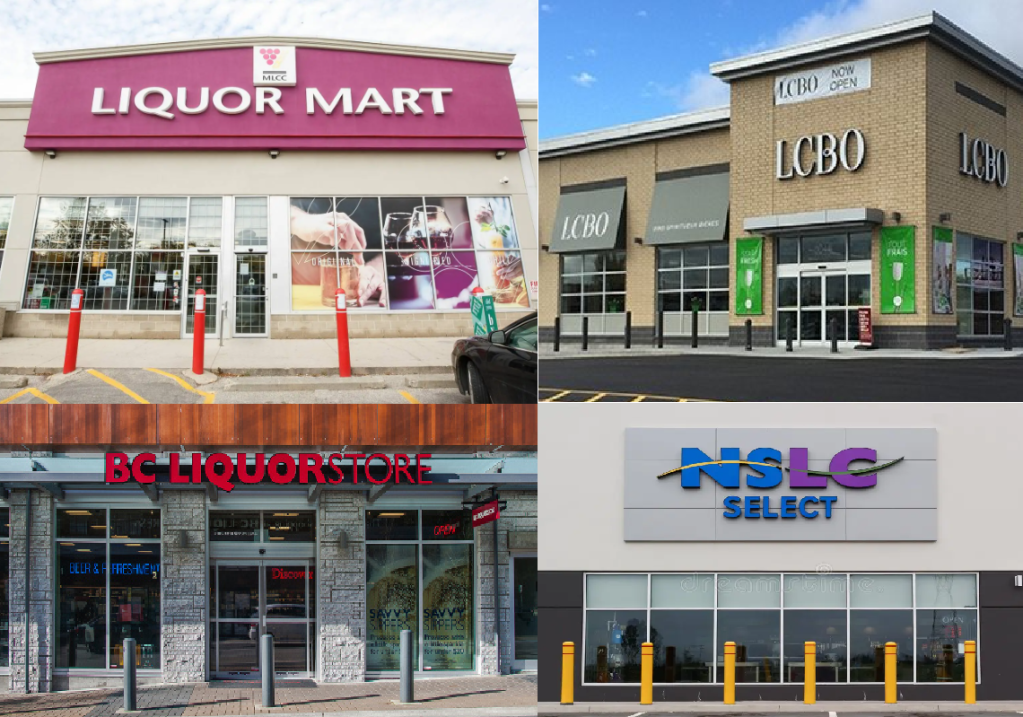
Photo credit: Manitoba Liquor Mart

In response to these bullying tactics by Trump, and as a proud Canadian, I will no longer purchase or write about American wine until such time as Trump refrains from his attack on Canada.

Canada has been the top export market for U.S. wines and Ontario’s provincial liquor board (the LCBO) has been among the largest purchasers of U.S. alcohol. In Ontario, imported wines are primarily sold through provincially owned and operated retail outlets, although recent regulatory changes have authorized 157 private grocery retail locations to distribute wine and beer.

The first phase of Canada’s response to the U.S. imposed tariffs includes tariffs on wine and spirits, in addition to many other products. Ontario is banning American liquor and the LCBO is removing American wine, spirits and beer from its shelves. This will represent about a billion dollars worth of American alcohol.

British Columbia, Alberta, Saskatchewan, Manitoba, Nova Scotia and Newfoundland are also removing U.S. liquor from their store shelves. At last word Quebec is considering the idea. On the bright side these bans will serve to enhance the sale of Canadian wines in Canada, as well as European, Australian, South American and South African wines.

Hopefully the American people will convince Trump that the imposition of his tariffs will not only hurt international economies but his own economy as well. It is a sad situation.

Sláinte mhaith