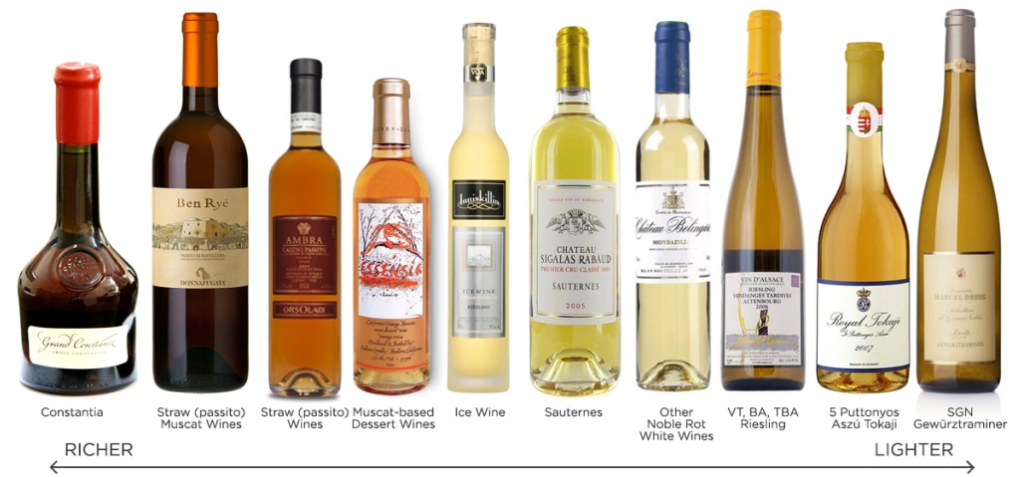
As the name suggests, dessert wine is a sweet wine that is intended to be served alongside dessert. These wines are often rich in flavour and have a high sugar content.
Photo credit: varuninamdar.wordpress.com
There has been a growing demand for premium dessert wines aimed at satisfying consumer demand for high-quality and unique flavours. This has driven market growth by enticing wineries to improve and enhance their product offerings and release new artisanal options, which in turn command higher price points and increased revenue.
There is rising interest in low-alcohol dessert wines by health-conscious Millennials and the Gen Z population who desire lighter wines. These wines also appeal to a broad range of wellness seekers, thus enhancing market growth.
Again, health-conscious and ethically driven drinkers are creating demand for vegan and allergen-free wine alternatives. By excluding animal-derived fining agents, which are added to wine to alter its colour, flavour, texture, and clarity, new dessert wine markets become available. These agents include additives such as casein or gelatin.
There are generally five types of dessert wine. Thirty percent of the market is made up of fortified wines, consisting of Port, Sherry, Madeira and Marsala.
Late harvest wines are next, consisting of twenty-five percent of the dessert wine market. Included in this category are Late Harvest Riesling, Late Harvest Sémillon and Late Harvest Gewürztraminer.
Controlling twenty percent of the market is Ice Wine. Included are Eiswein and Ice Cider.
Botrytized Wines, also referred to as Noble Rot, consist of fifteen percent of the market. For an explanation of this type of wine, refer to my post, Dessert Wines from April 18, 2020. Wines in tis group include Sauternes and Tokaji Aszú.
The “Other” wine category make up the remaining ten percent of the dessert wine market. Included in this catch-all category is Recioto della Valpolicella, Vin Santo and Muscat / Moscato.
During the past six years that I have been writing this blog I have always steered away from political issues. However, today I feel compelled to speak out against Canada’s one time ally, the United States. With the return of Donald Trump to the White House’s Oval Office, Canada’s economy was placed under direct attack by Trump when he decided to impose twenty-five percent tariffs on Canadian imports to the U.S., without just cause. Similar sanctions have been imposed on Mexico and China and are being threatened against the European Union.
Photo credit: Manitoba Liquor Mart
In response to these bullying tactics by Trump, and as a proud Canadian, I will no longer purchase or write about American wine until such time as Trump refrains from his attack on Canada.
Canada has been the top export market for U.S. wines and Ontario’s provincial liquor board (the LCBO) has been among the largest purchasers of U.S. alcohol. In Ontario, imported wines are primarily sold through provincially owned and operated retail outlets, although recent regulatory changes have authorized 157 private grocery retail locations to distribute wine and beer.
The first phase of Canada’s response to the U.S. imposed tariffs includes tariffs on wine and spirits, in addition to many other products. Ontario is banning American liquor and the LCBO is removing American wine, spirits and beer from its shelves. This will represent about a billion dollars worth of American alcohol.
British Columbia, Alberta, Saskatchewan, Manitoba, Nova Scotia and Newfoundland are also removing U.S. liquor from their store shelves. At last word Quebec is considering the idea. On the bright side these bans will serve to enhance the sale of Canadian wines in Canada, as well as European, Australian, South American and South African wines.
Hopefully the American people will convince Trump that the imposition of his tariffs will not only hurt international economies but his own economy as well. It is a sad situation.
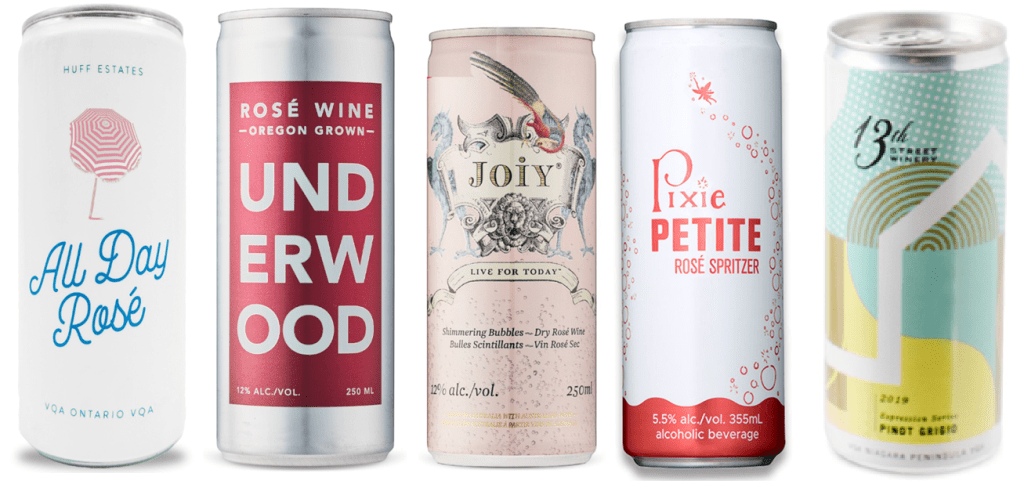
Since I first wrote an introduction to the canned wine market in a post from November 5, 2022, the market has continued to expand. Just as a reminder, canned wines are wines packaged in aluminum can, that provide convenience, portability and freshness. Cans offer a modern alternative to traditional glass bottles, catering to the needs of today’s fast-paced, on-the-go lifestyles of the Millennial and Gen Z consumer segments in particular.
Aluminum cans have enabled a surge in market share within the broader alcoholic beverage industry and has permitted expansion into new international markets and emerging regions. With cans being very adaptable for use at special events and outdoor activities, their popularity continues to grow.
This has all lead to growth in the premium and higher-priced canned wine sectors and encouraged investment from both major and niche wine producers. Strategic partnerships are driving industry growth resulting in innovative can designs to help improve consumer appeal and expand distribution channels into more diverse retail formats.
Wineries have been working to enhance their flavour profiles for canned wines by incorporating flavours such as fruit-infused, botanical and exotic blends. The trend toward moderation and portion control is driving the popularity of single-serve canned wines. Consumers realise the convenience, affordability and reduced environmental impact associated with single use cans.
Canned wines seem to be here to stay and are not just a passing fad.
Anti-alcohol messaging is going to continue and it will be increased during this upcoming year. The World Health Organization (WHO) is now warning against the consumption of any alcohol. Cancer warning labels are now being proposed and will no doubt soon be applied to all alcohol packaging. These warnings will no doubt be accompanied by a reduction in alcohol consumption. However, there are several other factors that will impact alcohol sales.
To begin with, many Millennial and Gen Z consumers are focused on their physical and mental state and how they portray themselves on social media. They have come to associate alcohol with vulnerability, loss of control, anxiety and abuse. For these reasons they have reduced their alcohol consumption.
The increase in popularity of anti-obesity drugs is also having an impact. Glucagon-like peptide 1 (GLP-1), anti-obesity Semaglutide, Liraglutide, as well as Tirzepatide drugs like Saxenda, Ozempic, Wegovy and Mounjaro are now very popular. GLP-1 works by trigging the release of insulin from the pancreas, reducing glucose from entering the bloodstream, slowing digestion and increasing the ‘full’ sensation people feel after eating.
So, how does this impact wine consumption? Studies revealed that Semaglutide reduced binge-like alcohol drinking. The drugs moderated GABA, the gamma-aminobutyric acid receptors in the brain responsible for the ‘buzz’ associated with moderate consumption of alcohol.
There is growing evidence that many users of these drugs feel less inclined to drink any form of alcohol. If GLP-1 becomes as affordable and as widely used as many predict, the effect on the food and drink industries may be dramatic.
Alcohol-free beverage alternatives are becoming more popular as the quality of these products continues to improve and they gain more market acceptance. Our own kids, who are all adults, are into alcohol free alternatives, especially beer. And now with many craft breweries and estate wineries expanding their offerings to include alcohol free options, the quality of these products maintains the same standard as their alcohol-based options. If nothing else, these beverages will provide lunchtime beverage alternatives to soda or mineral water.
Some countries, such as Great Britain, are imposing a different level of excise tax based on alcohol level. For example, beginning February 1, 2025, the duty and tax on a 13.5% Alcohol by Volume (ABV)bottle of wine will be £3.59, whereas an 8.5% ABV bottle will be taxed at just £2.05.
Finland has just reduced its alcohol distribution rules. Beverages with ABVs of 8% or less can now be sold in supermarkets. Traditionally, once one Nordic nation changes the rules, the others, such as larger Sweden, tend to soon follow.
Public attitudes toward alcohol are changing. The social licence to encourage a guest to have another glass of wine or to finish off the bottle are becoming less acceptable behaviours and are being widely revoked.
As Bob Dylan wrote, “The Times They Are a-Changin”.
Ignoring cardboard and aluminum packaging options, did you know that there are seventeen glass bottle packaging sizes available for holding your favourite white or red wine? Now every wine is not available in every size as that would be cost prohibitive, but producers have lots of options for packaging their wine, depending on the market for packaging their wines.
The vessels from smallest to largest include:
Split or Piccolo – ¼ the size of a standard bottle or one glass. This is the size often served on trains and airplanes.
Half or Demi – ½ standard bottle or two glasses. This size bottle is also commonly served on trains and airplanes.
Half-litre or Jenni – 2/3 standard bottle or three glasses. This is a common size served in restaurants.
Standard – 1 standard 750 ml. bottle or five glasses. This is the most common size sold in wine stores.
Litre – 1 1/3 standard bottles or 7 glasses. This size is often produced in countries that use the metric system of measure. It is a size commonly sold to venues serving significant quantities of wine.
Magnum – 2 standard bottles or ten glasses. Some wines are available in this size at local wine stores.
Jeroboam or Double Magnum –4 standard bottles or twenty glasses.
Rehoboam – 6 standard bottles or thirty glasses.
Methuselah or Imperial – 8 standard bottles or forty glasses.
Salmanazar – 12 standard bottles or sixty glasses.
Balthazar – 16 standard bottles or eighty glasses.
Nebuchadnezzar – 20 standard bottles or one hundred glasses.
Melchior – 24 standard bottles or one hundred twenty glasses.
Solomon – 26 standard bottles or one hundred thirty glasses.
Sovereign – 35 standard bottles or one hundred seventy-five glasses.
Primat or Goliath – 36 standard bottles or one hundred eighty glasses.
Melchizedek or Midas – 40 standard bottles or two hundred glasses.
As you can now see, there are many sizes of bottles available for supplying your wine.
With many people cruising wine store shelves this time of year looking for a bottle of bubbly to celebrate the season with, it is a good time to examine how to identify the various types sparkling wine or Champagnie. There is no doubt about it; the sweetness classification system for sparkling wines is confusing. There are seven standard sweetness categories. Those are brut nature or brut zero, extra brut, brut, extra sec, sec, demi sec and doux. Each class indicates slight differences in aromas and flavour.
Photo credit: coravin.com
The sweetness level is determined by the dosage or liqueur d’expedition, which is a mixture of sugar and wine. It is used to top off the amount of wine in the bottle after riddling has taken place. Riddling occurs when the winemaker removes the dead yeast cells (referred to as the lees) from the neck of the bottle.
The dosage mix may contain anywhere between 500 and 700 grams of sugar per litre of sparkling wine. The precise ratio of sweetener-to-wine varies according to the producers’ desires and region the wine is produced in. Some producers use a sweeter liqueur d’expedition, while others choose not to sweeten their wines at all.
The classification system was designed a hundred years ago by the French to identify the sugar levels in Champagne. This is part of the laws that govern the production of Champagne. The laws have been modified countless times over the years.
The seven levels from dryest to sweetest are:
Brut Zero/Brut Nature
These wines are the driest, containing less than three grams of sugar per litre. These wines may also be referred to as “sauvage” or “zero dosage”. They contain only natural residual sugar with no dosage added to the bottle.
Spanish Cava and Corpinnat producers may refer to these wines as “brut nature”, where in Germany the term “naturherb” may be used.
Extra Brut
In Champagne as well as Spanish Cava and Corpinnat, “extra brut”, or in Germany “extra herb”, is used to describe the second driest level of sweetness. These wines contain less than six grams of residual sugar.
Brut
“Brut” is the most common style of Champagne. To be labeled a brut wine, it must contain less than 12 grams per litre of sugar. This is a broad range and technically includes both “brut nature” and “extra brut”, so this category can vary widely in sweetness levels.
This term is also used to describe Spanish Cava and Corpinnat. In Germany the style may be referred to as “herb.”
Extra Sec/Extra Dry
“Extra Sec” or “Extra Dry” wines are slightly sweeter than “brut”. They contain between 12 and 17 grams of sugar per litre. In Spain, the style is referred to as “extra seco” and in both Germany and Australia the term “trocken” is used.
Sec
“Sec” wines contain sugar levels between 17 and 32 grams per litre. These wines are considered to be ‘medium dry’ or ‘off-dry.’
Demi-Sec
Wines labeled “demi-sec” or Spanish “semi seco” contain between 32 and 50 grams of sugar per litre. Fun fact, this is equivalent to the amount of sugar in a typical gin and tonic.
Doux
This is the sweetest style of sparkling wine with the highest sugar content, usually over 50 grams per litre. Doux wines are very rare.
The characteristic of the ideal corkscrew varies depending on who you ask. There is no right or wrong type of corkscrew to use. The best one is the one that you are most comfortable with and successful using. I think everyone has occasionally struggled to open a bottle of wine that has had an uncooperative cork, making it seem near impossible to free the contents from its glass prison. The trick is to find the type of corkscrew that maximizes your chances of successfully opening your wine seamlessly, without a broken cork, spilled wine or sloppily cut foil.
The most classic corkscrew option is the waiter’s style wine key corkscrew. It is simple enough to use with some practice. Learning how to best utilize the double hinge can be a little tricky, but once mastered it is generally the most cost affective and versatile option.
The winged style corkscrew is larger than the waiter’s style but offers similar ease of use. The screw is sharp and penetrates both natural and synthetic cork easily and the winged arms make it a favourite for many. While the functionality is high, it is a bit bulky for small, crowded kitchen drawers or well-stocked home bar carts. Because of its ergonomic grip and design that doesn’t require a ton of force to operate, it’s a good option for anyone who has joint issues, arthritis, or generally struggles to open a bottle of wine. This style often doesn’t include a foil cutter.
The vertical lever-style corkscrew works well overall as a wine opener. It removes the cork quickly, easily, and with minimal physical effort. Simply position the non-stick screw above the cork, and in two easy motions and one pump of the lever, the corkscrew releases and removes the cork.
If you desire something requiring the least amount of effort, an electric corkscrew is the best choice. These are available from a variety of vendors in a reasonable price range. They are the perfect tool for those who prefer high-tech kitchen gadgets or and anyone with mobility or strength limitations. Just make sure that you have the bottle placed on a level surface. Electric wine openers are effortless to hold and will seamlessly remove the cork with a push of a button. It’s also useful for opening older cellared bottles of wine with troublesome corks.
Depending on the manufacturer there may be some variation in the appearance of each of these types of corkscrews. Price points can also differ depending on the producer and materials used.
Here are some final thoughts to consider when purchasing your next corkscrew.
If you need to open bottles quickly, you will be slowed down if the opener doesn’t have a foil cutter. While many corkscrews have built-in options, there are numerous that don’t.
Corkscrews come in all shapes and sizes. Some are small and compact enough to carry in your pocket while others are much bulkier and more cumbersome to store.
The price may be a factor in your purchasing decision. For most everyday wine-drinking purposes, you can find a reliable and easy-to-use corkscrew for under $30.
I am always seeing articles about ‘TheTen Best this’ or a list of ‘The Best that’. When I read those articles I am always left with the question, “What makes these ones the best? To me beauty is in the eye of the beholder. Whether it be whisky or wine, I have tasted some that I love and others that are so-so, or even worse, that I detest. Just because someone tells you this one is fantastic doesn’t mean that you will agree. Does this mean you are less learned than the author or lacking in your ability to recognize great flavour? Absolutely not. After all, what makes the author’s opinions any better than our own? Nothing.
Another thing I find interesting is that often many of the selections found on these lists are not available in Canada and many are not even accessible to order via the internet. Thus, the information becomes basically useless. It would be like searching for a unicorn.
Lastly, the price point on some of these choices is out of reach for many as prices may reach well into four digits to obtain a bottle of the golden nectar. In my opinion, a steep price doesn’t automatically equate to it being a fantastic wine or whisky. It only means that it is expensive. A high price is better equated to the economic and production factors associated with making the wine or spirit.
To me these articles provide mere opinions and are nothing more than casual reading entertainment. I find it interesting to compare these lists to see whether there are any that I have tried. Of those that I have tasted, I compare the writer’s opinion to my own. If there is agreement, then I am more interested in what the writer has to say since there is then a stronger likelihood that we have similar tastes.
Looking for ideas on what wine or whisky to give this year? Here are some of my favourite suggestions that should be available at your local liquor store or online.
FOR THE WINE FANS
Under $20
Fantini Sangiovese $11.45 CDN – Expressive ripe fruit, supple tannins, and well-balanced acidity contribute to an inviting and versatile wine, making it an easy choice any night of the week. Serve it alongside braised meat dishes or with tomato-based pasta dishes.
This is a wine my wife discovered while browsing the aisles of our local liquor store and it is now our go-to house wine.
Famille Perrin Réserve Côtes du Rhône $16.95 CDN – With floral, red plum, chocolate and spice notes, this wine goes well with Mediterranean-style pizza or hearty lamb stew.
France’s Côtes du Rhône region is one of my personal favourites.
Featherstone Black Sheep Riesling $19.95 CDN – Vibrant, with honey, fresh fig, herbs and citrus, this wine consistently delivers the fine, pure mineral for which both great Riesling and Ontario are so renowned. It may be cellared for up to 5 years and will be superb with lightly grilled or smoked fish.
This has been one of my standards when guests come over or to pair with barbecued fish.
Under $50
Fontanafredda Barolo DOCG $34.95 CDN – With aromas and flavours of red fruit, floral tones, berry, plum and a touch of licorice, this wine is extra-dry with balanced acidity, firm tannins and fruit flavours that linger on the finish. Barolo pairs well with game meats and mushroom risotto.
Barolo is my favourite type of Italian wine and to find one with a price tag under $50 is uncommon.
Famille Perrin Les Sinards Châteauneuf-du-Pape $43.95 CDN – Perrin is among the finest producers in the southern Rhône. Some grapes for this rich, age-worthy red come from their legendary Château de Beaucastel estate. Drink over the next decade with roast duck, roast lamb or grilled game meats.
I have been intrigued by Châteauneuf-du-Pape wine ever since a close friend brought me a bottle from the French district quite a few years ago. After visiting there myself earlier this year and sampling the wines I am even more smitten with them. To find a bottle for less than $50 is a true find.
For That Special Someone
Mazzetti Grappa di Nebbiolo da Barolo in Decanter $199.95 CDN – Crafted from the pomace of Nebbiolo from Barolo, Italy, this is pure quality and elegance. The decanter and stylish gift box make it as breathtaking on the outside as it is on the inside. It is the perfect gift for any grappa enthusiast.
FOR THE WHISKY DRINKERS
Under $50
Jameson Irish Whiskey $39.95 CDN – Jameson Irish Whiskey is a versatile, smooth blend of pot still and fine grain whiskeys. Bright, pale amber with subtle aromas of white flower, nectarine, ripe pear and clove. Mellow and approachable on the palate, with spicy vanilla, wildflower honey and ginger flavours.
This is a great introduction for anyone who is being introduced to the world of whisky. It was one of my initial favourites.
Under $100
Bowmore 12 Year Old Islay Single Malt Scotch Whisky $65.95 CDN – This Islay whisky expresses the essence of Bowmore with rich amber colour; subtle notes of citrus and honey with typical peaty smokiness; the flavours are sweet and delicious with heather and honey; a soft peat smoke note lingers on a long and mellow finish.
My initiation to Bowmore 12 was at a friend’s cottage. It provides a wonderful Islay experience at a better price point than many of its competitors.
Green Spot Irish Whiskey $89.95 CDN – This single pot still whiskey from Ireland uses malted and unmalted barley to give it a unique spiciness. Clove, apricot and oak toast aromas evolve to flavours of cedar, clove, apple and ginger. The long finish echoes spicy notes of clove, nutmeg, and ginger.
This is my go-to Irish Whiskey and I try to always have some on my bar shelf.
Under $200
Lagavulin 16 Year Old Islay Single Malt Scotch Whisky $174.95 CDN – Considered by many to be the benchmark for Islay malts, this classic pours a golden amber colour and wafts from your glass with intense smoky peat and iodine. The palate is full flavour, rich and smooth with peat, figs, dates and vanilla followed by an enduring smoky and dry finish.
I was introduced to Lagavulin 16 by my wife’s uncle during a trip to the distillery several years ago. Even though he was a descendant of the original owners of the Laphroaig distillery he wanted me to try Lagavulin, his favourite whisky. I tried it and it has been a staple on my bar ever since.
The Glenlivet French Oak Reserve 15 Year Old Single Malt Scotch Whisky $114.95 CDN – The unique use of French Oak increases the intensity of the whisky, resulting in a richer and creamier finish along with a distinctive spiciness. Deep golden in colour, expect aromas and flavours of crème brûlée, sweet apple, gentle smokiness and peat alongside of lavender notes followed by a rich and complex finish.
This is another whisky that I like to always have on hand as one of my regular Scotch whisky choices.
For That Special Someone
The Glenlivet 18Year Old Single Malt Scotch Whisky $214.95 CDN – Distiller Alan Winchester takes this malt through a combination of cask types, including both first and second-fill American oak (for tropical fruitiness) and ex-sherry oak (for spiciness). The result is this golden-coloured dram with rich spicy aromas, toasty grain, vanilla and almond flavours and a long smooth finish.
This whisky I save for special occasions or when I want to treat myself.
With summer now behind us, it is once again time to focus on winter comfort foods, such as soup. That started me thinking about the possible pairings of wine with soup. If I am having a bowl of soup on its own, accompanying it with a glass of wine isn’t appealing to me. Why serve a hot liquid with a cold liquid?
Photo credit: lafatacellars.com
However, if the soup is being served as part of a multi course meal at home or in a restaurant, a glass of wine may have more appeal. In general, when picking a wine to go with soup, consider the consistency and main flavours. If you break down your soup’s ingredients and view them as you would a pasta sauce, the task may become less intimidating.
Overall, creamy soups pair well with a wine that contains a fair amount of acidity, whether that be red or white wine. Then look at the dominant flavours of the soup. Savory vegetables generally pair well with a fruit-forward wine. Ginger goes well with an aromatic white wine like Gewürztraminer. Spicy soups pair well with wines having a lower level of alcohol.
Lastly, consider the protein. Light vegetarian or chicken-based soups often pair well with white wine while red meats pair best with medium to full-bodied red wine.
Very thin soups, such as French consommé go well with a dry sherry or dry Madeira. Tomato consommé pairs well with a French Sauvignon while broths flavoured with fish sauce, coriander and lime will be complimented by an Austrian Grüner Veltliner or dry German Riesling.
Creamy vegetable soups generally go well with dry Italian whites such as Pinot Grigio or Soave or a French Pinot Blanc. Fennel and cauliflower soups pair with a white Burgundy or lightly oaked Chardonnay, white Bordeaux, Viognier or Chenin Blanc.
Mushroom soup will go well with a lightly oaked Chardonnay. A darker soup with more earthy varieties of mushrooms such as portabella or cremini, will match well with a Pinot Noir.
Chicken soup will go with a lightly oaked Chardonnay. A Thai style soup made with coconut milk will go with a Riesling or Verdelho. Chicken and dumplings will pair well with a lightly oaked Chardonnay or a light red wine like Pinot Noir.
Classic Provençal fish soup with flavours of garlic, tomato and saffron pairs well with a very dry, crisp white like a Picpoul de Pinet or a strong dry Rosé. Rich crab or lobster bisques match well with white Burgundy or a Chardonnay, while clam chowder goes well with a well-oaked Chardonnay. Corn chowder, on the other hand, goes along side a dry German Riesling.
Sweet vegetable soups, such as butternut squash and pumpkin, fair well with Chardonnay, Viognier or Gewürztraminer.
Tomato soups made from fresh tomatoes go well with a crisp white wine such as a Sauvignon Blanc or an Albariño. A chilled sherry could be used as well. However, if the soup has a richer, roast or cooked tomato flavour or is mixed with roast peppers, a medium bodied Italian or southern French red or a young Rioja will work well.
French onion soup is traditionally served with French Beaujolais, Beaujolais Nouveau or a white Burgundy.
Chunky, rustic soups with beans, such as minestrone or lentil soup match well with medium bodied reds like Côtes du Rhône, a young Syrah or a Sangiovese. Chickpea soup pairs with a Chianti Classico.
Beef or lamb stew will be well complimented with a Cabernet or Shiraz. If you prefer a white wine instead, Gewürztraminer is a good choice.
Beef and barley soup matches well with a bold red wine like Zinfandel or Cabernet Franc.
Cold soups go well with light, crisp dry whites such as Albariño. Gazpacho can be paired with an unoaked white Rioja, Rueda or a Fino Sherry.
There are no hard and fast rules for pairing wine with foods. However, there are some wines that will enhance your soup better than others. Don’t be afraid to experiment with some of these suggestions but don’t be afraid to try your own.