I have found myself frustrated many times over the past number of months when the wines I am hoping to purchase from the liquor store are not available. The reason I have been told is a result of the pandemic. COVID-19 has affected shipping companies and dock workers hard, resulting in huge backlogs and skyrocketing shipping costs.
The global wine supply chain generally starts with the grape grower -> producer -> packer -> exporter -> shipper -> importer -> trucker -> wholesale distributor -> retailer/restaurant/bar. The time to complete this process has increased from 30 days to 3 months or more.
Wine importers are having trouble bringing wine not just from Europe but also from Chile, Argentina and South Africa. Wineries are also experiencing a shortage of bottles, many of which are imported from China.
Many distributors historically operated on a just-in-time basis whereby goods were received as close as possible to when they are actually needed, to keep costs low. However, today just-in-time processing is not working because of all the delays.
Shipping costs have increased by over 50% during the past year. Along with a lack of shipping containers available to ship the wine, the containers get delayed at the dock resulting in additional charges, and there is a lack of truck drivers available to deliver the wine to its final destination. In preparation for the upcoming holidays wine merchants have planned their shipments at least 3 months in advance. However, there is no guarantee that the wines will reach their intended destination in time for the holidays.
It is expected that volume-driven wines will most likely bear the brunt of the skyrocketing costs. Chilean and Argentinian wines will most likely suffer the most from the soaring freight costs. It is felt that these less expensive wines will lose their competitive advantage with the extensive increase in freight cost.
However, there is optimism that the situation will eventually improve, though probably not until mid-2022, as countries come out of lockdown and more truckers are hired. It is now feared that inflationary pressures will take quite a while longer to come back into proper alignment.
It’s hard to imagine an upside for anyone for the foreseeable future, from producers to importers to distributors to retail and hospitality outlets to customers. The impact will soon become apparent on wine store shelves and restaurant tables as we end-consumers will eventually bear the added costs. Isn’t that always the way?
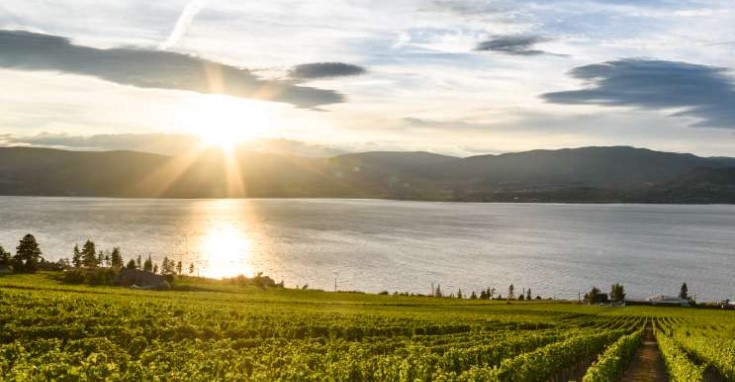
2021 presented lots of challenges for British Columbia’s vintners. The spring was one of the driest on record with very little rain from late May to the end of June. Temperatures in June climbed up to 47 degrees Celsius. The combination of these things resulted in the grapes maturing faster and earlier than normal. The grape yields were low but the quality was good, producing small, very ripe fruit bursting with flavour. It is hoped that this high concentration of flavour will translate into an excellent, though a low yield vintage.
Photo credit: TourismKelowna.com
The wild fires also wreaked havoc on the harvest in some areas, particularly the Thompson and Okanagan Valleys. Fortunately, the worst of the smoke exposure occurred before the grapes began to ripen so the impact is believed to be minimal.
The recent flooding in B.C. has affected all residents either directly or indirectly. With major transportation routes being blocked or damaged, supply chains and mobility have been severely restricted. At this point it is still too early to know what additional burden will be felt by B.C.’s wine industry as a whole because of the flooding.
This year was without a doubt a season with its challenges because of the smoke, heat and floods. However, early indications suggest that the 2021 vintage of British Columbia wines will be very flavourful. Unfortunately for consumers the prices will most likely be higher due to the smaller than normal yields produced. These are some things to keep in mind when the 2021 B. C. vintages begin hitting the store shelves in a year or two.
Ontario had 79 wineries enter this year’s National Wine Awards competition, second only to B.C. With such a strong field of competitors, earning a position in the top 10 is truly an accomplishment.
The wines were presented to the judges without displaying the producer, origin or price. The wines were identified and organized by grape variety or style. The top medalists were tasted in multiple rounds by many different judges.
All ten wineries were from the Niagara region. There were no winners from Prince Edward County, the North Shore of Lake Erie, Norfolk County, Georgian Bay, Huron Shores or the Toronto Wine Region.
The wineries identified in green periodically have their wines available for sale in local liquor stores. The award winning wines identified in blue are available in Ontario through the LCBO.
1. Malivoire Wine Company, Beamsville, ON (1st overall)
Malivoire Wine Company is the National Wine Awards Winery of the Year as a result of their earning 3 Platinum, 1 Gold, 8 Silver and 5 Bronze medals. This was the first year that a winery has received 3 Platinum medals. Malivoire’s wines may be purchased from their website at www.malivoire.com.
Platinum Medal Winners
2020 Le Coeur Gamay – Category: Gamay – $27.95
N/V Bisous Rose – Category: Sparkling Pink – $29.95
2020 Analog Demo Series – Category: Red Blend – $27.95
Gold Medal Winner
2020 Small Lot Chardonnay – Category: Chardonnay – $19.95
N/V Che Bello, Ontario – Category: Sparkling Wine – 17.95
2020 Ladybug Rosé – Category: Rosé – $16.95
2020 Vivant Rosé – Category: Rosé – $19.95
2. Trius Winery, Niagara-on-the-Lake, ON (4th overall)
Trius Winery was awarded 2 Platinum, 1 Gold, 7 Silver and 5 Bronze medals at this year’s event. Their wines may be purchased from their website at www.triuswines.com.
Platinum Medal Winners
2019 Showcase Late Harvest Vidal – Category: Late Harvest – $29.95
Brut Rose – Category: Sparkling Pink – $29.95
Gold Medal Winner
2019 Showcase Riesling Ghost Creek – Category: Riesling – $29.75
3. Peller Estates, Niagara-on-the-Lake, ON (5th overall)
Peller Estates received 2 Platinum, 2 Gold, 5 Silver and 3 Bronze medals at this year’s awards. Their wines are available at retailers across Canada, as well as from their website at www.peller.com.
Platinum Medal Winners
2019 Private Reserve Cabernet Franc – Category: Cabernet Franc – $23.75
2019 Signature Series Riesling – Category: Riesling – $29.95
Gold Medal Winners
2018 Andrew Peller Cabernet Franc Icewine – Category: Icewine – $108.90
2019 Winemaker’s Blend Red – Category: Red Blend – $24.95
2019 Small Lot Riesling Triangle Vineyard – Category: Riesling – $29.75
2018 Effervescent Riesling – Category: Sparkling White – $38.95
5. 13th Street Winery, St. Catharines, ON (15th overall)
13th Street was awarded 1 Platinum, 1 Gold, 5 Silver and 14 Bronze medals. Their wines are available at retailers in Ontario, as well as from their website at www.13thstreetwinery.com.
Platinum Medal Winner
2015 Premier Cuvee – Category: Sparkling White – $39.95
Gold Medal Winner
2020 Cabernet Franc June’s Vineyard – Category: Cabernet Franc – $24.95
Silver Medal Winners
2013 Grande Cuvee Blanc de Noir – Category: Sparkling White – $59.95
2019 Gamay – Category: Gamay – $19.95
2019 Blanc de Blanc – Category: Sparkling White – $29.95
7. Fielding Estate Winery, Beamsville, ON (22nd overall)
Fielding achieved 3 Gold, 5 Silver and 12 Bronze medals this year. Their wines are available at retailers across Ontario, as well as from their website at www.fieldingwines.com.
Gold Medal Winners
2018 Estate Bottled Cabernet Franc – Category: Cabernet Franc – $39.95
2019 Cabernet-Syrah – Category: Red Blend – $29.95
N/V Sparkling Brut – Category: Sparkling White – $37.15
Tawse received 2 Gold, 12 Silver and 7 Bronze medals at this year’s awards. Their wines are available from their website www.tawsewinery.ca and from retailers across Ontario.
This year was the twentieth anniversary of the WineAlign National Wine Awards of Canada (NWAC). The country’s largest competition of Canadian wines is usually held in June each year but this year the event was moved to October due to COVID-19 and took place in Penticton, British Columbia. The final results were not released until November 12th.
The judges’ panel consisted of 14 men and 12 women who tasted 2,075 wines from more than 260 wineries.
This year’s Winery of the Year is Niagara’s Malivoire Wine Company. Malivoire earned 17 medals at this year’s Nationals, including 3 Platinum, 1 Gold, 8 Silver and 5 Bronze.
It is the first time in NWAC history that a single winery has won three Platinum Medals at the Nationals. Equally incredible is that the medals were won in three different wine categories.
The NWAC top 10 wineries for 2021 are listed below, including their Platinum and Gold winning wines. The lion’s share of this year’s awards went to British Columbia.
In order to be considered for inclusion on the list, the winery must enter a minimum of five wines. The five top-scoring entries (not including Icewine) from each winery are used to determine the order.
Malivoire Wine Company, whose awards included 3 Platinum, 1 Gold, 8 Silver and 5 Bronze. The winning Platinum and Gold wines included:2020 Le Coeur Gamay (Platinum Award)
No Vintage (N/V) Bisous Rose (Platinum Award)
2020 Analog Demo Series (Platinum Award)
2020 Small Lot Chardonnay (Gold Award)
B.C.’s La Frenz Estate Winery was awarded Best Performing Small Winery of the Year. They earned 2 Platinum, 6 Gold and 5 Silver awards. The Platinum and Gold award winning wines included:
Over 800 of B.C.’s finest wines from more than 120 B.C. wineries were judged by a panel of 15 judges at the 2021 B.C. Lieutenant Governor Wine Awards. The results were released earlier this month.
The top honour went to the Tantalus Vineyards’ 2018 Old Vines Riesling. The wine was produced from Riesling grape vines first planted in 1978. The vineyards and winery are situated on the eastern shores of Lake Okanagan overlooking the lake and the City of Kelowna.
CedarCreek Estate Winery, 2019 Platinum Cabernet Franc
Church & State Wines, 2019 Marsanne
Church & State Wines, 2019 Trebella
Unfortunately from what I can tell, none of this year’s winners are presently available outside of British Columbia. I have indicated in green those wineries that do have products that are occasionally found east of the Rockies. Even though the winners may never travel beyond B.C., other wines from these vineyards would be well worth trying.
July 13th saw the beginning of torrential rains that resulted in devastating flooding in parts of Germany, Belgium and the Netherlands. The rivers were unable to withstand the volume of rain which resulted in rivers overrunning their banks, flooding some towns and villages. Some wine regions in northwestern Germany suffered extensive damage, with the full impact still to be determined. Even vintners in regions less impacted by the flooding have to contend with water in their cellars and mildew on grapevines.
Photo credit: TheTimes.co.uk
According to meteorologists, some parts of Germany received the equivalent of two months of rain in a 24 hour timeframe. Parts of the Rhine and its tributaries in Germany and the Meuse River in Belgium and Holland quickly overflowed their banks. The Ahr Valley, a Rhine tributary, was particularly ravaged. The steep slopes on both sides of the river contain Spätburgunder (Pinot Noir) vines, which are some of Germany’s best. The Germany’s Mosel region also experienced flooding that was compared to a tsunami. It came quickly and totally surprised everyone.
To date there have been upwards of 300 deaths attributed to the flooding with many more people still missing. Wineries in the region have all but been destroyed. All that remains in many cases are the bare walls of the structures. Furniture, cars, tanks, presses, tractors and other equipment are all lost.
With the equipment gone, the vintners will need a great deal of manual labour to maintain the vines for the balance of this season and then to harvest the grape crop. Then once it is harvested they will need to determine how they will press the grapes and ferment the juice.
Teams from the unaffected areas are organizing to help the grape growers in the devastated areas. The Verband Deutscher Prädikatsund Qualitätsweingüter (VDP), Germany’s association of top-quality wine, is organizing charity events. A wine festival is taking place this weekend where all of the proceeds will go to relief efforts.
It is worth making a mental note that when the 2021 vintage of German wines reach the shelves in a couple of years, the quantity will be less and the price will be relatively higher than in previous years. This will be due to the reduced supply and increased costs in getting these wines to market. There may also be some spoilage do to mold.
My thoughts are with everyone affected by this devastating situation.
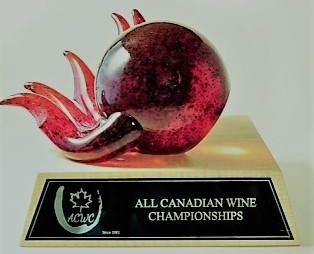
With COVID seeming to be lessening its grip, life as we used to know it is once again beginning to slowly return. Part of that are the various wine competitions. The 40th edition of the All Canadian Wine Championships was held from July 6th to 8th. In total, 208 wineries submitted 1,327 wines to assess.
Assessments and awards were based as follows:
Trophies : “All Canadian Best Wines of the Year”
All wines are judged using the 100-point system. Trophies are awarded for each of the following categories:
Best Red table wine
Best White table wine
Best Dessert wine
Best Sparkling wine
Best Fruit wine
The award for Best Red Wine of the Year went to BC’s Dark Horse Vineyard for their 2016 Red Meritage ($60.00).
The Best White Wine of the Year was the 2020 Gewürztraminer ($20.69) from BC’s Wild Goose Vineyards and Winery.
The Best Dessert Wine of the Year went to Ontario’s Peller Estates Winery for their 2019 Andrew Peller Signature Series Riesling Icewine ($89.85).
BC’s Forbidden Fruit Winery won the Best Fruit Wine of the Year award for their 2020 Flaunt Organic Sparkling Plum ($22.00).
Finally the Best Sparkling Wine of the Year award went to BC’s Gray Monk Estate Winery for their 2018 Odyssey Rose Brut ($29.90).
Double Gold medals / Best of Category were awarded to the single highest rated wine (using an average of the aggregate judges’ scores) from each of the categories. These wines were all submitted for the Trophy round.
Medals of Merit: Gold, Silver, Bronze were awarded in the following manner:
Gold awards were awarded to those wines scoring in the top 10 percentile.
Silver awards of merit were issued to those wines scoring in the second 10 percentile.
Bronze awards of merit were given to those wines scoring in the third 10 percentile.
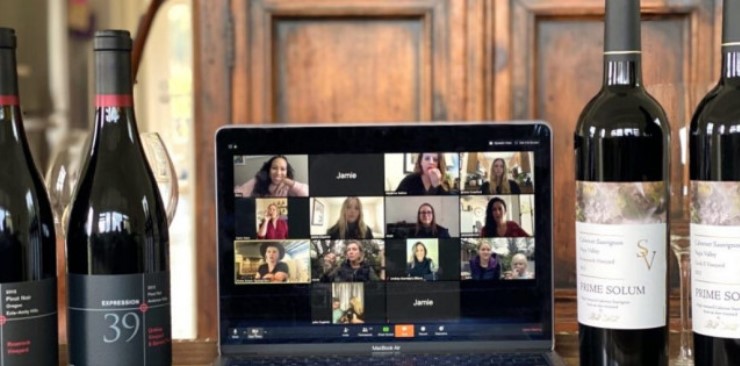
The times are changing in part due to changes in technology and in part due to COVID-19. A lot of gatherings and meetings will work well using Zoom, Google Meets or another online meeting facility. The wine industry has been forced to find alternatives to hosting in-person events and wine tastings and even award ceremonies have to now follow this practice.
In order to participate in a wine tasting each attendee should be prepared to do some work ahead of the virtual gathering. Attendees will need to obtain the list of wines to be sampled and then purchase a bottle of each of the wines. Obtaining these wines may prove to be a challenge given that they may not be readily available from the local wine store. Some may need to be obtained directly from the winery and if the winery is not located in the same vicinity as you, you will have to order the wines a couple of weeks ahead of the event.
In attending a tasting without having access to the wines to sample, you have to solely rely on the host’s verbal description. I think the value of the information would be lost without the opportunity to sample the wine yourself. I think it would be about as enticing as watching paint dry.
But if you have the wines being tasted, given that tastings involve only a small sampling of each wine, you will be left with a significant portion of each of the wines that you will then need to try and preserve until they can be consumed.
The same challenges are faced by anyone attending a wine award ceremony who wants to taste any of the wines eligible for or that received a reward.
Making the most of the current environment, there are now companies and wineries that will sell you a wine tasting kit. These kits consist of a bottle of each wine to be tasted, reviewer’s notes on each wine, and a link to a video of the expert conducting the actual wine tasting. This gives you the opportunity to invite your friends over (assuming there isn’t a lockdown) for a private wine tasting event hosted by a wine expert. In some cases you can arrange for a “live” tasting using a remote meeting site like Zoom.
Without a doubt some events and activities are best attended in person rather than virtually. However given these strange times that we live in, virtual events are probably better than no events.
This is traditionally the time when people reflect back over the year that was and reminisce over the happy and sad times of the past twelve months. Unfortunately this year there wasn’t a lot of opportunity for happy times. The main and some would say, only event of 2020 was COVID-19. It has disrupted life as we knew it.
With the production of this last year’s wine supply still in progress, the situation heavily impacts the existing product stocks of the winemakers looking to sell the wine reserves of 2018. However, due to the measures applied in the spring by most countries, the biggest wine producing countries – Italy, France, Spain and the US – have seen sales decline steadily.
Mid-spring to early autumn is when wineries here in Canada do most of their business. However, with wine tours, tastings and exploration being limited or completely on hold for the foreseeable future, the number of visitors to wineries was drastically reduced along with associated wine sales. The sale of other merchandise, such as food and clothing, was also negatively impacted. Some wineries closed entirely because of the virus.
The Demand for Champagne
Sales of champagne, one of France’s most iconic products, have tumbled over the past year with industry representatives estimating that some 100 million bottles will be left unsold. Lower demand due to the pandemic has led to an exceptionally low harvest quota in France’s Champagne region, with pickers in the vineyards harvesting one-fifth less than last year.
With many cafes, hotels and restaurants being closed at various times, and weddings and music festivals being called off, people consumed less champagne. However, lower demand will not necessarily lead to lower prices.
Australian Wild Fires
Wild fires wreaked havoc from late 2019 until the early part of this year in Australia. The Adelaide Hills wine region was the hardest hit, destroying 30% of its production. The Cudlee Creek fire affected more than 60 growers and producers in the region.
The financial blow to the Adelaide Hills wine industry was significant. The region lost $20 million worth of wine, which translates to 794,000 cases.
The Wild Fires on the U.S. West Coast
Wineries were already facing great financial strains due to the reduction in restaurant traffic and smaller crowds visiting vineyards for tastings. Many tasting rooms were closed due to fire and smoke risks, while many grapes have been damaged or totally ruined.
Oregon, Washington and California together produce about 90% of all U.S. wine. The true impact on the $70 billion industry will not be known for months as crop damage can vary greatly from region to region. Smoke blanketed much of the U.S. West as fires charred in excess of 2 million hectares.
Canadian Wine Awards
The judging of the 20th Anniversary Edition of the National Wine Awards of Canada has been postponed indefinitely due to the COVID-19 pandemic. The sessions were to be held the week of June 24 to 28 in Penticton, British Columbia. The hope is that the competition can resume in 2021.
The 2020 COVID-19 version of the Ontario Wine awards finally took place on August 28th. A small group gathered at Kew Vineyard, in Beamsville, Ontario as the awards were presented in front of a small, socially-distanced gathering. Unlike previous years there were no judges and no formal tastings for the four main awards. Instead the Awards Committee reached out to judges who had participated in the last three years of the competition and asked them to nominate their top three white, red and sparkling wines they had tasted during the year. Based on those responses the top scoring wines were tabulated.
Onward and Upward
Now that the COVID-19 vaccine is starting to be administered hopefully everyone who wants it will be able to have it within next few months. Then we can begin the journey toward a world that is better than what we are experiencing today. In the meantime stay safe and though it may be much quieter than usual, have the happiest New Year that these times will permit.
I have been asked on more than one occasion the meaning of the phrase Sláinte mhaith which appears at the end of each of my posts. These are the words of an Irish toast which are pronounced ‘slawncha va’. It means ‘good health’. It is often shortened to just Sláinte. If you have ever experienced a true Irish pub, in all likelihood you will have witnessed the raising of a glass and Sláinte given as a toast.
A toast is a ritual in which a drink is taken as an expression of honour or goodwill. As legend has it the custom of touching glasses came from concerns about poisoning. By one account, clinking glasses together would cause each drink to spill over into the other glasses. Another theory is that the word toast became associated with the 17th century custom of flavouring drinks with spiced toast.
The International Handbook on Alcohol and Culture says toasting “is probably a secular vestige of ancient sacrificial libations in which a sacred liquid was offered to the gods: blood or wine in exchange for a wish, a prayer summarized in the words ‘long life!’ or ‘to your health!'”
Toasting has deep roots in Western culture, with some anthropologists suggesting that it goes back to ancient religious rites. While a toast is generally positive — good health and good luck are common — the act carries certain negative superstitions in at least three European countries. Making eye contact while toasting is considered polite in many countries and the penalties for failing to do so can be severe. French and German superstition suggests that you’ll suffer through seven years of ‘bad sex’ if you don’t maintain eye contact during a toast. Many Spanish believe that the same curse will befall those who toast with glasses of water. Toasting with an empty glass may be viewed by some as acceptable behavior for the non-drinker though pretending to drink from an empty glass seems ridiculous. I am not sure how the people who think toasting with water is not acceptable feel about toasting with an empty glass. However, in many countries toasting with an empty glass is preferable to refusing a toast altogether.
Irrelevant of which theory is true, toasting traditionally involves alcoholic beverages. Sparkling wine, often Champagne, is considered festive and is widely associated with New Year’s Eve and other celebrations. Many people nowadays substitute sparkling fruit juice (often packaged in champagne-style bottles).
The words used during a toast vary from country to country, though the meaning is very similar. The Scots of the western half of Scotland, in Scottish Gaelic, say ‘dheagh shlàinte, (pronounced like ‘do slawncha’). This is often responded with ‘slàinte agad-sa”, which literally means “health at yourself”. Scots, like the English, and now Canadians and Americans, often now use the word ‘cheers’.
In Hebrew, it is’ L’chayim’; in French it is ‘À votre santé’; the Germans often say ‘Prost’ (rhymes with toast); in Spanish it is ‘Salud’; in Portuguese it is ‘Saude’; and the Italians say ‘Salute’.
So if a toast is offered up this year at a holiday gathering (no matter how small that gathering may be) now you have some insight as to how the tradition may have began.