Rhine River Cruise

My wife and I recently returned from a Rhine River cruise where we had the opportunity to sample wines from Switzerland, France and Germany during our travels. I was most anxious to try some Swiss wines as I had never had the opportunity of tasting any. These wines are not often available outside of Switzerland (see The Wines of Switzerland from May 1, 2021). 
The first Swiss wine we tried was a 2022 Weinbau Ottiger Pinot Noir. The wine is very similar in character to a French Pinot Noir.  The second sampling was a red blend from Château Constellation sa 1950 Sion, called “Humagne Rouge”.  It has a spicy bouquet characterized by notes of pine and cinnamon. It has accents of black fruit aromas balanced by silky tannins. It was very enjoyable.

We ventured through Strasbourg, France and the Alsace wine region. World-renowned for its viticulture, Alsace has a dry mild climate, favourable soils and ideal exposure to the sun for its vineyards. The white wines produced here rival the Rieslings created in neighbouring Germany.

While in Breisach, Germany, the tour offered a wine tasting at Domaine Albert Seltz, Alsatian Vineyards.  There they follow a rigorous process to preserve the authenticity of their wines, respecting traditional techniques while integrating the most recent advances in technology. Sustainable viticultural practices are followed that promote biodiversity and respect for nature.

The area surrounding Breisach, the capital of Alsatian wines, has the third largest wine co-op in the world, following California and South Africa. Twelve million litres of wine are produced there each year, taking advantage of being the sunniest place in all of Germany.

We also visited Rüdesheim, which is a German winemaking town in the Rhine Gorge, and part of the UNESCO World Heritage Site. It is in the heart of the Rheingau wine region.

Close to Speyer, Germany lies the Roter Hang wine area.  It is considered to be one of the most important vineyard sites in the world, sitting to the south of Mainz, not far from Nierstein and Nackenheim. The soil is red, the result of red slate that exists throughout the region, providing the perfect conditions for outstanding wines that are characterised by unmistakeable flavour.

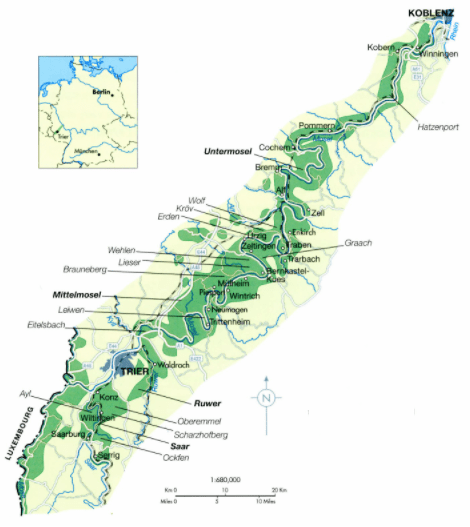
Further north at the intersection of the Rhine and Moselle Rivers is the town of Koblenz.  Koblenz is a principal seat of the Mosel and Rhenish wine trade. Mosel is best known for growing some of the finest Riesling grapes in the world. 

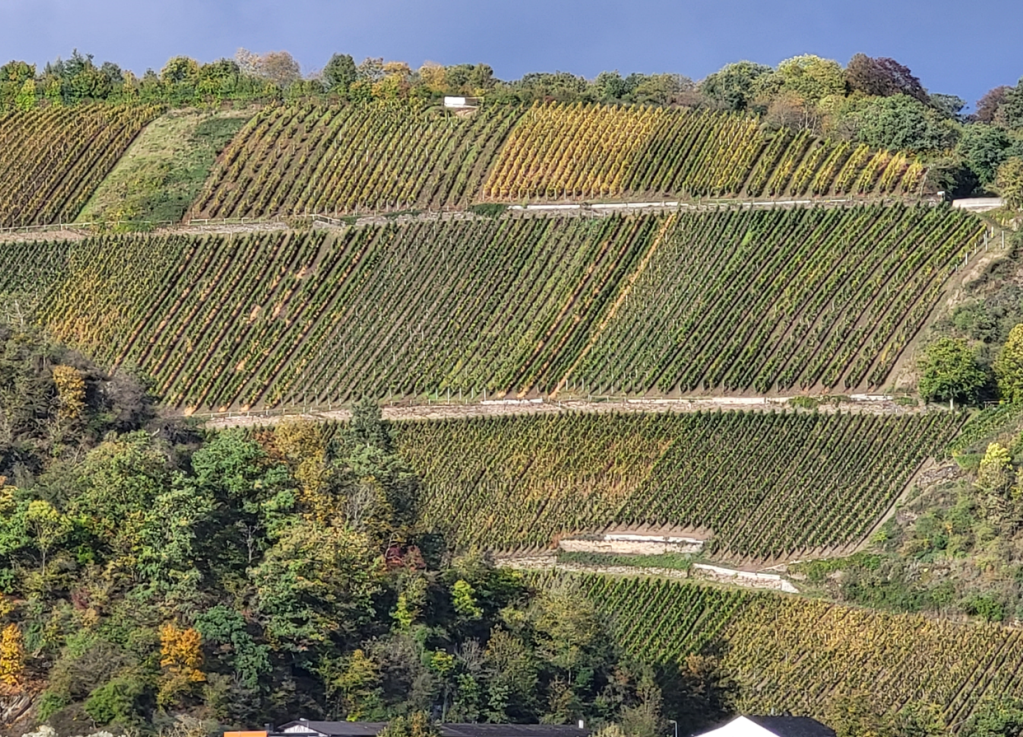
The vineyards are found tiered along the hillsides of the Moselle River. The steepest vineyard slopes in all of Europe are found here. Some of the grape vines are planted in vertical rows while others are in horizontal rows. The grapes planted vertically are machine groomed vines while those planted horizontally are generally on the steepest slopes and are maintained totally by manual labour.

Along the Moselle River in Winningen we visited the Weingut Rüdiger Kröber winery where we sampled four different Riesling wines ranging from dry to sweet; the 2022 “Kröber Weingut Steinig Riesling” dry, the 2022 “Kröber Weingut Uhlen Laubach” dry, the 2022 “Kröber Weingut Winninger Brückstück Riesling Feinherb” semi dry and the 2021 “Kröber Weingut Winninger Röttgen Kahimer Riesling Alte Reben” sweet. I found the Uhlen Laubach to be my favourite as it was robust with character and full of flavour.

The winery’s vineyards are up to 28 terraces in height along the slope of the hills. Weingut Rüdiger Kröber grows 90% Riesling, 5% Pinot Blanc and 5% Pinot Noir varietals. The vines range from 50 to 80 years in age.  The winery produces 60,000 bottles of wine per year and like many of the wineries in the region, it is all sold locally to individuals and restaurants.

Now that we have returned home from the Rhine, my wife and I are in the midst of planning our next wine excursion, which will be along the Rhone River in France during the spring of 2024.

Sláinte mhaith

Crus in Germany and Italy

Back on March 18, 2023, I talked about France’s use of the term cru for identifying wines. In France the label is used to identify geographic terrain, specifically the soil type, climate and altitude where the grapes are grown.  The term cru is also used in Germany and Italy but there are additional variations in how the name is applied, as well as its meaning.

In Germany, the Verband Deutscher Prädikatsweingüter (VDP), an association of elite German wine estates, has its own vineyard classification system, similar to the one used in Burgundy, France. In Germany the top tier is VDP.Grosse Lage (grand cru). This is followed by VDP.Erste Lage (premier cru), then by VDP.Ortswein (village) and finally VDP.Gutswein (regional).

In Italy, cru is used in several regions, but the application between regions is not exactly the same. Piedmont and Sicily are probably the best known regions using it. In Piedmont, Barolo and Barbaresco have mapped out their grand crus by geographic area, and those vineyard explanations are part of the bylaws of their Denominazione di Origine Controllata e Garantita (DOCGs).

Wine producers in Sicily’s Etna DOC are identifying crus that follow old lava flows and the soil and elevation changes along Mount Etna. At this point there is no formal classification system but it is anticipated to be ratified in the future.

So, if there is one thing that can be concluded regarding the use of the term cru in the labeling and description of wine, it’s that there is no consistency in its use within a country let alone between nations.

Sláinte mhaith

The European Floods

July 13th saw the beginning of torrential rains that resulted in devastating flooding in parts of Germany, Belgium and the Netherlands. The rivers were unable to withstand the volume of rain which resulted in rivers overrunning their banks, flooding some towns and villages. Some wine regions in northwestern Germany suffered extensive damage, with the full impact still to be determined. Even vintners in regions less impacted by the flooding have to contend with water in their cellars and mildew on grapevines.

Photo credit: TheTimes.co.uk

According to meteorologists, some parts of Germany received the equivalent of two months of rain in a 24 hour timeframe. Parts of the Rhine and its tributaries in Germany and the Meuse River in Belgium and Holland quickly overflowed their banks. The Ahr Valley, a Rhine tributary, was particularly ravaged. The steep slopes on both sides of the river contain Spätburgunder (Pinot Noir) vines, which are some of Germany’s best.  The Germany’s Mosel region also experienced flooding that was compared to a tsunami. It came quickly and totally surprised everyone.

To date there have been upwards of 300 deaths attributed to the flooding with many more people still missing.  Wineries in the region have all but been destroyed. All that remains in many cases are the bare walls of the structures.  Furniture, cars, tanks, presses, tractors and other equipment are all lost.

With the equipment gone, the vintners will need a great deal of manual labour to maintain the vines for the balance of this season and then to harvest the grape crop. Then once it is harvested they will need to determine how they will press the grapes and ferment the juice.

Teams from the unaffected areas are organizing to help the grape growers in the devastated areas. The Verband Deutscher Prädikatsund Qualitätsweingüter (VDP), Germany’s association of top-quality wine, is organizing charity events. A wine festival is taking place this weekend where all of the proceeds will go to relief efforts. 

It is worth making a mental note that when the 2021 vintage of German wines reach the shelves in a couple of years, the quantity will be less and the price will be relatively higher than in previous years. This will be due to the reduced supply and increased costs in getting these wines to market. There may also be some spoilage do to mold.

My thoughts are with everyone affected by this devastating situation.

Sláinte mhaith

The Wines of Mosel Germany

The Mosel (aka Moselle) River begins in France and flows into Germany where it flows 250 km and disperses into the Rhine River. It is along this winding river gorge that most classic Riesling wines in the world are situated.

So what makes the Mosel Valley so special for this wine and grape? It’s a combination of geology, geography and history (Riesling was first recorded in Germany in 1435) that makes the Mosel wine region unique.

Although over 60% of the grapes grown are Riesling, Elbling; Pinot Blanc, Pinot Gris, Kerner and Auxerrois are also grown. There are some Pinot Noir and Chardonnay in the region as well, often used in Sekt–German sparkling wine.

Mosel Riesling ranges from bone-dry to sweet.  The wines start out with a pale straw color and become deep yellow as they age.

Young wines have medium-intensity aromas of lime and honeydew, sometimes with slightly reductive smells of plastic or mineral notes. As the wines age, they reveal high intensity aromas of honey, apricot, lemon and petroleum. The smell of gas might be off-putting to some but it is a classic indicator of German Riesling.

Riesling has intensely high acidity, usually balanced with some level of sweetness. Wines that taste bone-dry will usually have around 6 to 10 grams per litre of residual sugar and wines that taste barely off-dry may have as much as 30 to 40 grams per litre of residual sugar. Generally, Mosel wines have low to medium low alcohol ranging from 7.5 to 11.5%  alcohol per volume.

German Riesling is known to age well. A wine by a quality producer from a great vintage will last up to 40 years. Even modestly priced wines can age for 5 years and develop a deep golden hue with aromatics of honey and petroleum.

The first level for identifying quality in Mosel’s wine is classification, of which there are 3: Qualitatswein (QbA), Pradikatswein, and VDP.  These are explained in detail in my August 11, 2019 post “Germany’s Quality Standards”.

The second level to finding great quality in the Mosel is understanding the variations from one vintage to the next. Cool climate wine growing regions, which the Mosel Valley is one, tend to be more susceptible to variable weather conditions. It’s possible that great producers will still make great wines in less favorable years, but the vast majority often suffer.

As a general rule, great vintages offer amazing wines at all price points, whereas less-awesome vintages require some buying finesse and a little bit of luck.  Here is a quick rundown of what the experts said about the past decade of releases:

Legend

  • 10: Purchase without hesitation with great cellaring capabilities.
  • 9: Purchase without hesitation as wines are very enjoyable.
  • 8: Purchase as wine is drinkable but not very noteworthy.
  • 7: Only the best producers made decent wine that year.

Vintage

2018 – 10 – Largest yield in the past decade; expecting to be of outstanding quality.

2017 – 8 – Difficult growing season.

2016 – 7 – Tough vintage. Lots of rain and insect problems.

2015 – 10 – A fantastic year.

2014 – 9 – A cooler vintage overall, leading to wines with more acidity. These wines may age quite well.

2013 – 8 – Great producers did well but others didn’t because of rain and rot problems.

2012 – 7 – Inconsistent grape bunch development meant only the best producers made out.

2011 – 9 – A great vintage; the wines have awesome structure and depth.

2010 – 8 – A challenging vintage for ripeness but some producers expect these wines will last for decades.

2009 – 9 – A long warm vintage that produced rich wines.

2008 – 9 – Great producers produced age-worthy wines.

Finding Great Mosel Wines by Sub-Region

The third layer of finding great quality Mosel wines is understanding the geography of the region. Not all of the vineyards here are created equal. The northerly latitude means longer days during the growing season, but only certain vineyards are situated to receive these sunshine hours.

Areas that face south receive up to 10 times more sunlight during parts of the year than those facing north. Also, vineyards located on slopes receive even more sun than the flat lands. 40% of the vineyard acres in the Mosel are located on steep slopes and the best vineyards typically face south.

The steepness of the vineyards makes the use of tractors or mechanical harvesting impossible; farming and harvesting on steep slopes requires as much as three times more labour than more level vineyards.

The 6 sub-regions of Mosel all offer different expressions of Riesling. While the most planted sub-region of Bernkastel attracts the most attention, other regions, including Saar and Ruwertal, make great wines as well.

Final Thought

Riesling is definitely the most renowned varietal in the Mosel.  There is no true comparison to these wines anywhere else in the world.  If you enjoy Riesling and have never experienced any from the Mosel, then you owe it to yourself to experience it.  I don’t think you will be disappointed.

Sláinte mhaith

Germany’s Quality Standard

Germany’s wine governing body is the Association of German Quality and Prädikat Wine Estates known as Verband Deutscher Prädikats- und Qualitätsweinguter (VDP).  This is an association of about 200 top German wineries. Membership is voluntary but requires adherence to strict standards well above those required by German wine law.

Since 1910, the VDP and its black eagle logo have been an important, although unofficial, symbol of German wine quality. The association has created its own wine quality system based on the vineyard classification terms ‘Grosse Lage’ and ‘Erste Lage’ (similar to France’s Grand Cru and Premier Cru).

Grosse Lage is used only for Germany’s very best vineyard sites – small, carefully demarcated areas with clear site-specific characteristics. Yields on these sites are limited to 50 hectoliters per hectare, which generally equates to about 8,000 kilograms of grapes per hectare, if that is any help giving you a visual.

Grosse Lage vineyards produce Grosses Gewächs (a dry wine). A Grosses Gewächs may be either white or red wine, depending on the vineyard.

Erste Lage identifies first class vineyards with distinctive characteristics, but which rank a little behind Grosse Lage in terms of quality. Yields are limited to 60 hectoliters per hectare.

From a government perspective, German wine is classified into 1 of 4 quality categories: Deutscher Wein, Landwein, Qualitätswein (QbA) and Prädikatswein. The latter is further divided into levels of ripeness: Kabinett, Spätlese, Auslese, Beerenauslese, Eiswein and Trockenbeerenauslese.

  • Kabinett = the lowest level of Prädikatswein.  It is lower in ripeness than Spätlese
  • Spätlese = a white wine made from fully ripe grapes harvested late in the season
  • Auslese = a late harvest white wine  made from grapes that are riper than Spätlese
  • Beerenauslese = made from individually selected grapes that are very ripe. Usually these grapes have been affected by Botrytis cinerea, (noble rot), further concentrating their high sugars. As a result these wines are rare and costly.
  • Eiswein = an icewine/dessert wine produced from grapes that have been frozen while still on the vine.
  • Trockenbeerenauslese = a medium bodied dessert wine with the highest sugar concentration of any German wine ity. Yields

Each of the quality categories is determined by the level of ripeness that the grapes have achieved by the time they are harvested. Generally speaking riper grapes provide more aroma and more flavourful wine. It is interesting to note that ripeness is used as the basis of the quality scale because it is not uncommon for grapes to not fully mature before being harvested.  This is due to the cool climate conditions which can reduce the growing season.

The German wine law identifies Prädikatswein (previously referred to as Qualitätswein mit Prädikat (QmP)), as representing graduating ripeness levels in ascending order: Kabinett, Spätlese, Auslese, BA, and TBA. These wines are all naturally produced with no chaptalization (no sugar is added).   This sounds like a winner to me.

The second category is Qualitätswein (QbA).  These wines must comply with the regional appellation laws and are tested for compliance by an official committee.  The laws ensure that the wine is from one specific wine-growing region, is made of approved grape varieties and reached sufficient ripeness for a quality wine.  Those wines that successfully meet the standard receive an AP-Number.

About three-quarters of all German wine are in this category.  A QbA wine must be made exclusively from grapes grown in one of Germany’s 13 official wine regions, called an Anbaugebiete.

It is interesting to note that the wines in this category are chaptalized (have sugar added to the juice before fermentation to increase the alcohol level after fermentation).  

The third category is Deutscher Wein, which consists of normally ripe and slightly under ripe grapes. This class of wine is primarily consumed in Germany with very little being exported to North America. These wines only have to comply with few restrictions and the wines are not officially tested. They do not have an AP-Number.  This would be the equivalent of France’s Vin De Pays and Europe’s IGP category.

A superior type of Deutscher Wein is Deutshcer Landwein, which has a minimum of 0.5% more alcohol. The wine must come from one of 19 specified wine districts. A Landwein must not contain more than 18 grams of sugar per liter.

From my interpretation I would see only the Qualitätswein (QbA) and Prädikatswein being a worthwhile pursuit in your wine search.  Grosse Lage and Ertse Laga wines would be included in these categories. Personally I am not a fan of incorporating sugars that are not part of the natural fermentation process, so I limit my own search to Prädikatswein grade wines.

Here are some hints that will help you interpret German wine labels.

  • Amtliche Prüfungsnummer (A.P. Nr) = Quality control number, granted after official quality testing
  • Anbaugebiet = One of Germany’s 13 wine regions
  • Bereich = One of Germany’s 39 wine districts, which make up the 13 Anbaugebiete
  • Einzellage = Single vineyard, meaning the grapes used to produce the particular wine came from one vineyard.  This helps to ensure quality control and consistency of the grape content
  • Erste Lage = High quality vineyard, similar to France’s ‘Premier Cru’
  • Goldkapsel = ‘Gold capsule’, indicating a producer’s finest wine
  • Grosslage = Collection of vineyards; the opposite of Einzellage above
  • Grosse Lage = Top-quality vineyard, similar to France’s ‘Grand Cru’
  • Grosses Gewächs = Dry wine from a Grosse Lage vineyard
  • Gutsabfüllung = Estate-bottled wine
  • Halbtrocken = Medium-dry
  • Liebfraumilch = Semi-sweet style, made most often from Muller-Thurgau grapes
  • Oechsle = Unit of must-weight (grape sugar content)
  • Prädikat = ‘distinction’, or ripeness level
  • Rotwein = Red wine
  • Rotling = Rosé wine made from red and white grapes
  • Schillerwein = Rotling-like rosé style from Württemberg (and N.Switzerland)
  • Sekt = Sparkling wine
  • Trocken = Dry
  • VDP Verband Deutscher Prädikats = Qualitätsweinguter, which is described above
  • Weingut = Wine estate
  • Weinkellerei = Winery
  • Weissherbst = Rosé made from a single red-wine grape variety
  • Weisswein = White wine

I have had a number of wonderful German Rieslings and Gewürztraminers over the years and I must admit that I have not paid attention to the quality rating the wine has had.  However, not being a fan of overly sweet wine, I do pay attention to the scale of dryness.  

Sláinte mhaith