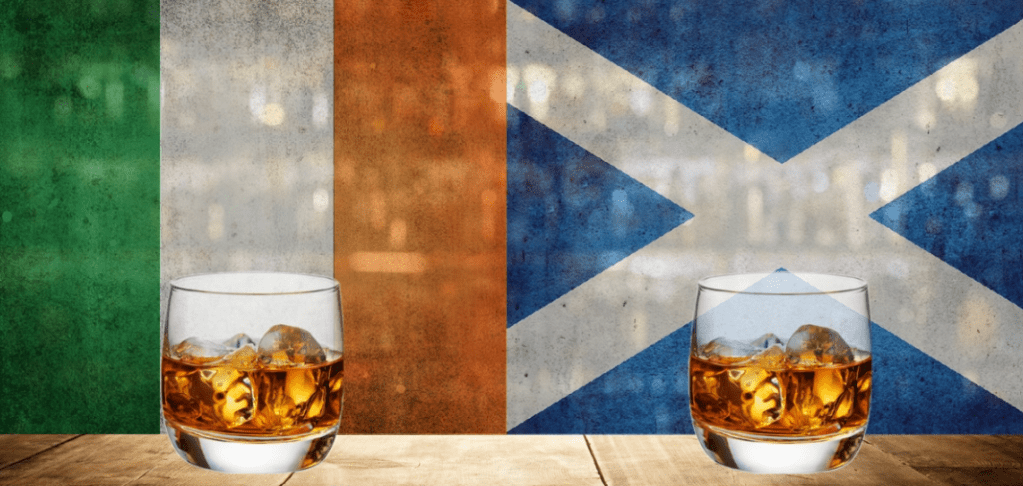
Don’t all types of whiskey pretty much taste the same, especially those ones that are made from the same type of grain? The simple answer is no. Just ask the Irish or the Scots. They will each tell you that theirs is far superior over all others. Irish whiskey and Scotch whisky have common roots but have developed differently over time.
Photo credit: kinnittycastlespirits.com
So, what are the differences between Irish whiskey and Scotch whisky? To begin, Irish whiskey is spelled with an “e” (whiskey), while Scotch whisky is spelled without an “e” (whisky). Whiskey labelled as Irish whiskey must be produced in Ireland and spend a minimum of three years maturing there while whisky labelled as Scotch whisky must be produced in Scotland and spend a minimum of three years maturing there.
Both are created using fermented grain and aged in wooden barrels. However, their distillation process, ingredients and flavour profiles differ. Irish whiskey is often triple-distilled whereas most Scotch whiskies are double-distilled. Thus, Irish whiskey is usually known for a smoother, lighter taste, often having fruitier flavours, while Scotch whisky is typically known for a fuller, heavier, more complex flavour profile with notes of oak, vanilla, fruit, spice and sometimes smokiness. However, as with most things there are exceptions. Occasionally Irish whiskey is only double-distilled and Scotch whisky is triple-distilled.
Irish whiskey may be made from a combination of cereal grains including barley, corn, wheat and rye. Scotch whisky is produced from 100% malted barley. The grain is distilled differently as well. Irish whiskey can mature in wood species other than oak, while Scotch whisky must be matured in oak barrels.
There are four types of Irish whiskey: Single Malt, Single Pot Still, Single Grain and Blended Irish Whiskey. For details on single malt and single pot, see my March 12, 2022 post “The Styles of Irish Whiskey”.
On the other hand, there are five types of Scotch whisky: Single Malt, Single Grain, Blended Malt, Blended Grain and Blended Scotch Whisky. Further information on the types of Scotch can be found in my post “Scotch Whisky Single Malt Vs Blend” dated December 18, 2021.
As you can see, both countries produce single malt, single grain and blends. In Scotland, blended malt and blended grain are separate categories whereas blended Irish Whiskey must be made from two or more different whiskey types.
The biggest difference between Irish whiskey and Scotch whisky is the single pot still classification. This is a style of whiskey that is unique to Ireland and is made from both malted and unmalted barley.
Scotch whisky sales exceed those of Irish whiskey. In 2023, Scotch exports were the equivalent of $10.3 billion CDN while Irish whiskey exports were just more than $1.6 billion CDN. There are currently about 150 whisky distilleries operating in Scotland and around 50 in Ireland.
However, being bigger doesn’t make it better. Scotch can boast more varieties and market exposure but it is up to you decide which one is better. It comes down to personal taste.
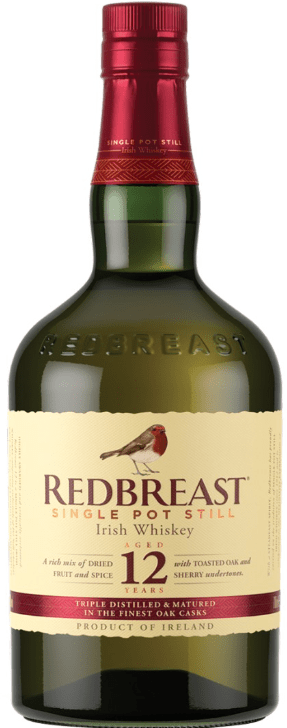
While visiting the Jameson Bow Street Distillery in Dublin, Ireland over a decade ago, I was told that the difference between Jameson whiskey and Redbreast whiskey was that Redbreast was distilled in the traditional way whereas Jameson was made in a more contemporary style. Being a novice at the time, I favoured the less complex flavour of the Jameson’s. It took me several years before I gained a full appreciation for single pot whiskey, which is now my Irish whiskey of choice.
The history of Redbreast goes back to the late 1800s in London, England, where a company by the name of W & A Gilbey began selling wines and distilling spirits. By 1875 they were distilling nearly a million bottles of whiskey a year. After experimenting with many whiskey types and labels, in 1912 the company released the first batch of Redbreast 12.
The political and economic turmoil of the 1980s resulted in a stoppage in production. The whiskey was reintroduced in 1991 by The Midleton Distillery that has been making single pot still Irish whiskey in County Cork, Ireland for over 200 years.
Redbreast is now distilled in top quality sherry and bourbon casks that contribute to the complex flavour of this pot still whiskey. With notes of spice, it has a grainy quality and depth that doesn’t exist in a single malt.
A lot goes into making Redbreast a great whiskey. The mash bill is made of a mix of malted and unmalted barley that is locally grown. The unmalted barley creates a unique creamy mouthfeel and spiciness. Water is sourced directly from the Dungourney River, part of which runs through a system of cooling underground caves. The whiskey is distilled in a copper pot still before being matured in a combination of bourbon seasoned American Oak barrels and Oloroso Sherry seasoned Spanish oak casks.
Being the most modestly priced of the Redbreast line, at $96 CDN, Redbreast 12 has great appeal. This is one of the best buys amongst Irish whiskies.
Its colour is clear gold and has the aroma of dried orange peel and toasted nutmeg. It is complex, fruity and spicy, with a hint of toasted wood notes. It finishes with notes of pepper and grass, with a lingering warmth.
After originally trying Redbreast in my “youth” of whiskey drinking years, and not truly appreciating what it truly had to offer, I have since revisited it and gained a new appreciation of this Irish standard.
Whiskey has been and continues to be, one of the world’s most favourite spirits. It is both a symbol of tradition and an area for continued innovation. From single malts to blended varieties, whiskey’s rich history that dates back several hundred years, is accompanied by a dynamic, evolving market that attracts both connoisseurs and casual drinkers.
Photo credit: nationalgeographic.com
Whiskey’s deep-rooted craftsmanship, with its complex aging processes and diverse production methods, continues to attract consumers. Distilleries are preserving traditional techniques while embarking on new technologies that help to enhance flavour profiles.
While countries like Scotland, Ireland and North America remain as key players in the industry, whiskey’s appeal is expanding globally, with countries such as Japan and India gaining significant recognition for their increased demand and innovative whiskey production.
Globally the demand for premium and supreme whiskeys is on the rise. This shift is pushing brands to offer a variety of variably priced, exclusive, limited-edition releases to attract whiskey enthusiasts, as well as collectors. These offerings range greatly in price from a few hundred dollars to well into the four-to-five-digit range. A few rare whiskeys have sold for prices even beyond that!
During recent years, producers have been experimenting with new barrel finishes; making use of barrels that were formerly used to store other spirits, such as cognac, sherry, bourbon or brandy. Distillers have found that maturing whiskey in these types of barrels will infuse new flavour from the wood of these barrels into the whiskey. Distillers have also experimented with combining multiple flavour infusions.
The popularity of whiskey-based cocktails and the craft cocktail movement is also expanding whiskey’s appeal. The industry is now attracting younger generations and enhancing market versatility.
Whiskey continues to be a beverage of choice for those who appreciate both tradition and innovation, offering endless possibilities for consumers, whiskey enthusiasts and collectors alike.
Ireland, the former whiskey capital of the world which dominated whiskey sales into the early 20th Century, quickly fell from grace due to several reasons. First, people were starting to prefer blended whiskies rather than the traditional single malts and single pot varieties. The Irish, however, chose to ignore this market trend and saw reduced sales as a result. Second, the American Prohibition negatively impacted sales, given that 60% of U.S. whiskey sales came from Ireland. Finally, internal conflict in the 1920s within Ireland itself and the subsequent trade war with Britain a few years later left the Irish Whiskey trade in a dismal state. By the 1970s the number of whiskey distilleries had been reduced to just two – Bushmills and New Midleton, which were both owned by the same company.
Fast forwarding to the period between 1990 and 2010, the Irish Whiskey industry experienced a resurgence, making it the fastest growing liquor industry. Today there are more than 40 distilleries throughout Ireland and more being added; the choices are becoming overwhelming. So today I will take you through a list of what many experts agree are many of the best Irish whiskeys on the market. Included are a couple of my personal favourites.
Before reviewing the list, it’s important to keep in mind that there are four styles of Irish Whiskey: Single Pot Still, Single Malt, Single Grain and Blended. Keep in mind that “Single” in the title refers to a single distillery, it is not a descriptor for the words following after.
SINGLE POT STILL
This was once the most common way to make whiskey but had become almost nonexistent by the end of the 20th Century. There has been somewhat of a resurgence in recent years. The single pot still variety originally came about during the 1700s as a way to avoid taxes imposed on malted barley.
The classification states that the whiskey must be made from a single distillery, distilled in pot stills from a mashbill that contains at least 30% malted barley and 30% unmalted barley, with up to 5% of other cereal grains. Pot still whiskey is noticeably spicier and creamier than other styles.
Recommended single pot style whiskies include:
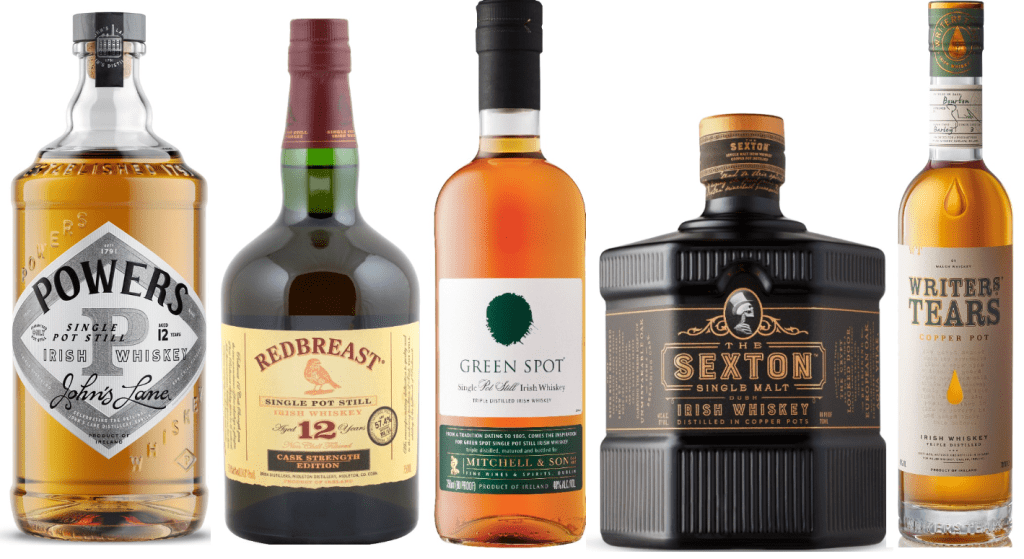
Powers John’s Lane
$76 at LCBO
Because of its 200 year history, Powers has a reputation for being mainstream though it is actually a lesser-known label. It is named after the location of its old distillery, where it held production beginning in the early 1800s until 1975. The whiskey is aged in bourbon barrels and finished in Oloroso sherry casks creating flavours of leather, tobacco, wood, dark chocolate and toffee.
Redbreast 12 Year Old Cask Strength
$120 at LCBO
Redbreast has several popular expressions, but the 12 Year Old Cask Strength is arguably its most popular. At 116 proof, this whiskey provides flavours of oak, buttery pears, cinnamon apple, baking spices, caramel and vanilla.
I have tried Redbreast but I personally have never found it too endearing.
Green Spot
$88 at LCBO
Not appearing on the experts’ list, but one of my own personal favourites is Mitchell and Sons Green Spot. The whiskey has matured in a combination of first and second fill bourbon casks as well as sherry casks. It has flavours of green apples, honey and cinnamon spice. To me this whiskey provides good value for the price.
SINGLE MALT
Single malt Irish whiskey must be made in a single distillery, distilled in pot stills from a mashbill composed entirely of malted barley. Single malt is noticeably smoother than the single pot still style.
Recommended single malt style whiskies include:
The Sexton
$50 at LCBO
Contained within a unique hexagonal bottle, The Sexton single malt has the appearance and taste of a good quality spirit even though it has a very affordable price; the least expensive in this list. Aged for four years in casks previously used for Oloroso sherry, the whiskey has a silky profile of oak, fruit, honeycomb and a hint of spice.
Overall, I like The Sexton although I often favour a whiskey with a little more complexity in flavour. If I am looking for a mindless dram to relax with, this is a good one.
Bushmills 21 Year
$264 at LCBO
Bushmills is the oldest licensed distillery in the world, successfully enduring the near extinction of Irish whiskey in the 1970s as one of two remaining distilleries. The 21 Year single malt is Bushmills’ premier expression, triple distilled and aged for 19 years in either former Oloroso sherry casks or bourbon barrels and then finished for an extra two years in Madeira casks. The result is a big flavour profile of fig, mango, caramel, cherry and apricot, all ending with a sweet finish.
SINGLE GRAIN
Single grain whiskey refers to any whiskey distilled in a column still rather than a pot still. Its mashbill can also be no more than 30% malted barley. The result is something with higher alcohol content, yet is less flavourful. As a result, single grain whiskey is largely used for blended varieties rather than bottled by itself, although there are some exceptions.
Recommended single grain style whiskies include:
Teeling Single Grain
Opening in 2015, Teeling is the first new distillery in Dublin in 125 years. However, Teeling was originally opened in 1782, closing in 1923. The current owners possess the Teeling family name. They put out one of the most versatile ranges of Irish whiskeys, including the rare single grain, which I unfortunately could find no reference to at the LCBO. It is made with a corn-dominant mashbill where it’s then aged in former Cabernet Sauvignon wine barrels creating a profile that ranges from cranberries to butterscotch to the typical sweetness of bourbon whiskey.
Method & Madness Single Grain
Method & Madness is part of the micro-distillery offshoot at New Midleton Distillery. It was launched a few years ago and has an outside the box approach to the aging process. The brand came up with a single grain spirit that’s aged in first-fill bourbon barrels and finished in virgin Spanish oak. The result is a flavourful single grain whiskey with hints of oak, spice and grapefruit. Unfortunately, this whiskey is not available for sale in Ontario.
BLENDED
The driving force behind blended whiskey is that it is a good way to produce the spirit while keeping costs lower. Blended whiskey combines two or more of the previous styles, usually a higher quality liquor with a lower quality one. Most mainstream Irish Whiskeys, such as Jameson and Tullamore Dew, are of the blended variety.
Writers’ Tears
$60 at LCBO
Writers’ Tears is produced by Walsh Whiskey. This blended spirit combines single pot still and single malt varieties. Aged in American bourbon barrels, the whiskey possesses flavours of lemon, honey, black pepper and floral notes.
I have tried Writers’ Tears a few times and have found the flavour to be light and subtle. It is a good choice for anyone new to the whiskey scene.
Jameson Bow Street 18 Year Cask Strength
Jameson, one of Ireland’s most renowned distilleries, put out its rarest release in 2018 and has done so once a year since. The historic Bow Street distillery operated for nearly 200 years until it closed in 1976 and was later turned into a museum, which I have visited. Jameson’s Bow Street 18 Year Cask Strength is claimed to be the king of all blended whiskies, combining both pot still and grain varieties. This expression has flavours of toffee, oak, vanilla and sherry, as well as notes of leather.
This particular Jameson rendition is unfortunately not available in Ontario.
Scotch Whisky can be a difficult drink for us North Americans to get into. When I was younger (how I long for those days) I perceived Scotch being a drink for mature whisky connoisseurs. Where rye and rum were often served as mixed drinks with cola or ginger ale, Scotch was not. If it was mixed with anything it was only water or maybe soda water. Many people like myself interpreted this to mean that Scotch Whisky was not for the faint of heart and you must be prepared for a strong flavoured throat-burning drink.
Another intimidating factor is the hard to pronounce names. With names such as Bruichladdich (Brook laddie), Craigellachie (Craig alecky), Glenmorangie (Glen maw ruhn jee) and Laphroaig (Luh froig), it can be very intimidating to try and pronounce them for fear of stumbling over the names or mispronouncing them entirely.
Though an acquired taste, Scotch is a very simple straightforward drink that is usually served in any of four ways
Neat
With water
With ice
In a cocktail
Neat
Drinking Scotch neat means drinking it with nothing added. To get the most benefit, the Scotch should be served in a whisky snifter at room temperature. A whisky snifter has a large bottom that tapers toward the top like a tulip to trap the whisky aromas in the glass and concentrate them all in one place.
Single malts or blends can be drunk in this manner.
With Water
Adding a splash of water will unleash new whisky flavours while decreasing the intensity of the alcohol. Water chemically suppresses ethanol molecules (alcohol) as well as the flavours extracted from the wood barrels. Water decreases the effects of less desirable, immature aromas.
Cask strength or barrel proof whisky will generally have a higher level of alcohol by volume. In such situations, by adding a couple drops of water, the flavour can be improved and more enjoyable.
Depending on how the whisky was filtered water may give the whisky appear hazy. However, there is nothing wrong with a hazy whisky and it won’t change the drinking experience.
With Ice / On the Rocks
There are those whisky enthusiasts who will scoff at the idea of chilling your Scotch and diluting it with melting ice. However, for those still developing a taste for whisky, ice can be very beneficial. Cooling a dram depresses dominant alcohol flavours and aromas, making the drink more palatable for some. However, it will also lessen some of the flavours that make Scotch taste like Scotch. The increased flavours from adding water are lost as the low temperature nullifies any flavour gains.
If you use ice be sure to use large cubes that will slowly melt and take up the majority of space in the rocks glass. That way you get the chill without diluting it so much that it becomes unrecognizable as Scotch.
In a Cocktail
The classic example of a Scotch Whisky cocktail is the Rob Roy, which is essentially a Manhattan that substitutes Scotch Whisky for Rye Whiskey. The cocktail was invented around 1900 in New York’s Waldorf-Astoria.
According to mixologists, Scotch may be used in place of other whiskeys in cocktails such as the Boulevardier, Old Fashioned, or Mint Julep. Who knew?
At the end of November, The Irish Whiskey Association announced the 2023 Irish Whiskey Awards winners. Now having over 40 distilleries, Ireland has reemerged as a powerhouse in the international whiskey industry and is now the fastest-growing whiskey making country in the world.
Whiskey tastings were conducted throughout Ireland with members of the Irish Whiskey Society. Events took place in Dublin, Dingle, Cork, Waterford, Kilkenny, Ennis, Carlow and Belfast. There was also a select group of international whiskey judges.
The Best Irish Whiskey of the Year prize was awarded to Connacht Irish Whiskey Distillery, Exclusive Cask Strength, Single Malt Irish Whiskey, 47% ABV, 750 ml.
Connacht’s single malt whiskey is a triple-distilled whiskey produced at their distillery in Ballina, County Mayo. The distillery was founded by Master Distiller Robert Cassell in 2016, along with a team of Irish whiskey entrepreneurs who saw the potential of northwest Ireland’s unique climate to produce an iconic Irish whiskey. The region is characterized by dramatic swings in atmospheric pressure that contributes to producing a flavourful, heavily extracted whiskey. The use of custom-designed stills further enhances the unique character of the whiskey.
Other winners included:
Single Pot Still 11 Years and Under
Winner: Drumshanbo Single Pot Still Irish Whiskey Pinot Noir Cask
Gold: Jameson Single Pot Still
Gold: Powers Three Swallows
Single Pot Still 12 Years and Over
Winner: Red Spot 15 Year Old
Gold: Yellow Spot 12 Year Old
Gold: Redbreast 15 Year Old
Single Malt 11 Years and Younger
Winner: Jack Ryan Whiskey 5-Year-Old Oloroso Finish Cask Strength
Gold: Dunville’s 10 Year Old Pedro Ximenez Cask
Gold: The Irishman Legacy
Single Malt 12 – 15 Year Old
Winner: Tullamore DEW 14 Year Old
Gold: Knappogue Castle 12 Year Old
Gold: The Irishman 12 Year Old
Single Malt 16 Years & Older
Winner: The Irishman 17 Year Old
Gold: Dunville’s 21-Year-Old Palo Cortado Cask
Gold: McConnell’s Irish Whisky 20 Year Old Port Finish Single Cask
At the dawn of the twentieth century, Ireland was the hub of the world of whiskey with Bushmills being the oldest licensed whiskey distiller in the world. Jameson was one of the most recognized names and Dublin, the centre of it all having one of every three workers involved in some way with the whiskey industry. At that time about three quarters of the world’s whiskey came from Ireland.
Photo credit: forbes.com
However, the events of history were not kind to the Irish whiskey trade. Two world wars, the Irish War of Independence, Prohibition and the rise of the Scotch Whisky industry all played a part in its demise. By the 1960s the industry was on the verge of extinction with only one percent of the world market share.
By the 1970s there were only two operational distilleries in all of Ireland; Midleton, who produces many well-known Whiskey brands including Midleton, Jameson, Powers, Redbreast, Writers Tears, The Irishman, Green Spot, Yellow Spot, Red Spot, Blue Spot amongst other labels, and Bushmills, who at the time was also then owned by the same company.
For several decades there were no working distilleries in Dublin (Midleton was located in County Cork and Bushmill was in County Antrim, Northern Ireland) but today there is a resurgence throughout Ireland, including Dublin. In 2015 the redevelopment began in Dublin with the launch of Teeling Distillery. Since then there have been others who set up shop including Roe & Co, Pearse Lyons and the Dublin Liberties.
Today the Irish Whiskey industry is healthier than it has been for over 120 years. According to the Irish Whiskey Association, as of December 2019 there were 32 distilleries in operation in Ireland.
If you are planning to visit Ireland here are some of the best distilleries to visit:
DUBLIN
Pearse Lyons Distillery – Founded by the late Pearse Lyons in the Liberties district of Dublin, this boutique distillery is a unique spot to learn about the brewing and distilling processes. It is located in the restored St James’ Church on James St.
Tullamore D.E.W. Distillery – Created in 1829 and later prospering under general manager Daniel E Williams (hence D.E.W. in the name), Tullamore D.E.W is the second largest selling brand of Irish Whiskey globally.
Teeling Whiskey Distillery – The first new distillery in Dublin for 125 years, it is located in Dublin’s historic distilling district.
Roe & Co Distillery – Named after legendary 19th-century whiskey pioneer George Roe, Roe & Co opened their doors in 2019 at the Guinness Power House.
The Dublin Liberties Distillery – Set in the district from which it takes its name, it is a modern, state-of-the-art distillery on Mill St. You can hear the tales of trade, conflict and debauchery about the Liberties district, stretching back hundreds of years to when it was outside of the official Dublin city limits.
Jameson Distillery, Bow St. – Ireland’s most famous whiskey opened in 1780 by John Jameson. The distillery on Bow St in Smithfield has been a staple in Dublin for over two centuries. Although since 1971 it has operated only as a visitors’ centre.
MIDLETON
Jameson Distillery, Midleton – Midleton, in County Cork, is where the bulk of Jameson operations have taken place since 1975.
COUNTY CARLOW
Royal Oak Distillery is the first to distill all three styles of Irish whiskey: pot still, malt and grain, all under one roof. It’s also the largest non-automated distillery in Ireland.
COUNTY CORK
Clonakilty Distillery – Single pot still whiskey is Clonakilty’s specialty. They also will explain how different woods change the character of the whiskey as it matures.
DINGLE PENINSULA
Dingle Distillery – Since 2012, the Dingle Whiskey Distillery has been distilling some excellent single pot still whiskey.
COUNTY KILKENNY
The Ballykeefe Distillery – Though only in operation since 2017, the distillery is situated on land that has a distilling heritage going back hundreds of years. They follow the family farm traditions and have a strong commitment to sustainability.
With records of distilling going back to 1324, it’s claimed that Kilkenny is the birthplace of Irish whiskey.
COUNTY MEATH
Slane Irish Whiskey Distillery – Located 50 minutes outside of Dublin, the distillery is located in in the 250-year-old stables of Slane Castle.
WATERFORD
Waterford Distillery – Distilling since 2015, Waterford Distillery’s state-of-the-art facility is on the banks of the river Suir.
COUNTY WESTMEATH
Kilbeggan Distilling Co. – Established in 1757, it claims to be Ireland’s oldest licenced distillery and after battling through a painful closure in 1953, it was revived by locals in the 1980s who have maintained it ever since.
COUNTY WICKLOW
Powerscourt Distillery – At the foot of the Wicklow Mountains, Powerscourt Distillery is located a short drive south of Dublin. Set in The Old Mill House, the distillery was once at the heart of the local farming community.
COUNTY ANTRIM, NORTHERN IRELAND
The Old Bushmills Distillery – On the wild north coast of Ireland, the Bushmills Distillery has been in operation for over 400 years, making it one of the oldest whiskey distilleries in Ireland. Established in 1608, it claims to be the oldest licensed distillery in the world.



 A Layman's Wine Musings