The first area I explored on my recent trip to France’s Bordeaux region was Médoc, which is situated on the Right Bank. The name Médoc is synonymous with exceptional wines. Considered as one of the world’s leading red wine producers, Médoc has been a winemaking region since the 18th century, with more than 16,000 hectares of vineyards across eight sub-appellations.
In Médoc, which is part of the Saint-Émilion appellation that has over 800 Chateaux, I visited the family-owned winery, Château Fleur Cardinale. The terroir consists of a mix of clay and limestone. Typical of Right Bank wineries, their wines consist of a blend of around 70% Merlot, 20% Cabernet Franc and 10% Cabernet Sauvignon. The blended portions vary slightly from year to year depending on the yield of each grape varietal.
La Maison Cardinale was established in 2001, when Dominique and Florence Decoster acquired Château Fleur Cardinale. In 2017, their son Ludovic and his wife Caroline took the reins of the family estate. In 2024, they created La Maison Cardinale, an entity that brings together Château Fleur Cardinale, a Saint-Émilion Grand Cru Classé, and Château Croix Cardinale, a Saint-Émilion Grand Cru.
They have two estates, Château Fleur Cardinale and Château Croix Cardinale. Château Fleur Cardinale covers 27.6 hectares on the northern slope, producing a Saint-Emilion Grand Cru Classé. The northern slope is also ideal to produce Fleur Cardinale white, in the Bordeaux appellation. Château Croix Cardinale covers 4 hectares on the southern slope, producing a Saint-Emilion Grand Cru.
While there I had the opportunity to sample 2023 “Cardinal Flower Intuition Saint-Emilion Grand Cru” and the 2019 “Grand Cru Classé, Saint-Emilion Grand Cru”. The Intuition had an intense aromatic profile of ripe black fruits. There were subtle tannins and a supple, fresh texture. The Grand Cru Classé had a sensation of fresh and intense fruit, both on the nose and in the mouth. In my opinion it was much smoother and better balanced than the Cardinal Flower Intuition.
The grapes for both wines are picked by hand. There are about 15,000 bottles of Cardinal Flower Intuition produced each year and 105,000 bottles of the Grand Cru Classé. About 80% of the wine is sold to wine agents for export with the balance being sold from the winery. Unfortunately, Château Fleur Cardinale wines do not appear to be available in Ontario liquor stores.
I recently returned from a trip to the Bordeaux region of France where I took advantage of the opportunity to experience some of the finest wines in the world.
The effects of climate change are impacting the grape harvests there the same as they are in many other parts of the world. The region is facing increasing temperatures and drought conditions each year. Not helping matters is the governing regulation that prohibits vineyards to irrigate vines that are more than 3 years old.
To help try and offset the effects of climate change, I saw horses being used in place of tractors to till the weeds that were growing between the rows of grape vines, lessening the need for herbicides and reducing the generation of carbon monoxide.
The Bordeaux region is separated into 2 distinct areas: the Left Bank and the Right Bank. To help identify which is which, the city of Bordeaux is situated on the Left Bank.
Bordeaux’s wine areas are often categorized into five main zones, primarily based on their location in relation to the Gironde, Garonne, and Dordogne rivers. These zones are: The Médoc, Graves and Sauternais, The Libournais, Blaye and Bourg and Entre-Deux-Mers. During our trip I visited wineries on both the Left Bank and Right Bank.
The Left Bank, often referred to as the Médoc and Graves, produces red wines, while the Right Bank, including Saint-Émilion and Pomerol, also focuses on red wines. Entre-Deux-Mers produces both red and white wines, and the Graves and Sauternais are known for their sweet white wines.
There are five Bordeaux wine classifications. These classifications serve as an expression of quality and prestige worldwide. The principle of the crus classés (“classified growths”) illustrates the synthesis of a terroir’s typical characteristics and dedicated human intervention over many generations to ensure quality. However, a wine or appellation can still be outstanding even if it is not a part of these classifications. The classifications are listed in order of seniority:
The 1855 classification
The Graves classification
The Saint-Émilion classification
The Crus Bourgeois du Médoc classification
The Crus Artisans classification
For a winery in Bordeaux to be referred to as a Château, the property must include a large house, vineyards and a place to make wine.
The age of the vines impacts the quality of the Bordeaux wine. The older the vine, the more expensive the wine. The roots on old vines extend much deeper and extend further int the soil. This adds minerality to the fruit, which in turn adds complexity to the flavour of the wine.
One thing I found interesting on this trip was how the various winery staff pronounced Cabernet Franc. I was always under the impression that Cabernet Franc was pronounced as the French do, with the ‘c’ in Franc being silent – ka·br·nay frong, but I now found out that it is acceptable to pronounce it in English as ka·br·nay frank.
Over the next few weeks I will describe my adventures through the region, as well as the wineries I had the opportunity to experience.
The Douro Valley is the oldest established wine region in the world, dating back to 1756. It was first renown for its Port production. However, from a tourism perspective, it has only been popular for the past couple of decades, after being declared as a UNESCO World Heritage site in 2001.
Photo credit: portugalbywine.com
The Douro Valley region is no longer just know for its Port, but also for an increasing number of dry red wines often made from the same native grape varieties. A much smaller number of quality white wines are also now produced.
The viticultural zone covers the steep slopes along the banks of the lower ranges of the Douro River. The river flows from northern Spain, where it is called the Duero. The river finally reaches the Atlantic Ocean at Oporto. The vineyards stretch up the steep, dry slopes on either side of the river.
There are three subregions in the Douro, each covering its own section of the river. Of these, the Douro Superior region is the furthest inland. It is covered in terraced vineyards and takes up about 20 percent of available vineyard land in Douro.
The central part of the Douro region, centered around the village of Pinhão, is the Cima Corgo region. It is where most of the prestigious Vintage Port originates from.
Cima Corgo is the largest subregion, accounting for almost half of the valley’s total wine production. The vineyards are steep with the vines nearer the river generally ripening much earlier than those at higher elevations. For this reason, the harvest is often completed in multiple sweeps of the same vineyard.
Nearest Oporto and the coast is the Baixo Corgo subregion. This area is best suited to produce table wines. The area is cooler and wetter than the other regions and more accessible, easily enabling bulk-wine operations to function.
Both the Douro’s still and fortified wines can be made from more than 80 different grape varieties. However, the vineyards are dominated by five key varieties: Touriga Nacional, Touriga Franca, Tinta Barroca, Tinto Cao and Tinta Roriz (Tempranillo). Of these, aromatic Touriga Nacional is the most highly regarded, but Touriga Franca is the most planted.
As recently as twenty years ago, Portugal produced very little quality still wine. However, since then it has become world renowned not only for Port but also for its DOC Douro still wines
There are several international varieties of grapes grown in the Douro valley, particularly to produce table wines. The most common of these are Cabernet Sauvignon, Sauvignon Blanc and Gewürztraminer.
As the end of the year rolls around I think back to the year that was and which wineries left me with an impressionable mark. This is not to suggest that these are the only great wineries in the province; they are merely the ones that caught my attention this year. My list varies in length from year to year as I like to focus on achievements rather than listing a specific number of wineries.
Here is my list for 2024. The wineries are presented in alphabetical order.
Henry of Pelham Family Estate
I was surprised when I checked back to my past lists and found that Henry of Pelham has never appeared until now. It was the top Ontario winery this year at the National Wine Awards.
This six-generation family farm is situated in the Short Hills Bench sub-appellation of the Niagara Peninsula. In 2006, Henry of Pelham was the first vineyard to be certified as local and sustainable by Local Food Plus. They have followed Sustainable Winemaking Ontario’s world-leading standards in their farming practices since 2004. In 2017, they became one of only six Ontario wineries to be certified by the Wine Council of Ontario as following sustainable winemaking practices from vine to table.
This year’s award-winning wines included:
Henry of Pelham NV Cuvée Catharine Brut Rosé
Henry of Pelham 2022 Speck Family Reserve Chardonnay
Henry of Pelham 2023 Pinot Grigio
Henry of Pelham 2020 Speck Family Reserve Cabernet-Merlot
Henry of Pelham 2023 Speck Family Reserve Riesling
Peller Estates Niagara-on-the Lake
This is Peller Estates fourth appearance on my Movers and Shakers list in the past five years. This year Peller Estates placed eighth at the National Wine Awards.
The Peller Estates team has operated in Niagara-on-the-Lake, in the heart of the Niagara wine region, as a family-owned Canadian company for four generations. Their winemaker is Katie Dickieson, who has previous work experience in vineyards in New Zealand and France, as well as in Ontario and British Columbia.
Their 2024 award winning wines included:
Peller Estates 2020 Signature Series Cabernet Sauvignon
Peller Estates 2022 Signature Series Sauvignon Blanc
Peller Estates 2023 Signature Series Vidal Oak Aged Icewine
The Organized Crime Winery
Organized Crime previously appeared as a Mover and Shaker in 2020. This year it was recognized as the fifth small winery at National Wine Awards.
Organized Crime is a second-generation, family-owned, small boutique winery located on the Beamsville Bench of the Niagara Peninsula.
They farm the land themselves and assist in the winemaking throughout all stages of the process. Their production volumes are very small as they intentionally lean towards the passion side of the business rather than the commercial.
Greg Yemen is Organized Crime’s Consultant Winemaker.
Award winning wines from 2024 included:
Organized Crime 2022 Sacred Series Cuvée Krystyna Chardonnay
Organized Crime 2020 Pipe Down
Organized Crime 2020 Sacred Series Tara Block Pinot Noir Unfiltered
Organized Crime 2020 Cabernet Franc Unfiltered
Organized Crime 2023 Riesling
Thirty Bench Wine Makers
Thirty Bench Wine Makers has previously appeared three times on the Movers and Shakers list, last in 2022. This year they were fifth at the National Wine Awards.
Thirty Bench is committed to “Small Lot” winemaking, which means that many of their wines are made in extremely limited numbers. With Riesling vineyards dating back as far as 1980, they are proud to be considered one of Niagara’s first true boutique wineries.
The Thirty Bench Wine Makers portfolio includes a diverse range of award-winning wines across nine varietals.
2024 award winning wines included:
Thirty Bench 2021 Small Lot Riesling Wood Post Vineyard
Thirty Bench 2022 Winemaker’s Blend Cabernet Franc
Thirty Bench N/V Sparkling Riesling
Thirty Bench 2021 Small Lot Chardonnay ‘Extended Barrel Aged’
Thirty Bench 2021 Small Lot Riesling Triangle Vineyard
Vieni Estates
Placing tenth at this year’s National Wine Awards, this is Vieni Estates first appearance on the Movers and Shakers list.
Vieni Estates brings the passion for wine from Italy and combines it with the love for this Canadian wine region. Located in the rolling hills of the Vinemount Ridge along the Niagara Escarpment, master winemaker Mauro Salvador takes the best of the many varietals grown on the estate to produce a broad range of still wines, ice wines and sparkling wines.
In addition to the many fine wines produced here, Vieni Estates also offers traditional Italian-style grappas and spirits distilled from the many fruits of Ontario.
This year’s award winning wines included:
Vieni Estates 2022 Cabernet Franc
Vieni Estates N/V Sparkling Apple Cider
Vieni Estates 2020 Cabernet Franc Reserve
Vieni Estates 2020 Aglianico Reserve
Vieni Estates 2023 Novello Nouveau Gamay Noir
Final Thoughts
The list of award-winning wines includes only a sampling from each winery in order to provide you with an idea of the noteworthy wines each winery produces. It is not an all-inclusive list.
As this is the final post for 2024, I would like to wish you all a safe and happy New Year!
As the end of the year rolls around I think back to the year that was and which wineries left me with an impressionable mark. My list varies in length from year to year as I like to focus on achievements rather than listing a specific number of wineries. Although B.C. wineries have had a very traumatic year, they continued to release some fantastic wines. The strength of B.C. wineries runs deep as they were awarded the majority of the awards at both the National Wine Awards and the All Canadian Wine Awards.
Here is my list of the wineries that have performed extremely well this past year. The wineries are presented in alphabetical order.
Black Hills Estate Winery
Black Hills last appeared on my list in 2022. This year they were fourth overall at the National Wine Awards.
Black Hills wine team is led by Ross Wise, one of only ten Masters of Wine in Canada. He has over 20 years of experience having worked in British Columbia, Ontario, and New Zealand, with an extensive background in organic and regenerative viticulture.
Black Hills has practiced organic farming since 2020, incorporating regenerative viticulture practices. By working with nature and promoting biodiversity, they strive towards a self-sustaining ecosystem.
Their approach is based on traditional, time-honoured winemaking techniques that favour patience over efficiency. The fruit is hand-harvested and slowly fermented using native yeasts to build complexity.
Black Hills approach to winemaking is defined by careful craftsmanship and a deep respect for nature. They blend traditional winemaking methods with modern technology.
Their 2024 award winning wines include:
Black Hills 2022 Bona Fide
Black Hills 2022 Ipso Facto
Black Hills 2022 Addendum
Black Hills 2022 Syrah
Black Hills 2022 Roussanne
Corcelettes Estate Winery
Corcelettes appeared on my Movers and Shakers list for the first time last year. This year they were the sixth place small winery at the National Wine Awards. They credit their success to their commitment to farming their vineyards in the most balanced and sustainable way possible.
The estate contains nearly 160 acres, with 30 planted acres of mostly Bordeaux varietal grapes, Syrah and Pinot Noir. The vineyards are located in the Similkameen Valley.
Their 2024 winning wines include:
Corcelettes 2021 Syrah
Corcelettes 2021 Cabernet Sauvignon Estate Grown
Corcelettes 2021 Malbec Micro Lot Series Estate Vineyard
Corcelettes 2020 Talus
Corcelettes 2021 Chardonnay
Lake Breeze Vineyards
Lake Breeze previously appeared on my list in 2020. This year they placed ninth overall at this year’s National Wine Awards. They were also the fourth place small winery.
Lake Breeze is located on the Naramata Bench on Lake Okanagan. The MacIntyre family purchased the property in 2001. Since then, Lake Breeze has become one of the most beautiful wineries in British Columbia. They practice careful and meticulous viticultural practices. They endeavor to take the natural expression of the grape and transfer it to the bottle with minimal intervention.
The vineyard consists of a 14 acre parcel originally named Rock Oven Vineyards. The first vines on the property were planted in 1985, making them some of the oldest on the Naramata Bench.
Their list of 2024 award winning wines include:
Lake Breeze 2020 Cellar Series Mistral
Lake Breeze 2022 Roussanne Viognier
Lake Breeze 2023 Riesling
Lake Breeze 2023 Ehrenfelser
Lake Breeze 2020 Cellar Series Alizé Roussanne
Meyer Family Vineyards
Meyer Family Vineyards was awarded second overall at this year’s National Wine Awards.
They follow the traditional French Burgundian style of wine making focusing on small case lots of varietals best suited and expressive of their unique place of origin. Chardonnay and Pinot Noir are the varietals produced. The grapes are hand harvested and hand crafted.
Meyer Family Vineyards has been in operation in the Okanagan Valley since 2006.
Their award-winning wines for 2024 include:
Meyer 2022 Chardonnay McLean Creek Road Vineyard
Meyer 2022 B Field Blend McLean Creek Road Vineyard
Meyer 2022 Old Block Pinot Noir McLean Creek Vineyard
Meyer 2020 Pinot Noir McLean Creek Road Vineyard
Meyer 2022 Micro Cuvee Pinot Noir McLean Creek Road Vineyard
Nostalgia Wines
Nostalgia Wines placed seventh this year at the National Wine Awards and was also the third-place small winery. They are located on the Black Sage Bench in Oliver.
Vintner Gina Fernandes Harfman is the fourth generation family farmer. She has created a small lot lineup of excellent quality wines.
The 2024 list of award-winning wines includes:
Nostalgia Wines 2020 Malbec Petit Verdot
Nostalgia Wines 2020 Merlot
Nostalgia Wines 2020 Meritage
Nostalgia Wines 2022 Rockabilly Red
Nostalgia Wines 2022 Chardonnay
Quails’ Gate Estate Winery
Quail’s Gate consistently performs well at the various Canadian wine awards. This year they placed sixth overall at the National Wine Awards.
They are a fourth-generation Okanagan farming family. The winery was founded in 1989. They remain committed to ensuring that the founding family principles and values are maintained throughout the winery. Through dedicated research and ground-breaking innovation, they have assembled a collection of wines that consistently exceed expectations in quality, character and flavour.
Quail’s Gate has 160 acres of vineyards which contain some of the most mature vinifera plantings in the country. They have been leaders in the development of Canadian viticulture practices.
Quails’ Gate Estate is certified by Sustainable Winegrowing BC, a made-in-BC program that leads the way in sustainable winegrowing practices and sets a standard for the province and the rest of the country.
Quails’ Gates 2024 award winning wines includes:
Quails’ Gate 2021 Rosemary’s Block Chardonnay
Quails’ Gate 2021 Stewart Family Reserve Chardonnay
Quails’ Gate 2022 Clone 49 Riesling
Quails’ Gate 2022 Clone 220 Chenin Blanc
Quails’ Gate 2023 Clone 49 Riesling
SpearHead Winery
SpearHead has been part of the Movers and Shakers list continually since 2022. This year they were named Winery of the Year and Small Winery of the Year at the National Wine Awards. In addition to the twin honours this year, they also had unprecedented success in an individual category (Pinot Noir), winning a total of seven medals for their Pinots, including three platinum, one gold, three silvers and a bronze. In total they earned a total of twelve medals.
Spearhead Winery is located on the benchlands of Southeast Kelowna. Their focus is on premium quality wine which they produce from grapes grown on the estate vineyard and from selected Okanagan Valley vineyards. The hand harvested grapes are sorted at the winery and fermented in small lots. They grow Pinot Noir, Chardonnay and Riesling grapes.
Their 2024 award winning wines include:
SpearHead 2022 Pommard Clone Pinot Noir
SpearHead 2022 Club Consensus Pinot Noir
SpearHead 2022 Saddle Block Pinot Noir
SpearHead 2021 Golden Retreat Pinot Noir
SpearHead 2021 Club Consensus Pinot Noir
Final Thoughts
Although these are the seven wineries I have featured, there are plenty of other fantastic British Columbia wineries. The devastation resulting from the environmental disasters of the past couple years have taken its toll on many of the wineries. I hope that all of the B.C. wineries will be able to recover from these disasters and continue to excel in producing the top-quality wines that we have come to enjoy over the years.
The list of award-winning wines includes only a sampling from each winery in order to provide you with an idea of the noteworthy wines each winery produces. It is not an all-inclusive list.
It seems that many people are not aware that Peru produces a variety of quality wines. In fact, it is the oldest wine producing country in South America, ahead of the more familiar wine nations of Chile and Argentina.
Photo credit: heinens.com
Because of the early Spanish settlers, Peru has a strong Spanish influence. During the 16th century Spanish conquistadors planted grape varieties that came from the Canary Islands. The 17th and 18th centuries were the golden age of wine production with Peruvian wine being sold throughout South America.
Unfortunately, during the 19th century viticulture suffered as a result of earthquakes, volcanic eruptions and phylloxera, an insect pest of grapevines worldwide. There were also economic restrictions imposed by Spain resulting in growers refocusing and producing crops other than grapes.
Those vineyards that remained changed their focus from wine making to producing pisco. Pisco is a pale yellowish to amber coloured spirit. It is produced by distilling fermented grape juice into a high proof spirit. Alternatively, grapes were used to make Borgoña, which is a sweet wine made from Isabella hybrid grapes.
Today Peruvian winemakers are once again focused on producing fine wine. They have modernized their wineries and repurposed their vineyards with the help of international consultants.
Producers are following one of two different paths. One is to grow European grape varieties, notably Malbec, Cabernet Sauvignon, Syrah, Merlot, Tannat, Sauvignon Blanc and Chardonnay. The other choice is to raise heritage grapes that have historically been used to make pisco. These include Quebranta, Mollar, Negra Criolla, Torontel, Muscatel Negro del Perú, Albilla and Italia. Some of these have been around since viticulture first began in South America, while others were bred there.
Production of wines from heritage grapes is a way to differentiate Peruvian wines from the other South American counties. On the other hand, there is plenty of potential to produce unique expressions using international varieties such as Malbec, Syrah, Cabernet and Muscat.
Whether you select a Peruvian wine made with heritage grapes or European varieties, the taste experience is well worth the effort to find one of these treasures along your wine store shelves.
Being only 30 miles long and several miles wide, California’s Napa Valley American Viticultural Area (AVA) is one of the smallest winegrowing regions in the world, with only one-sixth the planted acreage of Bordeaux. About 95% of the wineries are family-owned businesses. The region’s established viticultural practices result in low yields of high-quality grapes, from which the winemakers produce Napa Valley’s renowned wines, which include Cabernet Franc, Cabernet Sauvignon, Merlot, Pinot Noir, Zinfandel, Chardonnay and Sauvignon Blanc. Napa generates only 4% of California’s wine grape harvest but has an extraordinary mixture of microclimates, weather and geography, as well as some of the most varied soils found in a wine region anywhere.
In 1968 Napa Valley became the home of the first Agricultural Preserve in the U.S., a long time before environmental issues became a major concern. Today it has the most comprehensive and stringent land use and environmental regulations of any American winegrowing region.
Napa contains 16 sub or nested appellations, each with its own distinct microclimate and terrain that provide recognizable characteristics on the grapes grown there. These sub appellations are presented alphabetically below:
Photo credit: bigvalleywines.com
Atlas Peak
The elevation ranges between 230 to 800 metres above sea level with temperatures in the summer that are about 10–15° cooler than the valley floor. There is low day-to-night temperature range, with summer temperatures rarely rising above 32° Celsius.
Cabernet Sauvignon and Chardonnay grapes are grown in this region.
Calistoga
Daytime summer temperatures may reach more than 38° Celsius and fall to as low as 4° at night. There are cool afternoon and evening breezes. Elevations range from 90 to 370 metres above sea level.
The main varietals grown in this area are Cabernet Sauvignon, Zinfandel, Syrah and Petite Sirah.
Chiles Valley
Temperatures peak in the 25° range but the higher elevation and summer fog at night result in nighttime temperatures in the 10° range. With an elevation of 180 to 370 metres above sea level, there are colder winters and springs, as well as strong winds, which results in the harvest coming later than down in the valley.
The key varietals are Cabernet Sauvignon, Merlot and Cabernet Franc.
Coombsville
Because of the cool maritime winds from the San Pablo Bay, as well as the Petaluma Gap, high temperatures rarely get above 27° Celsius. This appellation is at a low elevation not exceeding 200 metres above sea level.
The grape varietals include Pinot Noir, Merlot and Chardonnay.
Diamond Mountain
There are moderately warm temperatures in this region, with less fluctuation than the north Napa Valley floor. Summertime temperatures range from 10° t0 30° Celsius. The elevation ranges from 120 to 670 metres above sea level.
Cabernet Sauvignon and Cabernet Franc varietals are grown in the region.
Howell Mountain
Howell Mountain is situated above the fog line on the eastern side of the valley. This area is warmer and drier than the other appellations because of more hours of sunshine and an insignificant amount of marine influence. The elevation ranges from 180 to 800 metres above sea level.
Cabernet Sauvignon, Merlot and Zinfandel grapes are grown in this area.
Los Carneros
With marine winds from the San Pablo Bay and the Petaluma Gap, high temperatures rarely exceed 27° Celsius. Elevations range from sea level to 215 metres above sea level.
Varietals grown include Pinot Noir, Merlot and Chardonnay.
Mount Veeder
There is a cool to moderate temperature in this region, with most of the vineyards situated above the fog line. This results in warmer nights and cooler days than on the valley floor below. Normal summer highs are in the 30° Celsius range. Elevation ranges from 150 to 800 metres above sea level.
Cabernet Sauvignon, Merlot, Zinfandel and Chardonnay grapes are grown.
Oak Knoll
Having a moderate to cool climate with marine air and fog often remaining until late morning, afternoon breezes often develop, maintaining summer temperatures that reach as high as 33° Celsius. Elevations rise from sea level up to 150 metres.
The varietals include Cabernet Sauvignon, Merlot, Chardonnay and Sauvignon Blanc.
Oakville
The climate is moderately warm, with temperatures generally in the mid-30s during summer, but are impacted by night and early morning fog. Elevations are the same as Oak Knoll, rising from sea level to 150 metres.
However, only Cabernet Sauvignon, Merlot and Sauvignon Blanc varietals produced here.
Rutherford
The region is moderately warm, marginally influenced by early morning fog. Summer temperatures usually rise to the mid-30s, with a distinct day-to-night fluctuation in temperature. Elevations range from sea level to 180 metres.
Grape varietals include Cabernet Sauvignon, Merlot, Cabernet Franc and Zinfandel.
St. Helena
Less fog and wind, along with heat reflecting off the hillsides, see summer temperatures often reach the mid-to-high 30s. Elevations range from 30 to 200 metres above sea level.
Grape grown include Cabernet Sauvignon, Cabernet Franc, Merlot, Syrah and Zinfandel.
Spring Mountain
Cool weather prevails as most of the vineyards are located above the fog line, providing warmer nights and cooler days than the valley floor below. Mid-summer temperatures reach 30° Celsius. Elevations range from 180 to 800 metres above sea level.
Grapes grown include Cabernet Sauvignon, Merlot, Cabernet Franc, Chardonnay and Zinfandel
Stags Leap
This region is moderately warm with afternoon marine winds cooling the warmer air. Summer temperatures can reach to about 40° Celsius but are normally in the mid-30s. Elevations range from sea level to 150 metres.
Grapes grown include Cabernet Sauvignon, Merlot, Chardonnay and Sauvignon Blanc.
Wild Horse Valley
This is one of the warmer regions with summer temperatures hovering in the mid-30s. Elevations range from 180 to 600 metres above sea level.
Varietals include Cabernet Sauvignon, Pinot Noir and Chardonnay.
Yountville
Moderate, with cool marine influence and morning fog, summer mornings are cool in this region. Marine breezes keep afternoons more comfortable than further up the valley with high temperatures reaching 32° Celsius and nighttime lows dropping into the teens. Elevations range from just above sea level to 60 metres.
Varietals are limited to Cabernet Sauvignon and Merlot.
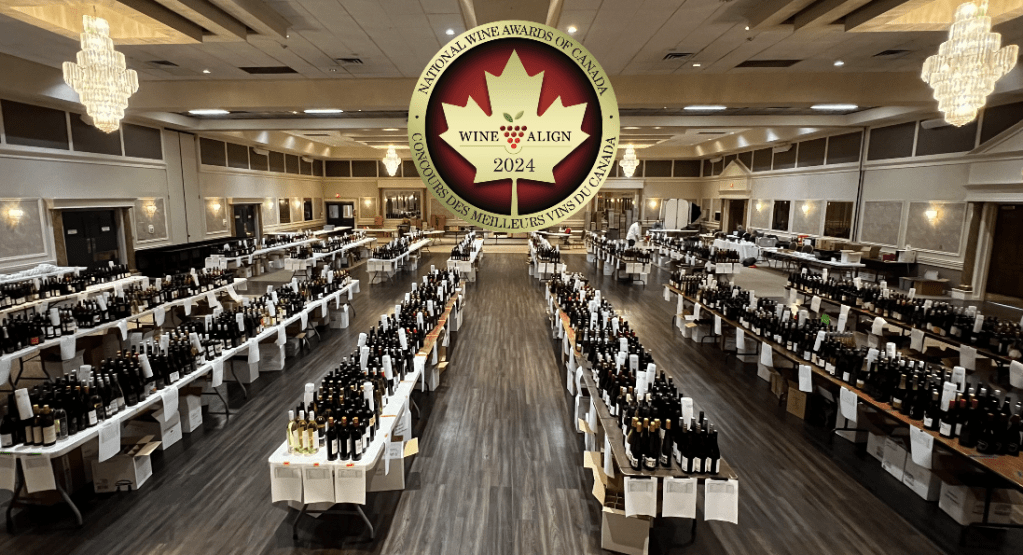
Here is what the organizers and judges were seeing, hearing and thinking at this year’s WineAlign National Wine Awards of Canada (NWAC). Their narrative has been separated by each judging category and presented below.
Photo credit: winealign.com
Sparkling Wine
While global wine consumption has decreased over the past two years. Sparkling wine, except for costly Champagne, has progressed upwards. In Canada, the Sparkling category burst during the pandemic, especially with accessible and affordable selections. The quality of Canadian sparkling wine continues to improve.
Red Blends
Red blends are abundant in both British Columbia and Ontario, making it the second largest category at the National Wine Awards. There is a variety of styles and grape varieties.
Bordeaux blends and Rhone blends continue to be important, but winemakers are increasingly evolving beyond the traditional French classic style. The next frontier is beginning to appear where blends consisting of Malbec, Carménère and Syrah are part of a new wave of Okanagan red blends.
White Blends
Winemakers continually mix and match with several varietal combinations. There are many permutations made with traditional varietals, as well as hybrid grapes.
There are no firm rules other than those set out by VQA which says that all the grapes in a labeled bottle must come from the province, an appellation and sub-appellation. Beyond this, the choices are endless, allowing white blends to vary from the traditional to the eclectic. Concepts include the Bordeaux combination of Sauvignon Blanc and Sémillon, Rhône blends that may include Marsanne, Roussanne and Viognier, but also Grenache Blanc, Clairette Blanche, Bourboulenc, Picpoul and Ugni Blanc. This year, British Columbia has continued to set the trends for blending and styles.
Rosé
There is a great deal of flexibility with respect to producing Rosé wine. Extraction levels and pigmentation can vary, many red or combination of red and white grape varietals can be used and there are no rules overseeing sweetness levels or oak aging.
Most Rosés are not meant for extended aging and are often best consumed in the year in which they are made. In Canada, most Rosés are bottled from March to June and make it to the stores between April and July.
Pinot Gris/Grigio
This white wine grape is a mutation clone of the black Pinot Noir grape. The skin colour varies greatly, and the wines produced from Pinot Gris also vary in hue from palest yellow to deep golden to blushing salmon. Pinot Gris also goes by its Italian name, Pinot Grigio. Wines made in the fresh, crisp and unoaked style of Italy’s Veneto region are called Grigio, while those in a richer, riper version go by Gris.
Orange
Orange wines are skiin contact white wines. There is no rule as to the length of the contact period or the grape varietals used. These wines range widely in colour and style.
Niagara’s popular Vidal grape responded well to skin contact, bringing texture and complexity to its tropical fruit profile. However, aromatic Gewürztraminer, with its subtly oily mouthfeel and subtle tannic framework, also showed well.
Gamay
Things change each year as there are new entries from newer wineries making Gamay. Some things also remain the same as many long-time advocates and committed Gamay producers continue to make excellent wines.
Pinot Noir
No other grape causes more of a stir. For many, there is no other grape variety. Pinot Noir has found enormous global success and Canadian soils are largely responsible for that. From agile, transparent, high-toned, red berry charmers to darker, seriously ripe and often tannic iterations, Pinot Noir succeeds with harmony and balance.
Chardonnay
This is always one of the largest categories in the competition. Chardonnay always leads or equals the greatest number of medals from platinum to bronze. Prices ranged from $87 for the most expensive medal winner to $11.95 for the least costly.
While the most expensive wine was not a platinum winner, there is a correlation between price and medal earned, establishing that top quality wine sells for more money. The average price for the platinum winners came in at just over $45, $40 for gold, $39 for silver and $33 for Bronze.
Malbec and other Red Single Varieties
Malbec represented 18 of the 41 medal winners in this category and accounted for 7 of 8 of the gold medals. It accounted for just 1.4% of entries in the competition but earned 4.1% of all gold medals.
This trend is almost entirely driven by British Columbia. There is something special about Okanagan Malbec. Much like Syrah, it does well up and down the valley.
Other White Single Varieties
Chardonnay and Riesling are often singled out as the signature grapes when it comes to top quality Canadian white wine. There are many other white varieties producing spectacular results including Grüner Veltliner wines from British Columbia.
Chenin Blanc is another consistent performer in BC and Ontario, making vibrant, fruit- forward wines.
Sleek, elegant Sémillon wines are also cropping up with increased frequency from coast to coast, as single variety wines and in classic Sauvignon blends.
Pinot Blanc proved its merit for good value, easy drinking white wine.
Gewürztraminer and Viognier
Viognier and Gewürztraminer remain minor varieties on the Canadian wine scene. Both grapes are particularly unreliable in Ontario, where Gewürztraminer accounted for just 2% of total production in 2023. Viognier is so rare that it is in the “other” category in the VQA’s annual report. In B.C. Gewürztraminer places a respectable 4th among white varieties in 2023, behind Pinot Gris, Chardonnay and Riesling. Viognier sits in ninth position alongside other Rhône varieties suitable to the West Coast’s unique conditions.
Sauvignon Blanc
At this year’s competition, Sauvignon Blanc took great strides and gained increased favour from judges and wine lovers. There were 32 medals awarded, with 20 going to Ontario and 12 to British Columbia. Of impressive interest is the average price of the 16 Silver Medal winners. These are wines that scored 90 points with an average cost of $23.40.
Syrah
“Syrah” above “Shiraz” is the key style in Canada. Reflective of a French Rhône style “Syrah”, as opposed to “Shiraz”, wines labelled as such tend to be distinctively peppery, with more sharp tannins, lower alcohol and exhibit more freshness than “Shiraz”. Yet in Canada, there is no enforcement over the use of these terms. Vintage variation and place do play a deterministic role, but the style of Syrah in Canada is heavily influenced by winegrowing and winemaking decisions that vary from producer to producer.
Ontario can produce excellent Syrah, but the category has forever been dominated by British Columbia.
Riesling
Canada has many great and quality examples of Riesling. It is a variety that truly expresses the place where it is grown. Riesling also counts among some of Canada’s oldest planted vinifera varieties, with plantings dating back to the mid 1970’s and early 1980’s in both Niagara and the Okanagan Valley.
Icewine & Late Harvest
Icewine, is the most important wine export. Now more than ever, due to erratic weather patterns, production is being threatened. Since the start of Icewine production in the 1970’s, a harvest has never been missed despite coming close a few times because of a mild winter in Ontario.
VQA regulations require the grapes to be naturally frozen on the vine, harvested, and pressed while the air temperature remains at or below -8 degrees Celsius. Recurrent periods of freezing and thawing can cause grapes to split, increasing unpredictable acidity in the wine. Production is a physically demanding task for both for the vines, that must bear their fruit into the cold of winter, as well as for the winemaker, who often harvests on the coldest of winter nights.
Cabernet Sauvignon
The number of gold medals has dropped from 13 in 2022 to 10 in 2023 to 7 this year. Despite the results, it is the category that has the most potential.
Cabernet Sauvignon is the most widely planted grape in the world, but such is not the case in Canada. It is the third most planted red variety in British Columbia, with 7.7% of total grapes grown. In Ontario, Cabernet Sauvignon represents only 5.9% of the grape harvest. There’s been a consistent downward trend, as a percentage of tonnage, over the last five years.
Cabernet Franc
Ontario has historically had a slight edge over the Okanagan Valley, given Ontario’s generally cooler and wetter climate, which suits the lighter, aromatic style that the judges tend to favour. However, the margin of difference has always been slim.
This year Ontario captured 38 out of 53 medals in total. However, British Columbia’s representation was impacted by the wildfires that severely impacted the Okanagan Valley in 2021, which resulted in smoke-tainted wines from some parts of the valley. Since these wineries did not submit any smoke-tainted wines, the number of submissions from B.C. was reduced significantly.
Merlot
Merlot remains the number one red planted grape in British Columbia.
There you have it; and that’s a wrap on the 2024 National Wine Awards.
The WineAlign National Wine Awards of Canada (NWAC) is the country’s largest competition, involving only 100 percent Canadian-grown and produced wines. The judging involves a select group of Canadian wine writers, educators, sommeliers and two international judges who spend a week assessing some 2000 wines and ciders. This year’s competition took place near Niagara Falls, Ontario.
Double Honour
The Winery of the Year and Small Winery of the Year is Kelowna British Columbia’s SpearHead Winery. In addition to the twin honours this year, they also had unprecedented success in an individual category (Pinot Noir), winning a total of seven medals for their Pinots, including three platinum, one gold, three silvers and a bronze. In total they earned a total of twelve medals.
Top 10 Wineries
Six of the top ten wineries this year are from British Columbia, with the remaining four from Ontario. The top ten are:
SpearHead Winery, British Columbia
Meyer Family Vineyards, British Columbia
Henry of Pelham, Ontario
Black Hills Estate Winery, British Columbia
Thirty Bench Wine Makers, Ontario
Quails’ Gate Estate Winery, British Columbia
Nostalgia Wines, British Columbia
Peller Estates Niagara-on-the Lake, Ontario
Lake Breeze Vineyards, British Columbia
Vieni Estates, Ontario
The Top 10 Small Wineries
Seven of the top ten small wineries are from British Columbia, with the remainder from Ontario. The top ten are:
SpearHead Winery, British Columbia
Meyer Family Vineyards, British Columbia
Nostalgia Wines, British Columbia
Lake Breeze Vineyards, British Columbia
The Organized Crime Winery, Ontario
Corcelettes Estate Winery, British Columbia
Black Bank Hill, Ontario
Kismet Estate Winery, British Columbia
Fort Berens Estate Winery, British Columbia
Lailey Winery, Ontario
Regional Top 10 Winners
British Columbia
SpearHead Winery
Meyer Family Vineyards
Black Hills Estate Winery
Quails’ Gate Estate Winery
Nostalgia Wines
Lake Breeze Vineyards
Corcelettes Estate Winery
Nk’Mip Cellars
Burrowing Owl Estate Winery
Kismet Estate Winery
Ontario
Henry of Pelham
Thirty Bench Wine Makers
Peller Estates Niagara-on-the-Lake
Vieni Estates
The Organized Crime Winery
Black Bank Hill
Two Sisters Vineyards
Lailey Winery
Hidden Bench Estate Winery
Marynissen Estates
Platinum and Gold Medal Winners
Only 1% of the wines entered earn a Platinum Medal. This year, 18 out of 1,800 wines received this recognition. Every Platinum winner has passed through a minimum of two tastings and a review by a minimum of five judges. These wines must be put forward by at least three judges in the first round and re-considered by at least five judges in the second round.
Earning a Platinum Medal greatly increases a winery’s performance score based on the mathematical degree of difficulty in reaching Platinum. This helps to decide the Winery of the Year and the Top 25 list.
Platinum and Gold medals were awarded in the following categories, presented alphabetically below:
Cabernet Franc
Platinum Medal
Black Bank Hill 2020 Cabernet Franc, Lincoln Lakeshore, Niagara Peninsula, Ontario
Vieni Estates 2022 Cabernet Franc, Vinemount Ridge, Niagara Peninsula, Ontario
Gold Medal
Bordertown 2020 Cabernet Franc Reserve, Okanagan Valley, British Columbia
Domaine Queylus 2022 Cabernet Franc Réserve du Domaine, Niagara Peninsula, Ontario
While on a river cruise that was part of my recent trip to France, I overheard someone say that Châteauneuf-du-Pape is a famous French winery. Well, that is not exactly true. Châteauneuf-du-Pape is a French Appellation d’origine contrôlée (AOC) located around the village of Châteauneuf-du-Pape in the Rhône wine region in southeastern France. It is one of the most renowned appellations of the southern part in the Rhône Valley, and its vineyards are located around Châteauneuf-du-Pape and in the neighboring villages of Bédarrides, Courthézon and Sorgues, between Avignon and Orange. The region covers more than 3,200 hectares or 32 square kilometres and produces over 110,000 hectolitres of wine each year.
The primary grape grown in the district is Grenache, but Cinsault, Counoise, Mourvèdre, Muscadine, Syrah, Terret noir, Vaccarèse, Grenache Blanc, Bourboulenc, Clairette blanche, Picardan, Roussanne, and Picpoul are also cultivated.
The terroir consists of white limestone. The stones absorb the heat of the sun and transfers it to the roots of the vines. The stones also help with allowing rain to penetrate the roots. This is critical since temperatures rise to about 45 degrees Celsius in the summer and irrigation is not permitted.
The harvest takes place from late August to early September. There are 323 vineyards in the district, all of which are family operated companies. Given the conditions, production yields are low and this is reflected in the price at your local wine store. However, the higher cost does not deter buyers as some wineries are selling their wines two years in advance.
Selections at Maison Bouachon
I visited Maison Bouachon winery, which has been in operation since 1898. The vines on the estate generally range from 80 to 100 years in age. Wine production is completed following the methods and rules established by the AOC.
While there I sampled three of their wines, 2023 Côtes du Rhône white, the Châteauneuf-du-Pape 2021 and the Châteauneuf-du-Pape Special Edition. My personal favourite was the Châteauneuf-du-Pape 2021, which is a blend of Syrah, Grenache and Mourvèdre grapes. I purchased a bottle which was later enjoyed by my wife and me. Unfortunately, like so many of the French wineries, Maison Bouachon wines are not available outside of France. Such a pity.




 A Layman's Wine Musings