My wife and I recently returned from a Rhine River cruise where we had the opportunity to sample wines from Switzerland, France and Germany during our travels. I was most anxious to try some Swiss wines as I had never had the opportunity of tasting any. These wines are not often available outside of Switzerland (see The Wines of Switzerland from May 1, 2021).
The first Swiss wine we tried was a 2022 Weinbau Ottiger Pinot Noir. The wine is very similar in character to a French Pinot Noir. The second sampling was a red blend from Château Constellation sa 1950 Sion, called “Humagne Rouge”. It has a spicy bouquet characterized by notes of pine and cinnamon. It has accents of black fruit aromas balanced by silky tannins. It was very enjoyable.
We ventured through Strasbourg, France and the Alsace wine region. World-renowned for its viticulture, Alsace has a dry mild climate, favourable soils and ideal exposure to the sun for its vineyards. The white wines produced here rival the Rieslings created in neighbouring Germany.
While in Breisach, Germany, the tour offered a wine tasting at Domaine Albert Seltz, Alsatian Vineyards. There they follow a rigorous process to preserve the authenticity of their wines, respecting traditional techniques while integrating the most recent advances in technology. Sustainable viticultural practices are followed that promote biodiversity and respect for nature.
The area surrounding Breisach, the capital of Alsatian wines, has the third largest wine co-op in the world, following California and South Africa. Twelve million litres of wine are produced there each year, taking advantage of being the sunniest place in all of Germany.
We also visited Rüdesheim, which is a German winemaking town in the Rhine Gorge, and part of the UNESCO World Heritage Site. It is in the heart of the Rheingau wine region.
Close to Speyer, Germany lies the Roter Hang wine area. It is considered to be one of the most important vineyard sites in the world, sitting to the south of Mainz, not far from Nierstein and Nackenheim. The soil is red, the result of red slate that exists throughout the region, providing the perfect conditions for outstanding wines that are characterised by unmistakeable flavour.
Further north at the intersection of the Rhine and Moselle Rivers is the town of Koblenz. Koblenz is a principal seat of the Mosel and Rhenish wine trade. Mosel is best known for growing some of the finest Riesling grapes in the world.
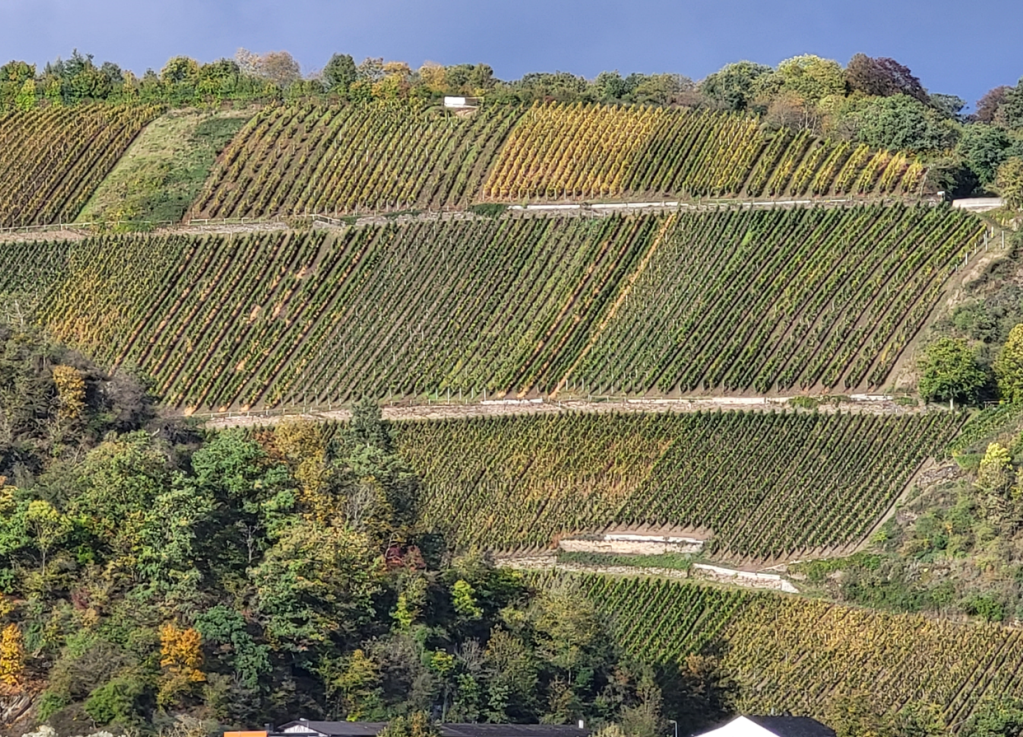
The vineyards are found tiered along the hillsides of the Moselle River. The steepest vineyard slopes in all of Europe are found here. Some of the grape vines are planted in vertical rows while others are in horizontal rows. The grapes planted vertically are machine groomed vines while those planted horizontally are generally on the steepest slopes and are maintained totally by manual labour.
Along the Moselle River in Winningen we visited the Weingut Rüdiger Kröber winery where we sampled four different Riesling wines ranging from dry to sweet; the 2022 “Kröber Weingut Steinig Riesling” dry, the 2022 “Kröber Weingut Uhlen Laubach” dry, the 2022 “Kröber Weingut Winninger Brückstück Riesling Feinherb” semi dry and the 2021 “Kröber Weingut Winninger Röttgen Kahimer Riesling Alte Reben” sweet. I found the Uhlen Laubach to be my favourite as it was robust with character and full of flavour.
The winery’s vineyards are up to 28 terraces in height along the slope of the hills. Weingut Rüdiger Kröber grows 90% Riesling, 5% Pinot Blanc and 5% Pinot Noir varietals. The vines range from 50 to 80 years in age. The winery produces 60,000 bottles of wine per year and like many of the wineries in the region, it is all sold locally to individuals and restaurants.
Now that we have returned home from the Rhine, my wife and I are in the midst of planning our next wine excursion, which will be along the Rhone River in France during the spring of 2024.
Sláinte mhaith

 A Layman's Wine Musings