With the introduction of tariffs this year by the U.S., American wine makers are now paying a higher price for all their wine making materials including French oak barrels, glass bottles, corks and even the wine-making equipment itself, such as pumps and de-stemmers. The 15% levy that was imposed on all goods entering the U.S. from the European Union means the cost of wine making supplies increased 15%. For example, each wine barrel now costs California wine makers an additional $100 to $150 US.
Photo credit: globaltradelawblog.com
California’s Paso Robles Wine Country Alliance said international wine orders were drying up as the aftereffects from President Trump’s trade war resonated around the world. U.S. winemakers are saying that this puts wine producers in high-cost California at an even greater disadvantage.
European wine producers are reducing their amount of American wine purchased. Danish wine stores are boycotting U.S. made wines. In Sweden, the state liquor store, Systembolaget, has seen sales of American wines drop 15%. Portugal as well has sought out alternatives to American wine.
Canada, who purchased 33% of all U.S. wine exports in 2024, has removed American wine and alcohol from liquor store shelves in most provinces. Robert P. Koch, president of California’s Wine Institute, said, “Canada is the single most important export market for U.S. wines, with retail sales in excess of $1.1 billion annually”. In April 2025, U.S. wine exports to Canada decreased 72.5% compared to April of last year. According to the American Association of Wine Economists (AAWE) exports declined by $25.5 million to $9.69 million.
It’s feared that these new anti-American sentiments are unravelling decades of marketing work and relationship building. Former consumers of American wine are now discovering interest in other New World wines, such as Australia, South Africa, South America and Canada.
Oregon is facing the same challenges as California. Oregon’s leading export targets are Mexico, China and Canada, representing about 81,000 jobs that are reliant on that export trade. Close to half of all Oregon wine exports in recent years have gone to Canada; in 2022, that was 73,323 cases of a total export of 162,939.
In April, the US Wine Trade Alliance stated that “restaurants will suffer, domestic producers will face new obstacles in bringing their wines to market, and retailers, importers, and distributors across the country will be placed at serious risk “.
I guess we will all have to wait and see what the longer-term effects of this trade war will be. However, I tend to agree with the economists who conquer that a trade war is a war that no one wins.
During the past six years that I have been writing this blog I have always steered away from political issues. However, today I feel compelled to speak out against Canada’s one time ally, the United States. With the return of Donald Trump to the White House’s Oval Office, Canada’s economy was placed under direct attack by Trump when he decided to impose twenty-five percent tariffs on Canadian imports to the U.S., without just cause. Similar sanctions have been imposed on Mexico and China and are being threatened against the European Union.
Photo credit: Manitoba Liquor Mart
In response to these bullying tactics by Trump, and as a proud Canadian, I will no longer purchase or write about American wine until such time as Trump refrains from his attack on Canada.
Canada has been the top export market for U.S. wines and Ontario’s provincial liquor board (the LCBO) has been among the largest purchasers of U.S. alcohol. In Ontario, imported wines are primarily sold through provincially owned and operated retail outlets, although recent regulatory changes have authorized 157 private grocery retail locations to distribute wine and beer.
The first phase of Canada’s response to the U.S. imposed tariffs includes tariffs on wine and spirits, in addition to many other products. Ontario is banning American liquor and the LCBO is removing American wine, spirits and beer from its shelves. This will represent about a billion dollars worth of American alcohol.
British Columbia, Alberta, Saskatchewan, Manitoba, Nova Scotia and Newfoundland are also removing U.S. liquor from their store shelves. At last word Quebec is considering the idea. On the bright side these bans will serve to enhance the sale of Canadian wines in Canada, as well as European, Australian, South American and South African wines.
Hopefully the American people will convince Trump that the imposition of his tariffs will not only hurt international economies but his own economy as well. It is a sad situation.
Being only 30 miles long and several miles wide, California’s Napa Valley American Viticultural Area (AVA) is one of the smallest winegrowing regions in the world, with only one-sixth the planted acreage of Bordeaux. About 95% of the wineries are family-owned businesses. The region’s established viticultural practices result in low yields of high-quality grapes, from which the winemakers produce Napa Valley’s renowned wines, which include Cabernet Franc, Cabernet Sauvignon, Merlot, Pinot Noir, Zinfandel, Chardonnay and Sauvignon Blanc. Napa generates only 4% of California’s wine grape harvest but has an extraordinary mixture of microclimates, weather and geography, as well as some of the most varied soils found in a wine region anywhere.
In 1968 Napa Valley became the home of the first Agricultural Preserve in the U.S., a long time before environmental issues became a major concern. Today it has the most comprehensive and stringent land use and environmental regulations of any American winegrowing region.
Napa contains 16 sub or nested appellations, each with its own distinct microclimate and terrain that provide recognizable characteristics on the grapes grown there. These sub appellations are presented alphabetically below:
Photo credit: bigvalleywines.com
Atlas Peak
The elevation ranges between 230 to 800 metres above sea level with temperatures in the summer that are about 10–15° cooler than the valley floor. There is low day-to-night temperature range, with summer temperatures rarely rising above 32° Celsius.
Cabernet Sauvignon and Chardonnay grapes are grown in this region.
Calistoga
Daytime summer temperatures may reach more than 38° Celsius and fall to as low as 4° at night. There are cool afternoon and evening breezes. Elevations range from 90 to 370 metres above sea level.
The main varietals grown in this area are Cabernet Sauvignon, Zinfandel, Syrah and Petite Sirah.
Chiles Valley
Temperatures peak in the 25° range but the higher elevation and summer fog at night result in nighttime temperatures in the 10° range. With an elevation of 180 to 370 metres above sea level, there are colder winters and springs, as well as strong winds, which results in the harvest coming later than down in the valley.
The key varietals are Cabernet Sauvignon, Merlot and Cabernet Franc.
Coombsville
Because of the cool maritime winds from the San Pablo Bay, as well as the Petaluma Gap, high temperatures rarely get above 27° Celsius. This appellation is at a low elevation not exceeding 200 metres above sea level.
The grape varietals include Pinot Noir, Merlot and Chardonnay.
Diamond Mountain
There are moderately warm temperatures in this region, with less fluctuation than the north Napa Valley floor. Summertime temperatures range from 10° t0 30° Celsius. The elevation ranges from 120 to 670 metres above sea level.
Cabernet Sauvignon and Cabernet Franc varietals are grown in the region.
Howell Mountain
Howell Mountain is situated above the fog line on the eastern side of the valley. This area is warmer and drier than the other appellations because of more hours of sunshine and an insignificant amount of marine influence. The elevation ranges from 180 to 800 metres above sea level.
Cabernet Sauvignon, Merlot and Zinfandel grapes are grown in this area.
Los Carneros
With marine winds from the San Pablo Bay and the Petaluma Gap, high temperatures rarely exceed 27° Celsius. Elevations range from sea level to 215 metres above sea level.
Varietals grown include Pinot Noir, Merlot and Chardonnay.
Mount Veeder
There is a cool to moderate temperature in this region, with most of the vineyards situated above the fog line. This results in warmer nights and cooler days than on the valley floor below. Normal summer highs are in the 30° Celsius range. Elevation ranges from 150 to 800 metres above sea level.
Cabernet Sauvignon, Merlot, Zinfandel and Chardonnay grapes are grown.
Oak Knoll
Having a moderate to cool climate with marine air and fog often remaining until late morning, afternoon breezes often develop, maintaining summer temperatures that reach as high as 33° Celsius. Elevations rise from sea level up to 150 metres.
The varietals include Cabernet Sauvignon, Merlot, Chardonnay and Sauvignon Blanc.
Oakville
The climate is moderately warm, with temperatures generally in the mid-30s during summer, but are impacted by night and early morning fog. Elevations are the same as Oak Knoll, rising from sea level to 150 metres.
However, only Cabernet Sauvignon, Merlot and Sauvignon Blanc varietals produced here.
Rutherford
The region is moderately warm, marginally influenced by early morning fog. Summer temperatures usually rise to the mid-30s, with a distinct day-to-night fluctuation in temperature. Elevations range from sea level to 180 metres.
Grape varietals include Cabernet Sauvignon, Merlot, Cabernet Franc and Zinfandel.
St. Helena
Less fog and wind, along with heat reflecting off the hillsides, see summer temperatures often reach the mid-to-high 30s. Elevations range from 30 to 200 metres above sea level.
Grape grown include Cabernet Sauvignon, Cabernet Franc, Merlot, Syrah and Zinfandel.
Spring Mountain
Cool weather prevails as most of the vineyards are located above the fog line, providing warmer nights and cooler days than the valley floor below. Mid-summer temperatures reach 30° Celsius. Elevations range from 180 to 800 metres above sea level.
Grapes grown include Cabernet Sauvignon, Merlot, Cabernet Franc, Chardonnay and Zinfandel
Stags Leap
This region is moderately warm with afternoon marine winds cooling the warmer air. Summer temperatures can reach to about 40° Celsius but are normally in the mid-30s. Elevations range from sea level to 150 metres.
Grapes grown include Cabernet Sauvignon, Merlot, Chardonnay and Sauvignon Blanc.
Wild Horse Valley
This is one of the warmer regions with summer temperatures hovering in the mid-30s. Elevations range from 180 to 600 metres above sea level.
Varietals include Cabernet Sauvignon, Pinot Noir and Chardonnay.
Yountville
Moderate, with cool marine influence and morning fog, summer mornings are cool in this region. Marine breezes keep afternoons more comfortable than further up the valley with high temperatures reaching 32° Celsius and nighttime lows dropping into the teens. Elevations range from just above sea level to 60 metres.
Varietals are limited to Cabernet Sauvignon and Merlot.
Many of the world’s wine regions are facing problems resulting from an oversupply of grapes. For example, last year the French government spent 200 million euros to dispose of surplus wine. In addition to that, Bordeaux region vintners received 57 million euros to destroy 9,500 hectares of grape vines.
Photo credit: vancouversun.com
In Australia, millions of vines are being destroyed and tens of millions more must be removed to control overproduction. Drastically reduced grape prices are threatening the incomes of growers and wine makers.
Falling consumption of wine worldwide has hit Australia particularly hard as demand shrinks fastest for the cheaper reds that are its biggest product. It had relied on the Chinese market for growth until recent years. Last year there was more than two billion litres of surplus wine in Australia.
Oversupply is not a new phenomenon. In the past the industry has always been able to readjust but going forward it may not be as easy. Past declines were triggered by economic factors such as market crashes, the tech boom, new tax laws and other more specific events that impacted the amount of money people spent and how they prioritized their consumption of wine.
Today the reduction in wine consumption is the result of a change in attitude and lifestyle resulting in people consuming less wine. Campaigns such a “Dry January” and “Sober October” are becoming more and more popular, leading to less wine consumption in the other ten months of the year. As a result, wine drinking has been declining year over year since 2017.
In France, wine consumption has declined significantly, from 150 litres per person per year in 1950, to 40 litres per person in 2022. The French people are no longer insular with just their own culture. Instead, they have adopted influences from other parts of the world and as a result, have substituted some of their wine consumption with other beverage options, such as beer, whiskey and cocktails.
Cuisine is changing as well, which has altered drinking habits. Lighter food choices and finger foods are often replacing traditional multi-course meals. Also, people have been reducing the amount of red meat in their diet. This has resulted in consumers wanting lighter, lower-alcohol wines. The Bordeaux region in particular has been greatly impacted by this, having reduced demand for their full-bodied red wines.
The U.S. market is being impacted as well due to a focus on wellness and a change in lifestyle. Non-alcoholic beverages sales there have increased 20.6 percent from 2021 to 2022.
People are drinking less wine but better wine. Over the past seven years, the U.S. wine industry is seeing growth rates sag in the under $12 category but wines in higher-priced tiers continue to see growth.
This change has also impacted wine sales in Australia where for the first time since the mid-1990s there is an oversupply based on a lack of consumer demand. A main driver of the decline is due to the lack of demand for Australin wine in the U.S.
There are other factors as well affecting Australian wine sales. In March 2021, China imposed a 218 percent tariff on Australian wine in response to Australia requesting an independent investigation as to the origins of COVID-19. China’s decision wreaked havoc on Australia’s wine industry.
The world is also still feeling the effects of the pandemic. From supply chain issues to how people purchase and consume wine was severely impacted. The good news is that there are indications that the wine industry is heading toward a return to normalcy, at least in this regard. Wine consumption remains lower than in 2015 but above what it was in 2021. This is largely due to the reopening of bars and restaurants. The long-term effects remain to be seen.
Depending on soil conditions, some French vintners are now investigating switching to other crops such as corn or wheat. Others are changing vineyards into livestock pastures. Australia is focusing on market expansion and providing wineries with market data so they can determine their best course of action. Not waiting for new markets to open, some growers are turning to citrus and nut trees instead.
One thing for certain is there is currently much uncertainty in the wine industry.
An American wine club operator from Napa Valley, California had arranged for a group of his members to take part on our recent river cruise aboard the Scenic Sapphire, through the Burgundy and Rhône wine regions. The group excursion included the CEO of Cuvaison Estate Wines of Napa, California, Dan Zepponi.
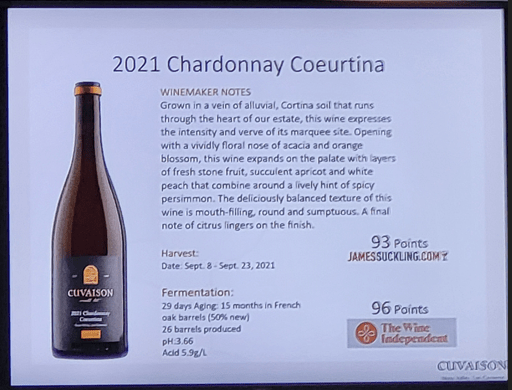
While sailing down the Rhône River between ports, Zepponi treated the passengers to two seminars; the first was an exploration of Chardonnay wine. The presentation included tastings of two different Chardonnays from Cuvaison which were compared to two French Chardonnays that are regularly served as part of dinner service on the ship.
The tastings were conducted as a head-to-head comparison. First, his unoaked Methibiton Chardonnay, was compared to an unnamed, unoaked French wine. The second comparison was between two oaked Chardonnays, Coeurtina from his winery against a second unidentified French.
In each comparison I found the flavours of the Napa wines to be extremely close to the French, though to me the French was slightly more mellow and smoother. The Cuvaison wines are priced at $70 US each and are only available directly from the winery. In comparison, the ships wines would have an equivalent price of approximately $15 – $20 US per bottle.
During the second seminar Zepponi discussed micro-lots as they pertain to the wine industry. When a winery wants to produce a type of wine but does not have enough of the varietal in their own vineyard they may purchase the varietal from another grape grower. The purchased grapes are then used to make a specific wine exclusively from that purchased micro-lot. This allows the winemaker to better control the grapes being used and the wine produced, in a similar manner that would be done if the vintner was using their own estate grown grapes.
Two taste comparisons were conducted, the first was with Cuvaison’s 2022 En Cigar Chardonnay Blanc and the ship’s undisclosed Sauvignon Blanc house wine. The second comparison was conducted using their 2022 Fiddlestix Pinot Noir and an undescribed French Pinot Noir. I favoured the French Sauvignon Blanc over the Cuvaison but did find Cuvaison’s Pinot to be smoother and less fresh that the French Pinot. Once again though, the price between the American and French wines was significantly different – $70 US for both Cuvaison’s versus under $20 US for the French wines.
Unfortunately, the two seminars lacked substance and honesty as they were actually marketing presentations for Cuvaison wines. Zepponi would have had more credibility in my eyes if he had presented his talks as being an introduction to Cuvaison wines. There was no value in conducting taste comparisons with wines that are not even identified by name, let alone any information about where or how the wines were produced. He should have simply talked about how his wines are produced.
Based on information presented about the various Cuvaison wines, they are producing decent wines at a reasonable price point. However, the feeble attempt at conducting product comparisons was an insult to the intelligence of the ship’s passengers.
Most wine enthusiasts are familiar with international wine regions such as France’s Bordeaux, California’s Napa Valley or Italy’s Tuscany. However, there are many other, lesser-known regions, each offering its own unique characteristics. These regions offer not only good wine but fewer crowds and opportunities to discover places less travelled. My list is not intended to be all-encompassing; it is merely a list of regions that I have found intriguing for one reason or another. The regions are presented in alphabetical order by country.
Pedernal Valley, Argentina
Located in the shadow of the Andes mountains, Argentina’s wine country is spectacular. Situated north of the famous Mendoza region is the lesser-known Pedernal Valley. It is felt that the Pedernal Valley can stand on its own merits as a premium wine region. The region’s Malbec is considered world-class and distinct and represents a unique style.
Mendocino County, California, United States
Mendocino County grows less than four percent of California’s grape yield but contains an impressive one-third of the state’s certified organic vineyards. The number of old vines, post-WWII plantings makes this region unique. Some of the best wineries in California source their grapes from Mendocino. Dry-farming practices were introduced to the region by Italian families in the early 1900s, which resulted in wines that are concentrated, balanced and distinctly Californian.
Okanagan Valley, British Columbia, Canada
Photo credit: dailyhive.com
Canada’s own Okanagan Valley is considered breathtaking as it is situated between two mountain ranges and contains glacial lakes and rolling hills of vineyards. The region produces world-class wines that are difficult to find outside of Canada. The high-quality wines combined with the beautiful views of the region have attracted top winemakers from France, New Zealand and South Africa.
Chinon, Bugey and Savoie, France
There are three lesser-known regions in France. Chinon is in the Loire Valley. It is much less popular than its neighbours, Bordeaux and Burgundy. The Loire Valley is famous for its white Sancerre and Pouilly-Fumés. The red variety is Cabernet Franc.
The wine regions of Savoie and nearby Bugey are nestled in the French Alps and are home to great wines and hospitality. Savoie has both a ski and hiking industry and thus there are quality restaurants, wine bars and a wide range of accommodations. The vineyards are spread throughout the Auvergne-Rhône-Alpes overlooking both the mountain ranges and fresh bodies of water.
Bugey is situated underneath the alps. There is a group of small producers that have either relocated from other parts of France or are new vintners who are focused on raising the profile of the region.
The Republic of Georgia
Georgia is the world’s oldest continuously producing wine region but it is one of the lesser known. This is due to The Republic formerly being under the control of the former Soviet Union. During that time only four grape varieties of the over 500 available were allowed in production. After gaining independence, Georgia rediscovered its wine culture and began sharing it with the world. Traditional Georgia wine production is unique, resulting in the production of some exceptionally distinctive wines. The wines are produced in underground amphorae called Qvevri.
For additional information about the wines and the region, see my posts The Wines of European Georgia from February 6, 2021 and Traditional Georgian Wine from September 18, 2021.
Szekszárd, Hungary
The Szekszárd wine region is located about 160 kilometres south of Budapest. Not many tourists explore beyond Budapest since the region has not been marketed. However, it is one of the country’s oldest wine regions, dating back around 2000 years. Wine production is small and the wineries are often family-owned, which equates to limited exports and less awareness about the region.
The region has a wide range wine styles. The most popular variety is the Kékfrankos grape (aka Blaufränkisch) which produces a tannic and spicy style of wine. There’s also Kadarka grapes which creates a fresh acid red fruit that is meant to be enjoyed without aging.
Mexico
Mexico’s wine history dates back to the1600s but the region remains a virtual unknown for many wine enthusiasts. Although wine grapes have been cultivated there for 400 years, it has only been during the past several decades that there has been a renewed focus on premium and terroir-driven expressions.
Valle de Guadalupe’s boutique wineries are experimenting with a mix of European red grapes such as Cabernet Sauvignon, Nebbiolo and Tempranillo. The varietals are often blended to create a Bordeaux style of wine.
Middleburg, Virginia, United States
California, Oregon, Washington and New York dominate the U.S. wine industry but there are other regions worth noting. One of these is Middleburg, Virginia. Virginia was one of the first places in America to produce wine but it is still a relative unknown. The wine industry there is mostly made up of small artisanal producers who are creating world-class wines. Some think of the region as a crossroads between Napa Valley and Bordeaux. The region is situated in the foothills of the Blue Ridge Mountains an hour outside Washington DC.
Final Thoughts
There are many lesser-known wine regions to be explored, either by visiting or merely by sampling the wines they produce. By expanding our horizons and creating new experiences, we will ultimately find more wines to enjoy.
New York is the third largest wine producer in the United States, following California and Washington. New York produces roughly 3.5% of the U.S.’s wine production compared to California at over 84% and Washington at slightly over 5%.
There are eleven designated American Viticultural Areas (AVA). An AVA is a designated wine grape-growing region in the United States as identified by the Alcohol and Tobacco Tax and Trade Bureau, and the United States Department of the Treasury. The AVAs are Champlain Valley, Long Island, North Fork of Long Island, The Hamptons Long Island; Hudson River Region; Finger Lakes, Seneca Lake, Cayuga Lake; Niagara Escarpment , Upper Hudson and Lake Erie.
Wine production began in New York in the 17th century with Dutch and Huguenot plantings in the Hudson Valley. Today the two dominant wine regions are the Finger Lakes and Long Island. In 1976 the Finger Lakes and Long Island regions had 19 wineries. By 1985 this number increased to 63 wineries.
The climate differs amongst the eleven regions because of regional influences, such as the Atlantic Gulf Stream and the numerous bodies of water and mountainous regions around the state. The annual precipitation ranges from 76 cm to 127 cm. The growing season in the Lake Erie and Finger Lakes regions ranges from 180 to 200 days a year, while on Long Island the season extends to 220 days.
Today there are over 450 wineries throughout the state.
Riesling grapes consist of less than 10% of New York’s wine production but are used to make some of the highest quality wines. Other varietals include French hybrids, American hybrids and Vitis Labrusca, which are vines native to eastern North America.
American hybrids grown include Catawba, Delaware, Niagara, Elvira, Ives and Isabella. French hybrids consist of Aurore, Baco Noir, De Chaunac, Seyval Blanc, Cayuga, Vidal and Vignoles, which is used to make late harvest wines and ice wines.
I find it interesting that even though I can see New York State from a Muskoka chair in my yard I can very seldom find New York wine in my local liquor store. On the other hand I can find California, Washington and even Oregon (ranked 5th in U.S. production at only 1.5%) wines all the time. Especially in the case of Oregon, I am left to think that either Oregon wines are superior in quality and flavour to New York wines or they have a much more aggressive marketing plan, or both. I can vouch for the quality of Oregon wine but have not had the opportunity to do the same for New York wine.
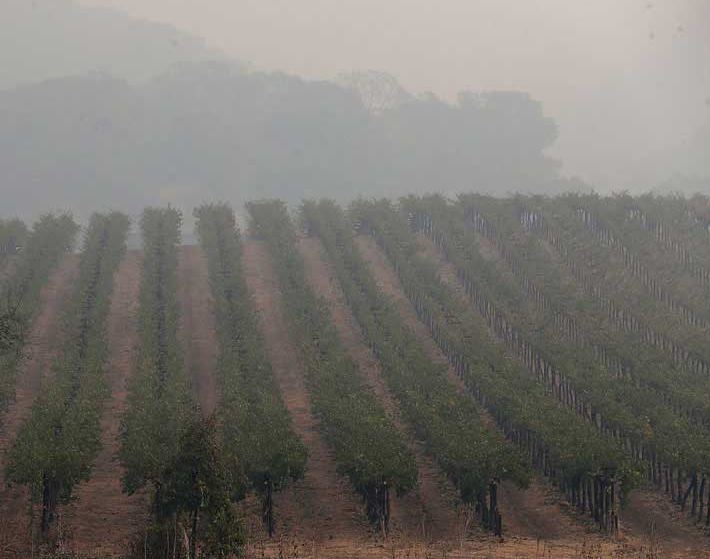
Smoke has caused a lot of damage to the 2020 grape harvest in California, Oregon and Washington during the past few weeks. In some cases production has been reduced by over 80. The smoke can be absorbed right into the grapes’ flesh giving them the flavour of a wet ash tray.
Atmospheric smoke has blocked the sunlight that is essential for the grapes to properly ripen. Poor air quality is slowing harvesting as fieldwork hours are being limited and particle-filtering masks are in short supply due to the coronavirus pandemic.
Wineries were already facing great financial strains due to the reduction in restaurant traffic and smaller crowds visiting vineyards for tastings. Many tasting rooms remain closed due to fire and smoke risks, while grapes may be damaged or totally ruined.
Oregon, Washington and California together produce about 90% of all U.S. wine. The true impact on the $70 billion industry will not be known for months as crop damage can vary greatly.
Smoke has blanketed much of the U.S. West as fires have charred some 2 million hectares.
Laboratories that test grapes for smoke contamination are being overwhelmed with some taking up to a month to return results, instead of the normal week. Vineyards need this data to determine whether or not to harvest their grapes.
Winemakers and scientists are still learning how smoke can affect wine grapes and how the effects can be mitigated. Australia has been at the forefront of the research, but studies at American universities have ramped up over the past five years.
The Australian Wine Institute has come up with a few practical ways to manage smoke-exposed grapes. These include:
Hand harvest fruit to minimize breaking or rupturing of skins
Exclude leaf material to limit smoke-related characteristics
Maintain integrity of harvest fruit, avoiding maceration and skin contact
Keep fruit cool to extract less smoke-related compounds
Whole bunch press to reduce extraction of smoke-derived compounds
If corrections cannot be made, smoke taint will add two distinct compounds to wine: guaiacol (commonly called Creosote) and 4-methyl guaiacol.
White wines are often more susceptible to smoke than reds. Low levels of smoke can mask the fruit and give a dirty finishing flavour and higher levels negatively affect the smell and taste ashy. Washing grapes with water might help get ash off the grapes but it does not reduce smoke compounds in the fruit.
It is too soon to judge how the wildfires will impact 2020 vintages but harvested grape supplies are expected to be much smaller. With smaller harvests winemakers are expected to buy bulk wine from the 2019 season for blending with what is available from this year.
The reduced supply will most likely increase prices making U.S. wines less competitive in the international wine market for the next couple of years.
My wife has a strong dislike for Chardonnay but a fond love for Chardonnay Musqué. This raised the question in my mind, what makes Chardonnay Musqué different from Chardonnay? Is there truly a discernible difference? My wife argues that absolutely there is.
I set forth on a research expedition to determine if there is a difference, and if so, why.
What I learned is that Chardonnay Musqué is an aromatic mutation of the Chardonnay grape. It is grown principally in the vineyards of Canada’s Niagara Peninsula and New York’s Finger Lakes.
The typical Chardonnay Musqué wine is off-dry, medium bodied, and has the distinctive, grapey, Muscat-like aroma. Depending on the region and producer, other flavours and aromas might range from tropical fruit to cinnamon-tinged lemon sorbet.
There are over 40 different clones of Chardonnay, but only two of these can be called “Musqué” due to their aromatic qualities. For you techies they are Clone 77 and Clone 809. These wines are generally unoaked in order to preserve the fresh and fragrant aromas natural to the grape. This is the reason why my wife likes it so much (she has a real aversion to any oaked white wine)
Several Ontario vineyards are now planted with musqué clones and the grapes may be used as either part of a blend or bottled on their own.
Generally these wines are best when consumed relatively young. The aromas of Chardonnay Musqué are reminiscent of Viognier or even Torrontes, and it can be made in a range of styles from dry to a little sweet to quite sweet, sometimes even with a slight spritz.
Chardonnay Musqué can be enjoyed on its own on a warm spring or summer day, or paired with mild curries, sushi, salads, grilled salmon, or seafood.
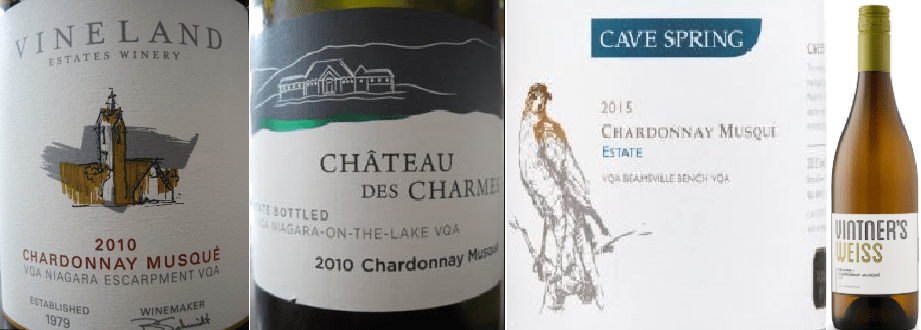
There are several Ontario wineries using one or both Chardonnay Musqué clones in their wines. Trail Vintner’s Weiss uses Chardonnay Musqué as part of a Riesling Chardonnay Musqué blend, while other producers, such as Chateau des Charmes, Cave Spring Cellars, and Vineland Estates, prefer to bottle the clone on its own.
A few Ontario Chardonnay Musqués:
Chateau des Charmes
Paul Bosc, founder of Chateau des Charmes, chose the particularly fragrant and interesting Clone 809 for his Chardonnay Musqué. Only about 500 cases are bottled by the winery annually. The 2015 vintage is available from the winery or online for $14.95.
Cave Spring Cellars
Cave Spring Cellars 2016 Chardonnay Musqué is made from 100% Chardonnay Musqué Clone 77. This wine is fermented in stainless steel and unoaked so as to maintain every nuance of the delightful aromatics of the Chardonnay Musqué grape. It’s a wine of refinement and class. Floral, yes, but it also offers bright citrus, tropical fruit, peach and a hint of vanilla aromas. Try it with green salads or shrimp Pad Thai. It is available from the LCBO for $17.95.
Vineland Estates
Their 2016 Chardonnay Musqué is available from the winery or online for $17.95. The wine is described as having an abundance of warm summer melon, lime zest and tangerine aromas that roll in the glass while the welcomed edge of acidity focuses and the perfect trace of a bitter finish.
Trail Vintner’s Weiss
The 2017 Riesling Chardonnay Musqué blend is available at the LCBO for $19.95. According to Natalie MacLean it is a delightful, vibrant white wine blend of Riesling and Chardonnay Musqué grapes form Prince Edward County. It has aromas of daisies, lychee, apple blossom and white peach, and is balanced with racy acidity for shellfish and vegetarian dishes.
If you are a fan of Chardonnay, and unoaked Chardonnay in particular, trying Chardonnay Musqué would be well worth your while; just ask my wife.
Over 84% of the U.S.’s wine production comes from California, 5% from Washington, 3% from New York, 1½% from each of Oregon and Pennsylvania, and the balance from the rest of the nation. Surprisingly there are 41 wine producing states.
The U.S. follows the Appellation System, similar to France and Italy, whereby there are currently 242 American Viticultural Areas (AVA). In order to have an AVA appear on a wine label, at least 85% of the grapes used to produce the wine must have been grown in that particular appellation.
I have elected to discuss in more detail the wines of California, Washington, and Oregon as these are the wines that are available from Canadian retailers. For whatever reason wines from New York, though having higher production levels than Oregon, are not as readily available to much of Canada.
For a state or county appellation to appear on the wine label, 75% of the grapes used must be from that state or county. Some states have stricter requirements. For example, California requires 100% of the grapes used be from California for a wine labeled as such, and Washington requires 95% of the grapes in a Washington wine to be grown in Washington.
For bottles labeled with a varietal, at least 75% of the grapes used to make the wine must be of that varietal. In Oregon, the requirement is 90% for certain varietals, such as pinot noir. The requirement is a minimum of 95% in California.
California
California has been stereotyped as a producer of big, blockbuster-style reds and ripe, oaky whites. However, while these wines do exist, elegance and subtlety also play their part.
Napa and Sonoma are two regions that dominate Californian wine, but other regions are gaining in reputation, particularly those south of San Francisco, such as Paso Robles, Monterey, Santa Cruz Mountains and Santa Maria Valley. The wine must be from a particular vintage for that year to appear on the label.
California’s most renowned grape varieties are Cabernet Sauvignon and Zinfandel. However, there are significant amounts of Pinot Noir and Chardonnay, as well as lesser amounts of a number of French varieties, such as Syrah, Marsanne, Roussanne, Viognier, and Mourvèdre.
Oregon
Oregon has a great reputation for Pinot Noir and aromatic white wines, such as Riesling and Sauvignon Blanc. The region is on the same latitude as Burgundy, but benefits from more consistently sunny summers and very cool nights.
There are now more than 400 wineries producing pinot noir in Oregon across many sub regional areas, with the Willamette Valley having the greatest concentration of wineries. The Pinot Noir produced there has higher natural acidity than those from California. They also often have a savoury characteristic on the nose, but generous red berry tart fruits on the palate. These wines can develop great complexity with age and at their best represent some of the most serious fine wines produced in the USA.
Washington
The state of Washington is second after California in terms of importance for wine and offers a great diversity of terroirs. All of the wine growing regions are in Eastern Washington where the Cascade Mountain range acts as a rain barrier allowing for vines to grow. The climate is generally continental with hot dry summers and a significant diurnal temperature flux with summer night time temperatures dropping by more than 15 degrees. Washington is becoming recognised globally for the production of fine Cabernet, Merlot, Riesling and Chardonnay.
Zinfandel
The one grape varietal that is pretty much exclusive to the U.S. and California in particular, is the Zinfandel. The Zinfandel grape is very challenging to grow. It does not ripen evenly and full ripeness can be hard to achieve without reaching high sugar levels and, therefore, alcohol. The best wines, often made from the lowest viable yields, will have an intensity of fruit that more than handles the higher alcohol. Older or particularly well-balanced vineyards tend to achieve good levels of ripeness at lower alcohol levels.
The grape’s reputation has been knocked somewhat by certain growers favouring quantity over quality with plantings in unsuitably hot climates and yields that were more than was good for it. But in the right hands the grape can really excel across all price levels, producing wine that is muscular, intense and spicy, yet structured and abundantly fruity.
Final Thoughts
With regards to American wines, Zinfandel is well worth a try, and if you like big and bold wine, California Cabernet Sauvignon and Chardonnay may be to your liking. My personal favourites would include Oregon’s Pinot Noir. Oregon Pinot is more expensive than similar wines from California or Washington, and often more difficult to find, but in my opinion the flavour difference is worth the extra effort and cost to acquire one.





 A Layman's Wine Musings