The Wines of Armenia

Armenia is a wine region that I was unaware of until I saw an Armenian wine advertised recently in a wine catalogue. That enticed me to do some research and here is what I learned.

The bulk of wine grapes indigenous to Armenia are not very well known in North America. Hindering Armenia’s ability to familiarize the rest of the world with its wines are the ongoing conflicts surrounding its borders. Armenia is situated between Georgia, Iran, Azerbaijan and Turkey. Armenia’s rivers and high plateaus are surrounded by the Caucasus Mountains.

The country’s wine history is ancient. The region of Vayots Dzor claims to be home to the oldest winery in the world, in operation since some 6,100 years ago.

As with some other Eastern European countries, the progression of Armenian wine ended when the Soviet Red Army invaded in 1920. In 1922 the country was merged into the Transcaucasian Soviet Federated Socialist Republic. Then, in 1936 it became the Armenian Soviet Socialist Republic or Soviet Armenia.

Innovation stopped with the elimination of private enterprise. The Soviets converted wineries into processing plants and vineyards turned over fruit for brandy distillation or bulk wine production.  Some vineyards were planted in unfavorable locations, while others went neglected or abandoned.

In 1991, after the demise of the Soviet Union, Armenia regained its sovereignty. Young Armenians and those with investment money began to embrace the region’s ancient wine-making techniques and wine culture. As a result, Armenia has become the youngest oldest wine industry in the world.

During the Soviet years a great deal of information was lost, including knowledge of the traits of many indigenous grape varieties, understanding soil suitability, sun preference, as well as how much maceration and aging of the grapes is best. Regaining this knowledge requires years of experimentation.

A few producers work with international grapes mainly for the Russian and other former Soviet republic markets. However, new quality-driven wineries focus on local varieties. Much of the post Soviet revival has included using a combination of modern technology and traditional techniques, such as aging the wine in terracotta jars called karasi.

The drive to produce quality wines has helped winemakers find export partners. Being a landlocked country, Armenia cannot produce low-cost wines. It must become part of the higher-priced market segment.

Armenia contains four main wine regions. The best known is the south-central region of Vayots Dzor, a long, narrow plateau which stands out for its highest elevation vineyards, some which reach almost 6,000 feet above sea level.

The Aragatsotn region is situated at slightly lower elevation. The remaining regions include Ararat, which is located on a sunny plateau, and Armavir, which is a mountainous area in the southwest.

Grape varietals include Areni Noir, which produces medium-bodied red wines with fruits like cherry and strawberry laced with black pepper aromas. It compares in its freshness, silkiness and transparency to Pinot Noir.

Voskehat is Armenia’s signature white grape. The wine has light to medium body. It has floral and stone fruit aromas with notes of herbs and citrus.

Khndoghni, or Sireni, is a red grape that gives black fruit flavors, deep colour, good tannins and the potential to age.

To sum it up, Armenia is small, landlocked and poor. However, it appears to have resilience, an ability to adapt, and a desire to show the world its world-class wines. Many experts feel that there is a future for quality Armenian wines.

Sláinte mhaith
Rhine River Cruise

My wife and I recently returned from a Rhine River cruise where we had the opportunity to sample wines from Switzerland, France and Germany during our travels. I was most anxious to try some Swiss wines as I had never had the opportunity of tasting any. These wines are not often available outside of Switzerland (see The Wines of Switzerland from May 1, 2021). 

The first Swiss wine we tried was a 2022 Weinbau Ottiger Pinot Noir. The wine is very similar in character to a French Pinot Noir.  The second sampling was a red blend from Château Constellation sa 1950 Sion, called “Humagne Rouge”.  It has a spicy bouquet characterized by notes of pine and cinnamon. It has accents of black fruit aromas balanced by silky tannins. It was very enjoyable.

We ventured through Strasbourg, France and the Alsace wine region. World-renowned for its viticulture, Alsace has a dry mild climate, favourable soils and ideal exposure to the sun for its vineyards. The white wines produced here rival the Rieslings created in neighbouring Germany.

While in Breisach, Germany, the tour offered a wine tasting at Domaine Albert Seltz, Alsatian Vineyards.  There they follow a rigorous process to preserve the authenticity of their wines, respecting traditional techniques while integrating the most recent advances in technology. Sustainable viticultural practices are followed that promote biodiversity and respect for nature.

The area surrounding Breisach, the capital of Alsatian wines, has the third largest wine co-op in the world, following California and South Africa. Twelve million litres of wine are produced there each year, taking advantage of being the sunniest place in all of Germany.

We also visited Rüdesheim, which is a German winemaking town in the Rhine Gorge, and part of the UNESCO World Heritage Site. It is in the heart of the Rheingau wine region.

Close to Speyer, Germany lies the Roter Hang wine area.  It is considered to be one of the most important vineyard sites in the world, sitting to the south of Mainz, not far from Nierstein and Nackenheim. The soil is red, the result of red slate that exists throughout the region, providing the perfect conditions for outstanding wines that are characterised by unmistakeable flavour.

Further north at the intersection of the Rhine and Moselle Rivers is the town of Koblenz.  Koblenz is a principal seat of the Mosel and Rhenish wine trade. Mosel is best known for growing some of the finest Riesling grapes in the world. 

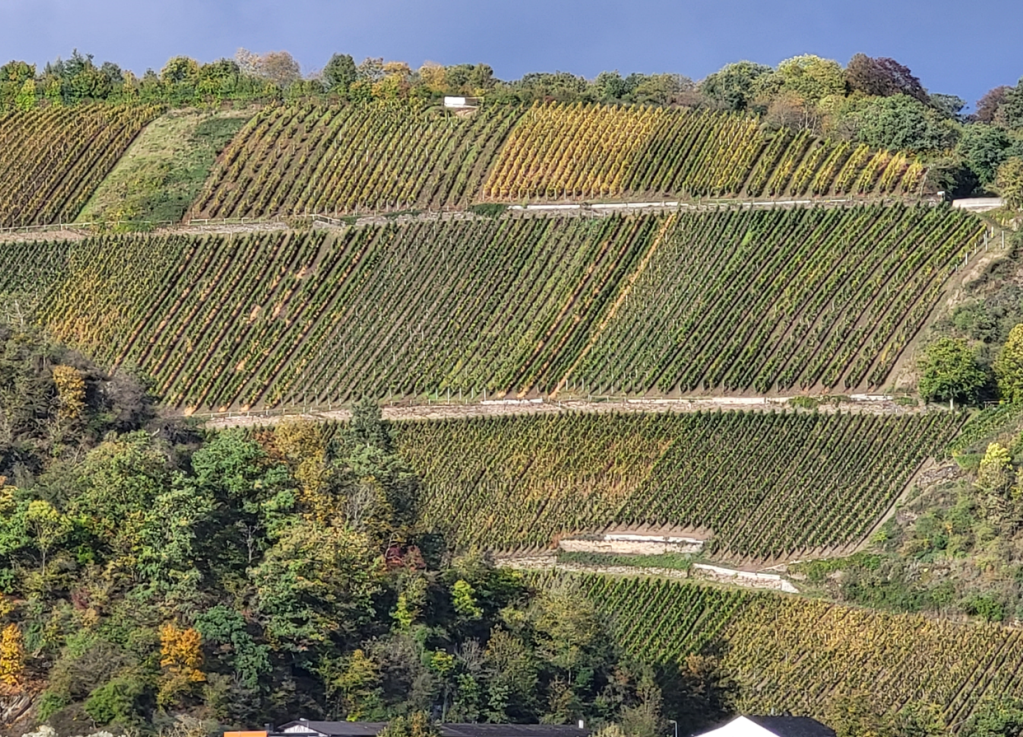
The vineyards are found tiered along the hillsides of the Moselle River. The steepest vineyard slopes in all of Europe are found here. Some of the grape vines are planted in vertical rows while others are in horizontal rows. The grapes planted vertically are machine groomed vines while those planted horizontally are generally on the steepest slopes and are maintained totally by manual labour.

Along the Moselle River in Winningen we visited the Weingut Rüdiger Kröber winery where we sampled four different Riesling wines ranging from dry to sweet; the 2022 “Kröber Weingut Steinig Riesling” dry, the 2022 “Kröber Weingut Uhlen Laubach” dry, the 2022 “Kröber Weingut Winninger Brückstück Riesling Feinherb” semi dry and the 2021 “Kröber Weingut Winninger Röttgen Kahimer Riesling Alte Reben” sweet. I found the Uhlen Laubach to be my favourite as it was robust with character and full of flavour.

The winery’s vineyards are up to 28 terraces in height along the slope of the hills. Weingut Rüdiger Kröber grows 90% Riesling, 5% Pinot Blanc and 5% Pinot Noir varietals. The vines range from 50 to 80 years in age.  The winery produces 60,000 bottles of wine per year and like many of the wineries in the region, it is all sold locally to individuals and restaurants.

Now that we have returned home from the Rhine, my wife and I are in the midst of planning our next wine excursion, which will be along the Rhone River in France during the spring of 2024.

Sláinte mhaith

Italy’s Hidden Gems

Italy is the largest wine-producing nation in the world and has 20 wine regions.  Unlike other countries where grape growing is largely restricted to specific geographical areas, Italian wine is produced nearly everywhere from the top of the boot to the tip of the toe. 

Most serious wine drinkers are well acquainted with Tuscany’s Chiantis and Piedmont’s Barolos and Barbarescos. However, with so many wine regions, each having its own unique terroir, and with over a thousand indigenous grapes, there are many great quality, lesser known Italian wines.

The next time you are at your favourite wine store, try a bottle from one of these lesser-known wine regions.

Abruzzo

This southern region is referred to as ‘the green lung of Italy’. Historically, the area was known for the bulk wine production of Montepulciano and Trebbiano, but wineries are working on changing that.  There is a native light-skinned white grape varietal called Pecorino, that was once thought to be extinct, but is now gaining popularity thanks to its ability to produce ripe and refreshing wines.       

Calabria

Calabria, which is situated at the toe of the boot, has been producing wine for more than 2,500 years. It’s best known for a regional style called Ciro Rosso, made from the Gaglioppo grape.  It is a powerful, flavourful red with earthy notes and persistent fragrance.

Campania

Located in southern Italy, east of Naples, Campania is primarily home to the Aglianico varietal. It has very high acidity and tannins, similar to Piedmont’s Nebbiolo grape.  Thus, Campania is sometimes referred to as the ‘Nebbiolo of the south’. It produces an earthy, hearty red wine that goes well with fatty meats and spicy sauces, and like its Piedmont counterpart, has tremendous aging potential.

Emilia-Romagna

Emilia-Romagna is one of the oldest wine-producing regions and spans most of central Italy. It’s known for Lambrusco, a sparkling red wine made from the grape of the same name. The wine ranges from dry to sweet, depending on the producer. It has high acidity and notes of berry.

Friuli

Friuli is situated in northeastern Italy between the Alps and the Adriatic Sea.  The region was historically known for its white wines, many of which were created from the area’s Friulano grapes.  However, it is now receiving international attention for its red wines, which are composed of international varietals such as Merlot.

Lake Garda

Lake Garda

Garda, the largest lake in Italy, is in the alpine foothills, midway between Venice and Milan.  There are several small wine regions scattered along its shores, each with its own specialty.  For example, the Bardolino region produces wines from Corvina, Molinara and Rondinella varietals, similar to those grapes of the Valpolicella region.

The Lugana region has developed a reputation for bold complex white wines from locally grown Trebbiano grapes.

Langhe

The Langhe region is found between the Barolo and Barbaresco appellations in the Piedmont region of northwestern Italy.  Just like Barolo and Barbaresco, Langhe makes its most acclaimed wines from local Nebbiolo grapes.

Liguria

Liguria is in north-west Italy to the south of Piemonte. The eastern half of the region is home to the famous wine-producing Cinque Terre area, while the western side, Riveria Ligure di Ponente, is known for several highly distinctive wines. Rossese is unique, said to be unlike any other Italian red. It’s been likened to both Dolcetto and Valpolicella and yet boasts its own unique complex character.

Sardinia

Sardinia is the second largest island in the Mediterranean Sea.  There are several underrated indigenous wine varietals found there such as Vermentino, Cannonau and Mirto. Wines made from the white grape Vermentino are crisp, acidic and fruity.

The island’s dominant red variety is Cannonau, which is very similar to France’s Chateauneuf-du-Pape.  It has robust fruit and earthy flavours.

Sicily

Sicily is an island off the coast of the tip of Italy’s boot.  Its finest red wines are made from  Nero d’Avola grapes which grow in arid vineyards and produce rich wines with intense flavour.  Similar to Syrah, it has the ability to produce a hearty, fruity and sometimes tannic wine. There are also reds that are produced from the Nerello Mascalese varietal that create elegant, expressive wines.          

Taurasi

In western Italy, south of Umbria is the town of Taurasi.  The local vineyards contain Aglianico, Nebbiolo and Sangiovese grapes which are Italy’s three most distinguished varieties.

Umbria

Umbria is located in the middle of central mainland Italy.  It is bordered by Tuscany to the north and west, Marche to the west and Lazio to the south.  According to some experts, Umbria is home to some of the most undervalued wines in Italy, ranging from crisp, dry Grechetto to bold, ruby red Sagrantino.  Sangiovese grapes are also popular in Umbria.

Sláinte mhaith

Springtime Adventure to Italy

During a recent 16-day springtime excursion to Italy as part of a tour group, I discovered passionate people, their food and their wine.  I enjoyed homemade soups, pasta, olives and olive oil, mozzarella and parmigiana reggiano cheese, prosciutto, seafood, pizza, risotto, gelato, tiramisu, limoncello and a variety of amazing coffees.

Aperol Spritz

Italy is the home of the “Dolce Vita” sweet life of physical pleasure and self-indulgence. It has the subliminal charm of fine leathers, renaissance art, classical music and of course, great food and wine.

My wife Valerie and I had the wonderful opportunity to travel by bus through the regions of Veneto, Emilia-Romagna, Tuscany, Lazio and Campania where we enjoyed the regional cuisine and wines.

We began our excursion in Veneto, the home of the cities of Venice and Verona where the white sparkling wine Prosecco is enjoyed in numerous cocktails; most notably Aperol Spritz and Bellini.  Aperol Spritz consists of 3 parts Prosecco, 2 parts Aperol and 1 part soda.  It is then garnished with an orange slice before serving.

A classic Bellini consists of 1 1/2 oz. of peach puree, topped off with chilled Prosecco.  It is served in a champagne glass and garnished with a peach slice.  Both drinks are refreshing on a warm sunny day.

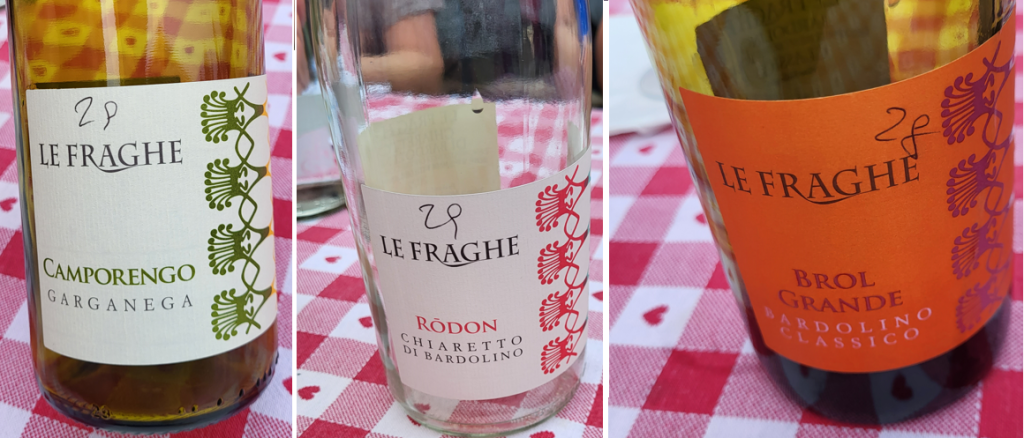
The first winery we visited was the Le Fraghe winery near Verona, where we sampled several of their wines. First was Camporengo Garganega, which is straw yellow in colour.  It has a balanced bouquet of floral hints of acacia and mimosa with peach and apple. It has full body flavour.

The second wine, Ròdon Chiaretto di Bardolino, consists of red Corvina and Rondinella grapes. Cherry red with rich purple highlights, Ròdon has fragrant aromas. Notes of wild rose are the first to emerge, followed by nuances of wild strawberry and redcurrant. The wine is crisp and full bodied.  It also had excellent tannins and acidity with a lengthy finish.

Brol Grande Bardolino Classico consists of Corvina and Rondinella grapes.  Brol Grande is a purple-tinged ruby red of medium intensity. Its bouquet is the result of a blend of the fruity essences of sweet-sour cherry and blueberry, along with spicy nuances of cinnamon and black pepper. The one-year barrel time helps the development of the wine. It has a long and slightly salted finish.

All three wines contain Italy’s DOC designation.  They are occasionally available in wine stores in Ontario and Quebec.

Veneto is also the home of Valpolicella and Amarone wines.  Unfortunately we did not have the opportunity to visit one of these wineries.

The second winery we visited was the Fattoria Poggio Alloro winery, in San Gimignano, Tuscany. The name Poggio Alloro means Bay Leaf Hill, and it refers to the bay laurel bushes that grow on the property. The farm is a family business. At the present time it consists of one hundred hectares and it is completely organic. The grape varietals include Vernaccia di San Gimignano (a local grape that grows only in this town), Sangiovese (to produce the famous Chianti wine), Canaiolo, Colorino, Malvasia and Trebbiano, Chardonnay, Cabernet, and Merlot.

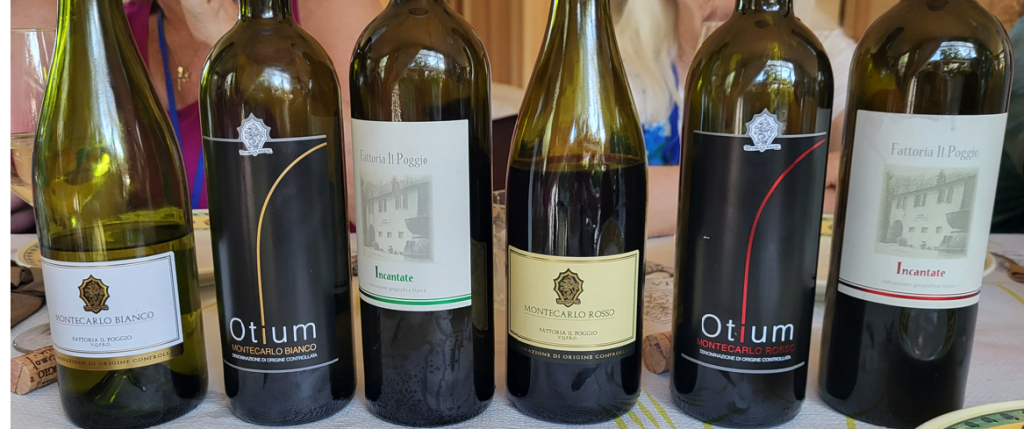
We sampled six wines while we were there, three white and three red.  The white wines included Montecarlo Bianco, which is a blend of 50% Vermentino Toscano and the balance consisting of Vermentino, Roussanne, Sauvignon and Pinot Bianco.  This combination produces a light, clear wine with a straw yellow colour. The aroma is delicate while the taste is dry, delicate and well-balanced.  Montecarlo Bianco has the DOC designation.

The second white was Montecarlo Bianco Otium, which consists of 40% Trebbiano Toscano, 20% Vermentino, 20% Roussanne, 10% Sauvignon and 10% Pinot Bianco.  This wine also contained the DOC designation.

The final white was Incantate Bianco IGT Toscana, which was made totally of Chardonnay grapes. The flavour is tropical and the wine is well balanced.

The first red wine presented was Montecarlo Rosso, which was a blend consisting of 60% Sangiovese, Syrah, Canaiolo, Malvasia and Merlot. It is a light red wine with an aroma that is intense, and the taste is delightfully smooth and dry.  It contains the DOC designation.

The second red was Montecarlo Rosso Otium, a DOC designated wine consisting of 50% Sangiovese, 30% Syrah, 10% Cabernet and 10% Merlot.  It was aged in oak barrels for four months.

The final wine was Incantate Rosso Toscana which was a bold and structured blend of 60% Merlot and 40% Syrah.

There are also 1,500 olive trees on the farm that are utilized to produce extra-virgin olive oil. The olives are completely hand picked each November and then cold pressed to guarantee the superior quality of this product.

The final winery that we attended was the Tenuta Torciano winery, also in the San Gimignano area.  The winery provided a wonderful lunch to accompany the wine tasting but unfortunately the staff did not display the labels of the wines or describe the wines in any detail.  The wines are available to be ordered online but they did not say whether any could be purchased from wine stores within Canada.

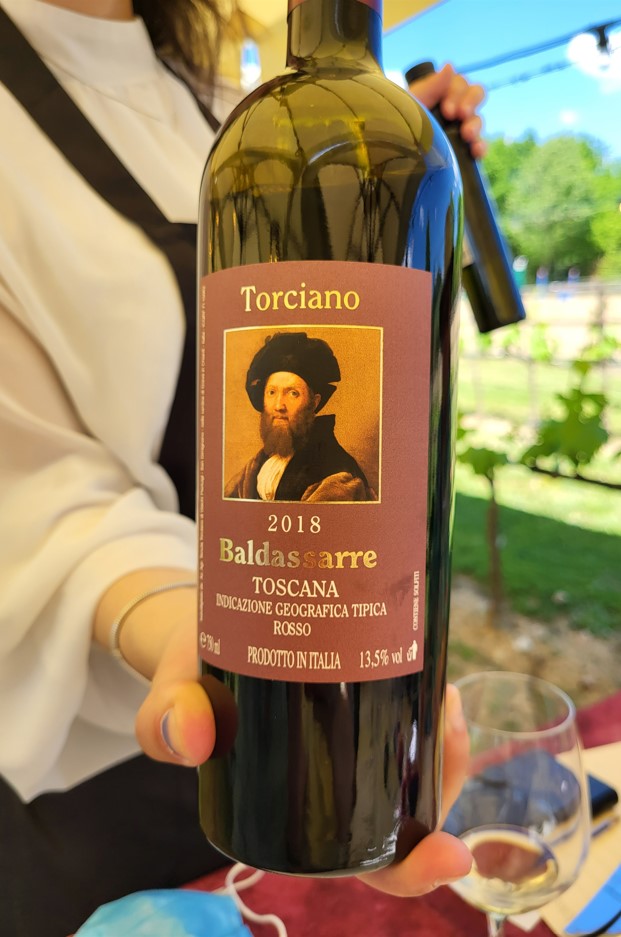
One wine that we sampled was Tenuta Torciano Baldassarre “IGT Toscana”. This wine is a blend of Sangiovese Grosso, Cabernet and Merlot. It had a deep ruby red colour which transitions to garnet as it ages.  It has an elegant bouquet. Hints of wood can be perceived amidst the typical herbaceous notes. Its flavour is dry, full and smooth.

Chianti Classico “Doge” DOCG red wine is produced with Sangiovese grapes, which are harvested by hand and then aged for 12 months.

Doge is characterized by an intense ruby red color. The nose contains hints of violet, then enriched with nuances of ripe red fruit, licorice and vanilla. The taste is full and harmonious, with soft tannins.

Tenuta Torciano Chianti Classico Riserva “Godenzio” is made from Sangiovese and Canaiolo grapes.  It has a deep ruby red colour with a penetrating bouquet and full and smooth taste.

Overall, many wines produced in Italy are not intended for export but to be consumed as table wine within Italy itself.  These wines are released and drank at a young age, have an abundance of fruit flavour and a slightly lower alcohol level. Examples of these wines include Dolcetto, Montepulciano, Nero d’Avola, Aglianico and Negroamaro.

Unfortunately, being part of a tour, we were at the mercy of the tour company as to which wineries we visited.  On the other hand, we had the opportunity to travel to two cheese factories, a couple of olive farms, a Prosciutto farm and a limoncello producer where we enjoyed experiences we otherwise wouldn’t have.

Sláinte mhaith

Wine from the Netherlands

When you think of wine regions of the world it is unlikely that the Netherlands immediately comes to mind.  Wine has been produced in The Netherlands for centuries but the winemaking industry has been working hard to reinvented itself over the past few decades.  The quality of wines made in the Netherlands has increased immensely and as a result, it is slowly but surely becoming a true wine country.

Photo credit: Google

The improvements are the result of the development of new grape varieties that are better suited to the Dutch climate. These new grapes have served to increase vineyard acreage 10-fold.  Also, the Dutch vintners are becoming more experienced, thus improving the quality of Dutch wines.

There are about 170 commercial vineyards in The Netherlands with a combined vineyard acreage of about 320 hectares. Most of the vineyards are in the south of Limburg, the warmest region in The Netherlands and traditionally the best place to grow grapes.  The majority of the grapes are white varietals due to the cool climate, although there is some Pinot Noir grown as well.

Traditional grape varietals include whites such as:

  • Auxerois
  • Chardonnay
  • Müller-Thurgau
  • Pinot Blanc
  • Pinot Gris

Since 2000, several new grape varieties better suited to the Dutch climate have been added. There are more red grapes among these new varieties.

White varietals include:

  • Johanitter
  • Muscaris
  • Solaris
  • Souvigner Gris

Red varietals include:

  • Regent
  • Cabernet Cortis
  • Rondo

I have never had the opportunity to try wine from The Netherlands but I am hopeful that I will have that chance when I visit there later this year.  Unfortunately, these wines do not seem to be available in any of the wine or liquor store that I have access to.  Hopefully one day …

Sláinte mhaith

The Aromas of Wine

The aromas of wine, which are also referred to as the nose or bouquet, range from simple to very complex, depending on the wine.  The best way to release the aromas is to swirl the liquid around the bowl of the glass.  This will expose the liquid to the air, thus releasing all of the smells.

Photo credit: finedininglovers.com

When you go to smell the wine don’t be bashful; stick your nose as far as you can into the glass and close your eyes. You will notice a lot more scents this way.  Then breathe in deep. As you do, think about what aromas you’re picking up.

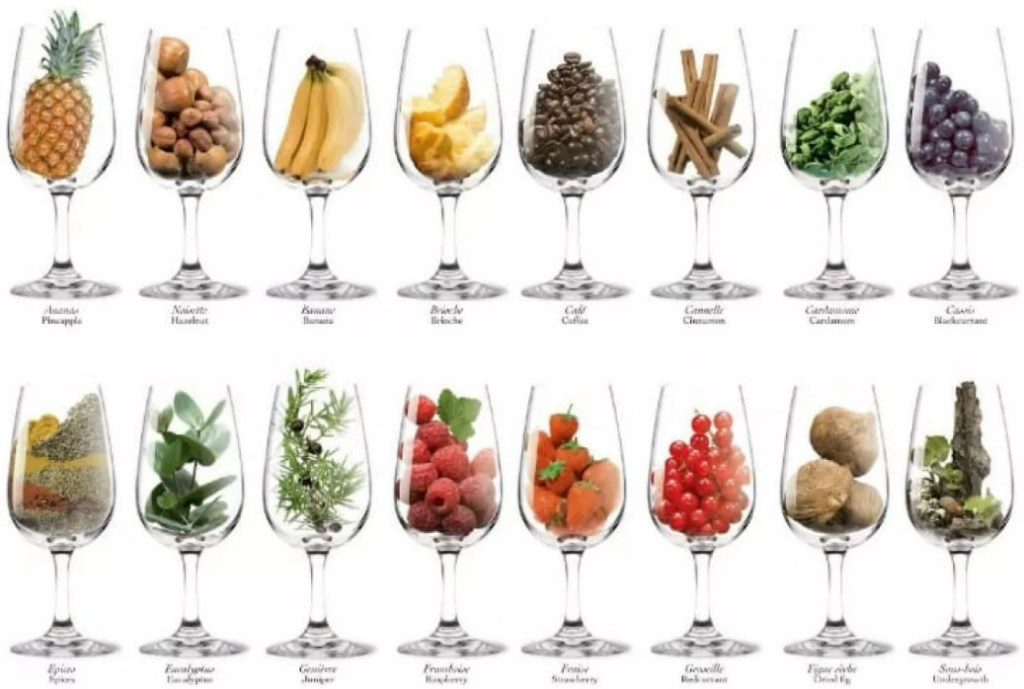
If it’s a white wine, you may be reminded of bananas, lemon rind or pineapple. If it’s a red wine, you may smell prunes, cherries, strawberries, peppers, plums or tobacco. Sometimes you may just smell grapes. Your brain will only pick up scents that you are familiar with and have smelled before. Thus, you and I could smell the same wine at the same time and relate a totally different experience.  The aroma is in the brain of the beholder.

When identifying the aromas, the experts will consider them at three levels referred to as primary, secondary and tertiary.  Primary aromas come from the grapes or are created during the fermentation process. A simple wine may show a very limited number of primary aromas whereas a more complex wine may display many more primary aromas.

White wines will display fruity aromas such as lemon, lime, grapefruit, apricot, peach or plum.  Red wines tend to present smells of strawberry, raspberry, blackcurrant or cherry.  There may also be floral, herbaceous scents in both white and red wines.

The secondary aromas in wine are created by the post-fermentation process. The most obvious of these are extracted from the oak that the wine barrels are made of.  Oak is often used when making wines such as Chardonnay, Cabernet Franc, Cabernet Sauvignon and Shiraz.  The oak can create hints of vanilla, cloves, coconut, cedar, chocolate, coffee or smoke.  Non-oak aromas may include cream, butter, cheese, toasted bread or biscuits.

Tertiary aromas occur as the wine ages in the bottle.  Only older mature wines will display these characteristics.  White wines may have aromas of orange marmalade, ginger, nutmeg, honey and stone fruits, such as peaches or plums.  Red wines may show hints of dried fruit, leather, mushroom, meat, tobacco or caramel.

There you have it; the aromas in wine are created at three different levels but how you interpret them will be as unique as you.

Sláinte mhaith

Bordeaux’s Left and Right Bank

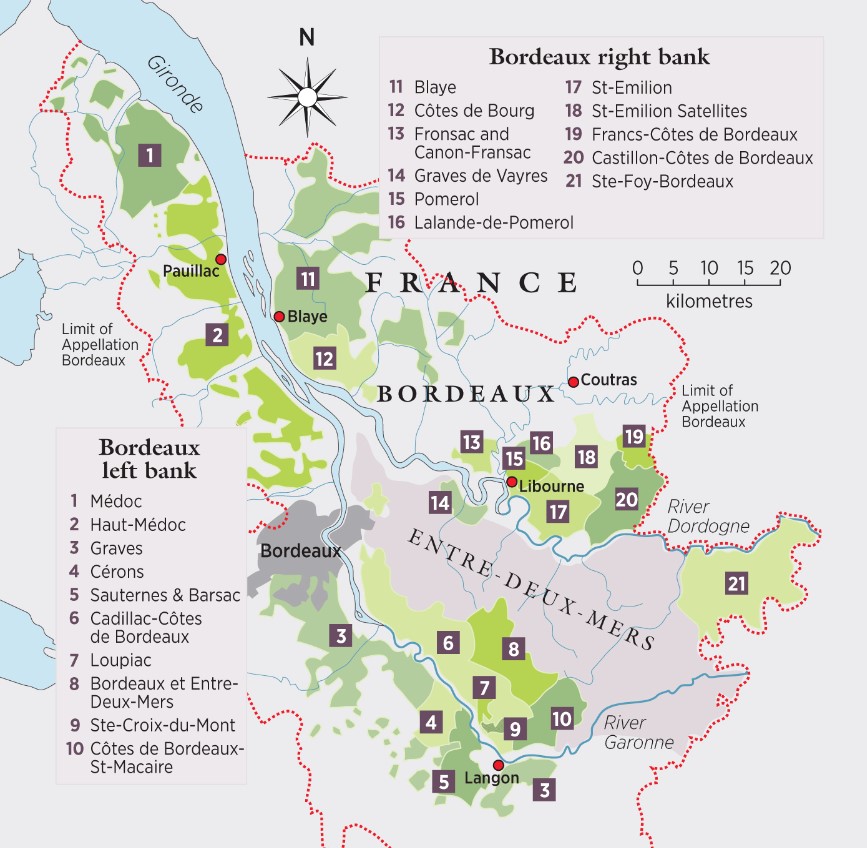
The prestigious Bordeaux wine region is located on the western coast of France. The region is separated into two sub-regions, referred to as the Right Bank and the Left Bank. Each region has its own unique nuances that characterize it from the other.

Photo credit: Decanter.com

The banks refer to the two riverbanks, the land masses on either side of the Gironde Estuary, the place where a river meets the sea. The Gironde Estuary is fed by two rivers, the Dordogne and the Garonne. The Left Bank viticultural region is on the southwest side of the Gironde and the Right Bank is on the northeast side.

The prominent difference between the Left and Right banks is the grape varietal grown.  The Left Bank is famous for its Cabernet Sauvignon while the Right Bank is mainly Merlot, Cabernet Franc, Petit Verdot and Malbec.  The reason for the grape varieties being different is due to the type of soil. The Left Bank is characterized by gravelly soils while the Right Bank is mainly clay soils.

The varietals grown determines the difference in style of wine produced.  The Left Bank’s Cabernet Sauvignon-based blends tend to be more structured, powerful and have a higher presence of tannins, whereas the Right Bank’s Merlot-dominant blends tend to be softer and silkier.  Personally, I am a fan of the wines from the Right Bank.

The most complicated difference between the Left and Right Banks is the way in which the wine is classified. For a detailed explanation of the classification methods see my post, France’s Cru Levels from March 18th.

The most notable vineyards on the Left Bank include Château Latour, Château Margaux, Château Haut-Brion, Château Lafite, and Château Mouton Rothschild.  Estates on the Right Bank include Château Cheval Blanc, Château Angélus, Château Pavie and Pétrus.

Sláinte mhaith

France’s Cru Levels

As I have discussed in the past, French wine labels can be rather puzzling since they indicate the region where the wine was produced rather than the grape varietal contained inside the bottle.  Also, the label will often contain such words as “Grand”, “Premier” or “Cru”.  Even though premier means first in French, you will often find grand appearing on the better quality wines.

Photo credit: Decanter.com

The simple translation for cru is growth.  However, in the world of French wine its reference is for the geographic terrain, specifically the soil type, climate and altitude where the grapes are grown.  It gets complicated by the fact that cru is not applied in the same manner throughout all the wine regions of France.  Further complicating things is that the term cru is also used in Germany and Italy where there are additional variations in the meaning.

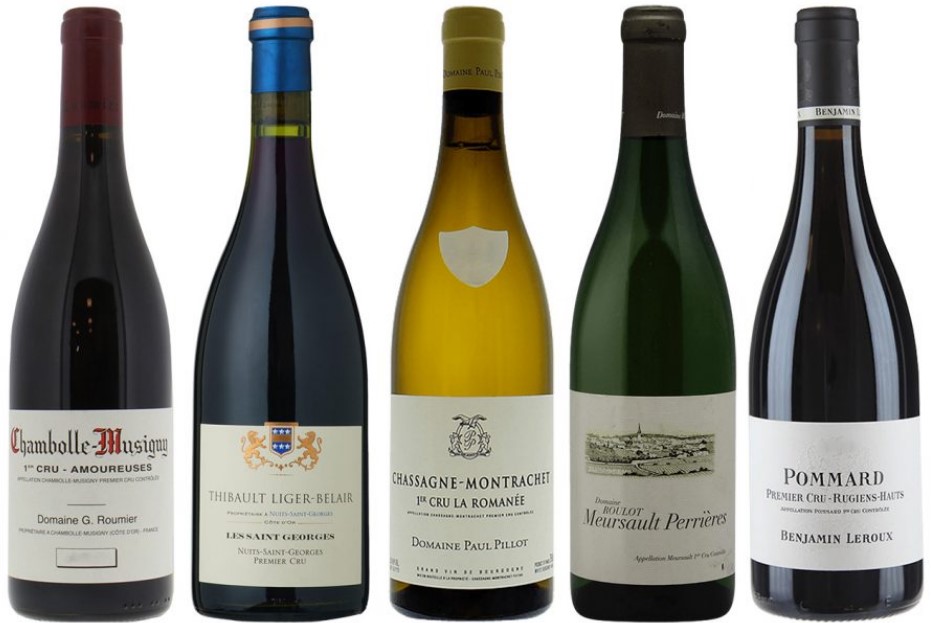
In the Burgundy region of France, the classification of cru is rather simple.  Cru designates a vineyard as being of a certain level of quality.  The classifications originate back to the 12th century and the Cistercian and Benedictine monks in the Côte d’Or.  Every vineyard in Burgundy is classified in the hierarchy where Grand Cru is at the top followed by Premier Cru and then “village” wines, with the generic Bourgogne category at the bottom.

There are 33 Grand Crus with each having its own appellation.  Only Pinot Noir and Chardonnay are grown here, but most appellations only permit one or the other varietal to be grown; very few allow both. Premier Cru wines are less expensive and are often a better value, though their long-term aging potential is typically less.

Chablis has one Grand Cru appellation that includes seven vineyards. These vineyards overlook the town of Chablis and benefit from a southwest exposure that helps ripen the grapes.

The Bordeaux region applies the term cru in a much different manner. Grand Cru Classé classification system forms the basis of the rating system and it’s tied to a specific chateau or estate, rather than adjacent vineyards. It was created in 1855 and is comprised of only left bank chateaus in Médoc, Graves and Sauternes, ranked from first to fifth growths, based on their value at that time. The first growths are called Premiers Crus, while second through fifth growth crus are called Crus Classes.

On the right bank Pomerol isn’t classified but Saint-Émilion is.  St.-Émilion has three chateau-based quality classifications. At the top is Premier Grands Crus Classés, of which there are 18, followed by Grands Crus Classés which contains 64 chateaus. The appellation’s third category is not tied to a specific ‘classed’ chateau or geographical subzone. Wines labeled “St.-Émilion Grand Cru” merely have more stringent production rules.

The Alsace region uses the term Grand Cru in similar fashion as the Burgundy region. Fifty-one vineyards have been designated superior, or Grand Cru, and wine from those vineyards can use the term on their label. There is a great deal of diversity in Alsace’s Grand Cru wines.  There are four grapes approved for use, as well as a wide variation in soils.

The Beaujolais region is where Gamay grapes are grown. Here cru is applied to villages rather than vineyards. There are 10 villages and the wine produced from these villages is called Cru Beaujolais.

The Champagne region also classifies entire villages as Grand Cru or Premier Cru. The Champenois created a system referred to as échelle des crus, or “ladder of the growths” in the early 20th century to fix grape prices for both farmers and buyers at Champagne houses.

At each harvest a price is set and growers with land in one of Champagne’s grand cru village receives 100% of that price. Grapes from the premier cru villages earns from 90% to 99% of the set price, while the rest receive from 80% to 89%.

There you have it; a little more of the puzzle of French wine resolved.

Sláinte mhaith

The Mystery of French Wine

In France the varietal of grape a wine is made of is seldom indicated on the label.  Instead, the French tend to identify flavour by the region from which the wine was produced.  Because of this, people often shy away from buying French wine.  However, the mystery of French wine can be solved by simply knowing which grapes are grown in each region.  To assist you, most wine and liquor stores arrange their French wines by region.

Photo credit: ihmkolkatafoodandbeveragenotes.blogspot.com

ALSACE

The Alsace region is located in the northeastern region of France between the Vosges Mountains and the Rhine River.  Historically, Alsace was part of Germany, which influences the types of grapes grown in the region. It is home to single varietal white wines including Gewurztraminer, Muscat, Pinot Gris, Riesling and Sylvaner.  The wines cover the spectrum, ranging from dry to sweet.

BEAUJOLAIS

The Beaujolais region is known for growing the Gamay grape, which has bright acidity and low tannins.

BORDEAUX

Bordeaux is France’s largest and most renowned wine region.  It is known for its red blends highlighting Cabernet Sauvignon on the Left Bank and Merlot, Pomerol and Saint Emilion on the Right Bank.  The white varietals of Bordeaux include Barsac and Sauternes grapes.

BURGUNDY

Pinot Noir and Chardonnay, referred to as Chablis, are the standard grapes grown in the Burgundy region.

CHAMPAGNE

The Champagne region is renowned for its sparkling wines produced from one or more of Chardonnay, Pinot Noir or Pinot Meunier.

LOIRE VALLEY

The Loire Valley stretches from the Auvergne region to the Atlantic Ocean.  It produces most of France’s white wine. The white varietals of the Loire include Chenin Blanc (called Vouray), Sauvignon Blanc (referred to as Sancerre and Pouilly-Fumé) and Muscadet.  It is also known for the red varietal, Cabernet Franc.

PROVENCE

Provence is the oldest wine region in France.  It is the only region that specializes in Rosé wines.

RHÔNE VALLEY

Syrah and Viognier are the highlights of the northern part of the region while Grenache, Syrah and Mourvèdre are prominent in the south.  Mourvèdre is the dominate grape in Châteauneuf -du-Pape.  Blending of the grapes results in rich reds and vigorous whites and rosé.

Final Thoughts

Once you know which regions grow your favourite grapes, it is much easier to find a suitable bottle of French wine to enjoy.

Sláinte mhaith

Grape Revival

There is a recurring theme of grape revivals beginning to take place in Europe. Back on May 28th I wrote about France’s The Forgotten Grape of the Loire, the Lignage grape, and today I will talk about efforts taking place by some of the world’s largest wine producers. Not only do they have the resources to take on such a massive undertaking, but they also have the land, the vineyards and the history to be able to go back in time to re-plant vines for the future.

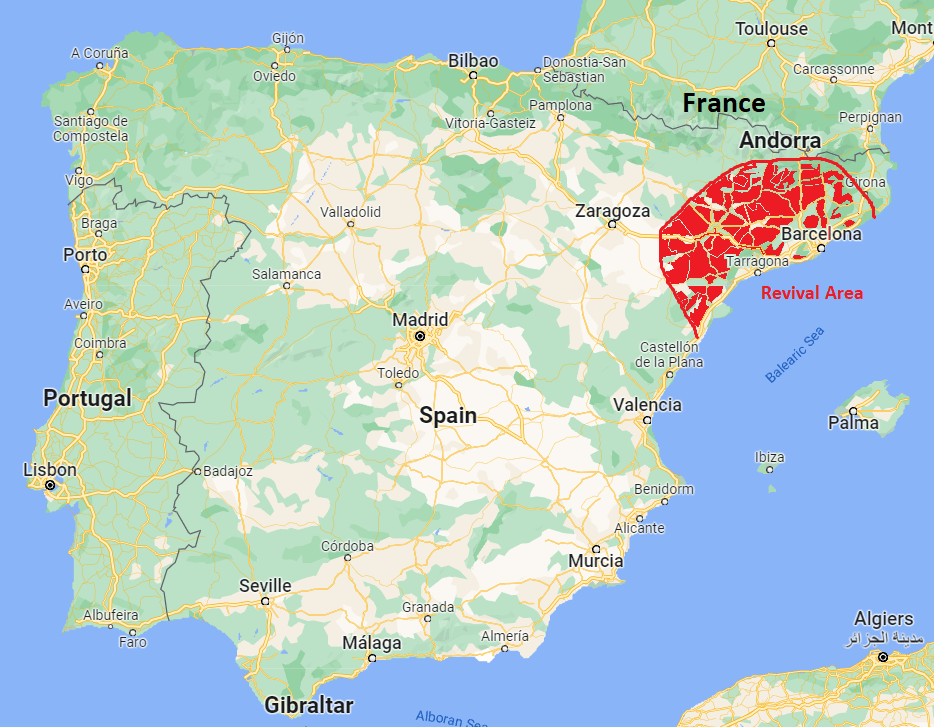
One such producer is Spain’s Familia Torres where Miguel A. Torres, the fourth-generation president, began the work about 40 years ago after discussing the great phylloxera aphid epidemic of the late 19th century with famed University of Montpellier viticulture professor Denis Boubals. The insect infestation, which unknowingly came from North America, destroyed most European vineyards.  However, Boubals believed that a few vines had probably survived somewhere.

Torres began the search for orphan vines and over several decades his winery has rediscovered 54 ancient grape varieties from Catalonia, including six good enough to produce as wine.  It is his belief that we need a new way of understanding wine in order to mitigate the effects of climate change. With that aim, Familia Torres focused their efforts on reducing their carbon footprint, while recovering ancestral varieties, promoting research and implementing regenerative viticulture to benefit the vineyards and the planet.  What makes these old varietals even more interesting and potentially important in light of climate change is that they have been found to be significantly resistant to both heat and drought.

Regenerating ancestral varieties is an exercise in viticultural archaeology to recover past heritage. By reviving varieties used by their ancestors, they can look to the future and discover the authenticity that will result in extraordinary wines that are truly special and cannot be made the same way anywhere else.

With an understanding of the type of varieties and vines that prospered so well in its soils in the past, the Torres family will be able to work better with the grapes and terroir they now have in their vineyards.

The first step of the project was to try and fine old vines and determine if they were indeed varieties that were no longer cultivated.  This required going to the media outlets and placing ads asking farmers to contact Torres if they came across vines they could not identify.

Their first breakthrough came in the mid-1980s when a vine was found that Torres’s technical team could not identify.  This unknown varietal was eventually identified as Garró.  After much examination and research the decision was made to plant the variety in Conca de Barberà and add it to the blend of the first Grans Muralles vintage in 1996.

In 1998 a second variety was found and named Querol, after the village where it was found. The 2009 vintage was the first Grans Muralles blend to include grapes from the Querol vines.

Since 2000, Familia Torres’s research team has collaborated with France’s National Agricultural Research Institute, the INRA, to establish and implement specific stages when looking to identify and revive ancestral varietals. These stages include:

Search for Varietals

This includes the placement of ads with local and regional media outlets to tell grape growers who to contact if they happen to come across an old vine. When a potential case presents itself, Torres’s technical team conducts a preliminary evaluation on site.

Identification and Classification

To identify different varieties, ampelographers analyze the shoots, leaves, canes and grapes. A DNA analysis of the vine is then completed to dispel any remaining doubts about the variety.  If the variety is identified as being unique, the team then completes a detailed description of all of the plant’s components.

Evaluation and Enological Potential

In order to study the behavior of these varieties under normal reproductive conditions, the vines are planted in a pilot vineyard. This allows for an in-depth analysis of the vegetative and productive parameters of each individual variety. The grapes are harvested to evaluate the enological (science that deals with wine and wine making) potential and organoleptic (being, affecting, or relating to qualities (such as taste, colour and odor) of a substance (such as a food) that stimulate the sense organs) quality of the wines.

Adapting to the Vineyard

The varieties displaying enological potential are planted in vineyards to evaluate their performance under more extreme climate conditions. Once the ideal conditions for each variety have been identified and its enological potential verified, the process of registering it with the relevant authorities begins.

The complete list of ancestral varieties that have been regenerated by Familia Torres include the following:

Garró

Garró was the first variety to be revived. First found on the terraced slopes of the Garraf Massif in the mid-1980s, it was planted in the early 1990s in Conca de Barberà.   It was initially used in the blend of the first Grans Muralles vintage (1996). This is a late ripening, low yield variety with “great aromatic complexity”, according to Torres.  It also “displays intense notes of green leaves and ripe black fruit. They are big on the palate, with lots of character and lively tannins”.

Querol

This old vine, rediscovered in 1998 near Querol (Tarragona,) saw the resurgence of a variety that was named after the village where it was found.  It is one of the few known varieties that is completely female. This means that unlike most vinifera vines, its flowers are female rather than hermaphroditic (having both male and female reproductive organs). s a result, the berries are smaller and more irregular, and produce in a low yield.

Torres says Querol wines “are intense and fruity (forest fruit, pomegranate juice) with a big, concentrated palate that displays good acidity”.

Moneu

Moneu was also found in 1998 near Querol. It is named after Coster de Moneu, located to the south of the village.  It is a red variety that grows well in high temperatures and drought conditions. The wines offer intense aromas of fragrant fresh fruit with well-defined acidity and gentle tannins.

Gonfaus

This is a red variety that was found around Lluçanès in Osona county in 1998. The climate conditions there are extremely dry, with large changes between daytime and nighttime temperatures. Gonfaus is a very low-yielding variety with wine that displays complex aromas of ripe fruit with slightly spicy undertones.  It has well-integrated acidity and ripe, sweet tannins.

Forcada

Forcada is a white varietal found in Ripollès county. It is very vigorous and productive, as well as very aromatic. It has aromas of herbs, white flowers and citrus.

Pirene

Found in the foothills of the Catalan Pyrenees, Pirene is a strongly pigmented red variety with high tannin levels and a spicy, minerally nuance. The flavour reveals flavourful fresh fruit.

Sláinte mhaith