The Whiskey Capital Booms Again

At the dawn of the twentieth century, Ireland was the hub of the world of whiskey with Bushmills being the oldest licensed whiskey distiller in the world.  Jameson was one of the most recognized names and Dublin, the centre of it all having one of every three workers involved in some way with the whiskey industry.  At that time about three quarters of the world’s whiskey came from Ireland.

Photo credit: forbes.com

However, the events of history were not kind to the Irish whiskey trade.  Two world wars, the Irish War of Independence, Prohibition and the rise of the Scotch Whisky industry all played a part in its demise.  By the 1960s the industry was on the verge of extinction with only one percent of the world market share.

By the 1970s there were only two operational distilleries in all of Ireland; Midleton, who produces many well-known Whiskey brands including Midleton, Jameson, Powers, Redbreast, Writers Tears, The Irishman, Green Spot, Yellow Spot, Red Spot, Blue Spot amongst other labels, and Bushmills, who at the time was also then owned by the same company.

For several decades there were no working distilleries in Dublin (Midleton was located in County Cork and Bushmill was in County Antrim, Northern Ireland) but today there is a resurgence throughout Ireland, including Dublin.  In 2015 the redevelopment began in Dublin with the launch of Teeling Distillery.  Since then there have been others who set up shop including Roe & Co, Pearse Lyons and the Dublin Liberties.

Today the Irish Whiskey industry is healthier than it has been for over 120 years.   According to the Irish Whiskey Association, as of December 2019 there were 32 distilleries in operation in Ireland.

If you are planning to visit Ireland here are some of the best distilleries to visit:

DUBLIN

Pearse Lyons Distillery – Founded by the late Pearse Lyons in the Liberties district of Dublin, this boutique distillery is a unique spot to learn about the brewing and distilling processes.  It is located in the restored St James’ Church on James St.

Tullamore D.E.W. Distillery – Created in 1829 and later prospering under general manager Daniel E Williams (hence D.E.W. in the name), Tullamore D.E.W is the second largest selling brand of Irish Whiskey globally.

Teeling Whiskey Distillery – The first new distillery in Dublin for 125 years, it is located in Dublin’s historic distilling district.

Roe & Co Distillery – Named after legendary 19th-century whiskey pioneer George Roe, Roe & Co opened their doors in 2019 at the Guinness Power House.

The Dublin Liberties Distillery – Set in the district from which it takes its name, it is a modern, state-of-the-art distillery on Mill St.  You can hear the tales of trade, conflict and debauchery about the Liberties district, stretching back hundreds of years to when it was outside of the official Dublin city limits.

Jameson Distillery, Bow St. – Ireland’s most famous whiskey opened in 1780 by John Jameson.  The distillery on Bow St in Smithfield has been a staple in Dublin for over two centuries.  Although since 1971 it has operated only as a visitors’ centre.

MIDLETON

Jameson Distillery, Midleton – Midleton, in County Cork, is where the bulk of Jameson operations have taken place since 1975.

COUNTY CARLOW

Royal Oak Distillery is the first to distill all three styles of Irish whiskey: pot still, malt and grain, all under one roof.  It’s also the largest non-automated distillery in Ireland.

COUNTY CORK

Clonakilty Distillery – Single pot still whiskey is Clonakilty’s specialty. They also will explain how different woods change the character of the whiskey as it matures.

DINGLE PENINSULA

Dingle Distillery – Since 2012, the Dingle Whiskey Distillery has been distilling some excellent single pot still whiskey.

COUNTY KILKENNY

The Ballykeefe Distillery – Though only in operation since 2017, the distillery is situated on land that has a distilling heritage going back hundreds of years.  They follow the family farm traditions and have a strong commitment to sustainability.

With records of distilling going back to 1324, it’s claimed that Kilkenny is the birthplace of Irish whiskey.

COUNTY MEATH

Slane Irish Whiskey Distillery – Located 50 minutes outside of Dublin, the distillery is located in in the 250-year-old stables of Slane Castle.

WATERFORD

Waterford Distillery – Distilling since 2015, Waterford Distillery’s state-of-the-art facility is on the banks of the river Suir.

COUNTY WESTMEATH

Kilbeggan Distilling Co. – Established in 1757, it claims to be Ireland’s oldest licenced distillery and after battling through a painful closure in 1953, it was revived by locals in the 1980s who have maintained it ever since.

COUNTY WICKLOW

Powerscourt Distillery – At the foot of the Wicklow Mountains, Powerscourt Distillery is located a short drive south of Dublin. Set in The Old Mill House, the distillery was once at the heart of the local farming community.

COUNTY ANTRIM, NORTHERN IRELAND

The Old Bushmills Distillery – On the wild north coast of Ireland, the Bushmills Distillery has been in operation for over 400 years, making it one of the oldest whiskey distilleries in Ireland. Established in 1608, it claims to be the oldest licensed distillery in the world.

Sláinte mhaith

No Corkscrew, No Problem

What do you do when you find yourself in the predicament of desperately needing to open a bottle of wine and you don’t have a corkscrew, and the bottle is not a screw top?  Several of the major wine publications have invested time and effort to find reasonable solutions to this problem. I will present those that I feel are not too farfetched, are fairly safe and hold a realistic chance of success.   However, none of these methods are as reliable as using a corkscrew and could result in breaking the cork, chipping the wine bottle, or in a worst-case scenario, breaking the wine bottle.

This list of potential solutions is presented in no particular order.

Screw, Screwdriver and Hammer

Take a screw (minimum 1 ½ inches long) and screw it into the cork with a screwdriver until there is about an inch or so left showing. Then, you take the claw side of the hammer, lock it under the screw, and pull the cork out.

Push the Cork into the Bottle

Using the handle of a wooden spoon, Sharpie, highlighter or other object that is slightly smaller in diameter than the cork, push the cork down into the bottle of wine. Unfortunately, it is almost impossible to remove the cork from the bottle once you push it in. If the bottle of wine is old, the cork may crumble and shed into the wine once pushed in. If this happens, use a strainer, coffee filter or sieve and pour the bottle of wine through it into a decanter to remove the cork pieces.

Wire Clothes Hanger

This method is relatively easy as long as you have an unused wire hanger taking up space in your closet.  However, in our house the wire hangers were replaced with plastic hangers years ago.   

To begin, bend the tip of the hanger about 30 degrees back so that it looks similar to a fishhook. Next, slide the wire down through the cork slowly until the hook is past the cork and into the wine. Rotate the wire 90 degrees so that the hook is underneath the cork. Then pull the wire up and the cork should release. Pliers can be used instead of your fingers to tug at the hanger.

Keys, Scissors or a Serrated Knife

This method is somewhat similar to the first option where a screw and hammer are used. However, this time plunge your keys, scissors or serrated knife into the cork at a 45-degree angle and move the top of the item in a circle, essentially twisting the cork out slowly. After several rotations the cork should come out. Make sure you really get the tool well into the cork otherwise the cork may crumble.

The Sole of a Shoe

Wrap the bottom of the wine bottle in a towel and place it upside down in between your legs while sitting and slap it with the sole of a shoe. Stop before the cork comes all the way out or the wine may end up all over you and the floor.

Tire Pump and Sports Ball Needle

Take a bike pump that has a needle attached that is used to inflate a basketball, football or volleyball and push it all the way through the cork where the needle reaches the air space between the cork and the wine. Then pump air into the bottle. As air is pumped in, the cork should slowly move out of the bottle due to the air pressure.

Final Thoughts

As long as you are careful and take your time, any of these alternatives should work.  However, in my opinion nothing is better than a tried and true corkscrew, if one is available.

Sláinte mhaith

It’s Not Just About the Number

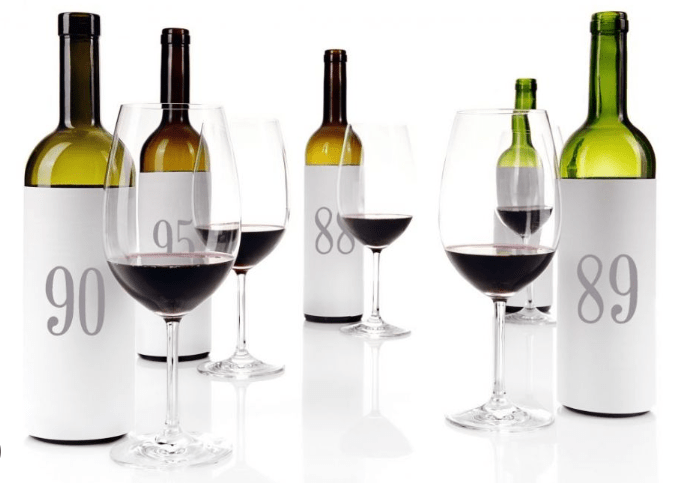
When searching for the ideal bottle of wine to compliment a meal, for a special occasion, or simply to lounge with in front of the television, many people rely on the wine’s rating number or score, as it’s often referred.

Photo credit: vivaavida.r7.com

The most commonly used scoring system is what is referred to as the 100-point scale, which was created by James Suckling in the 1980s. Wines with a score between 89 to 91 are considered good; a score between 92 and 94 is great; a score between 95 and 97 is excellent; and a score from 98 to 100 is considered outstanding.

It is important to realize however that every bottle of wine with a score of 98 is not necessarily better than every bottle of wine with a score of 92. Other factors, such as price to quality, must also be considered.  Therefore, it is important to take into account other factors of a wine review before making the ultimate decision as to which bottle you are taking home.

If you see the name of a winery whose wine you have enjoyed in the past, there is a good probability that you will like other wines produced by that winery as well. 

Noting the type of grapes contained in the wine is an excellent indicator as to whether you may like a wine or not.  If you favour certain grape varietals, for example Riesling or Merlot, chances are wines containing those grapes will be more enjoyable for you.

Many countries, including Canada, have a quality standards system that will indicate on the bottle whether the wine has met the appellation of origin standards.  These standards ensure that certain agricultural criteria are met.  In Canada we have the VQA (Vintner’s Quality Alliance) system.  For more information regarding quality standards see the following posts from 2019: Selecting Canadian Wines, France’s Standards of Quality, Germany’s Quality Standards and Italian Quality Standards.

A wine’s place of origin is one factor in determining its characteristics. The region where a wine comes from will indicate the style of wine as well as flavour characteristics.  So, if you find you favour the flavour of a wine from a particular region, chances are you will enjoy other wines from that same region.

Not all wines are intended to be consumed right away. Although the majority of wines may be enjoyed when you take them home, some wines are best drunk after they have been laid down for a few years. The vintner’s notes or the wine store will often indicate whether a wine is intended to be enjoyed now or is best to be cellared.  Drinking a wine too soon may leave you with unpleasant thoughts about that wine.

Happy wine shopping.

Sláinte mhaith

Rhine River Cruise

My wife and I recently returned from a Rhine River cruise where we had the opportunity to sample wines from Switzerland, France and Germany during our travels. I was most anxious to try some Swiss wines as I had never had the opportunity of tasting any. These wines are not often available outside of Switzerland (see The Wines of Switzerland from May 1, 2021). 

The first Swiss wine we tried was a 2022 Weinbau Ottiger Pinot Noir. The wine is very similar in character to a French Pinot Noir.  The second sampling was a red blend from Château Constellation sa 1950 Sion, called “Humagne Rouge”.  It has a spicy bouquet characterized by notes of pine and cinnamon. It has accents of black fruit aromas balanced by silky tannins. It was very enjoyable.

We ventured through Strasbourg, France and the Alsace wine region. World-renowned for its viticulture, Alsace has a dry mild climate, favourable soils and ideal exposure to the sun for its vineyards. The white wines produced here rival the Rieslings created in neighbouring Germany.

While in Breisach, Germany, the tour offered a wine tasting at Domaine Albert Seltz, Alsatian Vineyards.  There they follow a rigorous process to preserve the authenticity of their wines, respecting traditional techniques while integrating the most recent advances in technology. Sustainable viticultural practices are followed that promote biodiversity and respect for nature.

The area surrounding Breisach, the capital of Alsatian wines, has the third largest wine co-op in the world, following California and South Africa. Twelve million litres of wine are produced there each year, taking advantage of being the sunniest place in all of Germany.

We also visited Rüdesheim, which is a German winemaking town in the Rhine Gorge, and part of the UNESCO World Heritage Site. It is in the heart of the Rheingau wine region.

Close to Speyer, Germany lies the Roter Hang wine area.  It is considered to be one of the most important vineyard sites in the world, sitting to the south of Mainz, not far from Nierstein and Nackenheim. The soil is red, the result of red slate that exists throughout the region, providing the perfect conditions for outstanding wines that are characterised by unmistakeable flavour.

Further north at the intersection of the Rhine and Moselle Rivers is the town of Koblenz.  Koblenz is a principal seat of the Mosel and Rhenish wine trade. Mosel is best known for growing some of the finest Riesling grapes in the world. 

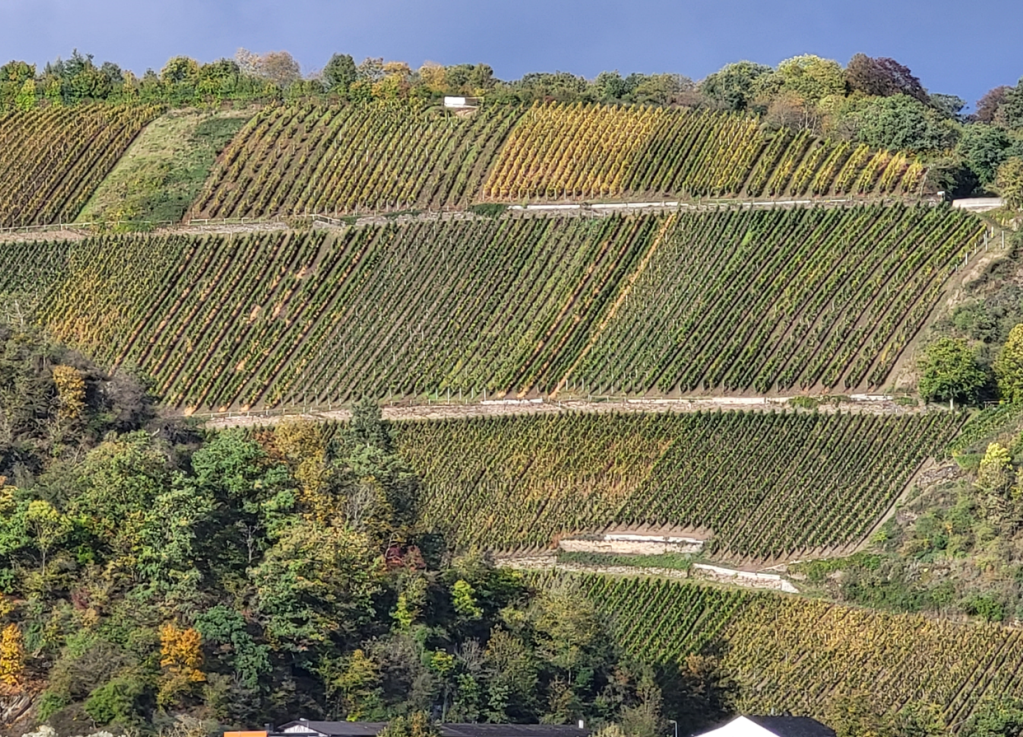
The vineyards are found tiered along the hillsides of the Moselle River. The steepest vineyard slopes in all of Europe are found here. Some of the grape vines are planted in vertical rows while others are in horizontal rows. The grapes planted vertically are machine groomed vines while those planted horizontally are generally on the steepest slopes and are maintained totally by manual labour.

Along the Moselle River in Winningen we visited the Weingut Rüdiger Kröber winery where we sampled four different Riesling wines ranging from dry to sweet; the 2022 “Kröber Weingut Steinig Riesling” dry, the 2022 “Kröber Weingut Uhlen Laubach” dry, the 2022 “Kröber Weingut Winninger Brückstück Riesling Feinherb” semi dry and the 2021 “Kröber Weingut Winninger Röttgen Kahimer Riesling Alte Reben” sweet. I found the Uhlen Laubach to be my favourite as it was robust with character and full of flavour.

The winery’s vineyards are up to 28 terraces in height along the slope of the hills. Weingut Rüdiger Kröber grows 90% Riesling, 5% Pinot Blanc and 5% Pinot Noir varietals. The vines range from 50 to 80 years in age.  The winery produces 60,000 bottles of wine per year and like many of the wineries in the region, it is all sold locally to individuals and restaurants.

Now that we have returned home from the Rhine, my wife and I are in the midst of planning our next wine excursion, which will be along the Rhone River in France during the spring of 2024.

Sláinte mhaith

Storing Your Whiskies

With the price of whisky ever increasing, ranging from $50 to $500 or more for a standard bottle to well into the thousands of dollars for rarer offerings, it is becoming more important to be sure that the whisky does not deteriorate after you purchase it.  There are a variety of factors to take into consideration when storing whisky; heat, evaporation and alcoholic content.

Photo credit: liquor.com

Rare collectable whiskies are best stored in a cold storage facility.  However, for most whiskies, storing it in a cool location in your house is often sufficient.  This will help to ensure that no evaporation occurs. 

Unlike wine, whisky bottles should be stored in an upright position. If a bottle is stored on its side, the high alcohol content will weaken the cork, resulting in the whisky leaking out of the bottle.  Be sure to keep an eye on the condition of the cork. Constant contact with the high strength alcohol can degrade the cork, causing it to disintegrate or transfer unpleasant flavours into the whisky. Turn the bottles upside down a couple times a year to help ensure the cork does not dry out or oxidate.

It’s best to keep the whisky in a consistently cool, but not cold location.  If the liquid becomes too cold, it can cause it to become cloudy. Experts recommend storing whisky at a temperature of between 15° and20° Celsius (59° to 68° Fahrenheit). If you’re collecting both whisky and wine, like I do, you may not want to store them together, as the ideal temperature for keeping whisky is higher than for wine, which is 13° to 14° Celsius (55° to 57° Fahrenheit).

Like wine, the bottles should be kept away from sunlight as the sun can affect the delicate flavours and desired colour of the spirit, as well as cause evaporation.   Darkness will also help preserve the labels from fading, maintaining them in mint condition.

It is important to maintain consistent temperature and humidity. Fluctuating temperatures and humidity can cause the liquid to expand and contract, destabilizing it. Excess humidity can cause damage to the labels and degrade the cork.

Sláinte mhaith

Fortified Wines

Photo credit: thewinedream.wine

Fortified wine is wine that has had a distilled spirit added during the winemaking process. There are several types of fortified wines, each classified by its own unique set of regulations. These regulations include the type of base wine, type of spirit that is added to the wine, the amount of alcohol by volume (ABV), the amount of sugar and the period that it is aged.  While fortified wines can be made anywhere, specific geographic regions are often regulated for a distinct category. For example, Madeira is only produced in Portugal’s Madeira Islands.

The basic process for making fortified wine involves fermenting the wine and adding distilled spirits, such as brandy. The winemaker determines the amount of sweetness in the fortified wine depending at which stage of the process the distilled spirits are added. If the spirit is introduced before fermentation is complete, the resulting wine will be sweet.  However, it the spirits are added after fermentation is complete, the resulting fortified wine will be dry.

Wine fermentation occurs when yeast breaks down sugar molecules in grapes and produces ethyl alcohol. Adding a spirit during the fermentation process reduces the yeast content and results in a sweeter fortified wine because a larger amount of residual sugar is left behind. On the other hand, if fermentation ends before the spirit is added, the yeast will break down a higher percentage of the sugar, resulting in a drier fortified wine.

Both sweet and dry varieties are often served as aperitifs or digestifs before or after meals to help stimulate appetite and digestion.  Some types of fortified wines are also used in cooking to add a delicious twist to a favourite recipe.

The regulations for making fortified wine vary by region. Here are some of the most popular types presented alphabetically:

Commandaria

Commandaria comes from Cyprus and is predominately a sweet dessert wine. It’s made with only two types of grapes, Xynisteri and Mavro, which are indigenous to the island. The maximum alcohol content is 20 percent ABV.  Commandaria is rich and sweet with a fruity taste.

 Madeira

This type of fortified wine derives its name from Portugal’s Madeira Islands. Brandy is added at different times during fermentation causing variations in flavours.  Types of Madeira range from dry wines served as an aperitif to sweet wines served with dessert.  An aging process known as estufagem is used to create the wine and give it its unique taste. Madeira can be produced in two ways: either over a period of months with hot water tanks or steam, or naturally over a period of decades.

Marsala

Marsala is a fortified wine from the Italian island of Sicily. It is available in both dry and sweet varieties and is produced using white Italian grapes and depending on its type, contains between 15 and 20 percent alcohol by volume. The various types of Marsala are determined based on their sweetness, age and colour.

Styles of Marsala range from dry aperitivos to sweet dessert-style wines.  Marsala is a common cooking wine that’s fortified after fermentation, giving it a distinct dry flavour. It’s also sometimes sweetened, making it a great addition to dessert recipes.

Moscatel de Setúbal

This a Portuguese fortified wine that comes from the municipality of Setúbal. It must be made with at least 85 percent white Muscat grapes and contain between 16 and 22 percent ABV. Moscatel de Setúbal is one of the sweeter fortified wines and frequently has notes of apricot and orange zest.

Port

Port wine comes from the Douro Valley region of Portugal. Grapes must be grown and processed in the region to be considered as Port.  Unaged brandy is added to the wine before it has finished fermenting, resulting in a sweeter flavour.  The ABV will be in the 20 percent range.

There are many styles of Port, but its most popular form is a sweet red wine, such as Ruby Port or Tawny Port. Those seeking a different type of dessert wine might consider a White Port or Rosé Port.

Sherry

This fortified wine is produced in from Palomino, Muscat or Pedro Ximénez grapes in the Jerez region of Spain. Sherry production is unique in that the winemaker intentionally exposes the wine to oxygen, which imparts nutty and briny flavours. Before bottling, entire barrels are blended with portions of older wines. This process is referred to as the solera method and is almost entirely exclusive to the production of sherry.

Sherry is fortified with brandy and will contain between 15 to 18 percent ABV. Like any wine, after opening it should be refrigerated but will retain its freshness about four times as long as a typical wine. There are many styles of sherry, ranging from the lighter Fino style to the darker Oloroso style.

Vermouth

Vermouth is fortified wine that is aromatized with flavours of fruits, herbs, spices and florals. Dry Vermouth, also referred to as French Vermouth, has a distinctly crisp and floral character. Dry Vermouth is produced by blending white wine with herbs and spices before adding brandy for fortification. Sweet Vermouth, also known as Italian Vermouth, has a heavier mouthfeel and a more caramelized, fruity character than Dry Vermouth. It doesn’t have to be made from red wine, although some producers insist on it.

Where Dry Vermouth is often the basis for a Dry Martini, sweet vermouth is used to create cocktails such as Manhattan and Negroni. However, Sweet Vermouth can also be enjoyed on its own with a bit of ice or soda.

In Closing…

Many people are either unfamiliar or intimidated by fortified wines.  They should not be feared and the best way to become familiar with them is to try them.  I would suggest starting with a mid-priced Tawny or Ruby Port, or a sweet or dry Sherry.

Sláinte mhaith

The World’s Biggest Wine Producers

Here’s some information that may be of help on trivia night or for those of you who simply have an enquiring mind.  Below are 2022’s wine production statistics measured in million hectolitres.  I have included production numbers for the top 30 countries; however, the complete list is available at http://www.visualcapitalist.com.  A hectolitre contains 100 litres.  The information was gathered by the International Organization of Vine and Wine (OIV).

 Rank              Country        ContinentQuantity
(million hl)
% of Total
Production
1ItalyEurope49.819.3
2FranceEurope45.617.7
3SpainEurope35.713.8
4United StatesNorth America22.48.7
5AustraliaOceana12.74.9
6ChileSouth America12.44.8
7ArgentinaSouth America11.54.4
8South AfricaAfrica10.23.9
9GermanyEurope8.93.5
10PortugalEurope6.82.6
11RussiaEurope4.71.8
12ChinaAsia4.21.6
13New ZealandOceana3.81.5
14RomaniaEurope3.81.5
15BrazilSouth America3.21.2
16HungaryEurope2.91.1
17AustriaEurope2.51.0
18GeorgaEurope2.10.8
19GreeceEurope2.10.8
20MoldovaEurope1.40.5
21SwitzerlandEurope1.00.4
22North MacedoniaEurope0.90.4
23JapanAsia0.80.3
24PeruSouth America0.80.3
25UruguaySouth America0.80.3
26BulgariaEurope0.70.3
27CanadaNorth America0.70.3
28UkraineEurope0.70.3
29TürkiyeEurope0.60.2
30Czech RepublicEurope0.60.2

Just for fun I did some number crunching to determine the ratio of world production by continent. Because I rounded the individual country totals the overall total percentage added up to 101%, not 100. However, the continental totals will give you a fairly accurate perspective of world wine production.

 Rank            ContinentQuantity
(million hl)
% of Total
Production
1Europe172,70667
2South America28,66111
3North America23,4739
4Oceana16,5756
5Africa11,1364
6Asia7,3073
2022 wine production by continent

It is incredible that Europe controls two thirds of the world’s wine production.  I was surprised to see that overall, North America’s wine production was greater than Oceana (Australia and New Zealand),and was very surprised to see that Canada’s production was ranked as only 27th.  I imagined it would be somewhere closer to that of Hungary and Greece. However, quality outranks quantity. It would be interesting to know whether a quality scale could ever be devised to compare countries..

Sláinte mhaith

Crus in Germany and Italy

Back on March 18, 2023, I talked about France’s use of the term cru for identifying wines. In France the label is used to identify geographic terrain, specifically the soil type, climate and altitude where the grapes are grown.  The term cru is also used in Germany and Italy but there are additional variations in how the name is applied, as well as its meaning.

In Germany, the Verband Deutscher Prädikatsweingüter (VDP), an association of elite German wine estates, has its own vineyard classification system, similar to the one used in Burgundy, France. In Germany the top tier is VDP.Grosse Lage (grand cru). This is followed by VDP.Erste Lage (premier cru), then by VDP.Ortswein (village) and finally VDP.Gutswein (regional).

In Italy, cru is used in several regions, but the application between regions is not exactly the same. Piedmont and Sicily are probably the best known regions using it. In Piedmont, Barolo and Barbaresco have mapped out their grand crus by geographic area, and those vineyard explanations are part of the bylaws of their Denominazione di Origine Controllata e Garantita (DOCGs).

Wine producers in Sicily’s Etna DOC are identifying crus that follow old lava flows and the soil and elevation changes along Mount Etna. At this point there is no formal classification system but it is anticipated to be ratified in the future.

So, if there is one thing that can be concluded regarding the use of the term cru in the labeling and description of wine, it’s that there is no consistency in its use within a country let alone between nations.

Sláinte mhaith

From One Passion to the Other

People sometimes look at me funny when I tell them I periodically write about whiskey in my wine blog.  However, here is an excellent example of how the world of one is in many ways very similar to that of the other.

Photo credit: thedrinksbusiness.com

Raimonds Tomsons, who is from Latvia, won the ASI (Association de la Sommellerie Internationale) Best Sommelier of the World competition earlier this year in Paris, France.  Prior to winning the championship, Tomsons had already made a name for himself due to his work in wine, being a board member of the Latvian Sommelier Association and having worked with several high-end restaurants and importers in Latvia.

He is now going to be the global brand ambassador for The Craft Irish Whiskey Co. of Dublin, Ireland.  Tomsons will now be applying his expertly trained nose and palate in his new role.  He sees this new endeavor as giving him the opportunity to further enhance his learning by exploring the diverse world of spirits and other beverages.

Tomsons sees that by joining Jay Bradley and his team at The Craft Irish Whiskey Co., he will have an opportunity to explore fine Irish whiskey in depth, and work on innovative whiskey and food pairings.  Bradley feels that Tomsons’’ knowledge and ability to detect nuances and layers of flavour compliments the way he makes whiskeys, each bottle of which offers a unique complexity of flavours.

The Craft Irish Whiskey Co. was founded by Bradley in 2018.  The distillery creates rare and ultra-rare Irish whiskeys, including The Emerald Isle, worth an incredible $2 million US, making it one of the most expensive whiskeys in the world.

Craft Irish Whiskey is made only in a pot still and with hand-selected barrels.  They craft whiskey as it was once made before the rise of blends and mass-production techniques. They are proud to be reviving the art of crafting whiskey.  The Craft Irish Whiskey Co.  considers themselves as being rooted in tradition but with an eye on the future, a modern expression of a historic craft.

It is now also a marriage between the world of wine and that of whiskey.

Sláinte mhaith

Wine Pronunciation Guide

Photo credit: abebooks.com

If you have ever found yourself gazing at a restaurant wine list unsure of how to properly pronounce the wine you want to select, rather than attempting to pronounce the name and facing the potential embarrassment of saying it wrong, many often point to the selection with an apologetic grin.

Since wines originate from all over the world, pronouncing many wines can be rather tricky. It may be helpful to think back to high school French, Italian, German or Spanish lessons. For those of us whose memory of those language lessons has faded or who didn’t take language courses, here is a pronunciation guide for many common wines and wine terms.  After all, you should never have to feel stressed or discouraged when you want to enjoy some wine.

The words appearing in italics are wine terms or descriptors.

Wine / TermPronunciation
Albariñoahl-bah-REE-nyo
Aligotéah-lee-go-TAY
Amaroneahm-mah-RO-nay
ArmagnacAHR-muh-nyak
Asti SpumanteAH-stee spoo-MAHN-tay
AusleseOWS-lay-zuh
Beaujolaisbo-zho-LAY
BeerenausleseBEH-ruhn-OWS-lay-zuh
Cabernet Francka-ber-NAY frahn
Cabernet Sauvignonka-ber-NAY so-vee-NYON
Carménèrekar-may-NAIR
Chablissha-BLEE
Chardonnayshar-dn-AY
Chemin BlancSHEN-in BLAHN
Châteauneuf-du-Papeshah-toh-NŒF-dy-pap
Chiantikee-AHN-tee
ChinonSHEE-nohn
Condrieucohn-DREE-uh
Crljenak Kaštelanskisuhrl-YEH-nak ka-STUH-lan-skee
EisweinICE-vine
Enologyee-NAW-luh-gee
Fumé BlancFYU-may BLAHN
Gewürztraminerguh-VURTS-tra-mee-ner
Grenachegruh-NAHSH
Grüner VeltlinerGROO-ner VE|LT-lee-ner
Kabinettka-bih-NET
Kirkeer
LiebfraumilchLEEB-frow-milk
Loirelwahr
Madeiramuh-DEER-uh
Merlotmehr-LO
Montepulcianomawn-tee-pool-CHYA-noh
MuscadetMYU-ska-day
MuskatMUH-skat
Nebbioloneh-BYO-lo
Nouveaunoo-VO
Petit Verdotpuh-TEET vair-DO
Petite Sirahpuh-TEET sih-RAH
Piemontepyay-MAWN-tay
Pinot GrigioPEE-no GREE-gee-o
Pinot GrisPEE-no GREE
Pinot MeunierPEE-no muh-NYAY
Pinot NoirPEE-no NWAHR
Pouilly-FuisséPOO-yee fwee-SAY
Pouilly-FuméPOO-yee fyu-MAY
PrädikatPRAY-dih-cot
RheingauRINE-gow
RieslingREES-ling
Riojaree-O-ha
Sangiovesesan-jo-VAY-zay
Sauternesso-TEHRN
Sauvignon BlancSO-vee-nyon-BLAHN
SémillonSAY-mee-yawn
Shirazsh-RAHZ
Sommeliersuh-muh-LYAY
SpätleseSHPAYT-lay-zuh
Syrahsih-RAH
Tempranillotem-pra-NEE-yo
Tokajitoke-EYE
Trebbianotreh-BYAH-no
Vinho VerdeVEE-nyo VEHR-day
Viogniervyo-NYAY
Vitis ViniferaVIH-tiss vin-IF-uh-rah
Vouvrayvoo-VRAY
ZinfandelZIN-fan-dell

It may be helpful to know that terms having a French origin do not vocalize the last letter.

Sláinte mhaith