2023 Ontario Wine Awards

Photo credit: ontariowineawards.com

The 2023 Canadian wine award season began in early June with the Ontario Wine Awards.  There were 558 entries from 77 Ontario wineries.

Receiving the honour of the Winemaker of the Year was Peller Estates Winery’s Katie Dickieson.  She earned more gold medals than any other winemaker in Ontario.

The Niagara region’s Domaine Queylus attained the Red Wine of the Year award for its 2020 Cabernet Franc Tradition.  This wine is only available directly from the winery but at a very affordable price of $33.50 CDN.

The White Wine of the Year award was presented to Prince Edward County’s Norman Hardie for their 2017 Semi-Dry Riesling.  This wine comes at a price of $21.00 CDN and is available from either the winery or select LCBO stores.

This year Gold medals were awarded in the following categories:

Sparkling Wine Award (Traditional Method)

Gold medals were presented to:

  • Malivoire Wine Bisous Rose NV
  • Megalomaniac Bubblehead Limited Edition Brut NV
  • Niagara College Teaching Winery, Balance Brut NV
  • Thirty Bench Wine Makers, Sparkling Riesling NV
  • Trius Winery, Showcase Blanc de Blancs NV

Sparkling Wine Award (Cuve Close)

The gold medal was awarded to Greenlane Estate Winery for their Saffron Sparkling Rose 2021

Riesling Award (Semi-Dry)

The gold medal was awarded to Megalomaniac Winery for their Narcissist Riesling 2021

Sauvignon Blanc / Semillon Award

Gold medals were awarded to:

  • Peller Estates Winery, Private Reserve Sauvignon Blanc 2021
  • Palatine Hills Estate Winery, Wild & Free Semillon 2021
  • Trius Winery, Showcase Wild Ferment Sauvignon Blanc 2020

Unoaked Chardonnay Award

The Gold medal was awarded to Big Head Wines Inc. for their 2022 Chardonnay Stone

Oaked Chardonnay Award

Gold medals were awarded to:

  • Exultet Estates, cru X Chardonnay 2018
  • Konzelmann Estate Winery, Chardonnay Barrel Aged 2022

Gewürztraminer Award

The Gold medal was presented to Magnotta Winery for their Gewürztraminer VQA Venture Series 2022

Blanc De Noir Award

The Gold medal was awarded to 180 Estate Winery for their Gamay Rose 2021

Gamay Award

The Gold award was presented to 13th Street Winery for their Gamay 2021

Pinot Noir Award

Gold medals were awarded to:

  • King and Victoria, Pinot Noir 2018
  • Domaine Queylus, 2018 Pinot Noir La Grande Réserve

Cabernet Franc Award

Gold Awards were presented to:

  • Big Head Wines Inc., 2020 Cabernet Franc Select
  • Domaine Queylus, 2020 Cabernet Franc Tradition
  • Peller Estates Winery, Signature Series Cabernet Franc 2020
  • Ravine Vineyard Estate Winery, Ravine Cabernet Franc 2020
  • Thirty Bench Wine Makers, Wild Cask Cabernet Franc 2020

Merlot Award

Gold medals were presented to:

  • Kacaba Vineyards and Winery, Signature Series, Reserve Merlot 2020
  • Niagara College Teaching Winery, Dean’s List Merlot 2020
  • Sprucewood Shores Winery, Merlot Hawk’s Flight Reserve 2020
  • Thirty Bench Wine Makers, Small Lot Merlot 2020

Meritage & Cabernet Blends Award

Gold medals were awarded to:

  • Konzelmann Estate Winery, Legacy Meritage 2020
  • Magnotta Winery, Magnotta Legacy Limited Edition VQA 2018
  • Ravine Vineyard Estate Winery, Reserve Red 2020
  • Three Dog Winery, Big Red 2020

Syrah / Shiraz Award

The Gold medal was awarded to Kacaba Vineyards and Winery for their Premium Series, Terraced Vineyard Syrah 2020

Late Harvest Reds & Whites

Gold medals were presented to:

  • Peller Estates Winery, Private Reserve Late Harvest Vidal 2021
  • Trius Winery, Showcase Late Harvest Vidal 2021

Other Red Wines

A Gold medal was awarded to Strewn Winery for their Select Late Harvest Cabernet 2017

Vinifera Icewine Award

Gold medals were presented to:

  • Inniskillin, Cabernet Franc Icewine 2019
  • Peller Estates Winery, Andrew Peller Riesling Icewine 2019
  • Riverview Cellars Estate Winery, Riesling Icewine 2019

Unassigned Wine

A Gold medal was presented to the London Born Wine Co for their Chardonnay Musque 2020

I did not include the Silver and Bronze medal recipients.  However, the complete list is available at https://winesinniagara.com/2023/06/domaine-queylus-captures-red-wine-of-the-year-award/.

Sláinte mhaith

The World of Ultra-Rare Scotch Whisky

Over the past few years whisky makers have released a variety of very rare and expensive Scotch whiskies to the marketplace.  The price of these rare offerings is determined by what the market will bear, or in other words, the amount the investor is willing to pay.  It appears that the price has little to do with the cost and time required to produce the bottle but more about who is interested in purchasing it. What has been happening is that there are a number of avid whisky enthusiasts who are willing to part with large sums of cash to claim one of these rare items as their own.

Photo credit: harpers.co.uk

The participants in this market consists of collectors, investors and high-end consumers.  Individuals may take on only one or even all three of these roles.  For example, the same person may try to acquire two bottles, one to keep and maybe sell later, and the other to drink.

Ironically, with the recent surge in whisky’s popularity, distillers have been creating and promoting no-age statement whiskies. Older whiskies are more valuable, but the industry is far from claiming that older is necessarily better.  The older the vintage, the fewer bottles there are available, making it more desirable to those who can afford it, as well as more collectible.

Marketing whisky is about the quality of the whisky and the stories it allows the producers to tell about their brand’s legacy and history.

The media seems to have become infatuated by the so-called investment potential of these expensive bottles and casks.  However, whisky producers shy away from considering them as an investment.  There are people collecting simply for the happiness gained from the achievement of getting hold of a particular brand or vintage item.  However, encouraging people to invest for profit is risky business.  A large outlay of cash doesn’t necessarily provide the opportunity for resale for an increased amount later.

In the same way the price of fine wine will fluctuate up and down, so, too will Scotch whisky.  But just like wine, most people don’t consider it an investment vehicle similar to stocks or bonds.

When it comes to distillers setting a price for their rare releases, the only reference point seems to be the auction houses. If the price is set too high they will be accused of having delusions of grandeur. If the price is too low, the whisky will be quickly purchased and resold.

If you find yourself in the possession of a bottle of Scotch from one of the distilleries that no longer exists, you may have something of great value without realizing it. This list of distilleries includes Brora, Imperial, Littlemill, Port Ellen and Rosebank.

Revenues from the sale of rare whisky is minuscule in comparison to the profit made from the sale of the distilleries’ standard fare.  That is one reason why every distillery doesn’t take part in this niche market. Another being that any of the newer distilleries haven’t existed long enough to have any casks that have aged long enough to enable them to provide such a rare offering.

A certain amount of snobbery exists in the ultra-rare whisky market.  There are those who believe that distilleries, such as Macallan, should not have luxury status because their whiskies are available through grocery retailers in Britain.  Apparently in the view of some, if a distiller makes their product easily accessible to consumers, it raises doubts about its luxury status.

Thankfully, this is not an opinion shared by everyone and that whisky is judged and valued by its quality and flavour.  Proof in point, a bottle of Macallan’s 1926 sold at Sotheby’s for £1.5 million or $2.325 million dollars CDN!

Sláinte mhaith

The All Canadian Wine Championships

Photo credit: allcanadianwinechampionships.com

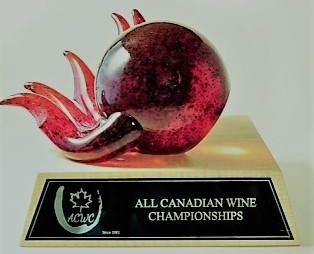
The 41st edition of the All Canadian Wine Championships was held in mid June.  There were participants from nine of the ten provinces and even one territory. In total 184 wineries entered 1,154 wines.

The overall results by province were as follows:

  • BC           5 Trophies/25 Double Gold/75 Gold/73 Silver /66 Bronze (612 entries)
  • ON          22 Double Gold/32 Gold/37 Silver/39 Bronze (379 entries)
  • QC           2 Trophies/3 Double Gold/14 Gold/10 Silver/10 Bronze (73 entries)
  • NS           7 Gold/ 2 Silver/6 Bronze (26 entries)
  • NB           3 Double Gold/ 3 Gold/1 Silver (26 entries)
  • PEI          1 Double Gold/1 Silver (4 entries)
  • AB            1 Double Gold/ 1 Gold/1 Silver/ 4 Bronze (24 entries)
  • MB          2 Bronze (3 entries)
  • SK            1 Silver (8 entries)
  • YT             1 Double Gold (2 entries)

Assessments and awards were based as follows:

Trophies: “All Canadian Best Wines of the Year”

All wines are judged using the 100-point system. Trophies are awarded for each of the following categories:

  • Best Red table wine
  • Best White table wine
  • Best Dessert wine
  • Best Sparkling wine
  • Best Fruit wine

Double Gold medals / Best of Category were awarded to the single highest rated wine (using an average of the aggregate judges’ scores) from each of the categories. These wines were all submitted for the Trophy round.

Medals of Merit: Gold, Silver, Bronze were awarded in the following manner:

  • Gold awards were awarded to those wines scoring in the top 10 percentile.
  • Silver awards of merit were issued to those wines scoring in the second 10 percentile.
  • Bronze awards of merit were given to those wines scoring in the third 10 percentile.

The Trophy Awards were presented as follows:

Best Sparkling Wine of the Year

TIME Family of Wines, BC; N/V Chronos Brut ($40.24 CDN)

Best Red Wine of the Year

Wild Goose Winery, BC; 2021 Pinot Noir ($29.89 CDN)

Best White Wine of the Year

Wild Goose Winery, BC; 2022 Gewürztraminer ($17.89 CDN)

Best Dessert Wine of the Year

Vignoble Rivière du Chêne, QC ; 2021 Monde ($32.00 CDN)

Best Fruit Wine of the Year

Maan Farms Estate Winery, BC; 2020 Raspberry ($23.00 CDN)

Double Gold Awards

Double Gold awards were presented to the following entries:

  • Sparkling Wine – Charmat Method – Fresh, ON; N/V Sparkling Rosé ($18.95 CDN)
  • Sparkling Wine – Frizzante Method – Seaside Pearl Farmgate Winery, BC  2021 Daffodils Sparkling To Go 250ml ($7.98 CDN)
  • Chardonnay, Unoaked – Two Sisters Vineyards, ON; 2020 Unoaked Chardonnay ($38.80 CDN)
  • Chardonnay Under $35.00 – Meldville Wines, ON; 2021 Chardonnay Barrel Select ($26.00 CDN)
  • Chardonnay Over $35.00 – Dark Horse Estate Winery, ON; 2018 Stirling Gait Chardonnay ($39.95 CDN)
  • Riesling Dry – Gehringer Brothers Estate Winery, BC; 2022 Private Reserve Dry Riesling         ($18.39 CDN)
  • Riesling Off Dry – Moraine Winery, BC; 2022 Riesling ($23.00 CDN)
  • Sauvignon Blanc – Gehringer Brothers Estate Winery, BC; 2022 Dry Rock Vineyards Sauvignon Blanc ($20.69 CDN)
  • Pinot Gris Style – Lighthall Vineyards, ON; 2022 Estate Pinot Gris VQA. Prince Edward County ($27.75 CDN)
  • Pinot Grigio Style – Ovino Winery, BC; 2022 Pinot Grigio ($18.40 CDN)
  • Viognier – Wesbert Winery, BC; 2022 Viognier ($26.95 CDN)
  • Other Single Vitis Vinifera Whites – Reif Estate Winery, ON; 2021 Chenin Blanc ($19.95 CDN)
  • White Vitis Vinifera Blends – Priest Creek Family Estate Winery, BC; 2022 Marsanne Roussanne Viognier ($32.74 CDN)
  • Single White Hybrids – The Roost Wine Company, ON; 2021 Frontenac ($24.75 CDN)
  • White Hybrid Blends – Privato Vineyard and Winery, BC; 2022 Sorpresa Bianco ($22.99 CDN)
  • Pet Nat – Black Market Wine Co., BC; 2022 Nothing to Declare ($40.25 CDN)
  • Orange Wines – Creekside Estate Winery Ltd., ON; 2022 Undercurrent Madame Marmalade ($35.00 CDN)
  • Rosé Dry – Forbidden Fruit Winery, BC; 2022 Dead End The Happy Ending Organic Cabernet Franc Rosé ($24.00 CDN)
  • Rosé Off Dry – Jabulani Vineyard & Winery Ltd, ON; 2022 Rosé ($16.00 CDN)
  • Cabernet Sauvignon Under $35 – Bordertown Vineyard & Estate Winery, BC; 2020 Cabernet Sauvignon ($35.00 CDN)
  • Cabernet Sauvignon Over $35.01 – Colchester Ridge Estate Winery, ON; 2018 Grand CREW ($39.95 CDN)
  • Merlot Under $35 – Squeezed Wines, BC; 2015 Merlot ($21.90 CDN)
  • Merlot Over $35.01 – Nk’Mip Cellars, BC; 2020 Qwam Qwmt Merlot ($43.69 CDN)
  • Pinot Noir Over $35.01 – Privato Vineyard and Winery, BC 2019 Woodward Collection – Grande Reserve Pinot Noir ($68.99 CDN)
  • Cabernet Franc Under $35 – Colio Estate Wines, ON; 2020 Reserve Cabernet Franc ($19.95 CDN)
  • Cabernet Franc Over $35.01 – Palatine Hills Estate Winery c/o John Neufeld Farms, ON; 2018 Wild & Free Cabernet Franc ($64.95 CDN)
  • Bordeaux Blends Under $35 – Creekside Estate Winery Ltd., ON; 2020 Red Tractor Cabernet Merlot ($17.95 CDN)
  • Bordeaux Blends Over $35.01 – Two Sisters Vineyards, ON; 2018 Eleventh Post ($47.80 CDN)
  • Syrah/Shiraz Under $35 – Moon Curser Vineyards, BC; 2021 Syrah ($34.49 CDN)
  • Syrah/Shiraz Over $35.01 – Moon Curser Vineyards, BC; 2021 Contraband Syrah ($43.69 CDN)
  • Single Red Hybrids – Seaside Pearl Farmgate Winery, BC; 2020 Cabernet Foch ($39.10 CDN)
  • Marechal Foch – Alderlea Vineyards, BC; 2020 Clarinet ($26.45 CDN)
  • Red Hybrid Blends – Vignoble Rivière du Chêne, QC ; 2021 Origine, Cuvée Spéciale  ($32.00 CDN)
  • Other Single Red Vitis Vinifera – Garry Oaks Estate Winery, BC; 2018 Zweigelt ($31.50 CDN)
  • Other Red Vitis Vinifera Blends – Bonamici Cellars, BC; 2020 Belviaggio ($51.75 CDN)
  • Malbec – Moon Curser Vineyards, BC; 2021 Malbec ($40.24 CDN)
  • Gamay – Byland Estate Winery, ON; 2021 Gamay Noir ($38.00 CDN)
  • Appassimento Style – Magnetic Hill Winery, NB; 2021 Terroir Generator Marquette ($45.00 CDN)

FRUIT WINES

  • Soft Fruit Dry – Yukon Wines, YT; 2020 Dry Haskap Wine ($23.30 CDN)
  • Soft Fruit Dessert – Magnetic Hill Winery, NB; N/V Framboise ($20.00 CDN)
  • Tree Fruit Dry – Forbidden Fruit Winery, BC; 2022 Organic Cherysh Cherry Rosé ($21.00 CDN)
  • Tree Fruit Off Dry – Caroline Cellars Winery, ON; N/V Plum ($12.30 CDN)
  • Tree Fruit Dessert – Puddicombe Estate Wines, ON; 2021 Iced Apple ($20.00 CDN)
  • Fruit Sparkling – Cornerstone Estate Winery, ON; 2020 Fizzy Peach ($6.15 CDN)
  • Fruit Fortified – Vinerie DesFruits Winery, NB ; N/V vin de cassis fortifié ($11.99 CDN)

DESSERT WINES

  • Late Harvest – Clos du Soleil Winery Inc, BC; 2022 Saturn ($38.50 CDN)
  • Red Icewine – Harbour Estates Winery, ON; 2017 Syrah Icewine ($100.00 CDN)
  • Grape Fortifieds – D’Angelo Estate Winery BC; N/V Dolce Vita Rosso ($49.39 CDN)

CIDERS

  • Trophy, Best Cider – The View Winery, BC; N/V Wards Winter Spice Picker’s Hut ($9.45 CDN)

MEADS

  • Trophy, Best Mead of the Year – Miel Nature Inc. QC; N/V Poire et miel ($35.00 CDN)

All of the results are available at https://allcanadianwinechampionships.com/acwc-2023-results/

Sláinte mhaith

The Use of Oak – Toasted Oak

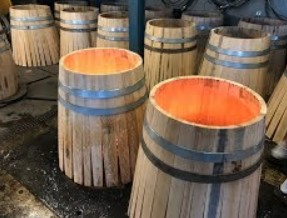
As I discussed previously, oak will enhance the flavour of wine.  Much of that flavour imparted by the oak occurs naturally from the raw wood but ‘toasting’ the inside of an oak barrel will further enhance these flavours.

Photo credit: vinethos.com

After a barrel is made its inside can be exposed to fire in order to toast it. This is done either over an open flame or by using a hand-held torch. The fire caramelizes the wood’s natural sugars and brings out complex compounds. From this, the wine will take on flavours that are toasty, charred, spicy and sweet depending on the amount of time the wood is toasted.

A lightly toasted barrel will be exposed to flame for about 25 minutes while a heavily toasted barrel may get up to one hour of flame exposure.  Generally, the heavier the toast, the stronger and more varied are the revealed flavours.

Light toasting will impart flavours of subtle vanilla, coconut, caramel, clove and cinnamon.  Medium toasting provides stronger vanilla, honey, caramel, toast, coffee and cocoa flavours.  Finally, heavy toasting provides vanilla, espresso, smoke, crème brûlée, butterscotch, toffee, coffee and molasses flavours.

Oak will interact with wine differently depending on the grape variety. Oak may provide hints of chocolate to a Merlot or vanilla or coconut to a Zinfandel. White wines aged in oak typically develop flavours of vanilla, baked apple, caramel, honey, toasted marshmallow, or buttered toast.

Sláinte mhaith

The Use of Oak – New Oak versus Old Oak

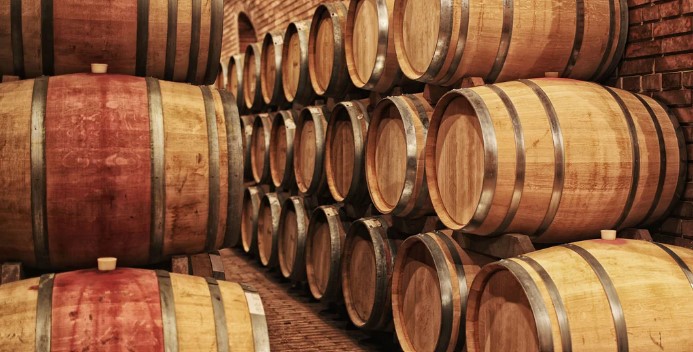
Oak has a major impact on the flavour of the wines we drink; whether it is absent or present; and if it is present, whether it be new oak, old oak or neutral oak.  When wine remains in contact with wood during the fermentation and aging process, changes take place due to extractable organic compounds.  These biochemistry effects translate into the wine’s aroma and flavour.

Photo credit: profilewinegroup.com

All oak wine barrels are toasted when they are made.  Toasting is when the inside of the barrel is exposed to a flame for a specific time and temperature depending on the style of barrel.  I will talk more about the toasting process in an upcoming post.

The impact of the toasting process declines as barrels age with use.  New oak creates aromatic and flavour complexity in the wine whereas old oak becomes more neutral year after year.  Some winemakers use a mix of new and old oak throughout the cellar in order to achieve their desired wine characteristics.

New oak influences red wines differently than white wines. In reds it will adjust the tannic structure while in whites it will open the aromatics of the wine.

The use of a high percentage of new oak barrels can create flavours of toast, vanilla, baking spices, coffee, caramel, maple or smoke.  Neutral barrels no longer generate these flavours or aromas.  New oak is also used to accelerate the softening of high tannin wines like Cabernet Sauvignon.  They can produce a more rounded wine at a younger age.

While neutral oak barrels no longer provide flavour, they still play an important role as they introduce oxygen to the wine.  This oxygen seepage has a big impact on the natural chemical conversions that wine undergoes during maturation.  Neutral barrels help maintain the fruit qualities of more delicate wines and soften wines that have a high amount of tannin.

The size of the barrel affects the oak’s impact on the wine.  The larger the barrel, the less oak lactones and oxygen that are transferred into a wine.  Thus, there is less impact on the flavour and aroma.  Barrels are normally 225 litres but can be as large as 1,000 to 20,000 litres.

The typical winemaking lifespan of a properly maintained barrel is around five years.  However, this may vary depending on the appellation, the type of wine and whether the winemaker is using the barrel for profile influence, oxygenation or storage.

Maintaining enough new oak on hand can be a challenge as there are only a limited number of new barrels available for purchase each year.  As well, the cost can be prohibitive as the price of one barrel can range from a few hundred to a few thousand dollars.

Sláinte mhaith

Use of Oak – Types of Oak

This is the first of a three-part series on the use of oak in the wine-making process.

Photo credit: wordonthegrapevine.co.uk

It’s a well-known fact that oak has become the most accepted way to affect the taste of a wine.  When added to wine, oak combines with the flavours of the grapes to create a wide variety of incredible tasting wines.

Most the world’s finest wines are aged in oak barrels, with French and American oaks being most commonly used.  However, Russian and Eastern European oak are also used, especially in Europe.  All wine barrels are made from white oak but the characteristics of the barrels vary greatly depending on the source of the oak.

French Oak

French oak is historically found in the forests of eastern and central France.  It has more tannin than the other oaks so lighter grape varieties, such as Pinot Noir, are well suited to tannin-rich French oak.  French oak has a tighter-grained wood structure which exposes subtler tastes like aromatic spices, cocoa and coffee. French oak grain is less coarse, contributing to wines with subtle, spicy and smooth, satiny or silky qualities.

American Oak

American oak is twice as dense as French oak, bringing greater spice and wood sugar compounds that slowly extract and fill out a wine’s body.  American Oak has a loose grain and is heavy in lactones, which creates flavours like coconut and banana to finished wines.  It can also provide an impression of a bit of creaminess and a hint of vanilla in wine.  American oak contains a lot of hemicellulose1, which when charred will break down into wood sugars, allowing for some caramelization. 

American oak is widely used in Spain to make Tempranillo. American oak barrels can weigh twice as much as French oak barrels but cost about half the price to purchase.

Russian and Eastern European Oak

Eastern Europe has a vast supply of oak trees. Hungarian oak is richer in eugenols, which impart spice, and tends to create a slightly richer mouthfeel with substantial tannin.   Caucasian oak, on the other hand, releases less tannin and aromatics, which is better for lighter wines desiring a straight-up expression of the grape itself.

Russian oak is used widely throughout Europe. Slavonian oak is used in a variety of Italian wines.  It is known for providing less tannin and more sweetness to the wine.

1 According to ScienceDirect.com, “Hemicelluloses are typically defined as components that can be precipitated by ethanol after extraction from the cell wall by dilute alkali. In such procedures they are extracted after depletion of the pectin content of the walls by aqueous solvents and calcium chelators”.

Sláinte mhaith

Misstated Scotch Whisky Names

The western half of Scotland has its roots based in the Gaelic language and given that many whisky distilleries are situated in Gaelic lands, it should be no surprise that their names are often Gaelic as well.  Even some of us who were raised with a Scottish Gaelic parent have difficulty deciphering and pronouncing the names correctly.

I have come up with a list of the distilleries that sport Gaelic names and export their whisky regularly to the Canadian marketplace.  The list is presented in alphabetical order.

AnCnoc Distillery

AnCnoc Distillery, founded in 1894, is situated in Knock, Aberdeenshire. It was originally known as Knocdu (“nock-doo”) from the Gaelic Cnoc Dubh which means ‘black hill’. It later became AnCnoc which simply means ‘the hill’. And is pronounced “ah-nock”.

Auchentoshan Distillery

Auchentoshan Distillery was established in 1823 and is located at the foot of the Kilpatrick hills, close to Clydebank. In Gaelic its name translates to ‘Achadh an Oisein’ which means ‘corner of the field’. It is pronounced as “ock-un-tosh-un”.  The distillery’s motto is “Challenging to say, easy to drink”.

Bruichladdich Distillery

Bruichladdich is located on the wild Rhinns, located on the west side of the Isle of Islay.  It was originally founded in 1881. The name is derived from the Gaelic words ‘brudhach’ and ‘chalddich’ which together translate to ‘brae by the shore’. The name is pronounced as “broo-ick-laddie”.

Bunnahabhain

Bunnahabhain Distillery, founded in 1881, is located near Port Askaig, on the north side of the Island of Islay. Its name is derived from the Scottish Gaelic for ‘mouth of the river’, Bun na h-Abhainn.  It is pronounced “bu-na-ha-venn”.

Caol Ila Distillery

Caol Ila Distillery is located on the northeastern shore of Islay. It was founded in 1846. The name derives from the Gaelic ‘Caol Ìle’ which means ‘sound of Islay’ and is pronounced as “cull – eela”.

Cragganmore Distillery

Cragganmore is in the Speyside region near the village of Ballindalloch.  It has been in existence since 1869. The Gaelic form of its name is creagan mór, which translates as ‘great rock’. Cragganmore is pronounced as “kra-guhn-more”.

Glenfiddich Distillery

Glenfiddich was founded in 1886, in the Highland community of Dufftown, Banffshire.  Glenfiddich is Gaelic for valley of the deer and is pronounced “glen-fidd- ick”.

Glenmorangie Distillery

Established in 1843, Glenmorangie is located in the Highlands, about 60 kilometres north of Inverness. There is debate as to whether the name was derived from Gleann Mòr na Sìth, which means ‘valley of tranquility’ or Gleann Mór-innse, which refers to ‘valley of big meadows’. In either event, Glenmorangie is pronounced “glen-muh-ran-jee”.

Lagavulin Distillery

Lagavulin, founded in 1816, is located at Laguvulin Bay on Islay. Its name is an anglicization of the Gaelic lag a’mhuilin which means ‘hollow by the mill’. Lagavulin is pronounced “lagga-voolin”.

Laphroaig Distillery

The name Laphroaig means ‘beautiful hollow by the broad bay’, which makes sense as the distillery, which was founded in 1815, is situated along the south shoreline on Islay.  Laphroaig is pronounced as “la-froyg”

Tamdhu Distillery

Established in 1897, Tamdhu Distillery is located in the Highlands in the village of Knockando. Its Scottish Gaelic name translates to ‘little dark hill’ and is simply pronounced “tam – doo”.

Tomintoul Distillery

Tomintoul Distillery is located in the Speyside whisky region, inside the Glenlivet estate. The distillery is named after the nearby village of Tomintoul, which is the highest village in the Highlands of Scotland.  Tomintoul is by far the youngest distillery in the group, established in 1964. The Gaelic translation of its name means ‘the hill of the barn’ and is pronounce “tom-in-towel”.

In Closing

I think I now have a better understanding as to why my father always drank Glenlivet; it was very easy to pronounce, even for a Scotsman!

Sláinte mhaith

Italy’s Hidden Gems

Italy is the largest wine-producing nation in the world and has 20 wine regions.  Unlike other countries where grape growing is largely restricted to specific geographical areas, Italian wine is produced nearly everywhere from the top of the boot to the tip of the toe. 

Most serious wine drinkers are well acquainted with Tuscany’s Chiantis and Piedmont’s Barolos and Barbarescos. However, with so many wine regions, each having its own unique terroir, and with over a thousand indigenous grapes, there are many great quality, lesser known Italian wines.

The next time you are at your favourite wine store, try a bottle from one of these lesser-known wine regions.

Abruzzo

This southern region is referred to as ‘the green lung of Italy’. Historically, the area was known for the bulk wine production of Montepulciano and Trebbiano, but wineries are working on changing that.  There is a native light-skinned white grape varietal called Pecorino, that was once thought to be extinct, but is now gaining popularity thanks to its ability to produce ripe and refreshing wines.       

Calabria

Calabria, which is situated at the toe of the boot, has been producing wine for more than 2,500 years. It’s best known for a regional style called Ciro Rosso, made from the Gaglioppo grape.  It is a powerful, flavourful red with earthy notes and persistent fragrance.

Campania

Located in southern Italy, east of Naples, Campania is primarily home to the Aglianico varietal. It has very high acidity and tannins, similar to Piedmont’s Nebbiolo grape.  Thus, Campania is sometimes referred to as the ‘Nebbiolo of the south’. It produces an earthy, hearty red wine that goes well with fatty meats and spicy sauces, and like its Piedmont counterpart, has tremendous aging potential.

Emilia-Romagna

Emilia-Romagna is one of the oldest wine-producing regions and spans most of central Italy. It’s known for Lambrusco, a sparkling red wine made from the grape of the same name. The wine ranges from dry to sweet, depending on the producer. It has high acidity and notes of berry.

Friuli

Friuli is situated in northeastern Italy between the Alps and the Adriatic Sea.  The region was historically known for its white wines, many of which were created from the area’s Friulano grapes.  However, it is now receiving international attention for its red wines, which are composed of international varietals such as Merlot.

Lake Garda

Lake Garda

Garda, the largest lake in Italy, is in the alpine foothills, midway between Venice and Milan.  There are several small wine regions scattered along its shores, each with its own specialty.  For example, the Bardolino region produces wines from Corvina, Molinara and Rondinella varietals, similar to those grapes of the Valpolicella region.

The Lugana region has developed a reputation for bold complex white wines from locally grown Trebbiano grapes.

Langhe

The Langhe region is found between the Barolo and Barbaresco appellations in the Piedmont region of northwestern Italy.  Just like Barolo and Barbaresco, Langhe makes its most acclaimed wines from local Nebbiolo grapes.

Liguria

Liguria is in north-west Italy to the south of Piemonte. The eastern half of the region is home to the famous wine-producing Cinque Terre area, while the western side, Riveria Ligure di Ponente, is known for several highly distinctive wines. Rossese is unique, said to be unlike any other Italian red. It’s been likened to both Dolcetto and Valpolicella and yet boasts its own unique complex character.

Sardinia

Sardinia is the second largest island in the Mediterranean Sea.  There are several underrated indigenous wine varietals found there such as Vermentino, Cannonau and Mirto. Wines made from the white grape Vermentino are crisp, acidic and fruity.

The island’s dominant red variety is Cannonau, which is very similar to France’s Chateauneuf-du-Pape.  It has robust fruit and earthy flavours.

Sicily

Sicily is an island off the coast of the tip of Italy’s boot.  Its finest red wines are made from  Nero d’Avola grapes which grow in arid vineyards and produce rich wines with intense flavour.  Similar to Syrah, it has the ability to produce a hearty, fruity and sometimes tannic wine. There are also reds that are produced from the Nerello Mascalese varietal that create elegant, expressive wines.          

Taurasi

In western Italy, south of Umbria is the town of Taurasi.  The local vineyards contain Aglianico, Nebbiolo and Sangiovese grapes which are Italy’s three most distinguished varieties.

Umbria

Umbria is located in the middle of central mainland Italy.  It is bordered by Tuscany to the north and west, Marche to the west and Lazio to the south.  According to some experts, Umbria is home to some of the most undervalued wines in Italy, ranging from crisp, dry Grechetto to bold, ruby red Sagrantino.  Sangiovese grapes are also popular in Umbria.

Sláinte mhaith

Springtime Adventure to Italy

During a recent 16-day springtime excursion to Italy as part of a tour group, I discovered passionate people, their food and their wine.  I enjoyed homemade soups, pasta, olives and olive oil, mozzarella and parmigiana reggiano cheese, prosciutto, seafood, pizza, risotto, gelato, tiramisu, limoncello and a variety of amazing coffees.

Aperol Spritz

Italy is the home of the “Dolce Vita” sweet life of physical pleasure and self-indulgence. It has the subliminal charm of fine leathers, renaissance art, classical music and of course, great food and wine.

My wife Valerie and I had the wonderful opportunity to travel by bus through the regions of Veneto, Emilia-Romagna, Tuscany, Lazio and Campania where we enjoyed the regional cuisine and wines.

We began our excursion in Veneto, the home of the cities of Venice and Verona where the white sparkling wine Prosecco is enjoyed in numerous cocktails; most notably Aperol Spritz and Bellini.  Aperol Spritz consists of 3 parts Prosecco, 2 parts Aperol and 1 part soda.  It is then garnished with an orange slice before serving.

A classic Bellini consists of 1 1/2 oz. of peach puree, topped off with chilled Prosecco.  It is served in a champagne glass and garnished with a peach slice.  Both drinks are refreshing on a warm sunny day.

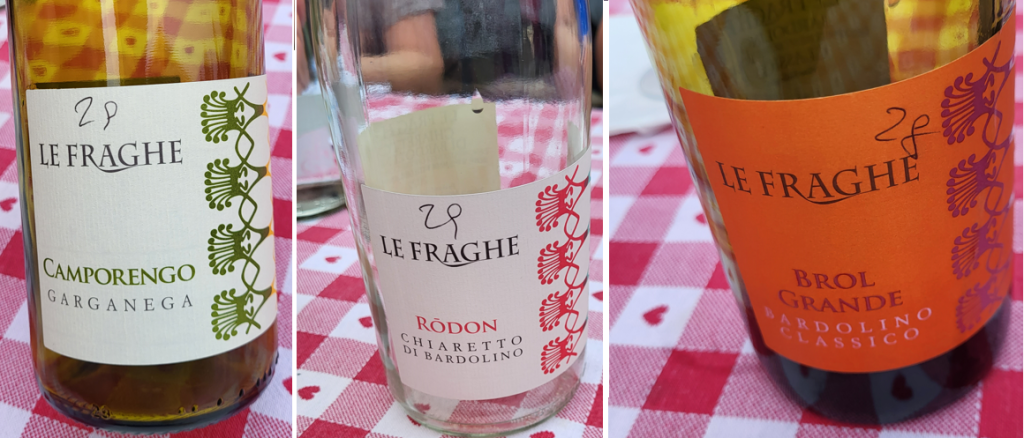
The first winery we visited was the Le Fraghe winery near Verona, where we sampled several of their wines. First was Camporengo Garganega, which is straw yellow in colour.  It has a balanced bouquet of floral hints of acacia and mimosa with peach and apple. It has full body flavour.

The second wine, Ròdon Chiaretto di Bardolino, consists of red Corvina and Rondinella grapes. Cherry red with rich purple highlights, Ròdon has fragrant aromas. Notes of wild rose are the first to emerge, followed by nuances of wild strawberry and redcurrant. The wine is crisp and full bodied.  It also had excellent tannins and acidity with a lengthy finish.

Brol Grande Bardolino Classico consists of Corvina and Rondinella grapes.  Brol Grande is a purple-tinged ruby red of medium intensity. Its bouquet is the result of a blend of the fruity essences of sweet-sour cherry and blueberry, along with spicy nuances of cinnamon and black pepper. The one-year barrel time helps the development of the wine. It has a long and slightly salted finish.

All three wines contain Italy’s DOC designation.  They are occasionally available in wine stores in Ontario and Quebec.

Veneto is also the home of Valpolicella and Amarone wines.  Unfortunately we did not have the opportunity to visit one of these wineries.

The second winery we visited was the Fattoria Poggio Alloro winery, in San Gimignano, Tuscany. The name Poggio Alloro means Bay Leaf Hill, and it refers to the bay laurel bushes that grow on the property. The farm is a family business. At the present time it consists of one hundred hectares and it is completely organic. The grape varietals include Vernaccia di San Gimignano (a local grape that grows only in this town), Sangiovese (to produce the famous Chianti wine), Canaiolo, Colorino, Malvasia and Trebbiano, Chardonnay, Cabernet, and Merlot.

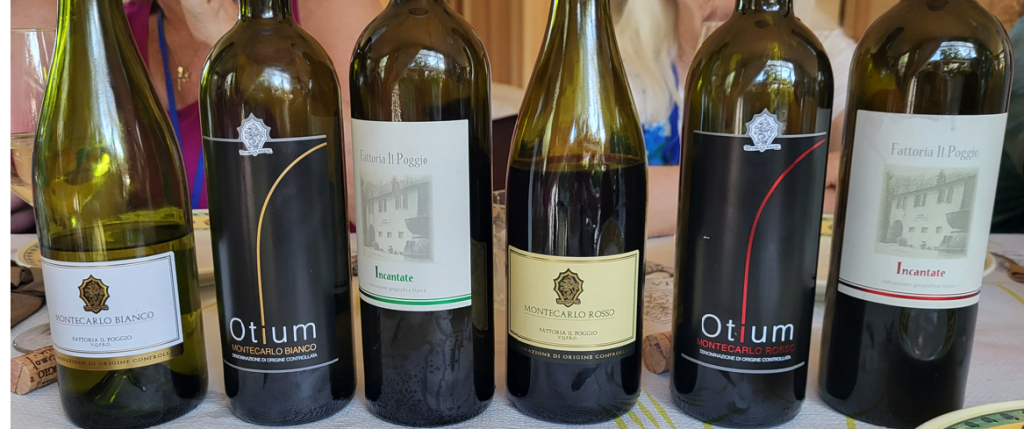
We sampled six wines while we were there, three white and three red.  The white wines included Montecarlo Bianco, which is a blend of 50% Vermentino Toscano and the balance consisting of Vermentino, Roussanne, Sauvignon and Pinot Bianco.  This combination produces a light, clear wine with a straw yellow colour. The aroma is delicate while the taste is dry, delicate and well-balanced.  Montecarlo Bianco has the DOC designation.

The second white was Montecarlo Bianco Otium, which consists of 40% Trebbiano Toscano, 20% Vermentino, 20% Roussanne, 10% Sauvignon and 10% Pinot Bianco.  This wine also contained the DOC designation.

The final white was Incantate Bianco IGT Toscana, which was made totally of Chardonnay grapes. The flavour is tropical and the wine is well balanced.

The first red wine presented was Montecarlo Rosso, which was a blend consisting of 60% Sangiovese, Syrah, Canaiolo, Malvasia and Merlot. It is a light red wine with an aroma that is intense, and the taste is delightfully smooth and dry.  It contains the DOC designation.

The second red was Montecarlo Rosso Otium, a DOC designated wine consisting of 50% Sangiovese, 30% Syrah, 10% Cabernet and 10% Merlot.  It was aged in oak barrels for four months.

The final wine was Incantate Rosso Toscana which was a bold and structured blend of 60% Merlot and 40% Syrah.

There are also 1,500 olive trees on the farm that are utilized to produce extra-virgin olive oil. The olives are completely hand picked each November and then cold pressed to guarantee the superior quality of this product.

The final winery that we attended was the Tenuta Torciano winery, also in the San Gimignano area.  The winery provided a wonderful lunch to accompany the wine tasting but unfortunately the staff did not display the labels of the wines or describe the wines in any detail.  The wines are available to be ordered online but they did not say whether any could be purchased from wine stores within Canada.

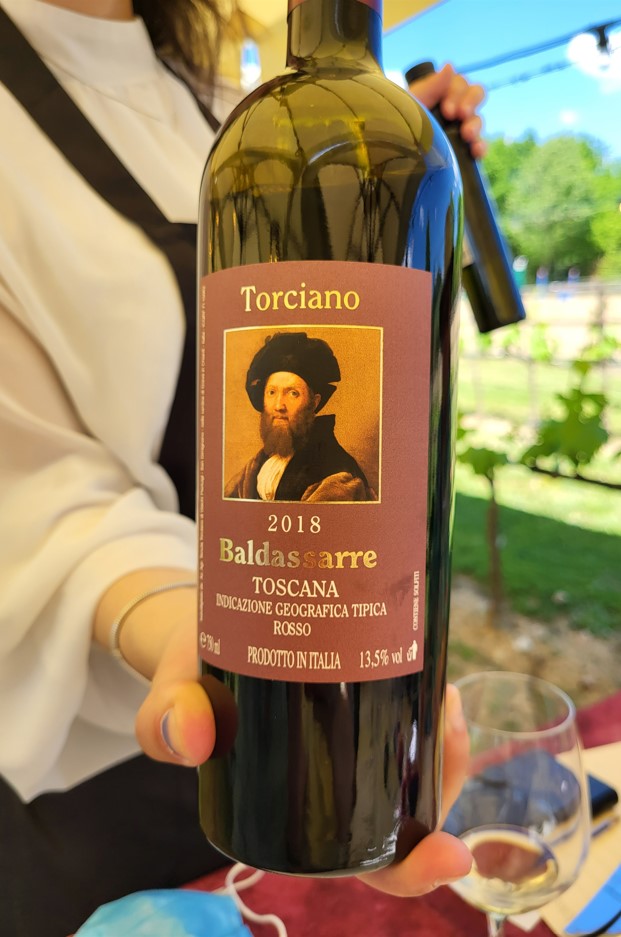
One wine that we sampled was Tenuta Torciano Baldassarre “IGT Toscana”. This wine is a blend of Sangiovese Grosso, Cabernet and Merlot. It had a deep ruby red colour which transitions to garnet as it ages.  It has an elegant bouquet. Hints of wood can be perceived amidst the typical herbaceous notes. Its flavour is dry, full and smooth.

Chianti Classico “Doge” DOCG red wine is produced with Sangiovese grapes, which are harvested by hand and then aged for 12 months.

Doge is characterized by an intense ruby red color. The nose contains hints of violet, then enriched with nuances of ripe red fruit, licorice and vanilla. The taste is full and harmonious, with soft tannins.

Tenuta Torciano Chianti Classico Riserva “Godenzio” is made from Sangiovese and Canaiolo grapes.  It has a deep ruby red colour with a penetrating bouquet and full and smooth taste.

Overall, many wines produced in Italy are not intended for export but to be consumed as table wine within Italy itself.  These wines are released and drank at a young age, have an abundance of fruit flavour and a slightly lower alcohol level. Examples of these wines include Dolcetto, Montepulciano, Nero d’Avola, Aglianico and Negroamaro.

Unfortunately, being part of a tour, we were at the mercy of the tour company as to which wineries we visited.  On the other hand, we had the opportunity to travel to two cheese factories, a couple of olive farms, a Prosciutto farm and a limoncello producer where we enjoyed experiences we otherwise wouldn’t have.

Sláinte mhaith

Invasive Species in Ontario

The spotted lanternfly is an invasive species from Southeastern Asia that poses a threat to Ontario’s wine-growing industry.  It has been recently detected in New York state, not far from the Niagara wine-growing region.

Photo credit: onnurserycrops.wordpress.com

According to the Invasive Species Centre, the spotted lanternfly is an invasive plant-hopper native to Southeast Asia. The insect was first detected in Pennsylvania in 2014 and since then has advanced to several other states, including Monroe and Erie Counties of New York, which are very close to the Niagara wine region. It has not yet been detected in Canada, but industry experts say it’s only a matter of time.

The spotted lanternfly has caused a great deal of destruction to grape vines and other tender fruit trees in the United States.  The insect sucks the sap out of grape vines, causing them to collapse.  If left unchecked, the insects could devastate entire vineyards, which would each cost upwards of $45,000 an acre to replant.  It is a much more aggressive pest than previous pests.

A 2019 study completed by Pennsylvania State University estimated that the insect caused between $43 million and $99 million US since being detected.  Although the study also includes nursery operators and Christmas tree growers, researchers noted that grape growers were hit especially hard. Pennsylvania has experienced a loss of between 45% to 100% of wine grape crops. 

Insecticide application in some vineyards and orchards in the affected areas have gone from four applications per season up to 14 applications, increasing industry expenditures and potential negative impact to the environment.

Early detection will be the key to mitigating the damage caused by the spotted lanternfly.  It’s easier to control and a lot less expensive at the prevention stage.  At the management stage it has proven to be very difficult to control and eradicate.

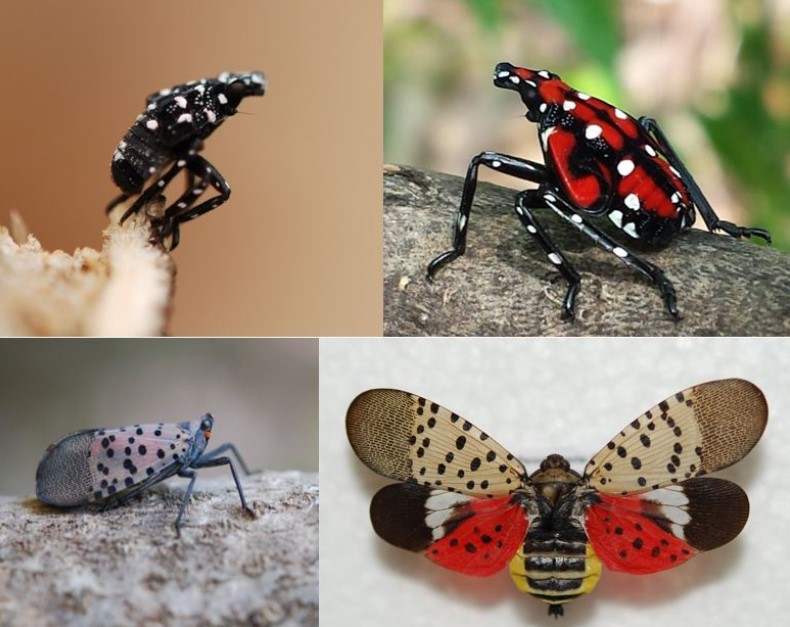
An adult spotted lanternfly can be identified by its black and grey spots and bright red underwing.  Their wings are about 2 centimetres or 1 inch long.  They will often be found clustered together on a tree.

The eggs are brown, seed-like, covered in a grey, mud-coloured secretion.  They will be grouped together in a vertical formation, usually found on trees, but can be laid on any surface, including cars.

The nymphs grow in four stages, starting out with black and white spots but as they mature they gain red spots with distinctive patches of black and white.

Spotted lanternflies spread into new environments in two ways. They are not strong flyers but are able to cling well to a variety of surfaces. They will hold on to people and vehicles who move through heavily infested areas. Their eggs masses are very difficult to spot and can be laid on almost any material, including stone, cut logs, Christmas trees, rusty metal, boats or grills. Egg masses are laid on an object then covered by a shiny, grey, putty-like material that darkens and turns brittle overtime.

The Ontario Ministry of Agriculture, Food and Rural Affairs is currently surveying for spotted lanternflies in high-risk areas to assist with early detection.  However, we can all help prevent the spread of spotted lanternfly by buying and burning local firewood, checking ourselves and our belongings thoroughly after visiting an infested area, and watching for egg masses especially during the winter.  If spotted, take photos, note the location, and report the sighting to the Canadian Food Inspection Agency.

The pending invasion of the spotted lanternfly is an example of a larger problem linked to climate change.  The longer growing season and more temperate winters caused by rising temperatures are allowing more invasive species to spread into the region and to live longer.

Sláinte mhaith