In Response to Donald Trump

During the past six years that I have been writing this blog I have always steered away from political issues. However, today I feel compelled to speak out against Canada’s one time ally, the United States. With the return of Donald Trump to the White House’s Oval Office, Canada’s economy was placed under direct attack by Trump when he decided to impose twenty-five percent tariffs on Canadian imports to the U.S., without just cause. Similar sanctions have been imposed on Mexico and China and are being threatened against the European Union.

Photo credit: Manitoba Liquor Mart

In response to these bullying tactics by Trump, and as a proud Canadian, I will no longer purchase or write about American wine until such time as Trump refrains from his attack on Canada.

Canada has been the top export market for U.S. wines and Ontario’s provincial liquor board (the LCBO) has been among the largest purchasers of U.S. alcohol. In Ontario, imported wines are primarily sold through provincially owned and operated retail outlets, although recent regulatory changes have authorized 157 private grocery retail locations to distribute wine and beer.

The first phase of Canada’s response to the U.S. imposed tariffs includes tariffs on wine and spirits, in addition to many other products. Ontario is banning American liquor and the LCBO is removing American wine, spirits and beer from its shelves. This will represent about a billion dollars worth of American alcohol.

British Columbia, Alberta, Saskatchewan, Manitoba, Nova Scotia and Newfoundland are also removing U.S. liquor from their store shelves. At last word Quebec is considering the idea. On the bright side these bans will serve to enhance the sale of Canadian wines in Canada, as well as European, Australian, South American and South African wines.

Hopefully the American people will convince Trump that the imposition of his tariffs will not only hurt international economies but his own economy as well. It is a sad situation.

Sláinte mhaith

Inter-Provincial Wine Sales

Given all of the recent tariff talk and the renewed patriotism that has come as a result of it, some interesting points have come to light regarding wine sales between provinces. Many Canadians are now avoiding U.S. made products, including wine. As a result, there are now signs of an increased need to support Canadian wineries and renewed calls to open inter-provincial trade in alcohol. However, there are inter-provincial trade barriers standing in the way.

Photo credit: LCBO

Until June 2019, federal legislation prohibited inter-provincial shipment of alcohol directly to the consumer.  This then allowed the provinces the opportunity to pass legislation to permit direct purchase to consumers.  Unfortunately, most provinces chose not to allow this, leaving only British Columbia, Manitoba, Nova Scotia and Saskatchewan who permit direct-to-consumer alcohol shipments.  Ontario has recently amended its laws to prohibit the possession of wine that has been imported from other provinces unless the transaction was handled via the Liquor Control Board of Ontario (LCBO). There are now calls to have this ban lifted.

Ontario wine consumers cannot support small local wineries in another province.  Ironically, living in Ontario and purchasing wines produced in another province, the LCBO charges the purchaser the same import duties as if the wine came from a foreign country.

The wine growers of B.C., as well as the B.C. government are advocates of opening provincial borders to enable wine to move east and west across this country. There is a great deal of regulatory burden making it difficult for small and medium-sized wineries. The process needs to be simple and streamlined.

The time has come for Canadian provinces to eliminate inter-provincial trade barriers.

Sláinte mhaith

Arterra Wines Canada

The name Arterra Wines has come up in discussion in a couple of my blog posts in the past regarding their acquisitions within the wine industry. So, it seems to be a good time to investigate and find out more about Arterra Wines.

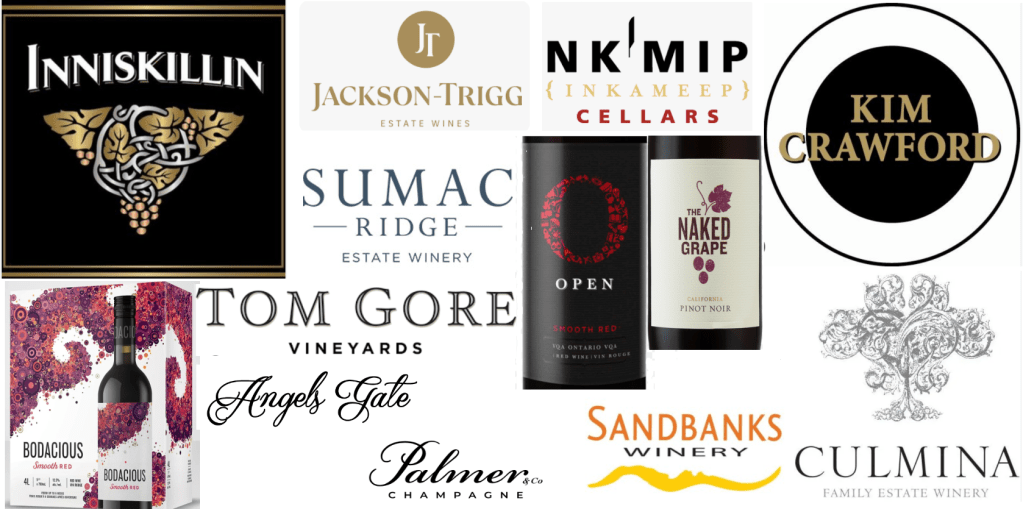
According to the Arterra Wines Canada website, their mission is, “To build wine brands people love”. Their origins date back to 1874 when the Niagara Falls Wine Company was founded. In 1994 they became known as Vincor International. In 2006, Vincor was acquired by Constellation Brands, a U.S.-based company that is both a leading international producer and marketer of beer, wine and spirits. Finally, in 2016, the Canadian branch of Constellation Brands was acquired by the Ontario Teachers’ Pension Plan and became Arterra Wines Canada.

With many iconic and recognized wine brands, Arterra is developing and expanding their wine portfolio to provide Canadians from coast-to-coast with the opportunity to enjoy and experience wines made both in Canada and from renowned wine-making regions around the world.

Arterra owns and operates Wine Rack retail stores in Ontario, as well as sells wine kits and products for winemaking at RJS Craft Winemaking.

Here is the timeline of important events that have taken place throughout the life of Arterra Wines:

1874

  • Niagara Falls Wine Company was founded.

1911

  • Niagara Falls Wine Company renamed T.G. Bright & Co. Limited.

1975

  • Inniskillin is given the first Canadian winery license since 1929 in Ontario, making it the first estate winery in Canada.

1986

  • T.G. Bright & Co. Limited acquires Jordan & Ste-Michelle Cellars Limited.

1989

  • Don Triggs and Alan Jackson, with a group of employees and investors, purchase Cartier Wines from John Labatt Limited.

1992

  • Cartier Wines acquires Inniskillin.

1993

  • Jackson-Triggs brand launches.

1994

  • T.G. Bright & Co. changes its name to become Vincor International Inc.

2000

  • Acquisition of Sumac Ridge, one of B.C.’s first wineries, and See Ya Later Ranch (formerly Hawthorne Mountain Vineyards) in the Okanagan, B.C.

2001

  • NK’Mip Cellars Inc. in B.C. becomes first Aboriginal winery thanks to the joint venture with Osoyoos Indian Band and Vincor International.
  • Jackson-Triggs Niagara Estate Winery opens.

2003

  • Acquisition of Kim Crawford Wines of Auckland, New Zealand.

2005

  • Naked Grape brand launches.

2006

  • Vincor International is acquired by Constellation Brands.

2009

  • Open Wine brand launches in Ontario (and later in B.C. in 2011).

2012

  • Vincor International starts operating under the Constellation Brands name.

2013

  • Bodacious brand wine launches.

2016

  • Constellation Brands is acquired by the Ontario Teachers’ Pension Plan.

2017

  • The name is changed to Arterra Wines Canada.

2019

  • Acquisition of Culmina Family Estate Winery in B.C.s Okanagan Valley. 
  • After stopping production in 2016, Jordan, Ontario’s Le Clos Jordanne wines were re-established.

2020

  • Acquisition of Sandbanks Winery, Prince Edward County, Ontario (see March 8, 2020 post, The Shifting of Sandbanks).
  • Acquisition of Tom Gore Vineyards and the trademark rights to Paso Creek, Revolution, Vintage Ink and R.H. Phillips.

2021

  • Acquisition of Vin First, a Canadian canning and Tetra™ packaging company, specializing in the beverage alcohol industry. 

2023

  • New location for Le Clos Jordanne on Niagara’s Beamsville Bench.
  • Acquisition of Angels Gate Winery and Kew Winery, Niagara, Ontario.
  • Acquisition of Champagne Palmer of Champagne, France.

How long Arterra Wines remains under the control of the Ontario Teachers’ Pension Plan and a Canadian corporation remains to be seen. Should ownership become non-Canadian in the future, a significant portion of the Canadian wine industry will hang precariously in the balance; a sobering thought.

Sláinte mhaith