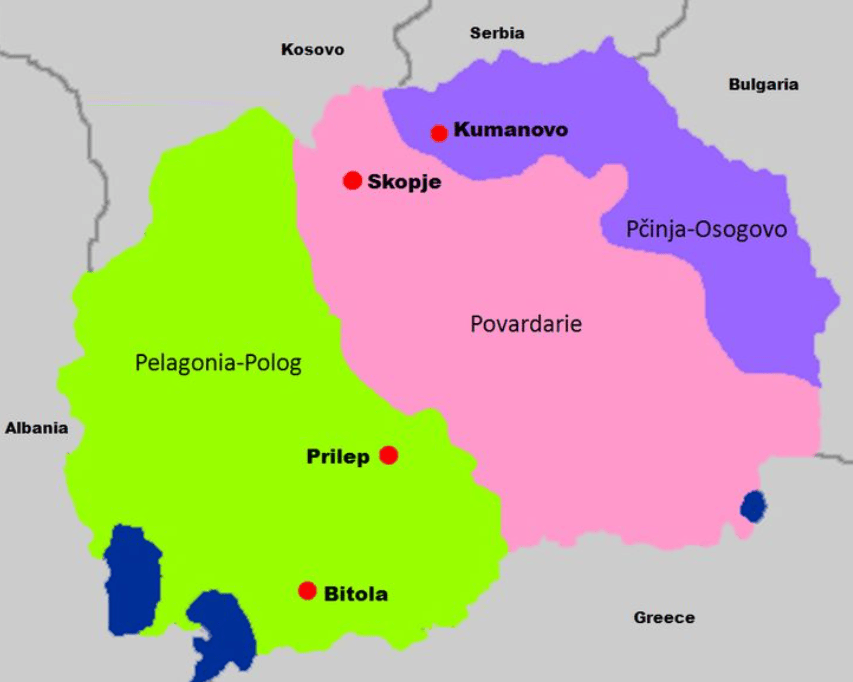
North Macedonia Wine Regions

Photo credit: pinterest.com

North Macedonia is a landlocked country of the south-central Balkans. It is bordered to the north by Kosovo and Serbia, to the east by Bulgaria, to the south by Greece, and to the west by Albania.

Macedonia produced wine when it was part of Yugoslavia. In the 1980s, it accounted for around two-thirds of the Yugoslav wine production. After the dissolution of Yugoslavia, the wine production of the new country decreased from 1.8 million hectoliters in the mid-1990s to 447,000 hectoliters in 2002.

North Macedonia has three wine regions. The most dominant region is Povardarie, which is in the valley of the river Vardar, near the towns of Negotino and Kavadarci. It is the most important region both in terms of quantity and wine quality. It incorporates about 87% of the country’s vineyard area.

The Eastern Region, Pchinja-Osogovo, is an area shaped by continental climatic influences and has its own geographical characteristics. It is situated on the border with Bulgaria.

The region with higher-altitude vineyards and mountain influences is the Western Region, Pelagonia-Polog. It is located around Lake Ohrid, to the west on the border with Albania.

Grape production consumes about 22,400 hectares (55,000 acres) of vineyards. Eighty percent of the wine produced is red wine.

Long, sunny summers, separate elevations, diverse soils and temperature variations all influence how grapes develop and ultimately shape the character of the wine produced in each region. The same grape variety can produce very different wines depending on the soil, climate and location where it grows. This unique combination of natural conditions that gives a wine its sense of place is referred to as the terroir.

The grape varieties in North Macedonia include a large proportion of indigenous varieties, as well as those common to Central Europe and the Balkans. They also produce some international varieties.

Red varieties include Vranec, which is the most common variety, Kratosija, Cabernet Sauvignon and Merlot. Stanušina Crna is a grape of local origin capable of producing very high quality wines. It is very popular within North Macedonia but little known beyond the borders.

White varieties include Smederevka, Welschriesling (usually referred to as Laški Rizling), Chardonnay, Sauvignon blanc and Žilavka.

Sláinte mhaith

Portugal’s Douro Valley Wine Region

The Douro Valley is the oldest established wine region in the world, dating back to 1756. It was first renown for its Port production. However, from a tourism perspective, it has only been popular for the past couple of decades, after being declared as a UNESCO World Heritage site in 2001.

Photo credit: portugalbywine.com

The Douro Valley region is no longer just know for its Port, but also for an increasing number of dry red wines often made from the same native grape varieties. A much smaller number of quality white wines are also now produced.

The viticultural zone covers the steep slopes along the banks of the lower ranges of the Douro River. The river flows from northern Spain, where it is called the Duero. The river finally reaches the Atlantic Ocean at Oporto. The vineyards stretch up the steep, dry slopes on either side of the river.

There are three subregions in the Douro, each covering its own section of the river.  Of these, the Douro Superior region is the furthest inland. It is covered in terraced vineyards and takes up about 20 percent of available vineyard land in Douro.

The central part of the Douro region, centered around the village of Pinhão, is the Cima Corgo region. It is where most of the prestigious Vintage Port originates from.

Cima Corgo is the largest subregion, accounting for almost half of the valley’s total wine production. The vineyards are steep with the vines nearer the river generally ripening much earlier than those at higher elevations. For this reason, the harvest is often completed in multiple sweeps of the same vineyard.

Nearest Oporto and the coast is the Baixo Corgo subregion. This area is best suited to produce table wines. The area is cooler and wetter than the other regions and more accessible, easily enabling bulk-wine operations to function.

Both the Douro’s still and fortified wines can be made from more than 80 different grape varieties. However, the vineyards are dominated by five key varieties: Touriga Nacional, Touriga Franca, Tinta Barroca, Tinto Cao and Tinta Roriz (Tempranillo). Of these, aromatic Touriga Nacional is the most highly regarded, but Touriga Franca is the most planted.

As recently as twenty years ago, Portugal produced very little quality still wine. However, since then it has become world renowned not only for Port but also for its DOC Douro still wines

There are several international varieties of grapes grown in the Douro valley, particularly to produce table wines. The most common of these are Cabernet Sauvignon, Sauvignon Blanc and Gewürztraminer.

Sláinte mhaith