This is a good time of year to have a whiskey tasting party. A whiskey tasting can be done in a couple of different ways. The simplest method is to just get a few bottles together and let everyone help themselves while they sit around and chat about the ways of the world. However, it can be more interesting if everyone is tasting together and there’s a progression of styles to sip from. This technique is similar to that of a wine tasting party.
If following the second approach, first determine how many people will attend and then how many whiskies you want to sample. If everyone is tasting the same whiskey at the same time it is probably best to keep the number of attendees to under a dozen. This will make it easier to keep organized and maintain a well-structured group conversation about each sample.
When deciding on which whiskies to try, you could follow a specific theme or make your selections based on ones you personally enjoy. The experts suggest that the number of whiskies should range from five to eight with each pour being about ½ an ounce. Following this guideline, you will only require one bottle of each whiskey. Depending on your approach, you can either provide the whiskies yourself or ask each guest to bring a bottle.
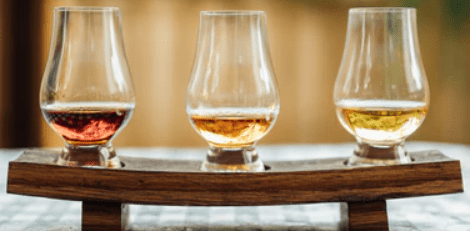
Regarding the number and type of glasses to use, some enthusiasts only use snifter or Glencairn style glass but white wine glasses with small to medium bowls work equally as well. Your guests only need a glass or two at a time, so you can either dispose or finish the remains after each tasting, rinse out the glass and proceed to the next. This saves on glassware plus the clean-up time afterwards.
Allow people to taste each sample first without adding any water. Then give them the option to add a couple of drops of water to see if that affects the taste. It is a good idea to provide a pitcher of filtered or bottled water served at room temperature and liquid droppers, which can be obtained from most pharmacies. When adding water, it is important not to dilute the whiskey, thus no more than a teaspoon should be added. Whiskey flavours are easier to identify as you lower the relative alcohol content, thus diluting your whiskey a few drops at a time helps open up new flavours to experience.
On the topic of water, each participant should be provided with drinking water to cleanse the palate between tastings, as well as to keep themselves hydrated. Crackers or plain bread, such as a baguette are also good ways to cleanse the palate between tastings.
It is a good idea to have a container available for your guests to pour out whiskies they don’t care for. The goal here is to experience a range of whiskies, not encourage anyone to drink something they don’t like.
The best way to progress through a tasting is to sip the lightest whiskey first and end with the richest and/or most heavily flavoured/smokiest one. As host, it’s a good idea to taste everything yourself prior to the event in order to know which order the whiskies should be served in. Keep in mind that lighter coloured whiskey doesn’t necessarily mean it is lighter in flavour.
If you decide to select your whiskies using a theme, options include selecting by country, such as all American, all Irish, all Scottish, all Japanese, etc. Another option is selecting all single malts, whether from Scotland or a selection from different parts of the world. Comparing whiskies of the same age or from a single region are a couple of other options.
When it comes time to sample each whiskey, begin by “nosing” or smelling the whiskey. When it comes to tasting, hold the first sip in your mouth for several seconds before swallowing. On subsequent sips, concentrate on discovering the flavours and aromas. Then after adding a few drops of water explore the flavours again.
With all the discussions, nosings, water additions and subsequent re-tastings, you can expect to spend at least a couple of hours exploring your selections. Most importantly, the experience should be enjoyable for everyone. It’s a bonus if either you or your guests discover a new favourite whiskey along the way.
Sláinte mhaith


