British Columbia’s Movers and Shakers for 2025

This week I present my annual list of British Columbia wineries that most impressed me this year. This is not to suggest that these are the only great wineries in the province but simply those that attracted my attention this year.  The list varies in length from year to year as I like to focus on achievements rather than listing a specific number of wineries. The wineries are presented alphabetically as follows:

Laughing Stock Vineyards

Laughing Stock was recognized as the Best Performing Small Winery of the Year at this year’s National Wine Awards where they earned 2 Platinum, 3 Gold, 1 Silver and 2 Bronze medals. The winemaking team is led by winemaker Sandy Leier.

They aim to continually improve their wines and have been exploring a variety of fermentation vehicles over the past few years, including temperature regulated stainless tanks and the addition of eight concrete eggs. Six clay Amphorae have been acquired from Italy, in which a variety of limited production wines are produced. Complexity is added to the red wines through an extended barrel-aging program using 100% French oak in both standard barrel sizes and 500 liter puncheons.

Laughing Stock has 2 separate vineyards:

  • Naramata Bench Vineyard – The estate winery vineyard is home to all the Bordeaux grape varieties (Merlot, Cabernet Sauvignon, Cabernet Franc, Malbec & Petit Verdot) that are included in their flagship wine, Portfolio.
  • Perfect Hedge Vineyard – Osoyoos – Since acquiring this 22-acre vineyard in 2007, it has become home to Bordeaux varieties (Merlot, Malbec & Cabernet Sauvignon) as well as Viognier and Syrah

This is Laughing Stock’s first appearance on the Movers and Shakers list.

Meyer Family Vineyards (2021, 2024

This is Meyers Family Vineyards third time on the Movers and Shakers List, having appeared previously in 2024 and 2021.

Meyer aims to produce the finest quality wines in the traditions of the Burgundy region of France. The grapes are hand-harvested, with great attention to detail and minimal winemaking intervention. The wines are produced from three main vineyards: the 6.9-hectare McLean Creek Road Vineyard in Okanagan Falls; the 1.62-hectare Old Main Road Vineyard on the Naramata Bench; and the 1.5-hectare Lakehill Road Vineyard in Kaleden. They also work with passionate quality-minded growers in Naramata and Osoyoos area to round out their portfolio of terroir-driven wines.

Winemaker Chris Carson’s philosophy is to care for the grape on the vine and maintain as much as possible a hands-off approach in the cellar to allow the true expression of the terroir. Each wine reflects the single vineyard of its origin, the soil, the climate and the slope.

The three main vineyards are:

  • McLean Creek Road Vineyard Okanagan Falls – This is the home vineyard. The vineyard was originally planted in 1994. Varietals grown include Chardonnay, Pinot Noir and Gewurztraminer.
  • Old Main Road Vineyard Naramata Bench – This vineyard was originally planted in 1996 with 100% Chardonnay vines which is still the case today.
  • Lakehill Road Vineyard Kaleden – The vineyard was planted with 3 acres of Pinot Noir in 2009 and another 0.75 acres in 2019.

Mission Hill Family Estate

Mission Hill was named Winery of the Year earlier this year at the National Wine Awards, making it Canada’s only six-time winner. This is reflected in the fact that Mission Hill appeared as a Mover and Shaker previously in 2022, 2021 and 2020.

This year Mission Hill Family Estate was awarded top honours with two platinum and seven gold awards. The award winning wines are:

  • 2022 Perpetua: Platinum
  • 2022 Terroir Cabernet Franc – Member Exclusive: Platinum
  • 2023 Terroir Chardonnay – Member Exclusive: Gold
  • 2020 Compendium: Gold
  • 2022 Terroir Cabernet Sauvignon – Member Exclusive: Gold
  • 2021 Oculus – Member Release Fall 2025: Gold
  • 2020 Quatrain: Gold
  • 2023 Perpetua – Coming Spring 2026: Gold
  • 2022 Terroir Meritage – Member Exclusive: Gold

Fostering an ecosystem natural to the region supports quality grape growing, which in turn creates wine of depth and character. Bees, falcons and chickens replace pesticides and insecticides. Cover crops, earthworms and compost are used in place of chemical fertilizers.

Their practices are fundamentally rooted in Old World techniques which they now support with modern technology.

Stag’s Hollow Winery

This is Stag’s Hollow’s first appearance as a Mover and Shaker.

Larry Gerelus and Linda Pruegger started with a 10 acre vineyard in 1992 that was planted with Vidal and Chasselas varietals. The winery was later constructed in 1995. At that time, Stag’s Hollow Winery was one of only 30 wineries in British Columbia. Initially Merlot, Pinot Noir, Chardonnay and Vidal were grown.

In 2011, another 18 acres of land was purchased which became Shuttleworth Creek Vineyard.

The vineyards are managed sustainably, which refers to conservation, pest management, responsible water usage and efficient energy use. To maintain good biodiversity and soil health in the vineyard, chemical fungicides are not used. Instead, only organic products are applied. All canopy management is performed by hand, which reduces energy consumption as well as allowing for far more precision. A natural vegetation buffer zone is used to provide breeding grounds for beneficial insects to control unwanted pests.

The winery’s two vineyards are:

  • Stag’s Hollow Estate Vineyard – Merlot and Pinot Noir blocks, now exceeding 30 years of age, are on the southwest facing slopes of the Hollow. 
  • Shuttleworth Creek Vineyard – This land, a former hay field, was purchased in 2011, recognizing that Pinot Noir was likely to be an excellent variety for its terroir. In addition, two Spanish varieties were planted – Albariño and Tempranillo, and two Italian varieties – Dolcetto and Teroldego.

Happy New Year!

Sláinte mhaith

Ontario’s Movers and Shakers for 2025

As the end of the year draws near, it is time to reveal my annual list of wineries that I found to be most impressive in 2025. Once again, I am not suggesting that these are the only great wineries in the province but merely those that attracted my attention this year.   The list varies in length from year to year as I like to focus on achievements rather than listing a specific number of wineries.

Without further ado, here is my list for 2025, presented in alphabetical order:

Broken Stone Winery

Broken Stone is a boutique winery that is in the heart of the Prince Edward County wine region. I was first introduced to Broken Stone’s wines in 2023 and was impressed enough that I included it in my list of movers and shakers that year. I returned to the winery again this past spring and was equally impressed again by the quality of their wines.

Their objective is to grow the highest quality grapes and craft world-class wines that are created from grapes grown in their vineyards:

  • Kuepfer Vineyard – This is the original vineyard where Pinot Noir, Chardonnay, Cabernet Franc, Pinot Gris, and Pinot Meunier grapes are grown
  • Applehouse Vineyard – This was the home of one of the first commercial plantings in the County that produces Riesling, Gewurztraminer and Chardonnay grapes.
  • King Eddie Vineyard – Varieties planted here include Gamay Noir, Pinot Noir, Chardonnay and Chenin Blanc.

The vintner continually works to improve the vineyard biodiversity and soils. They have adopted minimal winemaking approaches and use their knowledge of science and tradition to help the wines reveal their potential.

Karlo Estates Winery

Prince Edward County’s Karlo Estates first appeared on my Movers and Shakers list in 2021. Since then, it has continued to develop and improve not only their wines, but their customers’ experiences. Under the direction of their Executive Winemaker Derek Barnett and Winemaker Spencer Mayer, they have produced the first certified vegan wine in the world, and as a result are reducing their carbon impact.

Not only is the wine in their bottles certified vegan but all vineyard practices are vegan, their packaging is vegan and their restaurant menu is vegan. As a result, they have been placed on the “Top Ten Cutting Edge Wines of the World” list. 

The winery continues to provide the interesting single varietals and eclectic blends that it has become known for.

The Organized Crime Winery

I would be remiss if I failed to include the top Ontario winery at this year’s National Wine Awards. The Organized Crime earned a Platinum, 6 Gold, 4 Silver and 3 Bronze medals.

They are a second-generation, family-owned, small boutique winery located on the Beamsville Bench of the Niagara Peninsula. Owners Edward Zaski & Ania de Duleba farm the land themselves and assist in the winemaking throughout all stages of the process. Their production volumes are very small, but that hasn’t hindered them from appearing on my Movers and Shakers list previously in 2024 and 2020.

Two Sisters Vineyards

Two Sisters Vineyards began operations in 2007 guided by their passion to create exceptional wine. The winery and vineyards span over 130 acres in Niagara-on-the-Lake, Ontario. Grape varietals include Cabernet Franc, Cabernet Sauvignon, Merlot, Petit Verdot, Chardonnay, Riesling and Sauvignon Blanc.

The vineyards are Certified Sustainable by Sustainable Winegrowing Ontario. Two Sisters employ a science-based, decision-making process to reduce risks from grape pests in a way to minimize environmental risks. The winery also follows vegan practices as the wine fining agents that are used are vegan.

Two Sisters Vineyards was previously included as a Mover and Shaker back in 2020.

Coming up next week will be British Columbia’s 2025 list.

Sláinte mhaith

Bock Winery, Villany, Hungary

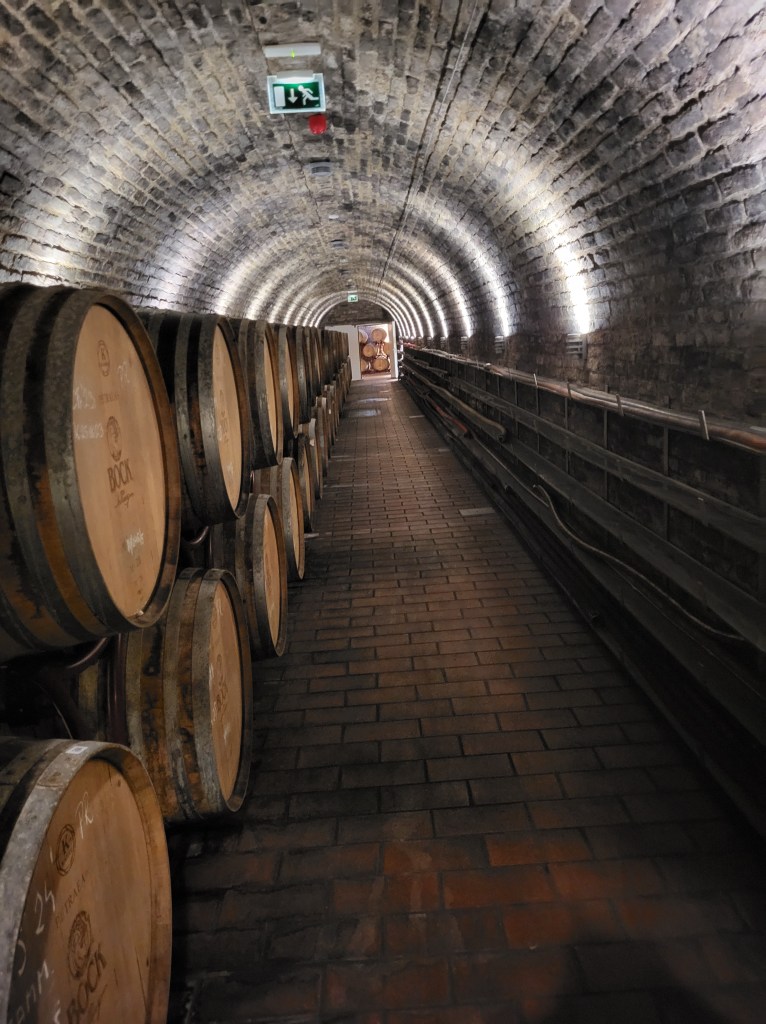
While on a recent Danube River cruise through some of the former Iron Curtain countries of eastern Europe, I visited the Bock Winery, which is located near Mohacs (“the mother of wine”), Hungary. It is a tenth-generation family winery that was established in 1850. It spreads out over 125 hectares or about 310 acres.

Bock’s cellars

Bock’s wines are aged in a combination of French, American and Hungarian oak barrels. The use of Hungarian oak introduces a flavour and nose that is slightly different than what would be experienced with most new world wines of Australia, North America or South America. The vintner also uses a combination of both new oak and old oak barrels, depending on the specific wine being produced.

In addition to wine, Bock also produces grape seed oil, grape seed tablets and grape seed flour. This is done to minimize the amount of waste resulting from the wine making process.

While there I had the opportunity to try four of Bock’s wines – a 2023 Villányi Hárslevelú, a 2024 Villányi Rosé Curvée, a 2017 Villányi Bock Curvée, and the 2022 Cabernet Franc.

2023 Villányi Hárslevelú

This is a fresh and fragrant white wine that is produced from a native Hungarian grape variety. It is made using overripe grapes grown on 40-year-old vines in the Göntér vineyard. Its colour is a medium-intensity, straw yellow. The aroma reveals linden blossom, combined with a slight citrus note, which is also reflected in the taste.

2024 Villányi Rosé Curvée

This is a fresh and fragrant wine produced from the virgin must of blue grape varieties from Bock’s vineyards. It has a medium colour with salmon-pink hues. The aroma and taste consist of strawberries, accompanied by satisfying acidity. The wine is enhanced with carbon dioxide before bottling.

2017 Villányi Bock Curvée

2017 Villányi Bock Curvée

This is Bock Winery’s flagship wine, produced from a blend of premium red grapes from several Bock vineyards which produce a full-bodied wine. It is a Bordeaux-type blend of Cabernet Sauvignon (60%), Cabernet Franc (30%) and Merlot (10%) that has developed in new, small oak barrels for 24 months and then in the bottle for an additional year. The wine is characterized by a deep, dark intensity and dark purplish red hue. It is a full-bodied wine, with a scent of ripe cherries and tobacco, and a taste of overripe fruits, chocolate and vanilla.

This was my personal favourite of the wines I sampled.

2022 Cabernet Franc

This is a medium-bodied red wine using grapes from several of Bock’s vineyards. After fermentation, the Cabernet Franc matures in large oak barrels for 12 months to produce a dark, intense, deep red wine with a large body. It has a complex aroma and taste, in which the fruitiness forms a unity with the aromas from the barrel.

Good news for Ontario residents, Bock Wines are periodically available liquor stores.

Sláinte mhaith

Buying Wine Online

I have previously shared my experiences on purchasing wine from a winery in a foreign country and shipping it home. Today I look at another purchase option, buying wine online.

Photo credit: vinpark.com

The online sources vary from individual wineries to liquor stores to wine brokerage houses to wine clubs and even auction houses. Online searches will help you find rare wines and older vintages. It also makes it easy to search where a specific wine is sold and allows you to compare prices. These sites will often provide additional information about the wine you are interested in, such as the vintner’s notes, wine critic reviews, a link to winery websites and other technical information.

However, before you begin scrolling through the wide assortment of online vendors, there are some things you need to be aware of.  First, if you are purchasing wine or any other alcohol from a website outside your country or province there will be a number of taxes and charges.  For example, alcohol being imported from outside Canada to Ontario will have a levy of 102.2% for wine, 143.7% for spirits and $1.70 per litre for beer.

In addition, there will most likely be a shipping fee, which will be a significant percentage of the per bottle price. The only exception I am aware of is when I purchase alcohol online from my liquor store (the LCBO); the price I pay is the same price as it would be in the bricks and mortar store. The only difference is my purchase is shipped to the local liquor store where I then go to pick it up. It enables me to purchase wines and spirits that I would otherwise not have access to, living in an area where there is a limited variety of selections.

The number of retailers able to ship to you may be restricted by shipping regulations in the vendor’s location. Thus, your online wine purchase options may not be as lucrative as it may seem.

Sláinte mhaith

The 2025 National Wine Awards

Photo credit: winealign.com

This year Penticton, British Columbia hosted the 25th anniversary of the WineAlign National Wine Awards of Canada (NWAC). The NWAC is the country’s largest competition, involving only 100 percent Canadian-grown and produced wines.

This year a new category was introduced – Library Wines. This classification includes wines that are 5 years or older. These aged wines were not compared against each other but instead, each wine was independently assessed as to where it was in its lifecycle and how well it was ageing and tasting.

The Replacement wines or Crafted in B.C. wines were not included as part of The WineAlign National Wine Awards.

Winery of the Year

The 2025 Winery of the Year is Penticton, British Columbia’s Mission Hill Family Estate. This is the sixth time Anthony von Mandl has been awarded this prestigious honour.

This year, Mission Hill entered 11 top-tier wines, earning two Platinum medals, five Golds and one Silver medal.

The balance of the top 10 wineries are:

  • Laughing Stock Vineyards, Penticton, British Columbia
  • Meyer Family Vineyards, Okanagan Valley, British Columbia
  • SpearHead Winery, Kelowna, British Columbia
  • The Organized Crime Winery, Beamsville, Ontario
  • Quails’ Gate Winery, Kelowna, British Columbia
  • Peller Estates, Niagara-on-the-Lake, Ontario
  • Fielding Estate Winery, Lincoln, Ontario
  • Trius Winery, Niagara-on-the-Lake, Ontario
  • Tantalus Vineyards, Kelowna, British Columbia

Best Performing Small Winery

This year’s Best Performing Small Winery is Penticton, British Columbia’s Laughing Stock Vineyards. Laughing Stock earned eight medals at this year’s event: two Platinum, three Gold, one Silver, and two Bronze. 

When the winery was acquired by Arterra Wines in 2017, some experts had concerns as to whether Laughing Stock would maintain its boutique identity under its new corporate umbrella. However, the winery continues to operate with a small, focused team and remains fully independent in its winemaking approach.

The balance of the top 10 small wineries are:

  • Meyer Family Vineyards, Okanagan Valley, British Columbia
  • SpearHead Winery, Kelowna, British Columbia
  • The Organized Crime Winery, Beamsville, Ontario
  • Tantalus Vineyards, Kelowna, British Columbia
  • Township 7 Vineyards and Winery, Penticton, British Columbia
  • Stag’s Hollow Winery, Okanagan Falls, British Columbia
  • Moon Cruiser Vineyards, Osoyoos, British Columbia
  • Orofino Vineyards, Similkameen Valley, British Columbia
  • Thirty Bench Wine Makers, Beamsville, Ontario

Platinum Awards

A Platinum medal is the highest award possible. Less than 2% of the 1,700 wines and ciders entered received this award.

The award process involves a minimum of eight judges, three or four in the first round, and five or six in the second round. Each wine must have achieved an aggregate score of 93 points by five of those judges. 93 points or better is considered entering the realm of “outstanding.” Thus, not every judging category had a Platinum recipient.

This year’s Platinum Award winners are listed below:

Library Wines

  • Moon Curser 2020 Malbec, Okanagan Valley, British Columbia

Red Blends

  • Black Hills 2023 Bona Fide, Okanagan Valley, British Columbia
  • Laughing Stock 2022 Blind Trust Red, Okanagan Valley, British Columbia
  • Nomad at Hinterbrook Winery 2021 Wanderlust, Niagara Lakeshore, Niagara Peninsula, Ontario
  • Palatine Hills Ramblers 2024 Schmoozer Cabernet Merlot, Niagara Lakeshore, Niagara Peninsula, Ontario
  • The Organized Crime 2022 The Download, Beamsville Bench, Niagara Peninsula, Ontario
  • Trius 2022 Grand Red, Niagara-on-the-Lake, Niagara Peninsula, Ontario

Pinot Noir

  • 1 Mill Road 2022 Pinot Noir Home Block, Naramata Bench, Okanagan Valley, British Columbia
  • Lightning Rock Winery 2022 Pinot Noir Canyonview Vineyard, Okanagan Valley, British Columbia
  • Meyer 2022 Old Block Pinot Noir   McLean Creek Road Vineyard, Okanagan Falls, Okanagan Valley, British Columbia
  • SpearHead 2022 Okanagan Valley Pinot Noir, Okanagan Valley, British Columbia
  • SpearHead 2022 Pommard Clone Pinot Noir, Okanagan Valley, British Columbia

Chardonnay

  • 1 Mill Road 2023 Chardonnay, Naramata Bench, Okanagan Valley, British Columbia
  • Meyer 2022 Chardonnay McLean Creek Road Vineyard, Okanagan Falls, Okanagan Valley, British Columbia
  • Mission Hill Family Estate 2022 Perpetua, Okanagan Valley, British Columbia
  • Quails’ Gate Winery 2022 Rosemary’s Block Chardonnay, Okanagan Valley, British Columbia

Syrah

  • Laughing Stock 2022 Syrah, Okanagan Valley, British Columbia
  • Sandhill 2022 Syrah Terroir Driven Wine, British Columbia
  • Stag’s Hollow 2022 Syrah, Okanagan Valley, British Columbia

Riesling

  • CedarCreek 2022 Aspect Collection Riesling, Okanagan Valley, British Columbia
  • Peller Estates 2023 Signature Series Riesling, Niagara Peninsula, Ontario
  • Thirty Bench 2022 Small Lot Riesling, Triangle Vineyard, Beamsville Bench, Niagara Peninsula, Ontario Trius 2023 Showcase Riesling, Ghost Creek, Four Mile Creek, Niagara Peninsula, Ontario

Icewine and Late Harvest

  • Inniskillin 2023 Riesling Icewine Niagara Estate, Niagara Peninsula, Ontario
  • Byland 2023 Riesling Icewine, Niagara-on-the-Lake, Niagara Peninsula, Ontario

Cabernet Franc

  • Black Bank Hill 2022 Cabernet Franc, Lincoln Lakeshore, Niagara Peninsula, Ontario
  • Fielding 2023 Cabernet Franc, Niagara Peninsula, Ontario
  • Kismet 2022 Cabernet Franc Reserve, Okanagan Valley, British Columbia
  • Mission Hill Family Estate 2022 Terroir Cabernet Franc, Okanagan Valley, British Columbia
  • Niagara College Teaching Winery 2022 Dean’s List Cabernet Franc, St. David’s Bench, Niagara Peninsula, Ontario
  • Tinhorn Creek 2022 Cabernet Franc, Okanagan Valley, British Columbia
  • Merlot

The complete list of award winners can be found at www.winealign/awards.

Sláinte mhaith

The 2025 All Canadian Wine Championships

The All Canadian Wine Championships (ACWC) is open to all Canadian licensed wineries, cideries and meaderies and content must normally be grown and made in Canada. However, for this year, a new section was added, the international “Cellared in Canada” segment. These wines contain imported grapes or juice. The “Cellared in Canada” program was introduced in 2024 in response to the environmental disasters that severely impacted many British Columbia vineyards. No trophies were awarded for this special category.

As with previous years, the judges come from across Canada and include wine writers, sommeliers, and professional wine judges from the Wine Judges of Ontario. Some judges have been with the competition for more than twenty years.

Awards are presented for Gold, Silver and Bronze winners but the top scoring wine in each category is awarded Double Gold.

This year there were a total of 911 wines entered from 163 wineries.

The Trophy and Double Gold winners for grape wines are presented below. For the complete listing of award winners, visit the ACWC website at www.allcanadianwinechampionships.com/acwc-2025-results/. All prices are expressed in Canadian dollars.

The 2025 Trophy Awards were presented to:

Best Sparkling Wine of the Year

Time Family of Wines, British Columbia – 2018 Evolve Brut Nature – $49.99

Best Red Wine of the Year

Creekside Estate Winery (Diamond Estate Wines and Spirits), Ontario – 2020 Shiraz – $15.95

Best White Wine of the Year

Solvero Wines, British Columbia – 2022 Chardonnay – $40.25

Best Dessert Wine of the Year

Pillitteri Estates Winery Inc., Ontario – 2019 Racina Riesling Icewine – $40.00

Best Rosé Wine of the Year

Keint-he Winery and Vineyards Ltd., Ontario – 2023 Portage Rosé – $24.80

Best Fruit Wine of the Year

Maan Farms Estate Winery, British Columbia – N/V Strawberry Dessert – $29.41

Best Cider of the Year

Archibald Orchards & Winery, Ontario – N/V Hard Ginger – $13.80

Best Mead of the Year

Miel Nature Inc., Quebec – N/V Pomme et miel – $20.00

The 2025 Double Gold medal winners were the following:

Sparkling Wine-Traditional Method

Time Family of Wines, British Columbia – 2018 Evolve Brut Rosé – $49.99

Sparkling Wine–Charmat Method

Monte Creek Winery, British Columbia – 2022 Living Land Sparkling – $27.59

Sparkling Wine–Frizzante Method

Cherry Point Estate Wines, British Columbia – 2024 Spritzy Rosé – $33.40

Chardonnay, Unoaked

Strewn, Ontario – 2023 Distinctive Small Lot Chardonnay Musque – $24.92

Chardonnay Under $35.00

Deep Roots Winery, British Columbia – 2023 Reserve Chardonnay – $34.90

Chardonnay Over $35.00

Solvero Wines, British Columbia – 2022 Chardonnay – $40.25 “Best White Wine of the Year

Riesling Dry

Three Sisters Winery, British Columbia – 2023 Riesling – $28.75

Riesling Off Dry

Huff Estates Winery, Ontario – 2023 Day Tripping Riesling – $20.00

Sauvignon Blanc

Featherstone Winery, Ontario – 2024 Sauvignon Blanc – $17.95

Gewürztraminer

Baillie-Grohman Estate Winery, British Columbia – 2023 Gewürztraminer – $26.00

Pinot Gris Style

Alderlea Vineyards, British Columbia – 2024 Pinot Gris – $26.45

Pinot Grigio Style

Volcanic Hills Estate Winery, British Columbia – 2024 Pinot Gris – $28.74

Viognier

Rainmaker Wines, British Columbia – 2022 Viognier Rainmaker – $30.00

Other Single Vitis Vinifera Whites

Chaberton Estate Winery, British Columbia – 2024 Estate Grown Siegerrebe – $19.95

White Vitis Vinifera Blends

Alderlea Vineyards, British Columbia – 2024 Valerie – $26.45

Single White Hybrids

Magnetic Hill Winery, New Brunswick – 2024 The OC Osceola by the Sea – $20.00

White Hybrid Blends

Bear River Vineyards, Nova Scotia – 2024 Greater Yellowlegs – $25.00

Orange Wines

The Good Earth Food and Wine Co., Ontario – 2023 Chardonnay Musque Orange – $23.80

Rosé Dry

Keint-he Winery and Vineyards Ltd., Ontario – 2023 Portage Rosé – $24.80 “Best Rosé of the Year

Rosé Off Dry

Kismet Estate Winery, British Columbia – 2024 Phulkari Rosé – $29.89

Cabernet Sauvignon $35 and Under

Black Sage Vineyard, British Columbia – 2022 Cabernet Sauvignon – $32.99

Cabernet Sauvignon Over $35.00

Laughing Stock Vineyards, British Columbia – 2022 Market Darling – $60.00

Merlot $35 and Under

Bordertown Vineyard & Estate Winery, British Columbia – 2020 Merlot – $25.00

Merlot Over $35.00

Pillitteri Estates Winery Inc., Ontario – 2020 Exclamation Merlot – $60.00

Pinot Noir $35 and Under

Keint-he Winery and Vineyards Ltd., Ontario – 2022 Portage Pinot Noir – $24.80

Pinot Noir Over $35.00

16 Mile Cellar, Ontario – 2022 Tenacity Pinot Noir – $59.80

Cabernet Franc $35 and Under

Pillitteri Estates Winery Inc., Ontario – 2020 Carretto Cabernet Franc – $28.00

Cabernet Franc Over $35.00

Bella Terra Vineyards, Ontario – 2022 Cabernet Franc – $49.72

Bordeaux Blends $35 and Under

Magnotta Winery, Ontario – 2019 Magnotta Meritage Gran Riserva VQA – $31.95

Bordeaux Blends Over $35.00

Dirty Laundry Winery, British Columbia – 2020 Bordello – $44.99

Syrah/Shiraz $35 and Under

Creekside Estate Winery (Diamond Estate Wines and Spirits), Ontario – 2020 Shiraz – $15.95 “Best Red Wine of the Year

Syrah/Shiraz Over $35.00

Moraine Estate Winery, British Columbia – 2022 Syrah – $39.00

Single Red Hybrids

Magnetic Hill Winery, New Brunswick, – N/V Terroir Generator New World Cali Style – $30.00

Red Hybrid Blends

Planters Ridge Winery, Nova Scotia – 2022 Quintessence Red – $25.36

Other Single Red Vitis Vinifera

Colchester Ridge Estate Winery, Ontario – 2022 Petit Verdot – $39.95

Other Red Vitis Vinifera Blends

Nk’Mip Cellars   British Columbia, – 2022 Winemakers Talon – $32.99

Marechal Foch

Alderlea Vineyards, British Columbia – 2023 Clarinet – $27.60

Malbec

Rainmaker Wines, British Columbia – 2022 Malbec – $40.00

Gamay

Hillside Winery & Bistro, British Columbia – 2021 Founder’s Block Gamay Noir – $45.00

Appassimento Style

Sprucewood Shores Estate Winery, Ontario – 2023 Appassimento Cabernet Franc Hawks Flight Reserve – $44.80

NEW SEGMENT FOR 2025 – INTERNATIONAL “CELLARED IN CANADA”

Single Red Vitus Vinifera

Devonian Coast Wineries, Nova Scotia – N/V Ducks Crossing Cabernet Sauvignon – $13.67

Sparkling

Moraine Estate Winery, British Columbia – 2024 Shipuchka Frizzante – $28.00

Single White Vitus Vinifera

See ya Later Ranch, British Columbia – 2024 Pinot Gris – $19.99

White Vitus Vinifera Blends

Sunnybrae Vineyards & Winery, British Columbia – 2024 Twisted Path Washington – $24.73

Rosé

Arterra Wines Canada, British Columbia – 2024 Saintly Rosé – $20.99

DESSERT WINES

Late Harvests

Vignoble Rivière du Chêne, Quebec – 2024 Cuvée Glacée des Laurentides – $28.05

White Icewines (Riesling, Vidal, Other)

Pillitteri Estates Winery Inc., Ontario – 2019 Racina Riesling Icewine – $40.00 “Best Dessert Wine of the Year

Red Icewines

Magnotta Winery, Ontario – 2019 Magnotta Cabernet Franc Icewine Limited Edition VQA – $44.95

Grape Fortifieds

Moraine Estate Winery, British Columbia – 2022 O’port – $47.00

Next up on the championship list will be the National Wine Awards. The results should be released around mid-July.

Sláinte mhaith
Bordeaux’s Sauternes Region

The final Bordeaux winery visit on our recent trip to France was to Château La Tour Blanche in the Sauternes region. The Sauternes Appellation d’Origine Contrôlée covers approximately 2,000 hectares and includes five communes: Barsac, Bommes, Fargues, Preignac and Sauternes.

La Tour Blanche estate, like most of the Crus Classés of the appellation, is located on a ridge elevating It 60 meters above sea level. This provides good exposure of the vines and better drainage of the land. The terroir provides a gravelly surface and a clay-limestone subsoil, which give a particular character to the wines produced.

The three traditional white grape varieties of the Sauternes Appellation d’Origine Contrôlée vineyard are Sémillon, Sauvignon Blanc and Muscadelle. Château La Tour Blanche grows 83% Sémillon, 12% Sauvignon Blanc and 5% Muscadelle.

Photo credit: tour-blanche.com

The Sémillon grapes provide the structure, give the wine its beautiful Golden colour and its aromas of dried fruits, candied fruits and honey. Sauvignon Blanc produces a very fine, full-bodied, and aromatic wine and creates the beautiful freshness in the blend. The Muscadelle adds to the unique style of the wines, bringing additional aromatic complexity thanks to its delicate scent of muscat grain and its spicy notes.

Like many of the wineries in Bordeaux, Château La Tour Blanche has already taken numerous steps to improve its environmental performance. They have imposed demanding specifications on sustainable development. In recent years, they have introduced waste reprocessing and confined spraying. Château La Tour Blanche is HVE 3 certified (High Environmental Values) and is a member of the first association for the Environmental Management System (EMS) of Bordeaux Wine certified ISO 14001.

The grapes arriving at the winery are botrytized (see my post, Dessert Wines from April 18, 2020), full of sugar. Once selected on the sorting table and pressed, the grapes produce musts in which the action of Noble Rot will have produced a reduction in acidity as well as an increase in sugar content. The average yield does not exceed 10 to 15 hectoliters per hectare at the La Tour Blanche estate, due to strict selection.

Only musts reaching an average of between 20 and 22 degrees of potential alcohol are selected for the 1er Cru Classé. The slightly less concentrated juices will be used to produce the second or third wines.

Unfortunately, I was unable to attend and sample any of the wines that day because of an unexpected visit to see a Bordeaux ophthalmologist as a result of a torn retina, which is now repaired. I may have to make a return trip to the region to experience what I missed.

Sláinte mhaith

The Blaye Côtes de Bordeaux Appellation

On the Right Bank, near the village of Bourg, I had the opportunity to visit Chateau Monconseil-Gazin, a third-generation family preserved estate winery owned by the Baudet family. The wines produced are part of the Blaye Côtes de Bordeaux appellation.

The vineyard’s hilly terrain benefits from a microclimate caused by the proximity of the estuary and the Atlantic Ocean. The clay-limestone soils rest on a soft rock substrate that is very favorable to the roots of the vines and perfect for drainage.

The 35 hectares of gentle slopes facing south and southwest predominantly grow the Merlot grape variety, complemented by Cabernet Sauvignon, Cabernet Franc and Malbec.

The first wine that I tasted was the 2023 “Blaye Côtes De Bordeaux”, a white Sauvignon. The vines are cultivated according to the sustainable agriculture charter for the development and protection of the terroir. No chemical fertilizers are used.

The wine consists of 100% Sauvignon Blanc that is aged on fine lees, which are the smaller, more gradual sediment that settles at the bottom of a fermentation vessel after winemaking. The fine lees age with the wine, adding complexity, texture, and flavour. The wine is bottled at the Château.

The terroir is a clay-limestone on stony subsoil, providing excellent drainage and deep roots. The slopes face south-southwest, ensuring optimal maturity of the grapes.

This wine’s aroma contains notes of citrus and flowers and has a smooth crisp palate. The finish is long, fresh and fruity.

The second wine I had was the “Blaye Côtes De Bordeaux – Blanc Prestige”, made of 80% Sauvignon Blanc and 20% Sémillon. This wine releases an elegant nose of lychee and citrus fruit complemented by a light oakiness. The palate is dense and smooth, with a freshness that lingers through to the finish.

The third wine I sampled was the 2020 “Blaye Côtes De Bordeaux” red. Once again, the vines are cultivated according to the sustainable agriculture charter for the development and protection of the terroir, using no chemical fertilizers.

The wine is produced from 70% Merlot, 20% Cabernet Sauvignon and 10% Malbec grapes. It is aged in French oak barrels for 12 months, then blended and lightly filtered before being bottled at the Château.

The terroir is clay-limestone hillsides on a stony subsoil, excellent for drainage and rooting.  The vineyard slopes are south/southwest facing, ensuring optimal maturity of the grapes.

The flavour has hints of woody and toasty accents accompanied by notes of violet, blackberry, crème de cassis, tobacco leaf and sage. There is an abundance of young fruit with tannins and acidity.

This wine has had more than twenty years of recognition by the most prestigious competitions in France and internationally: Mâcon, Paris, Aquitaine, Challenge International du Vin, Brussels and London.

The last wine I tasted was the 2019 “Grande Réserve”, which is made from 50% Merlot, 20% Cabernet Sauvignon, 20% Malbec and 10% Cabernet Franc. The wine was matured in French oak barrels (50% new) for 18 months, blended and lightly filtered and then bottled at the Château.

This wine offers ripe fruit and notes of mocha, toast and vanilla. The tannins are tight and the flavours are full.

This wine has been recognized by the most prestigious competitions and specialist magazines such as the HACHETTE Guide, the Revue des Vins de France, Decanter and In Vino Veritas.

My wife and I enjoyed this one enough that we purchased a bottle to drink after our day’s explorations. Unfortunately, Chateau Monconseil Gazin wines are not currently available in Ontario liquor stores.

Sláinte mhaith

Ontario’s Movers and Shakers for 2024

As the end of the year rolls around I think back to the year that was and which wineries left me with an impressionable mark. This is not to suggest that these are the only great wineries in the province; they are merely the ones that caught my attention this year.   My list varies in length from year to year as I like to focus on achievements rather than listing a specific number of wineries.

Here is my list for 2024. The wineries are presented in alphabetical order.

Henry of Pelham Family Estate

I was surprised when I checked back to my past lists and found that Henry of Pelham has never appeared until now. It was the top Ontario winery this year at the National Wine Awards.

This six-generation family farm is situated in the Short Hills Bench sub-appellation of the Niagara Peninsula. In 2006, Henry of Pelham was the first vineyard to be certified as local and sustainable by Local Food Plus. They have followed Sustainable Winemaking Ontario’s world-leading standards in their farming practices since 2004. In 2017, they became one of only six Ontario wineries to be certified by the Wine Council of Ontario as following sustainable winemaking practices from vine to table.

This year’s award-winning wines included:

  • Henry of Pelham NV Cuvée Catharine Brut Rosé
  • Henry of Pelham 2022 Speck Family Reserve Chardonnay
  • Henry of Pelham 2023 Pinot Grigio
  • Henry of Pelham 2020 Speck Family Reserve Cabernet-Merlot
  • Henry of Pelham 2023 Speck Family Reserve Riesling

Peller Estates Niagara-on-the Lake

This is Peller Estates fourth appearance on my Movers and Shakers list in the past five years. This year Peller Estates placed eighth at the National Wine Awards.

The Peller Estates team has operated in Niagara-on-the-Lake, in the heart of the Niagara wine region, as a family-owned Canadian company for four generations. Their winemaker is Katie Dickieson, who has previous work experience in vineyards in New Zealand and France, as well as in Ontario and British Columbia.

Their 2024 award winning wines included:

  • Peller Estates 2020 Signature Series Cabernet Sauvignon
  • Peller Estates 2022 Signature Series Sauvignon Blanc
  • Peller Estates 2021 Signature Series Estate Red
  • Peller Estates 2023 Private Reserve Sauvignon Blanc
  • Peller Estates 2023 Signature Series Vidal Oak Aged Icewine

The Organized Crime Winery

Organized Crime previously appeared as a Mover and Shaker in 2020. This year it was recognized as the fifth small winery at National Wine Awards.

Organized Crime is a second-generation, family-owned, small boutique winery located on the Beamsville Bench of the Niagara Peninsula.

They farm the land themselves and assist in the winemaking throughout all stages of the process. Their production volumes are very small as they intentionally lean towards the passion side of the business rather than the commercial.

Greg Yemen is Organized Crime’s Consultant Winemaker.

Award winning wines from 2024 included:

  • Organized Crime 2022 Sacred Series Cuvée Krystyna Chardonnay
  • Organized Crime 2020 Pipe Down
  • Organized Crime 2020 Sacred Series Tara Block Pinot Noir Unfiltered
  • Organized Crime 2020 Cabernet Franc Unfiltered
  • Organized Crime 2023 Riesling

Thirty Bench Wine Makers

Thirty Bench Wine Makers has previously appeared three times on the Movers and Shakers list, last in 2022. This year they were fifth at the National Wine Awards.

Thirty Bench is committed to “Small Lot” winemaking, which means that many of their wines are made in extremely limited numbers. With Riesling vineyards dating back as far as 1980, they are proud to be considered one of Niagara’s first true boutique wineries.

The Thirty Bench Wine Makers portfolio includes a diverse range of award-winning wines across nine varietals.

2024 award winning wines included:

  • Thirty Bench 2021 Small Lot Riesling Wood Post Vineyard
  • Thirty Bench 2022 Winemaker’s Blend Cabernet Franc
  • Thirty Bench N/V Sparkling Riesling
  • Thirty Bench 2021 Small Lot Chardonnay ‘Extended Barrel Aged’
  • Thirty Bench 2021 Small Lot Riesling Triangle Vineyard

Vieni Estates

Placing tenth at this year’s National Wine Awards, this is Vieni Estates first appearance on the Movers and Shakers list.

Vieni Estates brings the passion for wine from Italy and combines it with the love for this Canadian wine region. Located in the rolling hills of the Vinemount Ridge along the Niagara Escarpment, master winemaker Mauro Salvador takes the best of the many varietals grown on the estate to produce a broad range of still wines, ice wines and sparkling wines.

In addition to the many fine wines produced here, Vieni Estates also offers traditional Italian-style grappas and spirits distilled from the many fruits of Ontario.

This year’s award winning wines included:

  • Vieni Estates 2022 Cabernet Franc
  • Vieni Estates N/V Sparkling Apple Cider
  • Vieni Estates 2020 Cabernet Franc Reserve
  • Vieni Estates 2020 Aglianico Reserve
  • Vieni Estates 2023 Novello Nouveau Gamay Noir

Final Thoughts

The list of award-winning wines includes only a sampling from each winery in order to provide you with an idea of the noteworthy wines each winery produces. It is not an all-inclusive list.

As this is the final post for 2024, I would like to wish you all a safe and happy New Year!

Sláinte mhaith

2024: A Year to Remember in British Columbia

It would be an understatement to simply say that Mother Nature has been unkind to the B.C. wine industry this year. In January the extreme cold caused devastating damage to the vast majority of the grapevines in both the Okanagan and Similkameen Valley. It is estimated that 90% of this year’s grape crops were lost and 15% of the vines were destroyed.

Further devastation resulted because of the hot dry summer consisting of heatwaves and wildfires. The good news is that because of the heat, the remaining grapes ripened quickly, resulting in an early harvest with smaller but more concentrated fruit.

Lifelong workers in B.C.’s wine industry cannot recall a year that has been as devastating as this one. The provincial government has established a 26 million dollar vine replant program with an additional 92 million dollars to be paid through the Production Insurance and AgriStability program.

B.C.’s wine industry generates approximately 3.75 billion dollars annually for the province and employs more than 14,000 full-time workers. There are about 350 licensed grape wine wineries in the province that receive nearly 1.2 million visitors annually.

In order to help the wine industry recover from the lost grape harvest, the province is permitting the impacted wineries to import grapes and grape juice in order to produce the 2024 vintage. However, the imported products will not be eligible to carry the B.C. Vintners Quality Alliance (VQA) label. Without these unprecedented concessions, many wineries would face potential financial ruin resulting in cuts to thousands of direct and indirect jobs, including the loss of highly specialized wine makers and cellar masters whose expertise is essential to the industry.

So, what will all this mean for the wine drinker when comes to the 2024 vintage of BC wines? Because of the intense heat and early ripening of those grapes that did survive, they will provide very concentrated and flavourful wines. However, given the scarcity of the wines that will carry the VQA designation, you can expect the price of the 2024 vintage to be higher than most years.

You can also rest assured that the wines that will be created from imported grapes will meet the established standards of the winery producing them. After all, their hard established reputations are at stake here and no one is willing to jeopardize that. British Columbia’s talented winemakers will deliver great results.

Sláinte mhaith