Ireland, the former whiskey capital of the world which dominated whiskey sales into the early 20th Century, quickly fell from grace due to several reasons. First, people were starting to prefer blended whiskies rather than the traditional single malts and single pot varieties. The Irish, however, chose to ignore this market trend and saw reduced sales as a result. Second, the American Prohibition negatively impacted sales, given that 60% of U.S. whiskey sales came from Ireland. Finally, internal conflict in the 1920s within Ireland itself and the subsequent trade war with Britain a few years later left the Irish Whiskey trade in a dismal state. By the 1970s the number of whiskey distilleries had been reduced to just two – Bushmills and New Midleton, which were both owned by the same company.
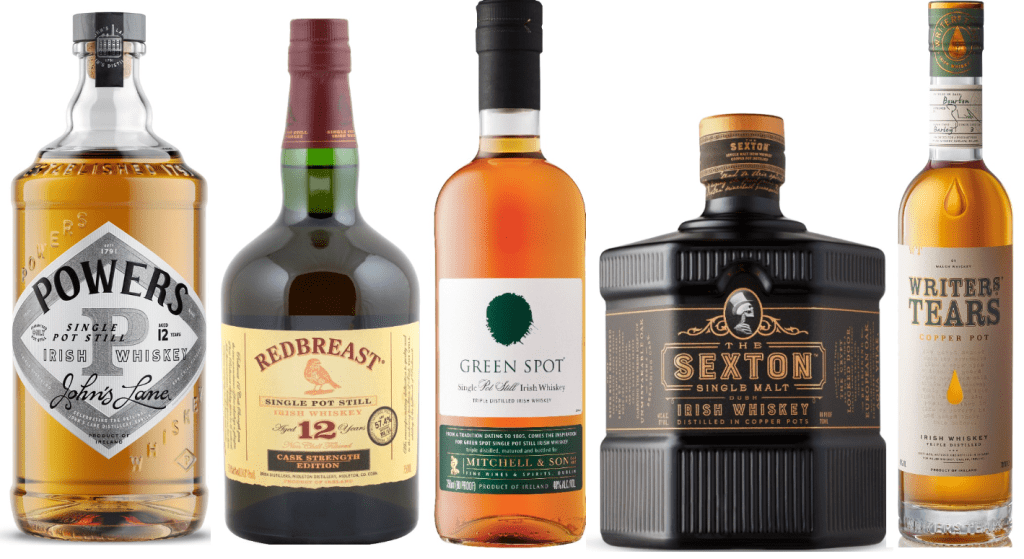
Fast forwarding to the period between 1990 and 2010, the Irish Whiskey industry experienced a resurgence, making it the fastest growing liquor industry. Today there are more than 40 distilleries throughout Ireland and more being added; the choices are becoming overwhelming. So today I will take you through a list of what many experts agree are many of the best Irish whiskeys on the market. Included are a couple of my personal favourites.
Before reviewing the list, it’s important to keep in mind that there are four styles of Irish Whiskey: Single Pot Still, Single Malt, Single Grain and Blended. Keep in mind that “Single” in the title refers to a single distillery, it is not a descriptor for the words following after.
SINGLE POT STILL
This was once the most common way to make whiskey but had become almost nonexistent by the end of the 20th Century. There has been somewhat of a resurgence in recent years. The single pot still variety originally came about during the 1700s as a way to avoid taxes imposed on malted barley.
The classification states that the whiskey must be made from a single distillery, distilled in pot stills from a mashbill that contains at least 30% malted barley and 30% unmalted barley, with up to 5% of other cereal grains. Pot still whiskey is noticeably spicier and creamier than other styles.
Recommended single pot style whiskies include:
Powers John’s Lane
$76 at LCBO
Because of its 200 year history, Powers has a reputation for being mainstream though it is actually a lesser-known label. It is named after the location of its old distillery, where it held production beginning in the early 1800s until 1975. The whiskey is aged in bourbon barrels and finished in Oloroso sherry casks creating flavours of leather, tobacco, wood, dark chocolate and toffee.
Redbreast 12 Year Old Cask Strength
$120 at LCBO
Redbreast has several popular expressions, but the 12 Year Old Cask Strength is arguably its most popular. At 116 proof, this whiskey provides flavours of oak, buttery pears, cinnamon apple, baking spices, caramel and vanilla.
I have tried Redbreast but I personally have never found it too endearing.
Green Spot
$88 at LCBO
Not appearing on the experts’ list, but one of my own personal favourites is Mitchell and Sons Green Spot. The whiskey has matured in a combination of first and second fill bourbon casks as well as sherry casks. It has flavours of green apples, honey and cinnamon spice. To me this whiskey provides good value for the price.
SINGLE MALT
Single malt Irish whiskey must be made in a single distillery, distilled in pot stills from a mashbill composed entirely of malted barley. Single malt is noticeably smoother than the single pot still style.
Recommended single malt style whiskies include:
The Sexton
$50 at LCBO
Contained within a unique hexagonal bottle, The Sexton single malt has the appearance and taste of a good quality spirit even though it has a very affordable price; the least expensive in this list. Aged for four years in casks previously used for Oloroso sherry, the whiskey has a silky profile of oak, fruit, honeycomb and a hint of spice.
Overall, I like The Sexton although I often favour a whiskey with a little more complexity in flavour. If I am looking for a mindless dram to relax with, this is a good one.
Bushmills 21 Year
$264 at LCBO
Bushmills is the oldest licensed distillery in the world, successfully enduring the near extinction of Irish whiskey in the 1970s as one of two remaining distilleries. The 21 Year single malt is Bushmills’ premier expression, triple distilled and aged for 19 years in either former Oloroso sherry casks or bourbon barrels and then finished for an extra two years in Madeira casks. The result is a big flavour profile of fig, mango, caramel, cherry and apricot, all ending with a sweet finish.
SINGLE GRAIN
Single grain whiskey refers to any whiskey distilled in a column still rather than a pot still. Its mashbill can also be no more than 30% malted barley. The result is something with higher alcohol content, yet is less flavourful. As a result, single grain whiskey is largely used for blended varieties rather than bottled by itself, although there are some exceptions.
Recommended single grain style whiskies include:
Teeling Single Grain
Opening in 2015, Teeling is the first new distillery in Dublin in 125 years. However, Teeling was originally opened in 1782, closing in 1923. The current owners possess the Teeling family name. They put out one of the most versatile ranges of Irish whiskeys, including the rare single grain, which I unfortunately could find no reference to at the LCBO. It is made with a corn-dominant mashbill where it’s then aged in former Cabernet Sauvignon wine barrels creating a profile that ranges from cranberries to butterscotch to the typical sweetness of bourbon whiskey.
Method & Madness Single Grain
Method & Madness is part of the micro-distillery offshoot at New Midleton Distillery. It was launched a few years ago and has an outside the box approach to the aging process. The brand came up with a single grain spirit that’s aged in first-fill bourbon barrels and finished in virgin Spanish oak. The result is a flavourful single grain whiskey with hints of oak, spice and grapefruit. Unfortunately, this whiskey is not available for sale in Ontario.
BLENDED
The driving force behind blended whiskey is that it is a good way to produce the spirit while keeping costs lower. Blended whiskey combines two or more of the previous styles, usually a higher quality liquor with a lower quality one. Most mainstream Irish Whiskeys, such as Jameson and Tullamore Dew, are of the blended variety.
Writers’ Tears
$60 at LCBO
Writers’ Tears is produced by Walsh Whiskey. This blended spirit combines single pot still and single malt varieties. Aged in American bourbon barrels, the whiskey possesses flavours of lemon, honey, black pepper and floral notes.
I have tried Writers’ Tears a few times and have found the flavour to be light and subtle. It is a good choice for anyone new to the whiskey scene.
Jameson Bow Street 18 Year Cask Strength
Jameson, one of Ireland’s most renowned distilleries, put out its rarest release in 2018 and has done so once a year since. The historic Bow Street distillery operated for nearly 200 years until it closed in 1976 and was later turned into a museum, which I have visited. Jameson’s Bow Street 18 Year Cask Strength is claimed to be the king of all blended whiskies, combining both pot still and grain varieties. This expression has flavours of toffee, oak, vanilla and sherry, as well as notes of leather.
This particular Jameson rendition is unfortunately not available in Ontario.
Sláinte mhaith
 A Layman's Wine Musings