Dessert Wine Trends

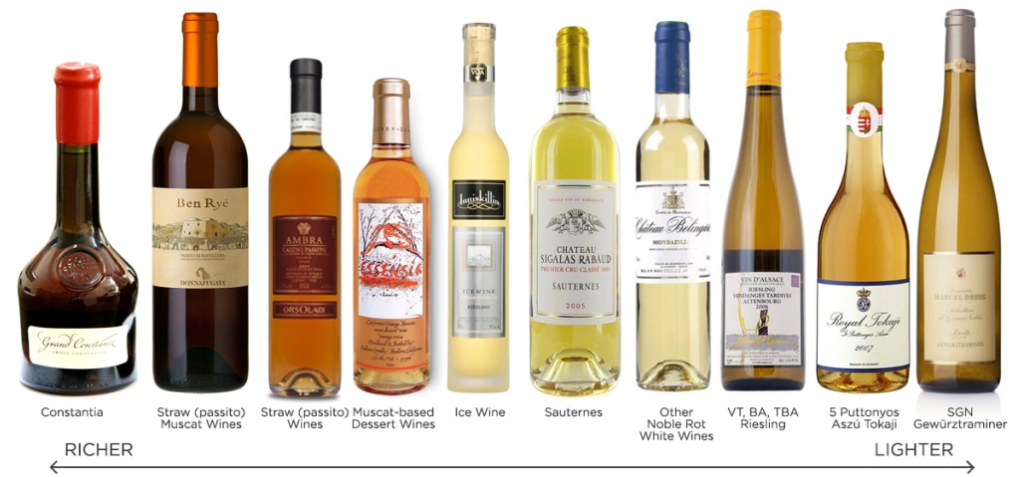
As the name suggests, dessert wine is a sweet wine that is intended to be served alongside dessert. These wines are often rich in flavour and have a high sugar content.

Photo credit: varuninamdar.wordpress.com

There has been a growing demand for premium dessert wines aimed at satisfying consumer demand for high-quality and unique flavours. This has driven market growth by enticing wineries to improve and enhance their product offerings and release new artisanal options, which in turn command higher price points and increased revenue.

There is rising interest in low-alcohol dessert wines by health-conscious Millennials and the Gen Z population who desire lighter wines. These wines also appeal to a broad range of wellness seekers, thus enhancing market growth.

Again, health-conscious and ethically driven drinkers are creating demand for vegan and allergen-free wine alternatives. By excluding animal-derived fining agents, which are added to wine to alter its colour, flavour, texture, and clarity, new dessert wine markets become available. These agents include additives such as casein or gelatin.

There are generally five types of dessert wine. Thirty percent of the market is made up of fortified wines, consisting of Port, Sherry, Madeira and Marsala.

Late harvest wines are next, consisting of twenty-five percent of the dessert wine market. Included in this category are Late Harvest Riesling, Late Harvest Sémillon and Late Harvest Gewürztraminer.

Controlling twenty percent of the market is Ice Wine. Included are Eiswein and Ice Cider.

Botrytized Wines, also referred to as Noble Rot, consist of fifteen percent of the market. For an explanation of this type of wine, refer to my post, Dessert Wines from April 18, 2020. Wines in tis group include Sauternes and Tokaji Aszú.

The “Other” wine category make up the remaining ten percent of the dessert wine market. Included in this catch-all category is Recioto della Valpolicella, Vin Santo and Muscat / Moscato.

Sláinte mhaith

Wine Barrels

Is the best wine made using French oak barrels or American oak barrels? The answer depends on who is answering. I would be amiss if I didn’t mention that there are also Hungarian oak and Romanian oak but these oaks are seldomly used in making wine.

Photo credit: bodegaspaniza.com

Oak can play a crucial role in the winemaking process. It is a long-known fact that not just any wood will do when it comes to aging wine. Oak has been the choice for centuries. Due to the natural wood compounds, aging wine in oak barrels exposes complex flavours and textures that are crucial to the overall taste and structure of a wine. There are natural wood sugars in the oak that influence the wine’s flavour. The wine’s texture can be enhanced from tannins found in the oak.

French Oak is known by winemakers for its subtlety. These trees have tighter grains that deliver lower amounts of tannin that are more readily integrated into the wine. This wood is also more aromatic, producing delicate notes of dark chocolate, roasted coffee beans, vanilla and baking spices to the wine.

American Oak presents more robust flavour profiles introducing bold vanilla notes along with coconut, sweet spices and dill. The wider grain patterns of American oak also injects more tannins into the wine.

French Oak lets wine age gracefully over time. The wine will evaporate less from barrels of French oak than American oak, thus producing a naturally slower oxidation. On the other hand, American oak will often go through a more rapid oxidation process in the barrel.

When it comes to price, American oak is less expensive to purchase. This is due to it being more readily available than French oak. However, French oak produces a more luxurious wine, making it well worth the higher price tag.

So, which wines work best with French oak versus American oak? Chardonnay flourishes when aged in French oak barrels because the French oak releases delicate vanilla undertones into the flavour of the wine.

Pinot Noir also benefits from the use of French oak. This light-bodied red grape works well with the lower tannin content inherent to French oak. It allows for slow maturation without overwhelming Pinot Noir’s naturally elegant profile.

In contrast, bold reds such as Zinfandel often get paired with American oak. The intense notes of coconut and sweet spice from the American oak can complement the robust nature of these types of wine.

Wines such as Cabernet Sauvignon, Merlot or Syrah can work well with either French or American oak, depending on the winemaker’s desires. European winemakers tend to use French oak while American winemakers and some Australian vintners may use American oak. It all comes down to the desired style of the wine.

Many winemakers use both types of barrels or blend wines aged separately. It lets them control flavour profiles more precisely. The type of barrel used, or combination of barrels used will depend on the flavour notes the winemaker wants to achieve.

Sláinte mhaith

Sweetness Levels in Sparkling Wine

With many people cruising wine store shelves this time of year looking for a bottle of bubbly to celebrate the season with, it is a good time to examine how to identify the various types sparkling wine or Champagnie. There is no doubt about it; the sweetness classification system for sparkling wines is confusing. There are seven standard sweetness categories. Those are brut nature or brut zero, extra brut, brut, extra sec, sec, demi sec and doux. Each class indicates slight differences in aromas and flavour.

Photo credit: coravin.com

The sweetness level is determined by the dosage or liqueur d’expedition, which is a mixture of sugar and wine. It is used to top off the amount of wine in the bottle after riddling has taken place. Riddling occurs when the winemaker removes the dead yeast cells (referred to as the lees) from the neck of the bottle.

The dosage mix may contain anywhere between 500 and 700 grams of sugar per litre of sparkling wine. The precise ratio of sweetener-to-wine varies according to the producers’ desires and region the wine is produced in. Some producers use a sweeter liqueur d’expedition, while others choose not to sweeten their wines at all.

The classification system was designed a hundred years ago by the French to identify the sugar levels in Champagne. This is part of the laws that govern the production of Champagne. The laws have been modified countless times over the years.

The seven levels from dryest to sweetest are:

Brut Zero/Brut Nature

These wines are the driest, containing less than three grams of sugar per litre. These wines may also be referred to as “sauvage” or “zero dosage”.  They contain only natural residual sugar with no dosage added to the bottle.

Spanish Cava and Corpinnat producers may refer to these wines as “brut nature”, where in Germany the term “naturherb” may be used.

Extra Brut

In Champagne as well as Spanish Cava and Corpinnat, “extra brut”, or in Germany “extra herb”, is used to describe the second driest level of sweetness. These wines contain less than six grams of residual sugar.

Brut

“Brut” is the most common style of Champagne. To be labeled a brut wine, it must contain less than 12 grams per litre of sugar. This is a broad range and technically includes both “brut nature” and “extra brut”, so this category can vary widely in sweetness levels.

This term is also used to describe Spanish Cava and Corpinnat. In Germany the style may be referred to as “herb.”

Extra Sec/Extra Dry

“Extra Sec” or “Extra Dry” wines are slightly sweeter than “brut”. They contain between 12 and 17 grams of sugar per litre.  In Spain, the style is referred to as “extra seco” and in both Germany and Australia the term “trocken” is used.

Sec

“Sec” wines contain sugar levels between 17 and 32 grams per litre. These wines are considered to be ‘medium dry’ or ‘off-dry.’

Demi-Sec

Wines labeled “demi-sec” or Spanish “semi seco” contain between 32 and 50 grams of sugar per litre. Fun fact, this is equivalent to the amount of sugar in a typical gin and tonic.

Doux

This is the sweetest style of sparkling wine with the highest sugar content, usually over 50 grams per litre. Doux wines are very rare.

Sláinte mhaith

Aging and Wine Vintage

Before I begin let’s be clear on what ‘vintage wines’ are. Vintage wines are wines that are produced from grapes harvested during a single growing season as opposed to non-vintage wines, which can be produced from grapes grown in two or more growing seasons.

Photo credit: stlukes-glenrothes.org

Vintage wines that are cellared go through ongoing chemical effects that will continue until a bottle is uncorked. These outcomes are the result of continuous interactions between the wine’s alcohol, sugar and acid compounds, which combine in the bottle to create new complex flavours, textures and aromas. However, these results are not random. Skilled winemakers understand the chemistry behind aging wine and will manipulate the cellar environment to encourage various flavours and aromas that result in an appealing good vintage.

During cellaring the varietal’s natural flavours do not significantly change. A wine’s primary flavours will always be preserved regardless of cellaring timelines. These flavours are a result of the grape varietal and the conditions the grapes grew in.

However, aging a vintage varietal will affect the secondary and tertiary flavours and aromas. Both notes result from the winemaker’s techniques as well as the chemical interactions between a wine’s natural compounds. These activities define an aging wine.

White wines, especially dry whites like Sauvignon Blanc or Chardonnay, tend to become oily, heavy and stickier over time. Red wines, particularly those with naturally high tannin levels such as Nebbiolo, Syrah or Cabernet Sauvignon, tend to soften with time. This creates sediment that collects at the bottom of a bottle. As a result, the wine becomes smoother and less sharp, resulting in a gentler drinking experience.

The final characteristic affected by aging wine is colour. To see if a red wine has been properly aged, first look at the outer edge where the poured wine meets the glass. At that meeting point, which is referred to as the rim, the wine will appear lighter in colour. A young red wine, on the other hand, will have a rim that appears murky or opaque.

As red wines oxidize with age, their colours often change to deep shades of ruby-purple to softened mauves and then finally to tawny, deep browns. As white wine ages it tends to move from paler, straw-yellow shades to deeper golden hues. White vintages aged three or more years can eventually darken to the point of turning a golden amber color.

These changes in colour are the result of oxidation. When a wine bottle is properly sealed the only oxygen in a bottle will be the small amount trapped in the bottle’s neck, as well as what little oxygen passes through the cork or seal. Most cellared red and white vintages will be sealed with a traditional cork, which allows minimal oxygen to permeate. However, given that cork is itself a natural non-uniform product, oxygen permeation will vary significantly even between bottles cellared and cased at the same time.

Not all wines are created with the ability to be aged. The wine maker’s notes are often a good indication of a wine’s aging capability. Red wines that generally age well include:

  • Bordeaux and Loire Valley Cabernet Franc, aged 2 to 4 years
  • Chianti Riserva, aged 2 to 4 years
  • Petite Syrah, aged 2 to 5 years
  • New World Nebbiolo, aged 2 to 6 years
  • Australian and Californian Grenache, aged 2 to 10 years
  • Italian or Californian Cabernet Sauvignons, aged 3 to 15 years
  • Italian Barolo, aged 3 to 15 years

White wines with aging capability include:

  • Dry White Bordeaux, aged 2 to 3 years
  • Alsace Pinot Gris, 2 to 5 years
  • White Rioja, aged 2 to 5 years
  • Alsace Gewürztraminer, aged 2 to 10 years
  • Californian Fume Blanc, aged 2 to 10 years
  • New Zealand Sauvignon Blanc, aged 3 to 10 years
  • Australian Chardonnay, 3 to 10 years
  • German Riesling, 3 to 15 years

These lists are only a suggested guideline, not an exclusive list.

Sláinte mhaith

Vintage versus Non-vintage Wine

On the surface, the difference between vintage and non-vintage wines is simple. Vintage wines are made from grapes harvested during a single growing season, while non-vintage wines can blend a few different harvests. Non-vintage wine, sometimes referred to as stylized wine, is where the winemaker often aims to match the flavour of the wine to be the same as previous years. On the other hand, vintage wines are based on the characteristics of the vineyard and climate. Due to climatic conditions, some years produce wines that are considered better than others.

Photo credit: vinepair.com

Finding a bottle’s vintage is relatively straightforward. Simply look for the year printed on the label of the bottle. This tells you when the grapes were grown and the wine produced was made. Wine labels containing the description “single vintage” indicate that the wine was produced exclusively from grapes from a single harvest. Depending on the producing country, that ratio must be comprised of 75% to 95% of same-crop grapes. As long as a producer abides by that percentage, they can label their bottle as vintage.

The vintage is an indication of the quality of the wine. The wine flavours, textures, mouthfeel, aroma and bouquets are fundamentally determined by the weather and climate conditions during its specific growing season. Since vintage tells you what year those grapes were grown, you are provided with an accurate distinction between “good” crop years yielding delicious, balanced wines from “bad” crop years hindered by poor weather.

Non-vintage wines are wines created by blending grapes from multiple crops. As a result, they will not have a year printed on the label or will simply have “N.V.” to denote the fact its contents are not from a single harvest. Non-vintage wine quality will vary, as with vintage wines. Many are raved about for their consistency and cost-consciousness and represent good value for more casual wine drinking.

Which is better? The answer depends on what you are looking for from your drinking experience. There are wonderful single vintages and non-vintages available. Non-vintages will offer more diversity and flexibility, particularly when it comes to blends combining several complementary grape varietals. In contrast, vintages provide the opportunity to discover a specific wine region, a micro-climate and even a winemaker’s bottling skills and expertise in ways non-vintages cannot.

Sláinte mhaith

Biodynamic Wine

While visiting a winery in the Beaujolais district of France a few weeks ago I was introduced to a new term. I was told that the winery I was visiting was a biodynamic winery. This was a description I had not heard before, so I decided to research the topic in more depth when I returned home from my trip.

You may be familiar with what organic farming entails (if not, see my post Organic Wine from August 8, 2020), however the biodynamic movement is somewhat different. According to the Biodynamic Farming and Gardening Association, biodynamics is “a spiritual-ethical-ecological approach to agriculture, gardens, food production and nutrition.” Biodynamic wine is made with a set of farming practices that views the vineyard as one solid organism. The ecosystem functions with each portion of the vineyard contributing to the next. Conceptually, everything in the universe is interconnected and gives off a resonance or ‘vibe’. This interconnectivity even includes celestial bodies like the moon, planets and stars. Biodynamic viticulture is the practice of balancing this resonance between vine, human, earth and stars. Biodynamics is a holistic view of agriculture.

As with organic farming, natural materials, soils, and composts are used to sustain the vineyard. Chemical fertilizers and pesticides are not permitted. A range of animals from ducks to horses to sheep live on the soil and fertilize it, creating a rich, fertile environment for the vines to grow in. Biodynamic farming also seeks sustainability, leaving the land in as good or better condition.

Biodynamic farming has been met with skepticism by many scientists as some of the practices are difficult at best to prove they work. In addition to organic practices, biodynamic farming takes other factors into account, such as the lunar calendar and astrology. This method of farming considers all aspects of life in the vineyard — other plants, insects and animals. It’s not just about the grapes.

Photo credit: winefolly.com

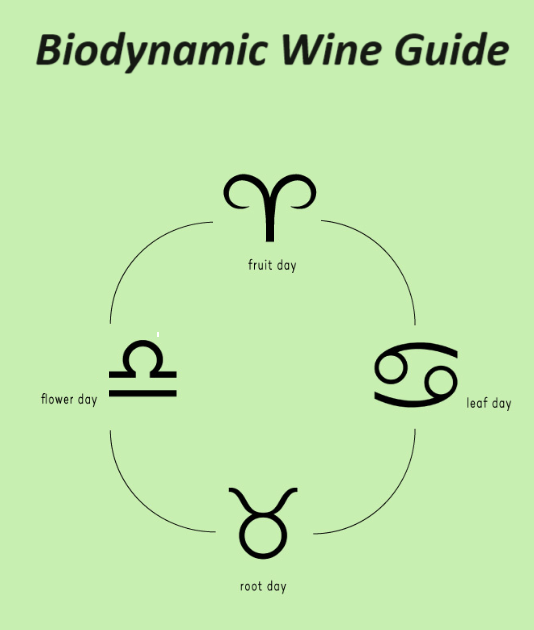
Farming practices from pruning to harvesting are controlled by the biodynamic calendar. It breaks all the tasks associated with farming into four types of days: root days, flower days, fruit days and leaf days. Each of these categories has certain tasks associated with it that are reflective of the earth’s four classical elements. Fruit days are meant for harvesting, leaf days for watering, root days for pruning. On flower days, nothing is done in the vineyard.

Biodynamic farming calls for specific and sometimes strange compost and field preparations. One of these is known as cow horn manure. Cow horns are stuffed with manure compost and buried into the ground all through the winter, then excavated the following spring. When excavated, the stuffed material is spread throughout the vineyard.

Biodynamic wines must be certified and adhere to strict rules and regulations. The wineries are overseen by 2 governing bodies, Demeter International and Biodyvin.

Biodynamic wines can be found in the United States, France, Germany, Spain, Italy, Eastern Europe, Chile, Argentina, India and Australia. Those who believe in the philosophy feel that the wines are more characteristic to the terroir where they originate. However, wine experts say there is no noticeable difference in the taste of biodynamic wine from organically produced wines. Is the difference worth the additional effort? You be the judge.

Sláinte mhaith

Winemaking Chemistry

The natural method of winemaking is the result of a series of biochemical transformations caused by the action of several enzymes. Many of these enzymes originate from the grapes themselves. However, the enzymes found in the grapes, yeasts and other microorganisms are often not sufficient so commercial enzymes are often added to supplement winemaking requirements.

Enzymes are used in winemaking to break down certain components in the grape juice, such as pectin and proteins, which help clarify the wine and improve its flavour, as well as improve the quality and efficiency of the fermentation process. Enzymes are also used to remove unwanted substances such as tannins.

To accomplish all this several different types of enzymes are used.

Pectinases are enzymes that break down pectin, which is a complex carbohydrate found in the cell walls of the plants.  The result is simpler sugars that can be fermented by yeast.

Beta-glucanases break down beta-glucans, which are complex sugars found in the cell walls of yeast and can cause problems during fermentation.

Proteases are enzymes that break down proteins into smaller peptides and amino acids, which can also be utilized by yeast during fermentation.

Glucosidases help to release aromatic compounds from the grape juice, which can enhance the flavour and aroma of the wine.  The selection of active yeast, fungal and bacterial glycosidases enhance the wine aroma.

Lipases are enzymes that break down fats and lipids, which can improve the clarity, filtration and stability of the wine.  They also assist with improving the pressing efficiency and juice extraction.

Anthocyanins contribute greatly to red wines because these molecules and their interactions with other compounds are responsible for the colour and the stability of red wine during ageing.

Exogenous enzymes are often used to accelerate the extraction of anthocyanins from the berry skin increasing the colour intensity of the wine.

The diagram below demonstrates where enzymes may be injected into the wine making process.  It is an excellent illustration as to why vintners require a strong biology or bio-chemical background.

Photo credit: creative-enzymes.com

Sláinte mhaith

Old Vines Versus New Vines

Old vines or new vines; does it make a difference when it comes to making wine? The simple answer is yes, but there are some things to take into consideration. The main sticking point is finding common ground for the definition of ‘old’. The definition is not industry controlled so depending on where you ask, the meaning changes.

Photo credit: lastbottlewines.com

In France, New Zealand and Canada, ‘old’ can mean 30 years. In Australia, California and Spain, the vines are not considered ‘old’ until they are 50 or 60 years of age. A few Californian producers who have vines as old as 80 to 100 years have adopted the designation ‘ancient vines’. If 80 years is considered ancient then by comparison there are several Australian vineyards with vines of such an age they would be considered prehistoric, dating back more than 150 years, the upper limit of longevity. Without a true international standard for identifying the relative maturity of vines from one country to the next, the consumer must beware and take into consideration where the wine was produced.

The lifespan of a vine is determined by several factors. The vines of France and other European nations were destroyed during the 1800s and early 1900s by a sap-sucking root pest called phylloxera that destroyed the plants and necessitated replanting on resistant North American rootstocks. Also, in the relatively rainy parts of Europe, such as much of France, the vines die decades before they tend to in the hot dry regions of South Australia, California, Chile and much of Spain. Harsh winters in countries such as Canada led to vines having only a 30 to 35 year lifespan.

Young grape vines, though productive, deliver variable quality wine from year to year. When the sun shines, they grow a great amount of foliage which can produce bitter grapes. When it rains, these vines bloat with water. The vines require massive pruning to reduce the amount of foliage and encourage ripening. By contrast, old vines are constant, their reduced sap flow naturally yields smaller berries with a higher ratio of solids to liquid.

The deep roots of old vines are a big asset. They tap moisture in drought conditions and guard against bloating during rainy times. Old vines also tend to ripen earlier, a great benefit to growers in cooler climates where cool autumn temperatures reduce the growing season.

Old vine wines provide richness and more complex flavours that build rather than trail off after the up-front fruit fades away.  Young vines produce nice, aromatic wines but lack the complexity of flavour of wine produced from older vines. Wines produced from old vines will often cellar longer than wines produced from young vines.

Wine produced by old vines is generally more expensive than similar young vine wines. Because of the rarity, lower yields and perceived enhancement of wine quality, old vines have become increasingly sought after and valued by both the wine industry and consumers. As a result, old vine grapes typically demand a higher price per tonne. This combined with consumer demand, has resulted in old vine wines being more expensive to purchase in the stores.

It has been said that the appreciation of an old vine wine can be a way to connect with the past and to celebrate an enduring art form, similar to listening to the music of a great composer, reading literature or observing at the art of past masters. Wine made from old vines can reveal the distinctive character of a specific historic place and the artistry of the vintner, both past and present.

Sláinte mhaith

Minerality in Wine

What does “minerality” in wine mean?  While ‘minerality’ is a useful term, there is no definite view on what it actually means.  Many wine labels provide no information about how the soil might affect the wine. Others specify in vague terms about how the soil contributes certain aromas or contains concentrated minerals.

Photo credit: diwinetaste.com

There is often an assumption that a small amount of material from the soil is drawn up through a grapevine’s roots and deposited in the fruit where it remains until the grape juice is fermented into wine. The popular notion is that the minerals can be tasted when we drink the wine.  However, scientific research has established that this is not the case.  It is not possible for us to taste minerals from the soil when we drink wine.

If this is true then why are people tasting minerality in wine?  In essence, the word mineral refers to three things.  The first is geologic minerals that make up the rocks in the ground.  Minerality can also refer to nutrient minerals like potassium, that vines absorb through their roots and use in vital processes. Finally, minerality can be a flavour descriptor where people think of the minerality in a physical sense rather than metaphorically as you would when describing a wine as having hints of lemon or fresh berries.

So, if minerality is not actually real is it still a useful concept?  The simple answer is yes.  Being able to associate imagery of things such as slate, gunflint, chalk or iodine helps us to associate and recognize flavour impressions even though we know we are not tasting the actual minerals.

Wines that are described as mineral are also generally described as ‘lean’, ‘pure’ and ‘acid’. They have a taste of licking wet stones and often a chalky texture. Some argue that it only applies to white wines, but it also occurs in reds.

There is an assumption that mineral wines are superior to mass produced New World fruity wines. They have a romantic image, one that implies they are handmade by artisans and express the mystery of the soil. Typical examples are found in the Old World such as Chablis and Sauvignon Blancs in France, Rieslings from the Mosel and Rheingau in Germany and Wachau and Kremstal in Austria.  This is not just a European characteristic but it does seem more prominent in places where the wines show less fruit and more acidity.

Many producers see it as an expression of the terroir, while some oenology experts (those who study wines) put it down to compounds produced in winemaking. Whatever the origin, there is no agreed definition of minerality, but for many it’s a very useful word.

Sláinte mhaith

The Effects of Histamines in Wine

If you get headaches when drinking wine or your face becomes flushed, chances are you have experienced an allergic reaction to the wine.  Antihistamine medications like Zyrtec, Allegra, Claritin or Benadryl may provide quick relief for your symptoms. This is because histamine has caused an immediate inflammatory response in the body.

Photo credit: therealreview.com

Histamine is part of the immune system that serves to provide a warning to your body of any potential attackers. It causes blood vessels to swell so the white blood cells can quickly find and attack an infection or problem.  The increase in the level of histamine is what causes a headache and leaves a person feeling flushed, itchy and miserable.

Many wines contain components that may react negatively to people with histamine sensitivity.  To begin, the wineries tend to use grapes that are ripe or even overripe; a state which leaves the fruit in the perfect state for excess histamine production.  Sulphur dioxide, which is a common preservative used in winemaking, can cause dermatitis, hives’ and/or flushing.   Another preservative, ammonium sulphates, may cause nausea or vomiting. It also causes histamine release in the body.  Commercial yeasts are also a known histamine trigger.

Lastly, ethanol, which is the alcohol we consume when we drink wine, is a by-product of the bacteria which feed on the sugars in the grapes from which the wine was made.  It is the reason why all alcohol contains histamines. Generally, the higher the alcohol content, the lower the sugar content and vice versa.

The level of histamine in wine varies depending on the processes used when making the wine; things such as the type of barrel used. You won’t find an alcohol completely without histamines and sulfites but there are techniques that will lower the histamine formed in wine.

While both red and white wines contain some trace nutrients, red wine has much higher levels of antioxidants, but all wines contain substances such as sulfites, which can cause mild to severe allergy symptoms to appear in some individuals.  White wine will contain between 3 to 120 micrograms of histamine per glass, whereas red wine will have 60 to 3,800 micrograms of histamine per glass.

Some people claim that natural wines contain low levels of histamine, however this is not always true.  It is not easy to determine which wines are safe as most wine labels do not legally have to show this kind of information and there isn’t a legitimized certificate for low histamine wines.

What works for many people with a sensitivity to histamine is a low histamine wine without sulfates.  White wines such as Sauvignon Blanc or sparkling wines like Cava or Prosecco are often a good choice for people with histamine sensitivity.

Sláinte mhaith