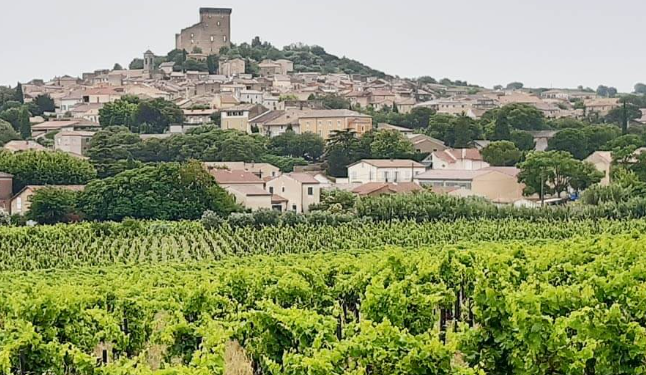
French Cuisine with French Wine

Inspired by my excursion earlier this year to France, I have compiled a list of popular French foods along with complimentary French wines.

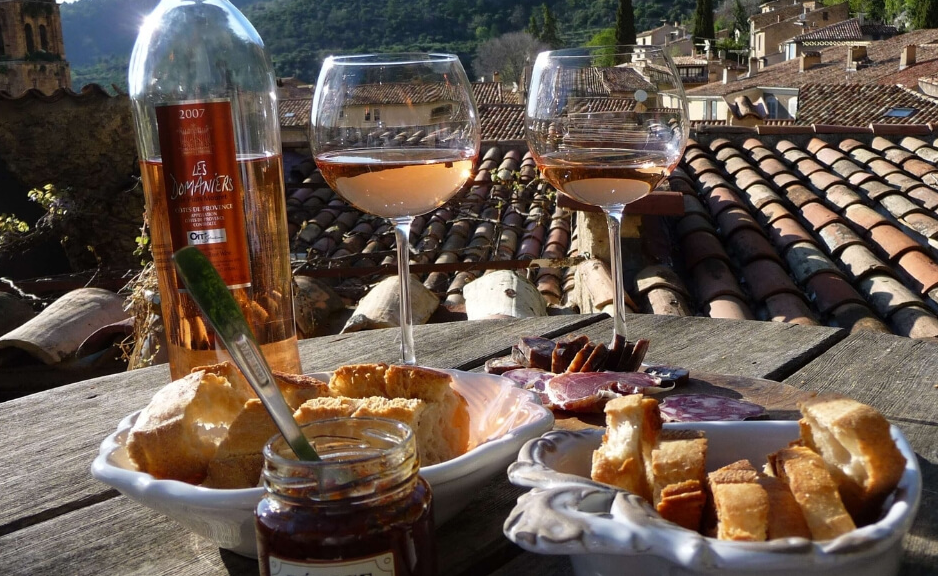
Photo credit: joinusinFrance.com

Asparagus and Hollandaise with Condrieu

Condrieu is the highest form of Viognier, a white grape known for its thick texture and exuberant aromatics. Asparagus makes a good combination.

Brie de Meaux with Champagne

The richness of the creamy cheese is balanced by the acidity and lightness of the bubbly Champagne. It creates a very decadent experience. 

Coq au Vin with Beaujolais

Beaujolais is the often-underestimated red from southern Burgundy. Made from pure Gamay, the wines are easy to appreciate. The freshness in Beaujolais allows it to cut through the richness of stew. However, the berry notes of the wine are better suited with chicken rather than beef or pork.

Boeuf Bourguignon with Red Burgundy

Boeuf bourguignon, being robust and savory, is well complimented by a red Burgundy, which is a complex and subtle expression of Pinot Noir.

Chèvre with Sauvignon Blanc 

As simple as it sounds, fresh goat cheese and Sauvignon Blanc make a great combination. The pungent flavours in chèvre are highlighted by the minerals and acidity of Sauvignon Blanc.

Comté with Vin Jaune

Vin Jaune is the oxidized, sherry-like wine made in France’s Jura region. It has intense, delicious notes of walnuts, dried fruit, curry and pine. It can be a bit sharp on its own, but with cheese, such as Comté, it is very appealing.

Duck with Red Burgundy

A red Burgundy will be a good compliment for roasted duck breast. It combines delicate berry fruits with cool earthiness. As the wine ages it is enhanced by notes of mushrooms and leather.

Foie Gras with Sauternes

Steeped in French tradition, foie gras should be paired with a Sauternes from the Bordeaux region.

Lamb with Northern Rhône Syrah

Northern Rhône Syrah is both subtle and elegant, combining characteristics of dark berry with lightweight aromatics. There are often notes of smoked meats, bacon, licorice, and cloves, which pairs well with lamb.

Mussels with Muscadet

Muscadet is a refreshing, uncomplicated white wine that is produced along the Loire River near the Atlantic Coast. With the ocean nearby, it’s a perfect match for shellfish, particularly oysters or mussels.

Olive Tapenade with Rosé

Olive tapenade served on seasoned crackers or crusty slices of baguette combined with a crisp Rosé is a great combination.

Oysters with Chablis

Chablis is a sub-region of Burgundy, known for its Chardonnay wines made with little or no oak. Classic Chablis is full of minerality and zest making it a great pairing with most oyster dishes.

Roquefort with Sauternes

Sauternes is a unique wine, being created from mold-covered shriveled up grapes just south of Bordeaux. It has notes of apricot, pineapple, ginger, caramel and honey. It pairs well with blue cheese.

Salade Lyonnaise with Beaujolais 

A traditional salad lyonnaise (greens, bacon, croutons and mustard dressing topped with a poached egg) is the perfect match for the low levels of tannins and high acidity found in Beaujolais, which is produced from Gamay grapes.

Sole or Flounder with Sancerre

Sancerre is pure Sauvignon Blanc. It is aged in a stainless steal tank without any oak. The combination of juicy grapefruit and mineral freshness matches beautifully with any fine white fish prepared in butter.

Steak with Bordeaux

Steak pairs well with many reds from France, but one sure bet is Bordeaux, especially the Right Bank Merlot dominant wines.

Stew with Southern Rhône Red

Southern Rhone reds usually consist of a blend of Grenache, Syrah and Mourvèdre. The resulting wines are bold and rich, with texture and dark, jammy notes. Most beef stews work well with these wines.

Veal with White Burgundy

White Burgundy is the highest expression of Chardonnay. As long as the wine retains some acidity, it should match beautifully with the subtle, delicate flavours of veal.

Bon appetite!

Sláinte mhaith

Bordeaux’s Sauternes Region

The final Bordeaux winery visit on our recent trip to France was to Château La Tour Blanche in the Sauternes region. The Sauternes Appellation d’Origine Contrôlée covers approximately 2,000 hectares and includes five communes: Barsac, Bommes, Fargues, Preignac and Sauternes.

La Tour Blanche estate, like most of the Crus Classés of the appellation, is located on a ridge elevating It 60 meters above sea level. This provides good exposure of the vines and better drainage of the land. The terroir provides a gravelly surface and a clay-limestone subsoil, which give a particular character to the wines produced.

The three traditional white grape varieties of the Sauternes Appellation d’Origine Contrôlée vineyard are Sémillon, Sauvignon Blanc and Muscadelle. Château La Tour Blanche grows 83% Sémillon, 12% Sauvignon Blanc and 5% Muscadelle.

Photo credit: tour-blanche.com

The Sémillon grapes provide the structure, give the wine its beautiful Golden colour and its aromas of dried fruits, candied fruits and honey. Sauvignon Blanc produces a very fine, full-bodied, and aromatic wine and creates the beautiful freshness in the blend. The Muscadelle adds to the unique style of the wines, bringing additional aromatic complexity thanks to its delicate scent of muscat grain and its spicy notes.

Like many of the wineries in Bordeaux, Château La Tour Blanche has already taken numerous steps to improve its environmental performance. They have imposed demanding specifications on sustainable development. In recent years, they have introduced waste reprocessing and confined spraying. Château La Tour Blanche is HVE 3 certified (High Environmental Values) and is a member of the first association for the Environmental Management System (EMS) of Bordeaux Wine certified ISO 14001.

The grapes arriving at the winery are botrytized (see my post, Dessert Wines from April 18, 2020), full of sugar. Once selected on the sorting table and pressed, the grapes produce musts in which the action of Noble Rot will have produced a reduction in acidity as well as an increase in sugar content. The average yield does not exceed 10 to 15 hectoliters per hectare at the La Tour Blanche estate, due to strict selection.

Only musts reaching an average of between 20 and 22 degrees of potential alcohol are selected for the 1er Cru Classé. The slightly less concentrated juices will be used to produce the second or third wines.

Unfortunately, I was unable to attend and sample any of the wines that day because of an unexpected visit to see a Bordeaux ophthalmologist as a result of a torn retina, which is now repaired. I may have to make a return trip to the region to experience what I missed.

Sláinte mhaith

The Left Bank’s Margaux Appellation

On my recent excursion to Bordeaux, France, I travelled to the Left Bank’s Margaux appellation where I visited Château Dauzac, which is a Margaux Grand Cru Classé according to the 1855 classification. Their vineyards span 49 hectares.

All the wines utilize gravity-flow vatting. Fermentation takes place in wooden vats with transparent double staves. The wine was aged in 100% French oak barrels (including 65% new barrels) for 15 months with racking based on tasting results.

Dedicated to the expression of terroir and dominated by Cabernet Sauvignon, Château Dauzac reveals a nicely complex bouquet that slowly unfolds during aeration. On the palate, it strikes a subtle balance between the richness of its tannins and the aromatic diversity of its supple fruits, emblematic of great wines for ageing.

Cabernet Sauvignon dominates with its complexity, elegance and minerality, while Merlot adds roundness and silkiness. Always deep in colour, Château Dauzac expresses a subtle balance where fruits, flowers and spices are combined, with a complex body and tannins ensuring an emotional tasting experience.

Like many of the wineries in the region, Château Dauzac is committed to reducing its carbon footprint. They have formed a partnership with Bioboon Agrology. Together they are working toward the ecological transition of agricultural activities that promote plant health while preserving the surrounding biodiversity.

They have also planted bamboo on the estate. The bamboo acts as an essential carbon sequestration mechanism, offsetting the residual emissions of their carbon-neutral wine. This initiative reduces the environmental impact of the winery’s activities.

Château Dauzac is also investing in research and development to fight against mildew. The aim is to use natural products free of heavy metals to preserve the health of their vines and the balance of the surrounding ecosystem.

The terroir is a clay-based soil that contains deep gravel outcrops. The vines have an average age of 35 to 40 years. The grape varietals consist of 69% Cabernet Sauvignon, 29% Merlot and 2% Petit-Verdot. The grapes are harvested by hand in small crates and sorted on tables before and after de-stemming.

The first wine that I sampled at Château Dauzac was the 2021 “Aurore de Dauzac Margaux”, which is a blend of 62% Cabernet Sauvignon, 37% Merlot and 1% Petit Verdot. It is bright red with ruby hues and a nose of red fruit with a slightly floral expression. The flavour displays a pleasant concentration with notes of black fruit.

The second wine I tasted was the 2019 Margaux Grande Cru Classé. Château Dauzac 2019 is a wine that expresses exceptional fruit vibrancy. It is very well-balanced and composed of dense tannins that exhibit finesse and elegance. It consists of a blend of 73% Cabernet Sauvignon and 27% Merlot.

I was surprised to see how much my wife enjoyed this wine as she usually prefers the Right Bank Merlot concentrated wines over the Left Bank Cabernet Sauvignon dominant wines. In fact, she enjoyed it so much that we decided to have some shipped home. When making the shipping arrangements we were told that the 2022 vintage would be more superior to the 2019, given the climate conditions that existed that year. The only caveat was that the 2022 would not reach its full potential for another 10 years.

We then decided that we would purchase some of the 2022 vintage as well to ship home. The 2022 wine consists of 63% Cabernet Sauvignon and 37 % Merlot. The overall yield was small due to the lack of water but the remarkable quality will make the 2022 vintage one of the greatest ever experienced in Bordeaux.

I was pleased to learn that Château Dauzac wines are occasionally available in Ontario liquor stores. I will be eagerly awaiting the next vintage to appear on store shelves.

Sláinte mhaith

The Blaye Côtes de Bordeaux Appellation

On the Right Bank, near the village of Bourg, I had the opportunity to visit Chateau Monconseil-Gazin, a third-generation family preserved estate winery owned by the Baudet family. The wines produced are part of the Blaye Côtes de Bordeaux appellation.

The vineyard’s hilly terrain benefits from a microclimate caused by the proximity of the estuary and the Atlantic Ocean. The clay-limestone soils rest on a soft rock substrate that is very favorable to the roots of the vines and perfect for drainage.

The 35 hectares of gentle slopes facing south and southwest predominantly grow the Merlot grape variety, complemented by Cabernet Sauvignon, Cabernet Franc and Malbec.

The first wine that I tasted was the 2023 “Blaye Côtes De Bordeaux”, a white Sauvignon. The vines are cultivated according to the sustainable agriculture charter for the development and protection of the terroir. No chemical fertilizers are used.

The wine consists of 100% Sauvignon Blanc that is aged on fine lees, which are the smaller, more gradual sediment that settles at the bottom of a fermentation vessel after winemaking. The fine lees age with the wine, adding complexity, texture, and flavour. The wine is bottled at the Château.

The terroir is a clay-limestone on stony subsoil, providing excellent drainage and deep roots. The slopes face south-southwest, ensuring optimal maturity of the grapes.

This wine’s aroma contains notes of citrus and flowers and has a smooth crisp palate. The finish is long, fresh and fruity.

The second wine I had was the “Blaye Côtes De Bordeaux – Blanc Prestige”, made of 80% Sauvignon Blanc and 20% Sémillon. This wine releases an elegant nose of lychee and citrus fruit complemented by a light oakiness. The palate is dense and smooth, with a freshness that lingers through to the finish.

The third wine I sampled was the 2020 “Blaye Côtes De Bordeaux” red. Once again, the vines are cultivated according to the sustainable agriculture charter for the development and protection of the terroir, using no chemical fertilizers.

The wine is produced from 70% Merlot, 20% Cabernet Sauvignon and 10% Malbec grapes. It is aged in French oak barrels for 12 months, then blended and lightly filtered before being bottled at the Château.

The terroir is clay-limestone hillsides on a stony subsoil, excellent for drainage and rooting.  The vineyard slopes are south/southwest facing, ensuring optimal maturity of the grapes.

The flavour has hints of woody and toasty accents accompanied by notes of violet, blackberry, crème de cassis, tobacco leaf and sage. There is an abundance of young fruit with tannins and acidity.

This wine has had more than twenty years of recognition by the most prestigious competitions in France and internationally: Mâcon, Paris, Aquitaine, Challenge International du Vin, Brussels and London.

The last wine I tasted was the 2019 “Grande Réserve”, which is made from 50% Merlot, 20% Cabernet Sauvignon, 20% Malbec and 10% Cabernet Franc. The wine was matured in French oak barrels (50% new) for 18 months, blended and lightly filtered and then bottled at the Château.

This wine offers ripe fruit and notes of mocha, toast and vanilla. The tannins are tight and the flavours are full.

This wine has been recognized by the most prestigious competitions and specialist magazines such as the HACHETTE Guide, the Revue des Vins de France, Decanter and In Vino Veritas.

My wife and I enjoyed this one enough that we purchased a bottle to drink after our day’s explorations. Unfortunately, Chateau Monconseil Gazin wines are not currently available in Ontario liquor stores.

Sláinte mhaith

The Médoc Area of Saint-Émilion

The first area I explored on my recent trip to France’s Bordeaux region was Médoc, which is situated on the Right Bank. The name Médoc is synonymous with exceptional wines. Considered as one of the world’s leading red wine producers, Médoc has been a winemaking region since the 18th century, with more than 16,000 hectares of vineyards across eight sub-appellations.

In Médoc, which is part of the Saint-Émilion appellation that has over 800 Chateaux, I visited the family-owned winery, Château Fleur Cardinale. The terroir consists of a mix of clay and limestone. Typical of Right Bank wineries, their wines consist of a blend of around 70% Merlot, 20% Cabernet Franc and 10% Cabernet Sauvignon. The blended portions vary slightly from year to year depending on the yield of each grape varietal.

La Maison Cardinale was established in 2001, when Dominique and Florence Decoster acquired Château Fleur Cardinale. In 2017, their son Ludovic and his wife Caroline took the reins of the family estate. In 2024, they created La Maison Cardinale, an entity that brings together Château Fleur Cardinale, a Saint-Émilion Grand Cru Classé, and Château Croix Cardinale, a Saint-Émilion Grand Cru.

They have two estates, Château Fleur Cardinale and Château Croix Cardinale. Château Fleur Cardinale covers 27.6 hectares on the northern slope, producing a Saint-Emilion Grand Cru Classé. The northern slope is also ideal to produce Fleur Cardinale white, in the Bordeaux appellation. Château Croix Cardinale covers 4 hectares on the southern slope, producing a Saint-Emilion Grand Cru.

While there I had the opportunity to sample 2023 “Cardinal Flower Intuition Saint-Emilion Grand Cru” and the 2019 “Grand Cru Classé, Saint-Emilion Grand Cru”. The Intuition had an intense aromatic profile of ripe black fruits. There were subtle tannins and a supple, fresh texture. The Grand Cru Classé had a sensation of fresh and intense fruit, both on the nose and in the mouth. In my opinion it was much smoother and better balanced than the Cardinal Flower Intuition.

The grapes for both wines are picked by hand. There are about 15,000 bottles of Cardinal Flower Intuition produced each year and 105,000 bottles of the Grand Cru Classé. About 80% of the wine is sold to wine agents for export with the balance being sold from the winery. Unfortunately, Château Fleur Cardinale wines do not appear to be available in Ontario liquor stores.

Sláinte mhaith

My Adventure to Bordeaux

I recently returned from a trip to the Bordeaux region of France where I took advantage of the opportunity to experience some of the finest wines in the world.

The effects of climate change are impacting the grape harvests there the same as they are in many other parts of the world. The region is facing increasing temperatures and drought conditions each year. Not helping matters is the governing regulation that prohibits vineyards to irrigate vines that are more than 3 years old.

To help try and offset the effects of climate change, I saw horses being used in place of tractors to till the weeds that were growing between the rows of grape vines, lessening the need for herbicides and reducing the generation of carbon monoxide.

The Bordeaux region is separated into 2 distinct areas: the Left Bank and the Right Bank. To help identify which is which, the city of Bordeaux is situated on the Left Bank.

Bordeaux’s wine areas are often categorized into five main zones, primarily based on their location in relation to the Gironde, Garonne, and Dordogne rivers. These zones are: The Médoc, Graves and Sauternais, The Libournais, Blaye and Bourg and Entre-Deux-Mers.  During our trip I visited wineries on both the Left Bank and Right Bank.

The Left Bank, often referred to as the Médoc and Graves, produces red wines, while the Right Bank, including Saint-Émilion and Pomerol, also focuses on red wines. Entre-Deux-Mers produces both red and white wines, and the Graves and Sauternais are known for their sweet white wines.

There are five Bordeaux wine classifications. These classifications serve as an expression of quality and prestige worldwide. The principle of the crus classés (“classified growths”) illustrates the synthesis of a terroir’s typical characteristics and dedicated human intervention over many generations to ensure quality. However, a wine or appellation can still be outstanding even if it is not a part of these classifications. The classifications are listed in order of seniority:

  • The 1855 classification
  • The Graves classification
  • The Saint-Émilion classification
  • The Crus Bourgeois du Médoc classification
  • The Crus Artisans classification

For a winery in Bordeaux to be referred to as a Château, the property must include a large house, vineyards and a place to make wine.

The age of the vines impacts the quality of the Bordeaux wine. The older the vine, the more expensive the wine. The roots on old vines extend much deeper and extend further int the soil. This adds minerality to the fruit, which in turn adds complexity to the flavour of the wine.

One thing I found interesting on this trip was how the various winery staff pronounced Cabernet Franc. I was always under the impression that Cabernet Franc was pronounced as the French do, with the ‘c’ in Franc being silent – ka·br·nay frong, but I now found out that it is acceptable to pronounce it in English as ka·br·nay frank.

Over the next few weeks I will describe my adventures through the region, as well as the wineries I had the opportunity to experience.

Sláinte mhaith

String Wine

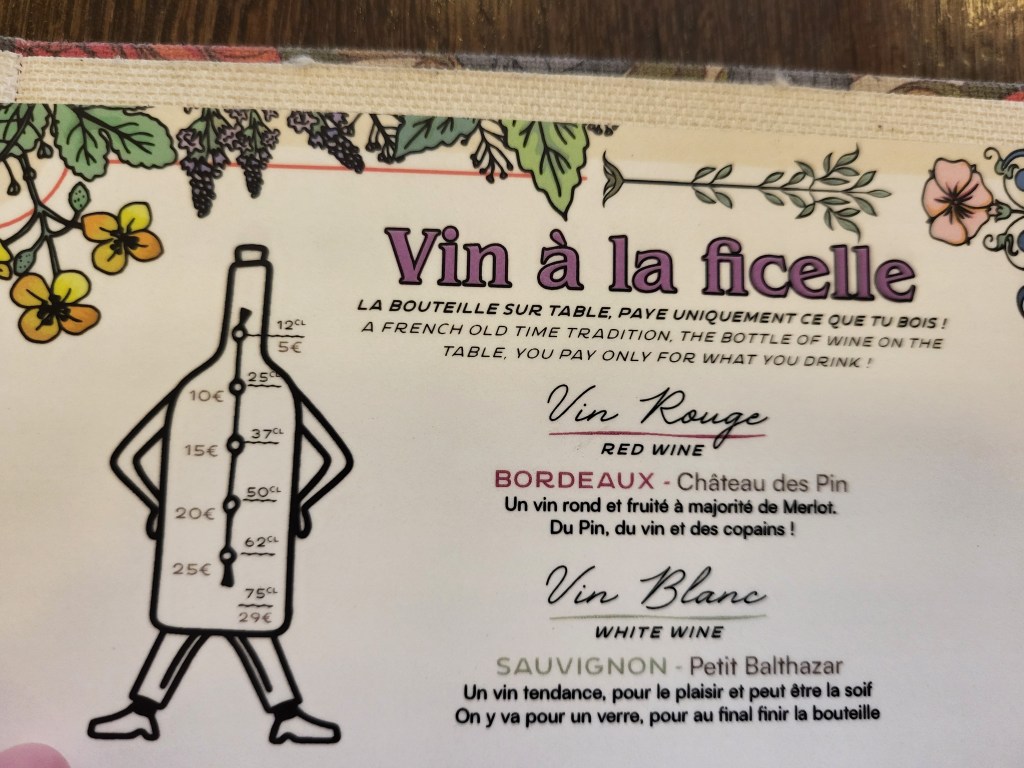
While dining in a restaurant in Paris earlier this year I came across something that I had never seen before – being able to purchase wine by the portion of the bottle that you consume. The server provides you with your choice of a bottle of French red or white. The bottle comes with a string tied around the neck that then drapes down the length of the bottle. There are knots in the string to indicate 12, 25, 37, 50, 62 and 75 centilitres of wine.

This is referred to as, “à la ficelle”.  It is a very practical approach to purchasing wine when you don’t want to consume a whole bottle but desire more than a single glass.

Although the concept of ficelle wine has only started to become popular in restaurants in recent years, the concept dates all the way back to the 15th century. According to legend, it was an Auvergne innkeeper by the name of Gaultier who, in the 1400s, ​​used a piece of string to determine how much wine his customers drank.

During that time wine was served in earthenware or pewter pitchers. The innkeeper used an evenly spaced knotted rope to determine the quantity of wine his patrons had consumed. The distance between each knot represented 25 centilitres of wine.

With the current trend where people are reducing their wine consumption, the concept of string wine is becoming more popular. Less restaurant patrons are purchasing wine by the bottle and instead 20% now favour wine by the glass while 12% now prefer the wine by string concept.

Sláinte mhaith

A Lost Appetite

Many of the world’s wine regions are facing problems resulting from an oversupply of grapes. For example, last year the French government spent 200 million euros to dispose of surplus wine. In addition to that, Bordeaux region vintners received 57 million euros to destroy 9,500 hectares of grape vines.

Photo credit: vancouversun.com

In Australia, millions of vines are being destroyed and tens of millions more must be removed to control overproduction. Drastically reduced grape prices are threatening the incomes of growers and wine makers.

Falling consumption of wine worldwide has hit Australia particularly hard as demand shrinks fastest for the cheaper reds that are its biggest product. It had relied on the Chinese market for growth until recent years. Last year there was more than two billion litres of surplus wine in Australia.

Oversupply is not a new phenomenon. In the past the industry has always been able to readjust but going forward it may not be as easy. Past declines were triggered by economic factors such as market crashes, the tech boom, new tax laws and other more specific events that impacted the amount of money people spent and how they prioritized their consumption of wine.

Today the reduction in wine consumption is the result of a change in attitude and lifestyle resulting in people consuming less wine. Campaigns such a “Dry January” and “Sober October” are becoming more and more popular, leading to less wine consumption in the other ten months of the year. As a result, wine drinking has been declining year over year since 2017.

In France, wine consumption has declined significantly, from 150 litres per person per year in 1950, to 40 litres per person in 2022. The French people are no longer insular with just their own culture. Instead, they have adopted influences from other parts of the world and as a result, have substituted some of their wine consumption with other beverage options, such as beer, whiskey and cocktails.

Cuisine is changing as well, which has altered drinking habits. Lighter food choices and finger foods are often replacing traditional multi-course meals. Also, people have been reducing the amount of red meat in their diet. This has resulted in consumers wanting lighter, lower-alcohol wines. The Bordeaux region in particular has been greatly impacted by this, having reduced demand for their full-bodied red wines.

The U.S. market is being impacted as well due to a focus on wellness and a change in lifestyle. Non-alcoholic beverages sales there have increased 20.6 percent from 2021 to 2022.

People are drinking less wine but better wine. Over the past seven years, the U.S. wine industry is seeing growth rates sag in the under $12 category but wines in higher-priced tiers continue to see growth.

This change has also impacted wine sales in Australia where for the first time since the mid-1990s there is an oversupply based on a lack of consumer demand. A main driver of the decline is due to the lack of demand for Australin wine in the U.S.

There are other factors as well affecting Australian wine sales. In March 2021, China imposed a 218 percent tariff on Australian wine in response to Australia requesting an independent investigation as to the origins of COVID-19. China’s decision wreaked havoc on Australia’s wine industry.

The world is also still feeling the effects of the pandemic. From supply chain issues to how people purchase and consume wine was severely impacted. The good news is that there are indications that the wine industry is heading toward a return to normalcy, at least in this regard. Wine consumption remains lower than in 2015 but above what it was in 2021.  This is largely due to the reopening of bars and restaurants. The long-term effects remain to be seen.

Depending on soil conditions, some French vintners are now investigating switching to other crops such as corn or wheat. Others are changing vineyards into livestock pastures. Australia is focusing on market expansion and providing wineries with market data so they can determine their best course of action.  Not waiting for new markets to open, some growers are turning to citrus and nut trees instead.

One thing for certain is there is currently much uncertainty in the wine industry.

Sláinte mhaith

Biodynamic Wine

While visiting a winery in the Beaujolais district of France a few weeks ago I was introduced to a new term. I was told that the winery I was visiting was a biodynamic winery. This was a description I had not heard before, so I decided to research the topic in more depth when I returned home from my trip.

You may be familiar with what organic farming entails (if not, see my post Organic Wine from August 8, 2020), however the biodynamic movement is somewhat different. According to the Biodynamic Farming and Gardening Association, biodynamics is “a spiritual-ethical-ecological approach to agriculture, gardens, food production and nutrition.” Biodynamic wine is made with a set of farming practices that views the vineyard as one solid organism. The ecosystem functions with each portion of the vineyard contributing to the next. Conceptually, everything in the universe is interconnected and gives off a resonance or ‘vibe’. This interconnectivity even includes celestial bodies like the moon, planets and stars. Biodynamic viticulture is the practice of balancing this resonance between vine, human, earth and stars. Biodynamics is a holistic view of agriculture.

As with organic farming, natural materials, soils, and composts are used to sustain the vineyard. Chemical fertilizers and pesticides are not permitted. A range of animals from ducks to horses to sheep live on the soil and fertilize it, creating a rich, fertile environment for the vines to grow in. Biodynamic farming also seeks sustainability, leaving the land in as good or better condition.

Biodynamic farming has been met with skepticism by many scientists as some of the practices are difficult at best to prove they work. In addition to organic practices, biodynamic farming takes other factors into account, such as the lunar calendar and astrology. This method of farming considers all aspects of life in the vineyard — other plants, insects and animals. It’s not just about the grapes.

Photo credit: winefolly.com

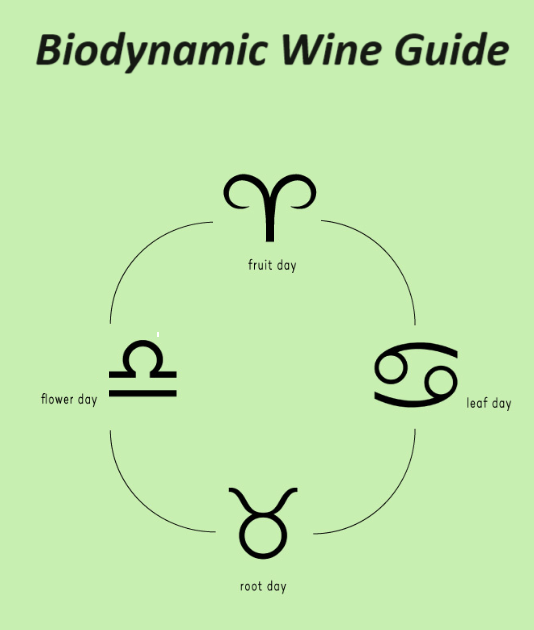
Farming practices from pruning to harvesting are controlled by the biodynamic calendar. It breaks all the tasks associated with farming into four types of days: root days, flower days, fruit days and leaf days. Each of these categories has certain tasks associated with it that are reflective of the earth’s four classical elements. Fruit days are meant for harvesting, leaf days for watering, root days for pruning. On flower days, nothing is done in the vineyard.

Biodynamic farming calls for specific and sometimes strange compost and field preparations. One of these is known as cow horn manure. Cow horns are stuffed with manure compost and buried into the ground all through the winter, then excavated the following spring. When excavated, the stuffed material is spread throughout the vineyard.

Biodynamic wines must be certified and adhere to strict rules and regulations. The wineries are overseen by 2 governing bodies, Demeter International and Biodyvin.

Biodynamic wines can be found in the United States, France, Germany, Spain, Italy, Eastern Europe, Chile, Argentina, India and Australia. Those who believe in the philosophy feel that the wines are more characteristic to the terroir where they originate. However, wine experts say there is no noticeable difference in the taste of biodynamic wine from organically produced wines. Is the difference worth the additional effort? You be the judge.

Sláinte mhaith

The Châteauneuf-du-Pape District of France

While on a river cruise that was part of my recent trip to France, I overheard someone say that Châteauneuf-du-Pape is a famous French winery. Well, that is not exactly true. Châteauneuf-du-Pape is a French Appellation d’origine contrôlée (AOC) located around the village of Châteauneuf-du-Pape in the Rhône wine region in southeastern France. It is one of the most renowned appellations of the southern part in the Rhône Valley, and its vineyards are located around Châteauneuf-du-Pape and in the neighboring villages of Bédarrides, Courthézon and Sorgues, between Avignon and Orange. The region covers more than 3,200 hectares or 32 square kilometres and produces over 110,000 hectolitres of wine each year.

The primary grape grown in the district is Grenache, but Cinsault, Counoise, Mourvèdre, Muscadine, Syrah, Terret noir, Vaccarèse, Grenache Blanc, Bourboulenc, Clairette blanche, Picardan, Roussanne, and Picpoul are also cultivated.

The terroir consists of white limestone. The stones absorb the heat of the sun and transfers it to the roots of the vines. The stones also help with allowing rain to penetrate the roots. This is critical since temperatures rise to about 45 degrees Celsius in the summer and irrigation is not permitted.

The harvest takes place from late August to early September. There are 323 vineyards in the district, all of which are family operated companies. Given the conditions, production yields are low and this is reflected in the price at your local wine store. However, the higher cost does not deter buyers as some wineries are selling their wines two years in advance.

Selections at Maison Bouachon

I visited Maison Bouachon winery, which has been in operation since 1898. The vines on the estate generally range from 80 to 100 years in age. Wine production is completed following the methods and rules established by the AOC.

While there I sampled three of their wines, 2023 Côtes du Rhône white, the Châteauneuf-du-Pape 2021 and the Châteauneuf-du-Pape Special Edition. My personal favourite was the Châteauneuf-du-Pape 2021, which is a blend of Syrah, Grenache and Mourvèdre grapes. I purchased a bottle which was later enjoyed by my wife and me. Unfortunately, like so many of the French wineries, Maison Bouachon wines are not available outside of France. Such a pity.

Sláinte mhaith