France’s Burgundy Wine Region

During the Middle Ages, Benedictine and Cistercian monks, whose responsibility it was to produce wine for the Church, began to recognize subtle variations in the wines from different areas.  They began to map the vineyards in terms of quality and as a result, Burgundy’s famous, complex cru system began to emerge.

Burgundy (aka “Bourgogne”) is small in size but its influence is huge in the world of wine.  It is home to some of the most expensive wines but there are tasty and affordable ones as well.

Chardonnay and Pinot Noir are the two primary grapes of Bourgogne (Burgundy) white and red wines.  However, Aligoté, Pinot Gris, Gamay, and Sauvignon Blanc are grown as well.
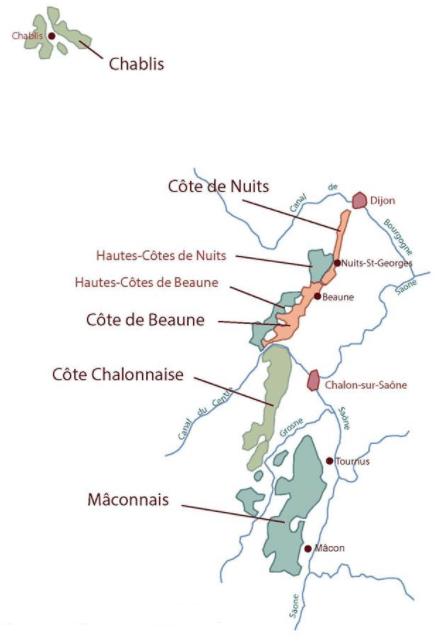
Burgundy has 5 primary wine growing areas:

  • Chablis
  • Côte de Nuits
  • Côte de Beaune
  • Côte Chalonnaise
  • Mâconnais

Chablis

Chablis is the growing region located furthest north and is geographically set apart from the rest of Burgundy. The river Serein (Serene) flows through the area, moderating the climate, and the grapes have been grown here since the Cistercian monks first started the vineyards in the 12th century.

All the wines are white and made with Chardonnay grapes.

Côte de Nuits

The Côte de Nuits  is home to 24 Grand Cru vineyards and some of the world’s most expensive vineyard real estate. The area begins just south of Dijon and ends at the village of Corgoloin. 80% of the wines produced here are Pinot Noir and the remaining 20% are either Chardonnay or Rosé.

Côte de Beaune

The Côte de Beaune is named after the medieval village that is the heart of wine commerce in Burgundy.  The wine from this region is quite different from that of its neighbor to the north. Chardonnay plays a more important role with 7 of the 8 Grand Cru vineyards producing white wine, but there are many amazing red wines produced in this region as well.

Côte Chalonnaise

Côte Chalonnaise is situated between the towns of Chagny and Saint-Vallerin. Here there are no Grand Cru vineyards.

The first village in the northern part of the region is Bouzeron, the only appellation devoted to the white grape, Aligoté. This is a perfect summer sipper or choice for fish and shellfish. Aligoté is floral, with notes of citrus and flint, and perhaps a touch of honey.

Another village that does something a bit different is Rully, a vibrant center of Cremant de Bourgogne production since the 19th century. These white and rosé sparklers are made in the traditional method, just as in Champagne.

The wines from this area are good value. They range from smooth Chardonnays with subtle oak influences and ripe tree fruits to more rustic Pinot Noirs.

Mâconnais

Mâconnais  is the most southerly region, and Burgundy’s largest.  Located between the town of Tournus and St. Veran, it lies at the crossroads between Northern and Southern France.  The warmer climate is evident in the well-structured Chardonnays, with notes of ripe stone fruits, honeysuckle, citrus peel, and wild herbs.

Burgundy Wine Classifications

There are four levels of quality for Burgundy wines:

  • 1% Grand Cru – Wines from Burgundy’s top plots (called climats). There are 33 Grand Crus in the Côte d’Or and about 60% of the production is dedicated to Pinot Noir.
  • 10% Premier Cru – Wines from exceptional climats in Burgundy. There are 640 Premier Cru plots in Burgundy.
  • 37% Village Wines – Wines from a village or commune of Burgundy. There are 44 villages including Chablis, Nuits-St-Georges, and Mâcon-Villages.
  • 52% Regional Wines – Wines from overarching Bourgogne appellations.

Regional Wines

Regional Wines can be made from grapes grown anywhere in Burgundy and tend to be fresh, light, and lively. You will find them labeled “Bourgogne Rouge” (red) or “Bourgogne Blanc (white).

Village Wines

The next step-up is the “Village” wines, named after the towns near to where the grapes are sourced. These wines are still fresh and fruity, with little to no oak.

Premier Cru Burgundy

“Premier Cru” wines are from special vineyard areas within a village. They produce wines that are slightly more intense than the regular old Village wines.  Premier Crus are affordable and make marvelous food wines. The label will say “Premier Cru” or “1er Cru.”

Grand Cru Burgundy

The “Grand Cru” wines account for just over 1% of Burgundy’s annual production. Bold, powerful, complex and made for cellaring, they are the epitome of both Pinot Noir and Chardonnay. There are a total of 33 Grand Cru vineyards in Burgundy.

Chablis Classification System

There is a separate ranking system for Chardonnay:

  • Petit Chablis

Petit Chablis is produced from grapes grown surrounding the village, which are higher in acidity and have lots of light citrus character.

  • Chablis

The majority of the wines found on wine store shelves are in this category. These wines are a bit rounder and more minerally with grapes sourced from the limestone slopes near the village of Chablis.

  • Premier Cru Chablis

Premier Cru Chablis make up about 15% of annual production.  These wines are more elegant coming from vineyards filled with Kimmeridgian limestone marl, giving them a distinctive character.

  • Grand Cru Chablis:

These vineyards are located north of the town of Chablis, where the steep slopes face south-southwest. There is technically only one Grand Cru, but there are 7 “climats” inside that Grand Cru, and their names will be on the label: Blanchot, Bougros, Les Clos, Grenouilles, Presuses, Valmur, and Vaudésir. Many of the Grand Cru wines in Chablis are aged in oak.

Final Thoughts

Whatever your pleasure, make a point of trying some of the wines of the Burgundy region.  You can’t go wrong and you don’t need to spend a fortune to find a nice one.

Sláinte mhaith

France’s Bordeaux Wine Region

Bordeaux is one of the most iconic wine regions of not only France, but all of Europe.  The wines produced in Bordeaux have become a benchmark for wine producers all around the world.

Bordeaux was first loved for its sweet white wines from the sub-region of Sauternes. The wine had prestigious clientele during an era when sweet white wines were more popular than dry red ones. There was also a rosé popular in the 1700’s, particularly with the English, who called it “claret” due to the wines translucent red color.

It wasn’t until the mid-1800’s that Bordeaux red wines became more well-known. The dramatic moment of this transformation was an official decree that classified the top producers of the day. The classification, now deemed the “1855 Classification”, identified the best producers in the region and ranked them 1 through 5. The classification basically hasn’t changed even though there are many more producers in the region making outstanding wines.

Bordeaux is one of the world’s oldest and most prestigious wine regions. Bordeaux is synonymous with quality and refinement. While the legendary wines of Château Margaux or Pétrus command prices that place them out of reach of the average consumer, Bordeaux’s true greatness lies in the fact that wines with elegance, sophistication and balance can be found at all price points.

Red wines from Bordeaux are medium to full-bodied with aromas of black currant, plums, and earthy notes. Cabernet Sauvignon and Merlot vines originated in Bordeaux. The tannins in these wines are often high enough that wines will age for several decades.

One of the most important things to know about Bordeaux wines is that they are a blend of grape varieties. The red Bordeaux Blend is one of the most copied around the world and it includes Cabernet Sauvignon, Merlot, Cabernet Franc, Petit Verdot, Malbec and a small amount of Carménère.

When serving Red Bordeaux, it should be slightly below room temperature (around 65 °F / 18 °C) and decanted for at least 30 minutes. All red wines should be stored below 65 °F / 18 °C.

You should expect to spend around $25–$30 for a great bottle of Red Bordeaux.

Suitable food pairings for Bordeaux include,

  • Meat
    • Black Pepper Steak
    • Roast Pork
    • Filet Mignon
    • Beef Brisket
    • Buffalo Burgers
    • Chicken Liver
    • Pot Roast
    • Venison
    • Duck
    • Goose
    • Dark Meat Turkey
  • Cheese
    • Ossau Iraty
    • Basque Cheeses
    • Manchego
    • Swiss Cheese
    • Comté
    • White Cheddar
    • Provolone
    • Pepper Jack
  • Herb/Spice
    • Black Pepper
    • White Pepper
    • Oregano
    • Rosemary
    • Mustard Seed
    • Cumin
    • Coriander Seed
    • Anise
  • Vegetable
    • Roast Potatoes
    • Lentils
    • Mushrooms
    • Onion
    • Green Onion
    • Green Bean Casserole

The Bordeaux region is separated into two sub-regions, the “Left Bank”, referred to as Médoc and Graves, and the “Right Bank”, known as Libournais.

The Left Bank (Médoc and Graves)

This area is known for its gravelly soils and graphite-driven red wines with a dominance of Cabernet Sauvignon in the blend. The most prestigious sub-regions in the Médoc include Pauillac, Saint-Julien, Saint–Estephe, Margaux and Pessac-Leognan (the areas first classified in 1855). The wines from Médoc are some of the boldest and most tannic of Bordeaux, perfect for aging or matching with red meat.

Left bank Bordeaux blends, in order of proportion are:

  • Cabernet Sauvignon
  • Merlot
  • Cabernet Franc
  • Malbec
  • Petit Verdot

The Right Bank (Libournais)

This area in Bordeaux is known for its red clay soils that produce bold plummy red wines with a dominance of Merlot. The most well-known and sought after sub-regions including Pomerol and Saint-Emilion. The wines from around Libourne are still moderately bold, but generally have softer, more refined tannins. For this reason, right bank wines are a great way to get introduced to the region. Here is a typical example of a Libournais Bordeaux blend in order of importance:

  • Merlot
  • Cabernet Franc
  • Cabernet Sauvignon

Entre-Deux-Mers “Between 2 Tides”

The area between the 2 major rivers of Bordeaux, the Garonne and the Dordogne, is called Entre-Deux-Mers. This area produces both red (predominantly Merlot) and white wines but is perhaps more well-known for its white wines, which are a blend of Sauvignon Blanc, Sémillon and the rare Muscadelle. Wines have grapefruit and citrus notes with zippy acidity–a perfect wine for summer and fish.

Sauternais Sweet Wines

Sauternes and its surrounding regions of Barsac and Cadillac, are along a particularly dank portion of the Garonne River. Morning fog causes the white grapes growing in the area to develop a certain type of fungus called Botrytis. The fungus causes the grapes to shrivel and sweeten making one of the sweetest white wines in the world.

White Bordeaux

Only a small part of Bordeaux’s wine production is dedicated to white wines. These wines are made with Sauvignon Blanc and Sémillon and range from zippy and fresh from places like Entre-Deux-Mers to creamy and lemon curd-like from places like Pessac-Leognan.

Last Word

Bordeaux is a region that has been a source of inspiration to many of today’s most popular wines. If you are a fan of red wine and have never tried a French Bordeaux, I recommend purchasing a bottle.  Better yet, try both a left bank and a right bank wine and see which you prefer.

Sláinte mhaith

French Versus Italian Wine

Italy and France are two of the world’s finest wine producing countries, for both quality and quantity.  Italy has made wines longer and is a larger producer of wine, but France is more renowned for its creation of premium wines.  So does one rein superior to the other?  I really don’t believe so but here are some of the facts to help you to decide for yourself.

Traditional Sparkling Wine

To begin the France Italy showdown are sparkling wines that are produced using the traditional method – Champagne versus Franciacorta.  Both wines utilize a second fermentation that occurs in the bottle.  It is the most labour intensive process that creates the most complex textured wines.

Champagne is considered the home of traditionally prepared sparkling wine and has the most stringent regulations for production.  These rules dictate both blending practices and aging requirements.

Franciacorta, though less famous than Champagne, uses the same type of grapes and may even have a longer aging process.  Given the warmer climate, the grapes are riper but do not have the same vibrancy as the French wine.  However, it is worth considering that a Franciacorta sparkler will have a more favourable price point than a similar one from Champagne.

Great-Value Sparkling Wine

Both France’s Crémant and Italy’s Prosecco share the versatility provided by the more expensive traditional sparkling wines but at a much gentler price. 

Crémant wines are produced using the traditional method but with less restrictions than Champagne.

Prosecco is produced using the Charmat method which conducts the second fermentation in a tank rather than in the bottle.  Some of the finer Proseccos are aged several years to create a more complex flavorful wine.

The price of both the French and Italian versions is comparable.

Notable Styles

France’s Châteauneuf-Du-Pape and Italy’s Amarone are premium wines from their respective regions and are considered to be among the finest wines in the world.  They are both full-bodied and smooth.

The wines from Châteauneuf-Du-Pape are a blend which has the Grenache grape as the principal grape.  The balance of the wine often consists of a combination of Mourvèdre, Counoise, Vaccarèse, and Muscardine. 

The region produces intense, powerful wines with great body.  Many of these offerings may be drunk when released or retained for quite a few years.

Italy’s Amarone wines are made from grapes from the most mature vines which are harvested late to ensure ripeness.  The grapes are then dried on racks or hooks for about 120 days in order to obtain a higher concentration of sugar and flavour.  During this process 30% to 40% of the grapes’ weight is lost which is part of the reason for this wine selling at a higher price.

Though the cost of both of these wines can run over $100, the average price is in the $50 range.  Whether one wine is preferred over the other will depend on your personal taste.

Challenging Grapes

France’s gentle flavoured Pinot Noir and Italy’s bold Nebbiolo grape share two things in common; they are both very difficult grapes to grow; and they are among the most sought after grapes in the world.

The majority of France’s Pinot Noir grapes are grown in Burgundy.

The Italian Nebbiolo grape is grown exclusively in Piedmont and is used in the creation of Barolo wine.

The two types of wine, apart from both being red, are vastly different in intensity, richness, and flavour.  It would not be fair to try and compare or rate one against the other.  They each stand on their own merits.

Notable Regions

The most recognized wine region within each country is France’s Bordeaux and Italy’s Tuscany.  These regions are home to some of the world’s most expensive sought after wines.  However, they also offer an enticing array of wines at a wide range of price points.

The wines of Bordeaux consist of a blend of Cabernet Sauvignon and Merlot. The region is divided into 2 sectors – the left bank and the right bank – by the Dordogne, Garonne and Gironde rivers.  The left bank wines will contain a higher concentration of Cabernet Sauvignon while the right bank wines contain a greater proportion of Merlot.

The wines of Bordeaux have extraordinary consistency of balance and structure, irrelevant of the price point.

The signature grape of Tuscany is the Sangiovese, which is the basis of 3 of Italy’s most famous wines, Chianti, Vino Nobile di Montepulciano and Brunello.  There are also other wines consisting of a combination of Cabernet Sauvignon and Merlot.

There are a great variety of styles , flavours, techniques and price points, all containing the definitive Tuscan identity.

There is no winner or loser in this comparison.  It comes down to a matter of personal taste.

The White Pinot

France’s Pinot Gris and Italy’s Pinot Grigio are the same grape but are produced in different styles.  The Pinot Gris is produced in the Alsace region of France whereas Pinot Grigio is associated with northern Italy.

Pinot Gris is produced in a range of styles ranging from dry to sweet.  They contain a distinct richness, weight, spiciness, and complexity that is said not to exist in the Italian version.  The French version of the grape has more potential for aging as well.

The Italian Pinot Grigio is light and zesty and makes a great sipping wine.  It is said to have subtle floral and fruit aromas and flavours.

Aromatic Whites

Aromatic whites are typically those wines producing the aroma of flowers and herbs.  Such wines are normally not aged in oak barrels.

France’s Sauvignon Blanc is the noted white wine grape of Bordeaux and the Loire.  It is renowned for the hint of lime, green apple, peach and tropical fruit, as well as its herb and grassy notes.

Italy’s Vermentino wine is light and refreshing.  It is also complex and layered displaying fruit tones, mineral and herbal notes.

As I stated earlier, I don’t believe there is a winner or a loser.  Both countries provide their own uniqueness and distinct flavours through their wine offerings.  There are no comparisons for a French Bordeaux or Châteauneuf-Du-Pape but the same can be said for an Italian Borolo or Chianti.  Whether a French wine is preferred over an Italian wine or vice versa is a matter of personal taste.

To simply say that one country is superior to the other and ignore the offerings of the other would be a travesty.  Such a person would be denying her/himself the opportunity to indulge in some great tasting wines.

Sláinte mhaith

Wine Futures

What Are Wine Futures?

The practice to sell wine before it’s bottled, commonly known as “en primeur” or wine futures, is well established across many wine regions like Burgundy, the Rhône Valley, Piedmont Port and in particular, Bordeaux.  The major châteaux of Bordeaux offer about 80% to 90% of their previous year’s wine production for sale as futures.

Beginning in late March or early April, the châteaus host tastings for the trade to evaluate the potential quality of the vintage harvested during the previous autumn.  This is the first opportunity to purchase the new vintage. At that point the wines have just been placed into barrels and are still about two years from reaching the market in bottles.

Over the course of the spring, the châteaux release their trade prices for the vintage based on the initial response to the wines, as well as current economic conditions. It will be interesting to see how this proceeds this spring given the COVID-19 pandemic and the resulting effects on the economy.

The wines first go through courtiers (brokers) who take a small percentage of the cost.  Next the right to sell the futures is passed on to the négociants (shippers), who set a new price for the wine, referred to as the ex-négoce price. With very few exceptions, no one deals directly with Bordeaux’s châteaux; they deal with the négociants.

Why Buy Wine Futures?

There are a few advantages of buying wine futures.  The wine is often the least expensive at the first release because the margins made by wine merchants are the smallest. It is common for the price of the wine to increase and the margins made by wine merchants to also increase once the wine is offered for sale in the bottle.

Futures may be the only way for individuals to obtain high quality, low quantity, hard to find wine as such wines are often sold out prior to them being available for distribution.

Futures enable an individual to purchase a special wine for a special birth year, or as a gift or for weddings and anniversaries.

Futures enable people to purchase the latest vintage of wines that they like to get every year and where there is generally strong demand, such as Mouton Rothschild, La Mission Haut Brion, Cheval Blanc, Lynch Bages, Montrose, Pichon Lalande, Pontet Canet and Haut Bailly.

Wine futures, like other commodities, can be purchased with the hope or expectation that there will be a return on investment.  Those who invest do so to secure high-quality wines at the best prices, but there’s no guarantee that they will be more expensive upon release.

Other Considerations

The wines are often not quite ready for consumption at the time they are released for distribution.  This then requires the purchaser to have a suitable location to store the wine until it is actually consumed.  Suggestions on cellaring wine can be found in my post from August 24, 2019, “Drink or lay down and how to cellar those you keep”.

Since any wine you purchase in this manner won’t be delivered for about 2 years, you will need to keep track of what you ordered, the quantity you ordered, the anticipated delivery date, and how much you deposited and what portion is due on delivery.

Selecting & Ordering Futures

I have purchased Bordeaux futures several times through my local liquor store.  Once a year the store releases a catalogue containing all of the wine futures they have access to that particular year.  The catalogue provides reviewers comments about each release, a scoring of the wine, the price per bottle, and the number of bottles available.

On the identified sale date, individuals can then order their selections either online or by calling a specified telephone number.

Realizing the Futures

When the wines are released from the winery they will be shipped to the wine merchant, who then contacts the purchaser.  Since the wines are packaged and shipped direct from the chateau they are securely packed and often in a wooden crate that clearly identifies the chateau.

The wines can then either be cellared in the crate or placed on a shelf or wine rack until you are ready to enjoy them.

Sláinte mhaith

France’s Wine Regions

People sometimes shy away from French wine because they are unable to determine what type of wine they are selecting.  No where will you see the varietal of grape identified.  This is because France identifies its wines using the Appellation System, a complex system of laws that define each wine region and its boundaries and imposes strict rules around winemaking practices.  

Most appellations take the form of place names, such as Champagne or Bordeaux. What this means is that the grapes grown in each region are consistent with all of the wine producers within that region.  This becomes the key to understanding what grapes are contained within a particular French wine.

Here is a brief explanation of what grapes are grown in each of the appellations.  Hopefully this will help you crack the code to identify the varietals found in French wines.

Alsace

Alsace is the only French wine region to grow significant quantities of Riesling and Gewurztraminer grapes, as well as Pinot Gris.

Alsace Grand Cru wines are general only allowed to be made from these three varieties but may also contain some Muscat.

Chasselas, Pinot Blanc and Auxerrois are also grown although these three varietals tend to be used only in blends.

There are some red wines produced in the region as well, mainly from Pinot Noir.  Alsace Pinot Noirs are typically lighter-bodied and more rustic than the majority of Pinot Noir wines produced in France.

Bordeaux

Bordeaux is produced in the southwest of France.  The majority of Bordeaux wines are the dry, medium- and full-bodied red Bordeaux Blends. There are some high-quality white wines as well, both dry styles and the sweet, botrytized varieties.  Botrytis is a type of fungus that generates sugar and sweetness in the grapes.

Most Bordeaux reds are made from a blend of Merlot and Cabernet Sauvignon.  Merlot is the most common red wine grape in Bordeaux, followed by Cabernet Sauvignon and then Cabernet Franc. Petit Verdot, Malbec and Carmenère are also permitted, but only make up around two percent of the red grape total.

Bordeaux’s white wines are generally blends of Semillon, Sauvignon Blanc and Muscadelle. Sauvignon Gris the only other white variety that is permitted.

Burgundy

The two key grape varieties of Burgundy are Pinot Noir and Chardonnay. Gamay and Aligote are also grown throughout the region, producing more rustic styles of wine. Gamay is used in the red and rosé wines.

Beaujolais

Beaujolais is famous for its vibrant, fruity red wines made from Gamay.

Pinot Noir is used in small quantities in red and rosé wines, but is being phased out. Although best known for its red wines, the region also produces white Beaujolais Blanc, from Chardonnay and Aligote.

Champagne

Champagne is the name of the world’s most famous sparkling wine. While it has been used to refer to sparkling wines from all over the world, Champagne is a legally controlled and restricted name.

Pinot Noir, Pinot Meunier and Chardonnay are the primary grape varieties used to make Champagne.

The key Champagne styles differ in their color, sweetness, base grape varieties, and whether they are the product of a single vintage or several (referred to as Non-Vintage). The whites may be either Blanc de Noirs (made from black-skinned grapes), Blanc de Blancs (made from green-skinned grapes) or just plain Blanc (made from any combination of the permitted varieties). Pink Champagne Rosé is made either by adding red wine to a white blend or sometimes by fermenting the juice in contact with the skins. These types all come with varying degrees of sweetness.

Cognac

Cognac is the world’s most famous brandy.  It is graded in three official tiers, which reflect how long the spirit spent in barrel. VS (Very Special) is the lowest tier and means the brandy has been stored for a minimum of two years in casks. VSOP (Very Special Old Pale) is the middle tier and denotes Cognac that has been aged for at least four years. XO is the finest grade and is reserved exclusively for those cuvees aged for six years or more.

Corsica

Corsica is an island in the Mediterranean Sea, located between the southeast coast of Provence and the west coast of Tuscany. Although it is closer to Italy, Corsica is governed by France. The island’s Italian origins are evident in its wines, which are made predominantly from the Italian classics Vermentino and Sangiovese.

Corsica’s wines have both a French and Italian influence. Pinot Noir, Grenache, Tempranillo and Barbarossa are all grown there alongside one another.

Grenache is a primary ingredient in many Corsican red wines and Syrah, Mourvedre, Cinsaut and Carignan all play a variety of supporting roles.

The only white varietal is Vermentino/Rolle.

Coteaux du Lyonnais

These wines are of a lighter style similar to those produced in Beaujolais. The red wines are produced from Gamay grapes.

A small amount of white wine is made from Chardonnay and Aligoté. Occasionally some Pinot Blanc is added to the blend. These are traditionally dry, floral styles, some of which are matured in oak barrels for up to a year to produce a slightly more structured, weighty version.

Jura

Jura is a small wine region in eastern France.

The five main grape varieties used in the region are Poulsard, a red grape which accounts for about one-fifth of the region’s plantings; Trousseau, the other local red variety, covers only the warmest 5% of Jura’s vineyards; White Savagnin, which is responsible for the idiosyncratic vins jaunes (‘yellow wines’);  Pinot Noir; and Chardonnay.

Dry white wines are also made in Jura, increasingly from Chardonnay as are dry red wines produced from Pinot Noir.

Loire

The Loire Valley is a key wine region in western France.

White wines are the Loire Valley’s best wines, and account for the vast majority of production. The key white-wine grape varieties used to make Loire Valley whites are Sauvignon Blanc, Chenin Blanc, Melon de Bourgogne and, more popular than traditional, Chardonnay.

Loire reds are of increasingly high quality.  The number one red-wine variety is Cabernet Franc. Lighter-bodied red wines are made from Pinot Noir, Malbec (known here as Côt) and Gamay.

Moselle

Moselle is an appellation covering white, red and rosé wines.  While Auxerrois Blanc, Muller-Thurgau and Pinot Gris are the principal varieties set out in the appellation law, Gewurztraminer, Riesling and Pinot Blanc are permitted in the white wines in limited amounts.

The reds must be made entirely of Pinot Noir, but Moselle rosés may have a proportion of Gamay.

Provence

Provence is a wine region in the far southeastern corner of France, best known for its rosé wines.

Traditional varieties such as Carignan, Barbaroux (Sardinia’s Barbarossa) and Calitor are being replaced by more commercially viable grapes like Grenache, Syrah and Cabernet Sauvignon.

The more successful local varieties Mourvèdre, Tibouren and Vermentino are incorporated in Provence’s red, rosé and white wines respectively.

Rhône

The Rhône Valley is a key wine-producing region in the southeast of France.  The smaller, more quality-driven northern section focuses on Syrah for red wines and Viognier, Marsanne and Roussanne for whites.  The larger south region contains a much longer list of varieties; the most notable of these are the red Grenache Syrah and Mourvedre, which are combined to produce the ‘GSM’ blend.

Savoie

Savoie is a wine region in eastern France.  Around three-quarters of the region’s wines are white.  Jacquère is the most widely planted white grape variety.  Altesse, known traditionally here as Roussette, is used to produce some of Savoie’s finer wines.

As in many other areas of France, Chardonnay is increasingly being planted in Savoie. It is used in still and sparkling wines.

Although Savoie is dominated by white wines, it does have a standout red variety, Mondeuse. Gamay and Pinot Noir are also grown. These are lighter in style than their respective counterparts in Beaujolais and Burgundy.

Personally, I am most attracted to the reds of the Rhône.  I find them to be very versatile, being both full bodied and flavourful while at the same time being smooth.  They are suitable for pairing with a favourite meal or simply enjoyed on their own.

No matter what your likes or dislikes, don’t allow yourself to be intimidated by foreign wine labels.  Be adventurous and go exploring.

Sláinte mhaith

France’s Standard of Quality

In a previous post I described Canada’s VQA standard for helping to ensure the wine you purchase is an enjoyable experience.  Not all countries take this same approach to standard identification.  Many countries, such as Australia and the United States, govern the wine industry with a general set of standards and controls and do not adhere to any particular categorization for wine quality.   However, there are other countries, such as France, Italy & Germany that do have quality standards specific to wine.

To begin I will focus on France, which has 3 primary quality groupings.   The first is AOC (Appellation d’Origine Contrôlée), which indicates the geographical origin, quality and the style of a wine.  The Europe-wide equivalent of AOC is AOP (Appellation d’Origine Protégée). All Grand Cru and Premier Cru wines fall into the AOC category.

Grand Cru is the very highest classification of French wine. The term can refer to a wine in one of two ways, either the plot of land where the grapes are grown or the chateau at which the wine is made. The former applies most famously in Burgundy, Alsace and Champagne but is also used in Languedoc and the Loire Valley; the latter being exclusive to Bordeaux.

Premier Cru denotes either a vineyard plot (most often in Burgundy) of superior quality, or the very highest tier within a Grand Cru classification (such as the ‘Premier Grand Cru Classé chateaux of Bordeaux).

The second wine category is VDP (Vin de Pays), which means ‘wine of the land’, although it is often translated as ‘country wine’. The European equivalent is IGP (Indication Géographique Protégée). This category focuses on geographical origin rather than style and tradition, and gives winemakers greater stylistic freedom than AOC. Vin de Pays was introduced in the 1970s, and by the year 2000 there were more than 150 individual VDP titles, covering about a quarter of French wine production

The final category, Vin de France, replaced Vin de Table in 2010, but remains the most basic quality tier for French wine. This is the least regulated (and least used) of the three categories; Vin de France wines can be made from grapes grown anywhere in France, but their labels do not mention a specific region of origin. Vintage and grape varietal statements are optional.

Some of the French quality scales can be easily identified on the wine label.  For example, if applicable the term ‘Grand Cru’ or ‘Premier Cru’ will appear somewhere on the label.  You will also notice a correlation between the quality rating and the price of the wines.  Generally speaking ‘Grand Cru’ wines are at the top end of the price scale, with ‘Premier Cru’ are somewhat less expensive.

Here are some helpful hints when interpreting a French wine label; some of the terms are more obvious than others.

  • Blanc = White wine
  • Brut = Dry
  • Château = The name of the wine producer
  • Côte/Coteaux = Slope of a hill/hillsides, for example Côtes du Rhône
  • Crémant = A style of sparkling wine different from Champagne
  • Cru = Means ‘growth’ – it is used to denote the status of a winery or vineyard
  • Cru Classé = Classified vineyard, suggesting a certain quality or age of the vines
  • Demi-sec = Medium-dry
  • Domaine = Estate
  • Doux = Sweet
  • Grand Cru = Signifying the highest quality wines
  • Méthode Traditionnelle = Traditional method of sparkling winemaking, like  Champagne
  • Mis en bouteille au château/domaine = Bottled at the winery
  • Premier Cru = First growth
  • Propriétaire = Identifies the estate or vineyard owner
  • Rouge = Red
  • Sélection de Grains Nobles = Sweet wine made from botrytized grapes (grapes containing botrytis fungus, which is seen as being beneficial to the wine)
  • Supérieur = Wine with a higher alcohol content as a result of being made from riper grapes
  • VDQS (Vin Délimité de Qualité Supérieure) = a mid-level classification used between 1949 and 2012
  • Vendange Tardive = Late harvest (sweet) wines
  • Vieilles Vignes = Old vines
  • Vigneron/Viticulteur = Vine grower/grape grower
  • Vignoble = Vineyard
  • Vin = Wine

Hopefully all of this will help take some of the mystery out of how to find an enjoyable French wine.  I have found that the French wines that are exported, especially any of those that appear on the shelves of the Vintages section of my local liquor store, are all worth a try.  I think you will find that French wine does not need to be expensive nor of a specific quality standard to be enjoyable.

In the future I will take a similar look at German and Italian wine classifications.

Sláinte mhaith