Old Vines Versus New Vines

Old vines or new vines; does it make a difference when it comes to making wine? The simple answer is yes, but there are some things to take into consideration. The main sticking point is finding common ground for the definition of ‘old’. The definition is not industry controlled so depending on where you ask, the meaning changes.

Photo credit: lastbottlewines.com

In France, New Zealand and Canada, ‘old’ can mean 30 years. In Australia, California and Spain, the vines are not considered ‘old’ until they are 50 or 60 years of age. A few Californian producers who have vines as old as 80 to 100 years have adopted the designation ‘ancient vines’. If 80 years is considered ancient then by comparison there are several Australian vineyards with vines of such an age they would be considered prehistoric, dating back more than 150 years, the upper limit of longevity. Without a true international standard for identifying the relative maturity of vines from one country to the next, the consumer must beware and take into consideration where the wine was produced.

The lifespan of a vine is determined by several factors. The vines of France and other European nations were destroyed during the 1800s and early 1900s by a sap-sucking root pest called phylloxera that destroyed the plants and necessitated replanting on resistant North American rootstocks. Also, in the relatively rainy parts of Europe, such as much of France, the vines die decades before they tend to in the hot dry regions of South Australia, California, Chile and much of Spain. Harsh winters in countries such as Canada led to vines having only a 30 to 35 year lifespan.

Young grape vines, though productive, deliver variable quality wine from year to year. When the sun shines, they grow a great amount of foliage which can produce bitter grapes. When it rains, these vines bloat with water. The vines require massive pruning to reduce the amount of foliage and encourage ripening. By contrast, old vines are constant, their reduced sap flow naturally yields smaller berries with a higher ratio of solids to liquid.

The deep roots of old vines are a big asset. They tap moisture in drought conditions and guard against bloating during rainy times. Old vines also tend to ripen earlier, a great benefit to growers in cooler climates where cool autumn temperatures reduce the growing season.

Old vine wines provide richness and more complex flavours that build rather than trail off after the up-front fruit fades away.  Young vines produce nice, aromatic wines but lack the complexity of flavour of wine produced from older vines. Wines produced from old vines will often cellar longer than wines produced from young vines.

Wine produced by old vines is generally more expensive than similar young vine wines. Because of the rarity, lower yields and perceived enhancement of wine quality, old vines have become increasingly sought after and valued by both the wine industry and consumers. As a result, old vine grapes typically demand a higher price per tonne. This combined with consumer demand, has resulted in old vine wines being more expensive to purchase in the stores.

It has been said that the appreciation of an old vine wine can be a way to connect with the past and to celebrate an enduring art form, similar to listening to the music of a great composer, reading literature or observing at the art of past masters. Wine made from old vines can reveal the distinctive character of a specific historic place and the artistry of the vintner, both past and present.

Sláinte mhaith

Right and Left Bank Bordeaux Wines

Bordeaux; most people have heard of this French wine region, which is one of the most famous Old World wine regions, but many people don’t understand it. To begin with, Bordeaux is divided into two sections, referred to as the Left Bank and the Right Bank. The banks refer to the left (west)and right (east) bank of the Gironde Estuary and Garonne River.

The Left and Right banks have significantly different terroirs. A terroir is the natural environment in which a particular wine is produced, including factors such as the soil, topography, and climate.  

The soil is rockier on the Left Bank. It is packed with gravel and deep deposits of limestone which serves to provide more character and potential quality in the wine. This is why Left Bank wines are considered prime candidates for aging, while Right Bank wines are generally thought to be smoother and more drinkable at the time they are released for sale.

This is not to suggest that Right Bank wines are simple and boring. With limestone closer to the surface and less gravel for the vine roots to contend with, the wines of the Right Bank don’t lack character; it’s just that they possess a different kind of character.

When it comes to the grape varietals grown, because of the differences in the terroir between the Left and Right Bank, each supports its own type of grape. As a result, this is often the best way to distinguish between a Left and Right Bank Bordeaux, as the label will not often tell you. Left Bank wines are mostly Cabernet Sauvignon with a smaller portion of Merlot. The Right Bank wines are dominated by Merlot balanced by a smaller proportion of Cabernet.

The Cabernet dominated Left Bank wines tend to be higher in tannin, thus the reason why they age well. Aging the wine helps to mellow out the tannins and integrate the flavors of the wine. Merlot-based Right Bank wines are generally smoother, with softer fruit flavours as tannins are not as dominating.

The last comparison is between the wineries or chateaux themselves. These are the castle-like structures that appear on many of the Bordeaux wine labels.  Generally, the Left Bank chateaux have larger vineyards than those of the Right Bank. Left Bank vineyards are on average 5o to 80 hectares in size versus those of the Right Bank, which only have a maximum of about 30 hectares. However, this is only a fun-fact as vineyard size really has no impact on the quality or character of the wine. Arguably the most renown chateaux include Chateau Margaux, Lafite, and Mouton Rothschild on the Left Bank and Petrus and Cheval Blanc from the Right Bank.

So, which wines are better?  Neither. If you are looking for a wine to enjoy with dinner tonight, a Right Bank wine is probably the better choice, whereas if you are looking for a wine to age and appreciate in the future, you will find that a Left Bank wine will improve with age and provide a delightfully satisfying experience when it is uncorked in a few years’ time.

Sláinte mhaith

The Wines of Armenia

Armenia is a wine region that I was unaware of until I saw an Armenian wine advertised recently in a wine catalogue. That enticed me to do some research and here is what I learned.

The bulk of wine grapes indigenous to Armenia are not very well known in North America. Hindering Armenia’s ability to familiarize the rest of the world with its wines are the ongoing conflicts surrounding its borders. Armenia is situated between Georgia, Iran, Azerbaijan and Turkey. Armenia’s rivers and high plateaus are surrounded by the Caucasus Mountains.

The country’s wine history is ancient. The region of Vayots Dzor claims to be home to the oldest winery in the world, in operation since some 6,100 years ago.

As with some other Eastern European countries, the progression of Armenian wine ended when the Soviet Red Army invaded in 1920. In 1922 the country was merged into the Transcaucasian Soviet Federated Socialist Republic. Then, in 1936 it became the Armenian Soviet Socialist Republic or Soviet Armenia.

Innovation stopped with the elimination of private enterprise. The Soviets converted wineries into processing plants and vineyards turned over fruit for brandy distillation or bulk wine production.  Some vineyards were planted in unfavorable locations, while others went neglected or abandoned.

In 1991, after the demise of the Soviet Union, Armenia regained its sovereignty. Young Armenians and those with investment money began to embrace the region’s ancient wine-making techniques and wine culture. As a result, Armenia has become the youngest oldest wine industry in the world.

During the Soviet years a great deal of information was lost, including knowledge of the traits of many indigenous grape varieties, understanding soil suitability, sun preference, as well as how much maceration and aging of the grapes is best. Regaining this knowledge requires years of experimentation.

A few producers work with international grapes mainly for the Russian and other former Soviet republic markets. However, new quality-driven wineries focus on local varieties. Much of the post Soviet revival has included using a combination of modern technology and traditional techniques, such as aging the wine in terracotta jars called karasi.

The drive to produce quality wines has helped winemakers find export partners. Being a landlocked country, Armenia cannot produce low-cost wines. It must become part of the higher-priced market segment.

Armenia contains four main wine regions. The best known is the south-central region of Vayots Dzor, a long, narrow plateau which stands out for its highest elevation vineyards, some which reach almost 6,000 feet above sea level.

The Aragatsotn region is situated at slightly lower elevation. The remaining regions include Ararat, which is located on a sunny plateau, and Armavir, which is a mountainous area in the southwest.

Grape varietals include Areni Noir, which produces medium-bodied red wines with fruits like cherry and strawberry laced with black pepper aromas. It compares in its freshness, silkiness and transparency to Pinot Noir.

Voskehat is Armenia’s signature white grape. The wine has light to medium body. It has floral and stone fruit aromas with notes of herbs and citrus.

Khndoghni, or Sireni, is a red grape that gives black fruit flavors, deep colour, good tannins and the potential to age.

To sum it up, Armenia is small, landlocked and poor. However, it appears to have resilience, an ability to adapt, and a desire to show the world its world-class wines. Many experts feel that there is a future for quality Armenian wines.

Sláinte mhaith

BC’s 2023 Movers and Shakers

These are the wineries from British Columbia that particularly caught my attention this past year. My impressions are based on several factors: the winery’s performance at both the National Wine Awards and the All Canadian Wine Championships, environmental and sustainability practices of each winery and my own thoughts.

I have listed the wineries in alphabetical order and have included several of their 2023 award winning wines. 

Corcelettes Estate Winery

Corcelettes was ranked as the second best performing small winery at this year’s National Wine Awards.  It is located on 150 acres in British Columbia’s Similkameen Valley. Charlie and Jesce Baessler blend passion, precision and science to craft their expressive, small lot premium wines. No short cuts are taken in finding balance between viticulture, the environment and winemaking.

Corcelettes first vintage was in 2011, consisting of 200 cases. They currently craft 8,200 cases of wine per year, with plans of each future vintage growing in production size.

Their portfolio includes predominantly Syrah and Pinot Noir, crafted from Similkameen grown grapes. There is also a small selection of premium wines from the Micro Lot Series; wines crafted from specially selected grapes available only in limited quantities.

In addition to this year, Corcelettes was among the Top 10 Small Wineries at the 2018, 2019 and 2021 National Wine Awards of Canada.       

This year’s Platinum and Gold award winning wines included:

  • Corcelettes 2020 Syrah Corcelettes Estate Vineyard
  • Corcelettes 2021 Reserve Pinot Noir Micro Lot Series
  • Corcelettes 2022 Oracle Rosé
  • Corcelettes 2020 Cabernet Sauvignon Corcelettes Estate Vineyard
  • Corcelettes 2019 Merlot
  • Corcelettes 2020 Merlot
  • Corcelettes 2019 Reserve Cabernet Sauvignon
  • Corcelettes 2020 Cabernet Franc

Deep Roots Winery

Deep Roots was awarded Best Performing Small Winery at this year’s National Wine Awards where they earned 1 Platinum, 4 Gold, 1 Silver and 4 Bronze medals.

Their Platinum and Gold winners included:

  • Deep Roots 2020 Reserve Chardonnay
  • Deep Roots 2020 Parentage Red
  • Deep Roots 2022 Gamay
  • Deep Roots 2020 Syrah
  • Deep Roots 2022 Sauvignon Blanc

Deep Roots is a family owned and operated winery situated on the clay cliffs above Okanagan Lake on the Naramata Bench, where beginning in 2003 the Hardman family began switching their 100-year-old family farm from an apple orchard to a vineyard. Today they have 19 acres of grape vines spread between two Naramata vineyards, using almost exclusively estate fruit.

Initially the grapes were all sold to CedarCreek and Lake Breeze, among others. However, that all changed in 2012 when Will Hardman broke ground to create his own winery.  There are two vineyards at two sites on the Naramata Bench where they grow Muscat, Gamay, Merlot, Chardonnay, Pinot Gris, Malbec and Syrah grapes.

All the vineyard work is done by hand, as the Hardmans are passionate about producing grapes that are the best expressions of each varietal.

Road 13 Vineyards

At Road 13 in Oliver, B.C., they farm to protect the land. Their philosophy is that by taking care of the dirt, the dirt then can take care of the roots of the vines, thus producing the best fruit possible. Doing things right means going the extra mile, in both the vineyard and in the cellar. Winemaker, Barclay Robinson and his crew farm organically to produce the best wine possible.

Road 13’s Platinum and Gold award winning wines included the following:

  • Road 13 2020 Select Harvest GSM
  • Road 13 2013 Jackpot Sparkling Chenin Blanc
  • Road 13 2020 John Oliver Cabernet Franc
  • Road 13 2021 Viognier
  • Road 13 2020 John Oliver Petit Verdot
  • Road 13 2022 Honest John’s Rose

SpearHead Winery

SpearHead Winery of Kelowna, B.C, appears on my list of British Columbia’s list of movers and shakers for the second straight year. 

Their focus is on premium quality wine which is produced from grapes grown in their estate vineyard and from selected Okanagan Valley vineyards. The hand harvested grapes are sorted at the winery and fermented in small lots.

SpearHead produces Pinot Noir, Chardonnay and Riesling varietals.  Approximately 80% of the 15 acres of vines is comprised of Pinot Noir including four different Dijon clones, 2 California heritage clones and Pommard.  This combination of plantings enables the wine maker to select from the different characteristics of these clones to create a complex Pinot Noir from their home vineyard.  They also draw from several other vineyards in the Okanagan including Golden Retreat in Summerland and Coyote Vineyard in West Kelowna.

Their 2023 Platinum and Gold award winning wines include the following:

  • SpearHead 2020 Club Consensus Pinot Noir
  • Spearhead 2020 Golden Retreat Pinot Noir
  • SpearHead 2021 Saddle Block Pinot Noir
  • SpearHead 2021 Cuvée Pinot Noir
  • SpearHead 2021 Golden Retreat Pinot Noir
  • SpearHead 2022 Pinot Gris

Wild Goose Winery

It all began in early 1983 when founder Adolf Kruger purchased a piece of land east of Okanagan Falls.

Kruger first planted Riesling and Gewürztraminer with the intention of selling the grapes. Over the following few years, outstanding wines were produced by purchasers of the grapes leading him to the decision to make his own wine.

Wild Goose Winery became the seventeenth winery in British Columbia and was established in June 1990. The winery started producing Riesling, Gewürztraminer and Maréchal Foch. Over time Wild Goose established itself as a premium small producer of VQA wines.

In July of 2021, the Wyse family of Burrowing Owl Vineyards purchased Wild Goose Vineyards & Winery.  Wild Goose’s approach to winemaking has been to grow the highest quality fruit and then transform it into premium wines.

Wild Goose’s 2023 award winning wines include:

  • Best White Wine of the Year – 2022 Gewürztraminer
  • Best Red Wine of the Year – 2021 Pinot Noir
  • 2022 Mystic River Gewürztraminer
  • 2020 Cabernet Merlot

Sláinte mhaith

Ontario’s Movers and Shakers 2023

It has become a bit of a tradition that as the year draws to a close that I share my thoughts as to which wineries are stepping forward to be noticed.  As usual I have based my opinions on each winery’s performance at both the National Wine Awards and the All Canadian Wine Championships, environmental and sustainability practices and my own personal impressions.

The number of wineries on my list varies from year to year as I prefer to highlight wineries that I feel have excelled. This is not to suggest that these are the only great wineries in the province; they are merely the ones that especially caught my attention this year.  The wineries are presented in alphabetical order and I have included several of each winery’s 2023 award winning wines. 

Broken Stone Winery

Having been introduced to this winery this past summer I have become a big fan.  I then did some research to see what I could find out about it.

Broken Stone began in 2009 when Tim and Micheline Kuepfer purchased three hayfields along a backroad near Hillier, in Prince Edward County.  At the time, the acre of newly planted grape vines that came with the land was almost an afterthought.  The first harvest was in 2010 when two tonnes of quality Pinot Noir grapes were picked.  An additional four acres of grapes were then planted with a vague notion that someday maybe a winery may be developed. 

In 2012 a small building was constructed and the necessary licensing to make wine was obtained.  Broken Stone Winery was born.   Since then, the Kuepfers have been balancing the busy lifestyle of raising a family in Toronto with their passion for growing vines and making wine in Prince Edward County.

The result has become a dynamic boutique winery in the heart of the Prince Edward County wine region. Their mission is to grow the highest quality grapes and craft world-class wines.  They believe that great grapes make great wine, and they strive to ensure that each great vintage is a little better than the last. Broken Stone continually strives to improve the vineyard biodiversity and soils. They strive to live in harmony with the earth and leave a legacy for future generations. 

Colchester Ridge Estate Winery

Colchester Ridge is a relatively new winery located in Harrow, which is in the Lake Erie North Shore wine region. The wine labels display the acronym CREW.

I was first introduced to CREW wines by a friend who brought my wife and I a bottle of Meritage when they came to stay with us for a weekend just prior to the pandemic. From then until this past July, my search for another bottle had been fruitless (no pun intended). Then finally I was able to order several bottles of their most recent release, the CREW 2020 Meritage.

CREW was established in 2001 by the husband and wife team of Bernie and Nancy Gorski. The Gorski’s planted twelve acres of vines on their family land in 2001 and produced their first vintage in 2004. Then in 2006 they opened their shop.  After years of continual growth, the Gorski’s launched the new CREW Winery & Gallery in November 2019.

Their award-winning wines include the following:

  • CREW  2020 Barrelman’s Blend
  • CREW  2020 Meritage
  • CREW 2018 Grand CREW Cabernet Sauvignon

Hidden Bench Estate Winery (ranked 1st at National Wine Awards)

Hidden Bench was recognized as the 2023 Winery of the Year at the National Wine Awards of Canada.  Hidden Bench has come close to top Awards before, previously competing in the small winery category. However, the winery has grown to produce now over 10,000 cases of wine each year, allowing it to qualify for the top prize. Owner Harald Thiel is committed to being an estate winery using only Beamsville Bench fruit. By controlling his own fruit, he can control the quality as well.

Hidden Bench has emerged as the signature property among several highly regarded wineries on Niagara’s Beamsville Bench, an area of gently sloping, north-facing, limestone-laced sites and maturing vineyards and wineries. All of the wines of Hidden Bench are sourced from the Beamsville Bench and are produced using a comprehensive sustainable approach.

Hidden Bench also appeared in my 2022 and 2020 Ontario lists.

Hidden Bench’s 2023 award winning wines include 2 Platinum, 5 Gold and 5 Silver winners.  The platinum and gold winning wines included the following:

  • Hidden Bench 2020 Pinot Noir Felseck Vineyard
  • Hidden Bench 2020 Chardonnay Tête de Cuvée Rosomel Vineyard
  • Hidden Bench 2020 Estate Riesling
  • Hidden Bench 2017 Natur Zero Dosage
  • Hidden Bench 2020 Chardonnay Felseck Vineyard
  • Hidden Bench 2021 Nuit Blanche Rosomel Vineyard
  • Hidden Bench 2021 Chardonnay Beton

Tawse Winery (Ranked 2nd at National Wine Awards)

Tawse Winery adheres to a non-interventionist philosophy and a firm belief that the start of every great wine begins in the vineyard. Their wines reflect their unique terroir near Vineland, in the heart of the Niagara wine Region.

Healthy vines yield quality fruit which allows for the creation of terroir-driven wines of great elegance, depth and character. Promoting the health of the vines and vineyards requires a labour-intensive and hands-on approach. Yields are kept low by cluster-thinning to ensure that all the energy of the vine is focused to ripen fewer, higher-quality grape clusters.

Organic farming feeds the vines and controls diseases without the use of synthetic insecticides, fungicides and fertilizers. They strive to create a diversified balanced ecosystem that generates health and fertility from the vineyard itself. Healthy vines mean less need for outside substances to control diseases and promote growth.

The architecture of the winery was created to be environmentally friendly. The wines are aged in underground cellars, which keeps the ambient temperature between 10 and 16 degrees Celsius, with a natural humidity of approximately 85%. The modern geo-thermal energy system has reduced the use of traditional forms of energy by 80%. There is also a wetland bio-filter which allows them to re-use all their sanitary and winery process water.

Tawse earned 2 Platinum, 4 Gold, 8 Silver and 5 Bronze medals this year at the National Wine Awards.  The Platinum and Gold award-winning wines include the following:

  • Tawse 2020 Carly’s Block Riesling
  • Tawse 2020 Tawse Riesling
  • Tawse 2020 Quarry Road Riesling
  • Tawse 2021 Sketches Riesling
  • Tawse 2020 Cabernet Merlot
  • Tawse 2020 Limestone Riesling Spark!

Sláinte mhaith

The World’s Biggest Wine Producers

Here’s some information that may be of help on trivia night or for those of you who simply have an enquiring mind.  Below are 2022’s wine production statistics measured in million hectolitres.  I have included production numbers for the top 30 countries; however, the complete list is available at http://www.visualcapitalist.com.  A hectolitre contains 100 litres.  The information was gathered by the International Organization of Vine and Wine (OIV).

 Rank              Country        ContinentQuantity
(million hl)
% of Total
Production
1ItalyEurope49.819.3
2FranceEurope45.617.7
3SpainEurope35.713.8
4United StatesNorth America22.48.7
5AustraliaOceana12.74.9
6ChileSouth America12.44.8
7ArgentinaSouth America11.54.4
8South AfricaAfrica10.23.9
9GermanyEurope8.93.5
10PortugalEurope6.82.6
11RussiaEurope4.71.8
12ChinaAsia4.21.6
13New ZealandOceana3.81.5
14RomaniaEurope3.81.5
15BrazilSouth America3.21.2
16HungaryEurope2.91.1
17AustriaEurope2.51.0
18GeorgaEurope2.10.8
19GreeceEurope2.10.8
20MoldovaEurope1.40.5
21SwitzerlandEurope1.00.4
22North MacedoniaEurope0.90.4
23JapanAsia0.80.3
24PeruSouth America0.80.3
25UruguaySouth America0.80.3
26BulgariaEurope0.70.3
27CanadaNorth America0.70.3
28UkraineEurope0.70.3
29TürkiyeEurope0.60.2
30Czech RepublicEurope0.60.2

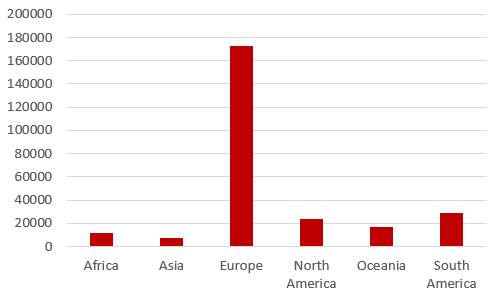
Just for fun I did some number crunching to determine the ratio of world production by continent. Because I rounded the individual country totals the overall total percentage added up to 101%, not 100. However, the continental totals will give you a fairly accurate perspective of world wine production.

 Rank            ContinentQuantity
(million hl)
% of Total
Production
1Europe172,70667
2South America28,66111
3North America23,4739
4Oceana16,5756
5Africa11,1364
6Asia7,3073
2022 wine production by continent

It is incredible that Europe controls two thirds of the world’s wine production.  I was surprised to see that overall, North America’s wine production was greater than Oceana (Australia and New Zealand),and was very surprised to see that Canada’s production was ranked as only 27th.  I imagined it would be somewhere closer to that of Hungary and Greece. However, quality outranks quantity. It would be interesting to know whether a quality scale could ever be devised to compare countries..

Sláinte mhaith

The Effects of Climate Change in Bordeaux

Rising summer temperatures are impacting grape growers around the world, however today I will focus on France’s Bordeaux region.  Temperatures are expected to rise between 0.3°C and 1.7°C over the next 20 years. At this point global warming has benefited Bordeaux but that is about to change, especially if the grape crop is not somewhat modified. 

Photo credit: foodandwine.com

Growers are going to need to reconsider their mix of grapes as temperatures continue to rise.  The future of white varietals from the region may become non-existent while the existing proportion of reds, where 60% to 70% is currently Merlot, is already too great an amount.  Merlot is ideal in cooler regions where there is a shorter growing season. However, with temperatures increasing and the growing season getting longer, Merlot now ripens too quickly.  Many of these vines will need to be replaced with varietals such as Cabernet Sauvignon, which perform better in hotter climates with a longer growing season.

At least until now the increase in temperature and the resulting riper fruit have not had a detrimental effect on the quality of the wine. Instead, higher temperatures have made wine quality more consistently better. However, if warming continues the quality of the wine will begin to deteriorate.

It is well known that high temperatures can have harmful effects on grape composition, such as a decrease in anthocyanins (the pigmented molecules that give red wine its colour), as well as other molecules, that could cause unpredictable aromas.  The grape skins are also negatively impacted by higher temperatures.

Growers, scientists, and wine professionals all speculate that continued increases in temperature will negatively impact fruit and wine quality in the future. However, to date Bordeaux has successfully adapted to the quickly changing climate, but experts fear that the danger point is swiftly approaching.

Sláinte mhaith

Challenges for France’s Bordeaux Region

This summer has proven to be especially bad for the grape harvest in France’s Bordeaux region.  The perfect combination of meteorological conditions has led to an alarming spread of mildew throughout the region. The combination of warm weather and rain has resulted in new plant growth being left unprotected as the wet weather has hindered the application of herbicides.

Photo credit: vivino.com

The mildew has been having the greatest impact on the red grape varietals, most notably Merlot.  So far this year the region has been impacted by two separate waves of mildew.   It remains to be seen whether the disease will progress onto the stalks of bunches and if it can be ultimately contained.

Some growers have lost their entire harvest.  As a result, a helpline has been established to help growers cope with the devastation.  Some grape growers are even considering their careers because of the mildew.  It has been quite traumatic for those trying to control it.

This is the second consecutive year where Bordeaux growers have been impacted by the weather.  The 2022 harvest was about 11% less than the ten-year average.

Grape growers are hoping that the region will soon see a return to more uninterruptedly dry, hot weather.  If the dry heat returns, Bordeaux may see the 2023 harvest being within the top three earliest harvests in the past decade.  However, given the devastation caused by the mildew, the harvest yield will be much lower than in previous years.  This will no doubt impact the price when the 2023 vintage of Bordeaux reaches store shelves in a few years’ time.

Sláinte mhaith

B.C. Winemaker Séverine Pinte

In June, Séverine Pinte, French born viticulturist and managing partner at both LaStella and Le Vieux Pin wineries, was awarded the Knight of the Order of Agricultural Merit.  The award was presented in Oliver, British Columbia by the Consul General of France, Nicolas Baudouin.

Photo credit: en.wikipedia.org

The Order of Agricultural Merit (Ordre du Mérite agricole) is presented by France for outstanding contributions to agriculture.  It is the highest distinction given in France to individuals, both French and foreign, who have made significant contributions in the fields of agriculture and the food and wine industry, whether in public duties or in the practice of agriculture. It also rewards people who have distinguished themselves in scientific research or in related publications.

Severine Pinte came to LaStella and Le Vieux Pin in 2010 with 14 harvests of international winemaking experience along with 8 years of vineyard management.  She is a graduate of the infamous ENSAM (Ecole National Superior Agronomic of Montpellier) where she acquired her Masters in viticulture and oenology, and her National Diploma of Oenology. After graduating from ENSAM she apprenticed at the Cave de Tecou in the AOC Gaillac before coming for the first time to British Columbia to work for Domaine de Chaberton as an assistant winemaker. In 1999 she returned to France and worked a year in Bordeaux under the direction of Andre Lurton in Pessac-Leognan. For nine years Severine was head winemaker and viticultural council for ‘Le Vignoble des 2 terres’ in the Terrasse du Larzac terroir.

In 2003 Severine worked at Frankland Estate winery in Australia and learned about the Australian way of making Cabernet Sauvignon and other Bordeaux originated varieties. Curiosity and the pursuit of new challenges lured Severine to British Columbia’s Okanagan.

Severine is an active member of British Columbia’s wine industry as a board member of the B.C. Wine Grape Council. She is a leading advocate of sustainable viticulture practices and was instrumental in launching the Sustainable Winegrowing B.C. certification program.

She has proven to be a true steward of the land, making some of the finest, most sought-after wines in B.C. at both Le Vieux Pin and LaStella wineries.  The wines produced by the two wineries may be purchased online through their respective websites, www.levieuxpin.ca and www.lastella.ca .

Sláinte mhaith

Trek to The County

During the first week of August my wife Valerie and I made our first post pandemic adventure to Prince Edward County.  I came prepared with a selection of wineries that I felt deserved a closer look, each having caught my attention for a variety of reasons.

The wineries are not presented in any particular order.

Hinterland Wine Company, 1258 Closson Rd, Hillier, Ontario

Hinterland Wine Company is a boutique winery specializing in wines made using the traditional method. Hinterland uses minimal intervention in their winemaking process, allowing the unique terroir to shine through.

I was particularly impressed with their 2021 L’Imparfait Seneca, which is classified as an orange wine, though it is very much red in colour.  It is a blend of 67% Pinot Noir, 26% Marquette and 7% Savagnin grapes.  If you like a sweet wine this one is definitely not for you; it has distinct earthy tones.

Closson Chase Winery, 629 Closson Rd, Hillier, Ontario

From Closson Chase we came away with some of their 2022 Estate Unoaked Chardonnay and 2021 Churchside Pinot Noir

The unoaked Chardonnay was sourced entirely from their South Clos vineyard. It was whole cluster pressed, then cool fermented in stainless steel at 14 C.

The Pinot Noir is sourced entirely from their Churchside vineyard. Destemmed with no crushing and cold soaked for 3-5 days. The juice was then fermented in oak tonneau and aged for 18 months in French oak barrels, 20% new. The wine has five to seven years of cellaring potential.

Rosehall Run, 1243 Greer Rd, Wellington, Ontario

At Rosehall Run we found a 2021 Chardonnay Musque, a wine that not many wineries seem to produce. It is an unoaked variety that contains Chardonnay Musque grapes, rather than the more common Chardonnay.  The wine is 100% estate grown and bottled.

Another find was their 2019 Cabernet Merlot which is a blend of 49% Merlot, 43% Cabernet Franc and 8% Cabernet Sauvignon grapes that were sourced from select vineyards in the Niagara Peninsula.  This wine has a cellaring potential of a minimum of ten years. It has been consistently rated as a 92 out of 100 by several wine critics.

Grange of Prince Edward Vineyards and Estate Winery, 990 Closson Rd, Hillier, Ontario

At Grange I had to go with one of my favourite varietals, Cabernet Franc.  In this case it was their 2020 Cabernet Franc, which contains 100% estate grown grapes.  This is unusual for Prince Edward County given the slightly cooler climate and shorter growing season than either Niagara or the North Shore of Lake Erie. 

Broken Stone Winery, 524 Closson Rd., Hillier, ON

This find I must credit my brother for as he happened by it when he was touring the County earlier this summer.  He brought me back a bottle of each of their 2018 Intensity Meritage Blend Niagara Peninsula and 2021 Gamay Noir Barrel Reserve.  Both were delightful.

In addition to purchasing these two wines, I also picked up some of their 2021 Chardonnay Sans Chene.

Karlo Estate Winery, 561 Danforth Rd, Wellington, Ontario

I am pleased to report that Karlo is back in full swing with a complete lineup of both red and white wines, including their unique red blend Quintus.  Winemaker, Derek Barnett, has recreated this work of founder Richard Karlo using a blend of the classic noble grape varieties, Malbec, Petit Verdot, Merlot, Cabernet Franc, and Cabernet Sauvignon.

The Old Third Vineyard, 251 Closson Rd, Hillier

The Old Third produces unfiltered Pinot Noir, Cabernet Franc and Chardonnay.  Unfortunately, the tasting room is inside a barn that can only be entered by climbing steps consisting of some uneven precariously strung planks with no handrail.  This proved too much of an obstacle for my post-stroke climbing ability so I had to pass on going inside.

Stanners Vineyard, 76 Station Rd., Hillier

Stanners locally grown Cabernet Franc has always been one of my favourite Prince Edward County wines but given the small quantity produced, it is often difficult to obtain and this year is no exception.  The 2020 Cabernet Franc VQA Prince Edward County is already sold out, as well as the 2020 Pinot Noir VQA Prince Edward County and the 2020 Pinot Noir VQA Prince Edward County.  However, I was still able to obtain the 2020 Cabernet Franc VQA Lincoln Lakeshore. The grapes for this Cabernet Franc came from a single vineyard in the Lincoln Lakeshore sub-appellation of the Niagara Peninsula. The grapes were hand harvested then destemmed to whole berries with no crushing. The wine was aged in mostly older French oak barrels for 19 months and was not fined or filtered in order to preserve its fine fruit flavours. This wine is likely to age gracefully for quite a few years.

Devils Wishbone, County Road 7, Prince Edward County, Ontario

In the past I always enjoyed several of Devil Wishbone’s red varietals.  When I last visited the County in 2020 the winery was temporarily closed.  I anticipated a return visit there this summer but was saddened to learn that the owner, Jennifer Baldini, passed away in June of 2021 after suffering from a two-year illness.  The retail operations of the Devils Winery had been closed since the onset of her illness in 2019 but the vineyards were maintained in anticipation of her successful recovery.  Sadly, this didn’t prove to be the case and Devils Wishbone is now closed permanently.

Sláinte mhaith