This summer has proven to be especially bad for the grape harvest in France’s Bordeaux region. The perfect combination of meteorological conditions has led to an alarming spread of mildew throughout the region. The combination of warm weather and rain has resulted in new plant growth being left unprotected as the wet weather has hindered the application of herbicides.
Photo credit: vivino.com
The mildew has been having the greatest impact on the red grape varietals, most notably Merlot. So far this year the region has been impacted by two separate waves of mildew. It remains to be seen whether the disease will progress onto the stalks of bunches and if it can be ultimately contained.
Some growers have lost their entire harvest. As a result, a helpline has been established to help growers cope with the devastation. Some grape growers are even considering their careers because of the mildew. It has been quite traumatic for those trying to control it.
This is the second consecutive year where Bordeaux growers have been impacted by the weather. The 2022 harvest was about 11% less than the ten-year average.
Grape growers are hoping that the region will soon see a return to more uninterruptedly dry, hot weather. If the dry heat returns, Bordeaux may see the 2023 harvest being within the top three earliest harvests in the past decade. However, given the devastation caused by the mildew, the harvest yield will be much lower than in previous years. This will no doubt impact the price when the 2023 vintage of Bordeaux reaches store shelves in a few years’ time.
In June, Séverine Pinte, French born viticulturist and managing partner at both LaStella and Le Vieux Pin wineries, was awarded the Knight of the Order of Agricultural Merit. The award was presented in Oliver, British Columbia by the Consul General of France, Nicolas Baudouin.
Photo credit: en.wikipedia.org
The Order of Agricultural Merit (Ordre du Mérite agricole) is presented by France for outstanding contributions to agriculture. It is the highest distinction given in France to individuals, both French and foreign, who have made significant contributions in the fields of agriculture and the food and wine industry, whether in public duties or in the practice of agriculture. It also rewards people who have distinguished themselves in scientific research or in related publications.
Severine Pinte came to LaStella and Le Vieux Pin in 2010 with 14 harvests of international winemaking experience along with 8 years of vineyard management. She is a graduate of the infamous ENSAM (Ecole National Superior Agronomic of Montpellier) where she acquired her Masters in viticulture and oenology, and her National Diploma of Oenology. After graduating from ENSAM she apprenticed at the Cave de Tecou in the AOC Gaillac before coming for the first time to British Columbia to work for Domaine de Chaberton as an assistant winemaker. In 1999 she returned to France and worked a year in Bordeaux under the direction of Andre Lurton in Pessac-Leognan. For nine years Severine was head winemaker and viticultural council for ‘Le Vignoble des 2 terres’ in the Terrasse du Larzac terroir.
In 2003 Severine worked at Frankland Estate winery in Australia and learned about the Australian way of making Cabernet Sauvignon and other Bordeaux originated varieties. Curiosity and the pursuit of new challenges lured Severine to British Columbia’s Okanagan.
Severine is an active member of British Columbia’s wine industry as a board member of the B.C. Wine Grape Council. She is a leading advocate of sustainable viticulture practices and was instrumental in launching the Sustainable Winegrowing B.C. certification program.
She has proven to be a true steward of the land, making some of the finest, most sought-after wines in B.C. at both Le Vieux Pin and LaStella wineries. The wines produced by the two wineries may be purchased online through their respective websites, www.levieuxpin.ca and www.lastella.ca .
During the first week of August my wife Valerie and I made our first post pandemic adventure to Prince Edward County. I came prepared with a selection of wineries that I felt deserved a closer look, each having caught my attention for a variety of reasons.
The wineries are not presented in any particular order.
Hinterland Wine Company is a boutique winery specializing in wines made using the traditional method. Hinterland uses minimal intervention in their winemaking process, allowing the unique terroir to shine through.
I was particularly impressed with their 2021 L’Imparfait Seneca, which is classified as an orange wine, though it is very much red in colour. It is a blend of 67% Pinot Noir, 26% Marquette and 7% Savagnin grapes. If you like a sweet wine this one is definitely not for you; it has distinct earthy tones.
From Closson Chase we came away with some of their 2022 Estate Unoaked Chardonnay and 2021 Churchside Pinot Noir.
The unoaked Chardonnay was sourced entirely from their South Clos vineyard. It was whole cluster pressed, then cool fermented in stainless steel at 14 C.
The Pinot Noir is sourced entirely from their Churchside vineyard. Destemmed with no crushing and cold soaked for 3-5 days. The juice was then fermented in oak tonneau and aged for 18 months in French oak barrels, 20% new. The wine has five to seven years of cellaring potential.
Rosehall Run, 1243 Greer Rd, Wellington, Ontario
At Rosehall Run we found a 2021 Chardonnay Musque, a wine that not many wineries seem to produce. It is an unoaked variety that contains Chardonnay Musque grapes, rather than the more common Chardonnay. The wine is 100% estate grown and bottled.
Another find was their 2019 Cabernet Merlot which is a blend of 49% Merlot, 43% Cabernet Franc and 8% Cabernet Sauvignon grapes that were sourced from select vineyards in the Niagara Peninsula. This wine has a cellaring potential of a minimum of ten years. It has been consistently rated as a 92 out of 100 by several wine critics.
Grange of Prince Edward Vineyards and Estate Winery, 990 Closson Rd, Hillier, Ontario
At Grange I had to go with one of my favourite varietals, Cabernet Franc. In this case it was their 2020 Cabernet Franc, which contains 100% estate grown grapes. This is unusual for Prince Edward County given the slightly cooler climate and shorter growing season than either Niagara or the North Shore of Lake Erie.
Broken Stone Winery, 524 Closson Rd., Hillier, ON
This find I must credit my brother for as he happened by it when he was touring the County earlier this summer. He brought me back a bottle of each of their 2018 Intensity Meritage Blend Niagara Peninsula and 2021 Gamay Noir Barrel Reserve. Both were delightful.
In addition to purchasing these two wines, I also picked up some of their 2021 Chardonnay Sans Chene.
Karlo Estate Winery, 561 Danforth Rd, Wellington, Ontario
I am pleased to report that Karlo is back in full swing with a complete lineup of both red and white wines, including their unique red blend Quintus. Winemaker, Derek Barnett, has recreated this work of founder Richard Karlo using a blend of the classic noble grape varieties, Malbec, Petit Verdot, Merlot, Cabernet Franc, and Cabernet Sauvignon.
The Old Third Vineyard, 251 Closson Rd, Hillier
The Old Third produces unfiltered Pinot Noir, Cabernet Franc and Chardonnay. Unfortunately, the tasting room is inside a barn that can only be entered by climbing steps consisting of some uneven precariously strung planks with no handrail. This proved too much of an obstacle for my post-stroke climbing ability so I had to pass on going inside.
Stanners Vineyard, 76 Station Rd., Hillier
Stanners locally grown Cabernet Franc has always been one of my favourite Prince Edward County wines but given the small quantity produced, it is often difficult to obtain and this year is no exception. The 2020 Cabernet Franc VQA Prince Edward County is already sold out, as well as the 2020 Pinot Noir VQA Prince Edward County and the 2020 Pinot Noir VQA Prince Edward County. However, I was still able to obtain the 2020 Cabernet Franc VQA Lincoln Lakeshore. The grapes for this Cabernet Franc came from a single vineyard in the Lincoln Lakeshore sub-appellation of the Niagara Peninsula. The grapes were hand harvested then destemmed to whole berries with no crushing. The wine was aged in mostly older French oak barrels for 19 months and was not fined or filtered in order to preserve its fine fruit flavours. This wine is likely to age gracefully for quite a few years.
Devils Wishbone, County Road 7, Prince Edward County, Ontario
In the past I always enjoyed several of Devil Wishbone’s red varietals. When I last visited the County in 2020 the winery was temporarily closed. I anticipated a return visit there this summer but was saddened to learn that the owner, Jennifer Baldini, passed away in June of 2021 after suffering from a two-year illness. The retail operations of the Devils Winery had been closed since the onset of her illness in 2019 but the vineyards were maintained in anticipation of her successful recovery. Sadly, this didn’t prove to be the case and Devils Wishbone is now closed permanently.
The 2023 Canadian wine award season began in early June with the Ontario Wine Awards. There were 558 entries from 77 Ontario wineries.
Receiving the honour of the Winemaker of the Year was Peller Estates Winery’s Katie Dickieson. She earned more gold medals than any other winemaker in Ontario.
The Niagara region’s Domaine Queylus attained the Red Wine of the Year award for its 2020 Cabernet Franc Tradition. This wine is only available directly from the winery but at a very affordable price of $33.50 CDN.
The White Wine of the Year award was presented to Prince Edward County’s Norman Hardie for their 2017 Semi-Dry Riesling. This wine comes at a price of $21.00 CDN and is available from either the winery or select LCBO stores.
This year Gold medals were awarded in the following categories:
Sparkling Wine Award (Traditional Method)
Gold medals were presented to:
Malivoire Wine Bisous Rose NV
Megalomaniac Bubblehead Limited Edition Brut NV
Niagara College Teaching Winery, Balance Brut NV
Thirty Bench Wine Makers, Sparkling Riesling NV
Trius Winery, Showcase Blanc de Blancs NV
Sparkling Wine Award (Cuve Close)
The gold medal was awarded to Greenlane Estate Winery for their Saffron Sparkling Rose 2021
Riesling Award (Semi-Dry)
The gold medal was awarded to Megalomaniac Winery for their Narcissist Riesling 2021
Italy is the largest wine-producing nation in the world and has 20 wine regions. Unlike other countries where grape growing is largely restricted to specific geographical areas, Italian wine is produced nearly everywhere from the top of the boot to the tip of the toe.
Most serious wine drinkers are well acquainted with Tuscany’s Chiantis and Piedmont’s Barolos and Barbarescos. However, with so many wine regions, each having its own unique terroir, and with over a thousand indigenous grapes, there are many great quality, lesser known Italian wines.
The next time you are at your favourite wine store, try a bottle from one of these lesser-known wine regions.
Abruzzo
This southern region is referred to as ‘the green lung of Italy’. Historically, the area was known for the bulk wine production of Montepulciano and Trebbiano, but wineries are working on changing that. There is a native light-skinned white grape varietal called Pecorino, that was once thought to be extinct, but is now gaining popularity thanks to its ability to produce ripe and refreshing wines.
Calabria
Calabria, which is situated at the toe of the boot, has been producing wine for more than 2,500 years. It’s best known for a regional style called Ciro Rosso, made from the Gaglioppo grape. It is a powerful, flavourful red with earthy notes and persistent fragrance.
Campania
Located in southern Italy, east of Naples, Campania is primarily home to the Aglianico varietal. It has very high acidity and tannins, similar to Piedmont’s Nebbiolo grape. Thus, Campania is sometimes referred to as the ‘Nebbiolo of the south’. It produces an earthy, hearty red wine that goes well with fatty meats and spicy sauces, and like its Piedmont counterpart, has tremendous aging potential.
Emilia-Romagna
Emilia-Romagna is one of the oldest wine-producing regions and spans most of central Italy. It’s known for Lambrusco, a sparkling red wine made from the grape of the same name. The wine ranges from dry to sweet, depending on the producer. It has high acidity and notes of berry.
Friuli
Friuli is situated in northeastern Italy between the Alps and the Adriatic Sea. The region was historically known for its white wines, many of which were created from the area’s Friulano grapes. However, it is now receiving international attention for its red wines, which are composed of international varietals such as Merlot.
Lake Garda
Lake Garda
Garda, the largest lake in Italy, is in the alpine foothills, midway between Venice and Milan. There are several small wine regions scattered along its shores, each with its own specialty. For example, the Bardolino region produces wines from Corvina, Molinara and Rondinella varietals, similar to those grapes of the Valpolicella region.
The Lugana region has developed a reputation for bold complex white wines from locally grown Trebbiano grapes.
Langhe
The Langhe region is found between the Barolo and Barbaresco appellations in the Piedmont region of northwestern Italy. Just like Barolo and Barbaresco, Langhe makes its most acclaimed wines from local Nebbiolo grapes.
Liguria
Liguria is in north-west Italy to the south of Piemonte. The eastern half of the region is home to the famous wine-producing Cinque Terre area, while the western side, Riveria Ligure di Ponente, is known for several highly distinctive wines. Rossese is unique, said to be unlike any other Italian red. It’s been likened to both Dolcetto and Valpolicella and yet boasts its own unique complex character.
Sardinia
Sardinia is the second largest island in the Mediterranean Sea. There are several underrated indigenous wine varietals found there such as Vermentino, Cannonau and Mirto. Wines made from the white grape Vermentino are crisp, acidic and fruity.
The island’s dominant red variety is Cannonau, which is very similar to France’s Chateauneuf-du-Pape. It has robust fruit and earthy flavours.
Sicily
Sicily is an island off the coast of the tip of Italy’s boot. Its finest red wines are made from Nero d’Avola grapes which grow in arid vineyards and produce rich wines with intense flavour. Similar to Syrah, it has the ability to produce a hearty, fruity and sometimes tannic wine. There are also reds that are produced from the Nerello Mascalese varietal that create elegant, expressive wines.
Taurasi
In western Italy, south of Umbria is the town of Taurasi. The local vineyards contain Aglianico, Nebbiolo and Sangiovese grapes which are Italy’s three most distinguished varieties.
Umbria
Umbria is located in the middle of central mainland Italy. It is bordered by Tuscany to the north and west, Marche to the west and Lazio to the south. According to some experts, Umbria is home to some of the most undervalued wines in Italy, ranging from crisp, dry Grechetto to bold, ruby red Sagrantino. Sangiovese grapes are also popular in Umbria.
During a recent 16-day springtime excursion to Italy as part of a tour group, I discovered passionate people, their food and their wine. I enjoyed homemade soups, pasta, olives and olive oil, mozzarella and parmigiana reggiano cheese, prosciutto, seafood, pizza, risotto, gelato, tiramisu, limoncello and a variety of amazing coffees.
Aperol Spritz
Italy is the home of the “Dolce Vita” sweet life of physical pleasure and self-indulgence. It has the subliminal charm of fine leathers, renaissance art, classical music and of course, great food and wine.
My wife Valerie and I had the wonderful opportunity to travel by bus through the regions of Veneto, Emilia-Romagna, Tuscany, Lazio and Campania where we enjoyed the regional cuisine and wines.
We began our excursion in Veneto, the home of the cities of Venice and Verona where the white sparkling wine Prosecco is enjoyed in numerous cocktails; most notably Aperol Spritz and Bellini. Aperol Spritz consists of 3 parts Prosecco, 2 parts Aperol and 1 part soda. It is then garnished with an orange slice before serving.
A classic Bellini consists of 1 1/2 oz. of peach puree, topped off with chilled Prosecco. It is served in a champagne glass and garnished with a peach slice. Both drinks are refreshing on a warm sunny day.
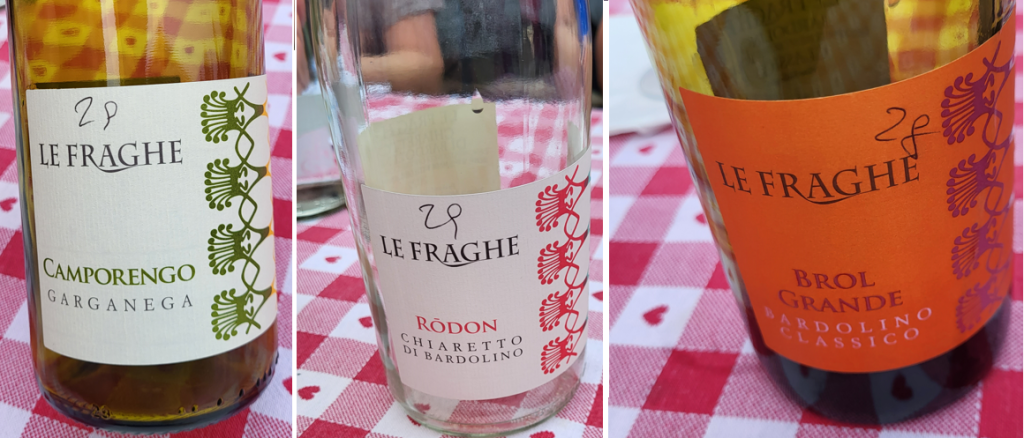
The first winery we visited was the Le Fraghe winery near Verona, where we sampled several of their wines. First was Camporengo Garganega, which is straw yellow in colour. It has a balanced bouquet of floral hints of acacia and mimosa with peach and apple. It has full body flavour.
The second wine, Ròdon Chiaretto di Bardolino, consists of red Corvina and Rondinella grapes. Cherry red with rich purple highlights, Ròdon has fragrant aromas. Notes of wild rose are the first to emerge, followed by nuances of wild strawberry and redcurrant. The wine is crisp and full bodied. It also had excellent tannins and acidity with a lengthy finish.
Brol Grande Bardolino Classico consists of Corvina and Rondinella grapes. Brol Grande is a purple-tinged ruby red of medium intensity. Its bouquet is the result of a blend of the fruity essences of sweet-sour cherry and blueberry, along with spicy nuances of cinnamon and black pepper. The one-year barrel time helps the development of the wine. It has a long and slightly salted finish.
All three wines contain Italy’s DOC designation. They are occasionally available in wine stores in Ontario and Quebec.
Veneto is also the home of Valpolicella and Amarone wines. Unfortunately we did not have the opportunity to visit one of these wineries.
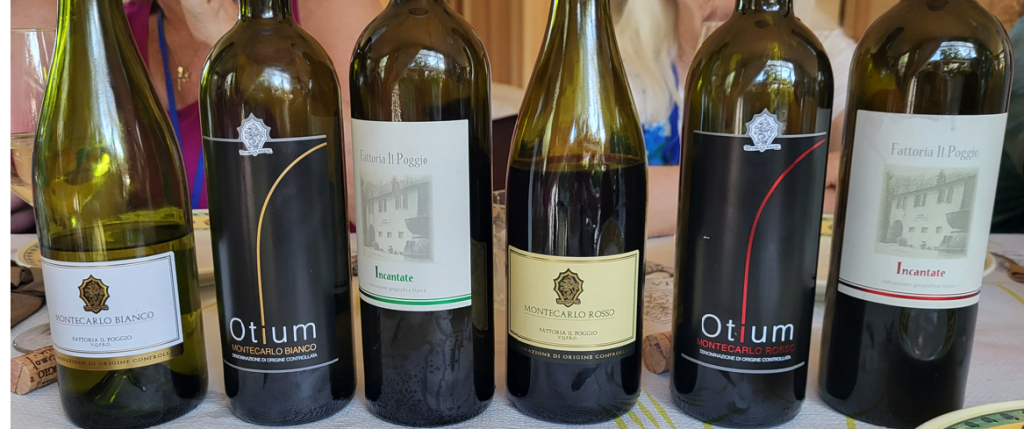
The second winery we visited was the Fattoria Poggio Alloro winery, in San Gimignano, Tuscany. The name Poggio Alloro means Bay Leaf Hill, and it refers to the bay laurel bushes that grow on the property. The farm is a family business. At the present time it consists of one hundred hectares and it is completely organic. The grape varietals include Vernaccia di San Gimignano (a local grape that grows only in this town), Sangiovese (to produce the famous Chianti wine), Canaiolo, Colorino, Malvasia and Trebbiano, Chardonnay, Cabernet, and Merlot.
We sampled six wines while we were there, three white and three red. The white wines included Montecarlo Bianco, which is a blend of 50% Vermentino Toscano and the balance consisting of Vermentino, Roussanne, Sauvignon and Pinot Bianco. This combination produces a light, clear wine with a straw yellow colour. The aroma is delicate while the taste is dry, delicate and well-balanced. Montecarlo Bianco has the DOC designation.
The second white was Montecarlo Bianco Otium, which consists of 40% Trebbiano Toscano, 20% Vermentino, 20% Roussanne, 10% Sauvignon and 10% Pinot Bianco. This wine also contained the DOC designation.
The final white was Incantate Bianco IGT Toscana, which was made totally of Chardonnay grapes. The flavour is tropical and the wine is well balanced.
The first red wine presented was Montecarlo Rosso, which was a blend consisting of 60% Sangiovese, Syrah, Canaiolo, Malvasia and Merlot. It is a light red wine with an aroma that is intense, and the taste is delightfully smooth and dry. It contains the DOC designation.
The second red was Montecarlo Rosso Otium, a DOC designated wine consisting of 50% Sangiovese, 30% Syrah, 10% Cabernet and 10% Merlot. It was aged in oak barrels for four months.
The final wine was Incantate Rosso Toscana which was a bold and structured blend of 60% Merlot and 40% Syrah.
There are also 1,500 olive trees on the farm that are utilized to produce extra-virgin olive oil. The olives are completely hand picked each November and then cold pressed to guarantee the superior quality of this product.
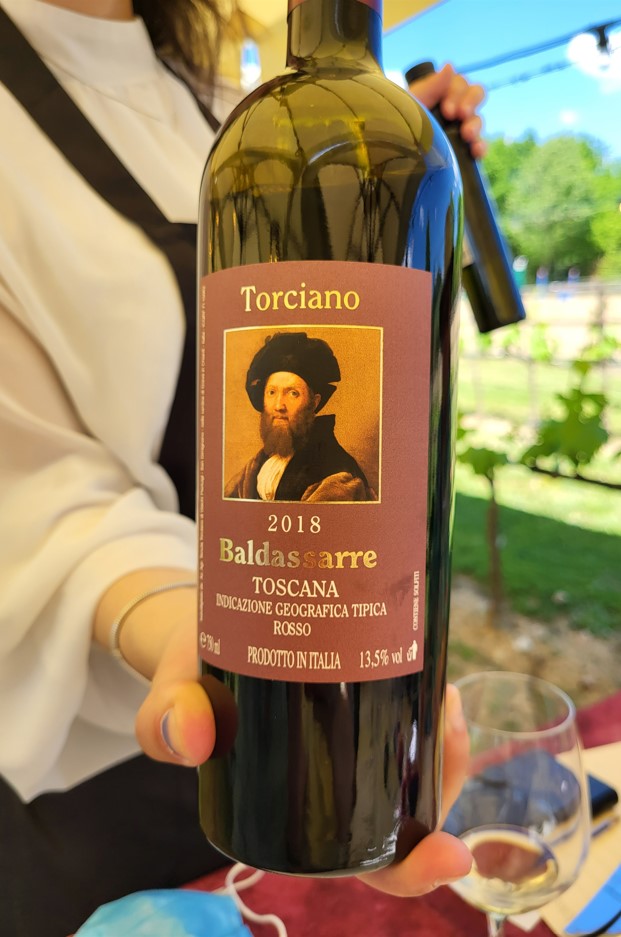
The final winery that we attended was the Tenuta Torciano winery, also in the San Gimignano area. The winery provided a wonderful lunch to accompany the wine tasting but unfortunately the staff did not display the labels of the wines or describe the wines in any detail. The wines are available to be ordered online but they did not say whether any could be purchased from wine stores within Canada.
One wine that we sampled was Tenuta Torciano Baldassarre “IGT Toscana”. This wine is a blend of Sangiovese Grosso, Cabernet and Merlot. It had a deep ruby red colour which transitions to garnet as it ages. It has an elegant bouquet. Hints of wood can be perceived amidst the typical herbaceous notes. Its flavour is dry, full and smooth.
Chianti Classico “Doge” DOCG red wine is produced with Sangiovese grapes, which are harvested by hand and then aged for 12 months.
Doge is characterized by an intense ruby red color. The nose contains hints of violet, then enriched with nuances of ripe red fruit, licorice and vanilla. The taste is full and harmonious, with soft tannins.
Tenuta Torciano Chianti Classico Riserva “Godenzio” is made from Sangiovese and Canaiolo grapes. It has a deep ruby red colour with a penetrating bouquet and full and smooth taste.
Overall, many wines produced in Italy are not intended for export but to be consumed as table wine within Italy itself. These wines are released and drank at a young age, have an abundance of fruit flavour and a slightly lower alcohol level. Examples of these wines include Dolcetto, Montepulciano, Nero d’Avola, Aglianico and Negroamaro.
Unfortunately, being part of a tour, we were at the mercy of the tour company as to which wineries we visited. On the other hand, we had the opportunity to travel to two cheese factories, a couple of olive farms, a Prosciutto farm and a limoncello producer where we enjoyed experiences we otherwise wouldn’t have.
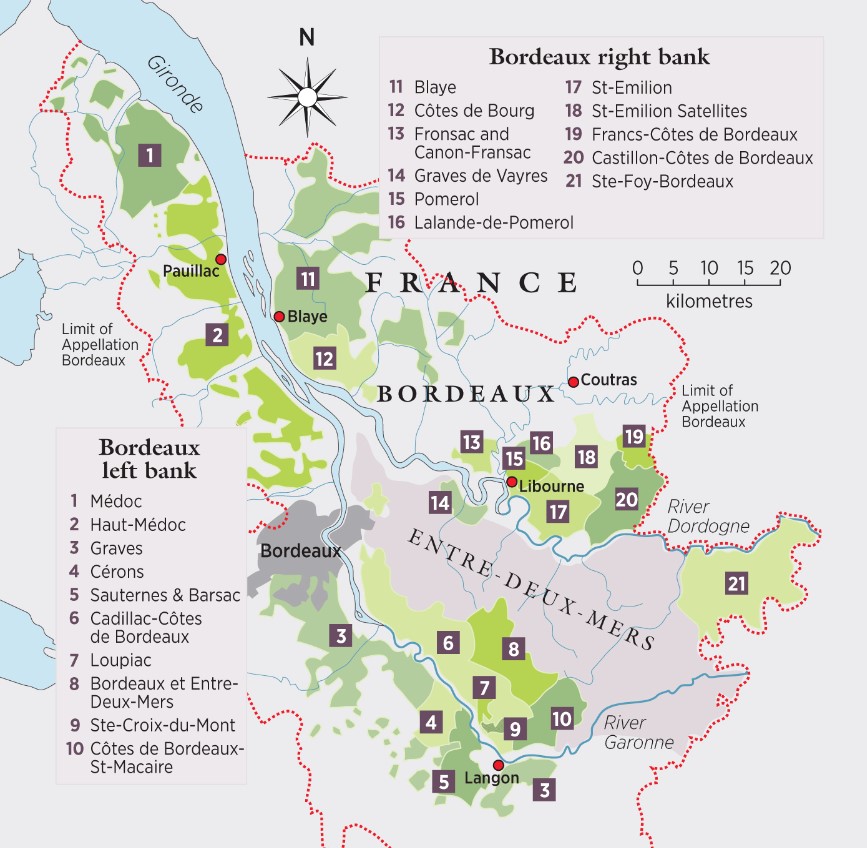
The prestigious Bordeaux wine region is located on the western coast of France. The region is separated into two sub-regions, referred to as the Right Bank and the Left Bank. Each region has its own unique nuances that characterize it from the other.
Photo credit: Decanter.com
The banks refer to the two riverbanks, the land masses on either side of the Gironde Estuary, the place where a river meets the sea. The Gironde Estuary is fed by two rivers, the Dordogne and the Garonne. The Left Bank viticultural region is on the southwest side of the Gironde and the Right Bank is on the northeast side.
The prominent difference between the Left and Right banks is the grape varietal grown. The Left Bank is famous for its Cabernet Sauvignon while the Right Bank is mainly Merlot, Cabernet Franc, Petit Verdot and Malbec. The reason for the grape varieties being different is due to the type of soil. The Left Bank is characterized by gravelly soils while the Right Bank is mainly clay soils.
The varietals grown determines the difference in style of wine produced. The Left Bank’s Cabernet Sauvignon-based blends tend to be more structured, powerful and have a higher presence of tannins, whereas the Right Bank’s Merlot-dominant blends tend to be softer and silkier. Personally, I am a fan of the wines from the Right Bank.
The most complicated difference between the Left and Right Banks is the way in which the wine is classified. For a detailed explanation of the classification methods see my post, France’s Cru Levels from March 18th.
The most notable vineyards on the Left Bank include Château Latour, Château Margaux, Château Haut-Brion, Château Lafite, and Château Mouton Rothschild. Estates on the Right Bank include Château Cheval Blanc, Château Angélus, Château Pavie and Pétrus.
As I have discussed in the past, French wine labels can be rather puzzling since they indicate the region where the wine was produced rather than the grape varietal contained inside the bottle. Also, the label will often contain such words as “Grand”, “Premier” or “Cru”. Even though premier means first in French, you will often find grand appearing on the better quality wines.
Photo credit: Decanter.com
The simple translation for cru is growth. However, in the world of French wine its reference is for the geographic terrain, specifically the soil type, climate and altitude where the grapes are grown. It gets complicated by the fact that cru is not applied in the same manner throughout all the wine regions of France. Further complicating things is that the term cru is also used in Germany and Italy where there are additional variations in the meaning.
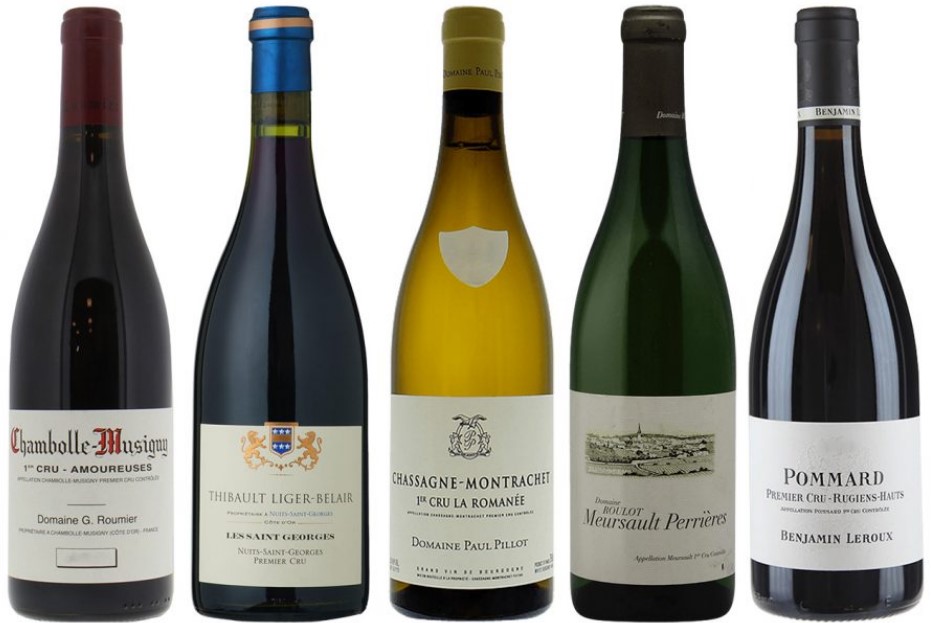
In the Burgundy region of France, the classification of cru is rather simple. Cru designates a vineyard as being of a certain level of quality. The classifications originate back to the 12th century and the Cistercian and Benedictine monks in the Côte d’Or. Every vineyard in Burgundy is classified in the hierarchy where Grand Cru is at the top followed by Premier Cru and then “village” wines, with the generic Bourgogne category at the bottom.
There are 33 Grand Crus with each having its own appellation. Only Pinot Noir and Chardonnay are grown here, but most appellations only permit one or the other varietal to be grown; very few allow both. Premier Cru wines are less expensive and are often a better value, though their long-term aging potential is typically less.
Chablis has one Grand Cru appellation that includes seven vineyards. These vineyards overlook the town of Chablis and benefit from a southwest exposure that helps ripen the grapes.
The Bordeaux region applies the term cru in a much different manner. Grand Cru Classé classification system forms the basis of the rating system and it’s tied to a specific chateau or estate, rather than adjacent vineyards. It was created in 1855 and is comprised of only left bank chateaus in Médoc, Graves and Sauternes, ranked from first to fifth growths, based on their value at that time. The first growths are called Premiers Crus, while second through fifth growth crus are called Crus Classes.
On the right bank Pomerol isn’t classified but Saint-Émilion is. St.-Émilion has three chateau-based quality classifications. At the top is Premier Grands Crus Classés, of which there are 18, followed by Grands Crus Classés which contains 64 chateaus. The appellation’s third category is not tied to a specific ‘classed’ chateau or geographical subzone. Wines labeled “St.-Émilion Grand Cru” merely have more stringent production rules.
The Alsace region uses the term Grand Cru in similar fashion as the Burgundy region. Fifty-one vineyards have been designated superior, or Grand Cru, and wine from those vineyards can use the term on their label. There is a great deal of diversity in Alsace’s Grand Cru wines. There are four grapes approved for use, as well as a wide variation in soils.
The Beaujolais region is where Gamay grapes are grown. Here cru is applied to villages rather than vineyards. There are 10 villages and the wine produced from these villages is called Cru Beaujolais.
The Champagne region also classifies entire villages as Grand Cru or Premier Cru. The Champenois created a system referred to as échelle des crus, or “ladder of the growths” in the early 20th century to fix grape prices for both farmers and buyers at Champagne houses.
At each harvest a price is set and growers with land in one of Champagne’s grand cru village receives 100% of that price. Grapes from the premier cru villages earns from 90% to 99% of the set price, while the rest receive from 80% to 89%.
There you have it; a little more of the puzzle of French wine resolved.
In France the varietal of grape a wine is made of is seldom indicated on the label. Instead, the French tend to identify flavour by the region from which the wine was produced. Because of this, people often shy away from buying French wine. However, the mystery of French wine can be solved by simply knowing which grapes are grown in each region. To assist you, most wine and liquor stores arrange their French wines by region.
The Alsace region is located in the northeastern region of France between the Vosges Mountains and the Rhine River. Historically, Alsace was part of Germany, which influences the types of grapes grown in the region. It is home to single varietal white wines including Gewurztraminer, Muscat, Pinot Gris, Riesling and Sylvaner. The wines cover the spectrum, ranging from dry to sweet.
BEAUJOLAIS
The Beaujolais region is known for growing the Gamay grape, which has bright acidity and low tannins.
BORDEAUX
Bordeaux is France’s largest and most renowned wine region. It is known for its red blends highlighting Cabernet Sauvignon on the Left Bank and Merlot, Pomerol and Saint Emilion on the Right Bank. The white varietals of Bordeaux include Barsac and Sauternes grapes.
BURGUNDY
Pinot Noir and Chardonnay, referred to as Chablis, are the standard grapes grown in the Burgundy region.
CHAMPAGNE
The Champagne region is renowned for its sparkling wines produced from one or more of Chardonnay, Pinot Noir or Pinot Meunier.
LOIRE VALLEY
The Loire Valley stretches from the Auvergne region to the Atlantic Ocean. It produces most of France’s white wine. The white varietals of the Loire include Chenin Blanc (called Vouray), Sauvignon Blanc (referred to as Sancerre and Pouilly-Fumé) and Muscadet. It is also known for the red varietal, Cabernet Franc.
PROVENCE
Provence is the oldest wine region in France. It is the only region that specializes in Rosé wines.
RHÔNE VALLEY
Syrah and Viognier are the highlights of the northern part of the region while Grenache, Syrah and Mourvèdre are prominent in the south. Mourvèdre is the dominate grape in Châteauneuf -du-Pape. Blending of the grapes results in rich reds and vigorous whites and rosé.
Final Thoughts
Once you know which regions grow your favourite grapes, it is much easier to find a suitable bottle of French wine to enjoy.
Most wine enthusiasts are familiar with international wine regions such as France’s Bordeaux, California’s Napa Valley or Italy’s Tuscany. However, there are many other, lesser-known regions, each offering its own unique characteristics. These regions offer not only good wine but fewer crowds and opportunities to discover places less travelled. My list is not intended to be all-encompassing; it is merely a list of regions that I have found intriguing for one reason or another. The regions are presented in alphabetical order by country.
Pedernal Valley, Argentina
Located in the shadow of the Andes mountains, Argentina’s wine country is spectacular. Situated north of the famous Mendoza region is the lesser-known Pedernal Valley. It is felt that the Pedernal Valley can stand on its own merits as a premium wine region. The region’s Malbec is considered world-class and distinct and represents a unique style.
Mendocino County, California, United States
Mendocino County grows less than four percent of California’s grape yield but contains an impressive one-third of the state’s certified organic vineyards. The number of old vines, post-WWII plantings makes this region unique. Some of the best wineries in California source their grapes from Mendocino. Dry-farming practices were introduced to the region by Italian families in the early 1900s, which resulted in wines that are concentrated, balanced and distinctly Californian.
Okanagan Valley, British Columbia, Canada
Photo credit: dailyhive.com
Canada’s own Okanagan Valley is considered breathtaking as it is situated between two mountain ranges and contains glacial lakes and rolling hills of vineyards. The region produces world-class wines that are difficult to find outside of Canada. The high-quality wines combined with the beautiful views of the region have attracted top winemakers from France, New Zealand and South Africa.
Chinon, Bugey and Savoie, France
There are three lesser-known regions in France. Chinon is in the Loire Valley. It is much less popular than its neighbours, Bordeaux and Burgundy. The Loire Valley is famous for its white Sancerre and Pouilly-Fumés. The red variety is Cabernet Franc.
The wine regions of Savoie and nearby Bugey are nestled in the French Alps and are home to great wines and hospitality. Savoie has both a ski and hiking industry and thus there are quality restaurants, wine bars and a wide range of accommodations. The vineyards are spread throughout the Auvergne-Rhône-Alpes overlooking both the mountain ranges and fresh bodies of water.
Bugey is situated underneath the alps. There is a group of small producers that have either relocated from other parts of France or are new vintners who are focused on raising the profile of the region.
The Republic of Georgia
Georgia is the world’s oldest continuously producing wine region but it is one of the lesser known. This is due to The Republic formerly being under the control of the former Soviet Union. During that time only four grape varieties of the over 500 available were allowed in production. After gaining independence, Georgia rediscovered its wine culture and began sharing it with the world. Traditional Georgia wine production is unique, resulting in the production of some exceptionally distinctive wines. The wines are produced in underground amphorae called Qvevri.
For additional information about the wines and the region, see my posts The Wines of European Georgia from February 6, 2021 and Traditional Georgian Wine from September 18, 2021.
Szekszárd, Hungary
The Szekszárd wine region is located about 160 kilometres south of Budapest. Not many tourists explore beyond Budapest since the region has not been marketed. However, it is one of the country’s oldest wine regions, dating back around 2000 years. Wine production is small and the wineries are often family-owned, which equates to limited exports and less awareness about the region.
The region has a wide range wine styles. The most popular variety is the Kékfrankos grape (aka Blaufränkisch) which produces a tannic and spicy style of wine. There’s also Kadarka grapes which creates a fresh acid red fruit that is meant to be enjoyed without aging.
Mexico
Mexico’s wine history dates back to the1600s but the region remains a virtual unknown for many wine enthusiasts. Although wine grapes have been cultivated there for 400 years, it has only been during the past several decades that there has been a renewed focus on premium and terroir-driven expressions.
Valle de Guadalupe’s boutique wineries are experimenting with a mix of European red grapes such as Cabernet Sauvignon, Nebbiolo and Tempranillo. The varietals are often blended to create a Bordeaux style of wine.
Middleburg, Virginia, United States
California, Oregon, Washington and New York dominate the U.S. wine industry but there are other regions worth noting. One of these is Middleburg, Virginia. Virginia was one of the first places in America to produce wine but it is still a relative unknown. The wine industry there is mostly made up of small artisanal producers who are creating world-class wines. Some think of the region as a crossroads between Napa Valley and Bordeaux. The region is situated in the foothills of the Blue Ridge Mountains an hour outside Washington DC.
Final Thoughts
There are many lesser-known wine regions to be explored, either by visiting or merely by sampling the wines they produce. By expanding our horizons and creating new experiences, we will ultimately find more wines to enjoy.