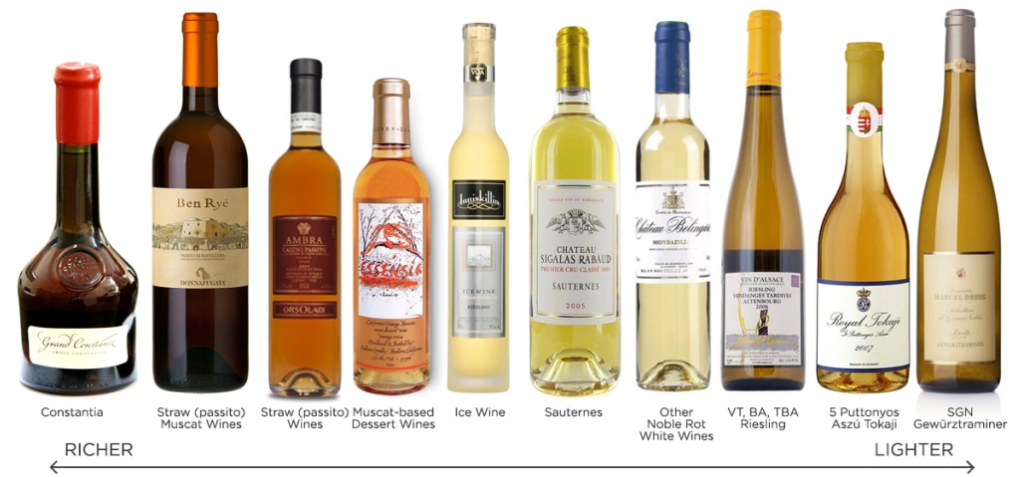
As the name suggests, dessert wine is a sweet wine that is intended to be served alongside dessert. These wines are often rich in flavour and have a high sugar content.
Photo credit: varuninamdar.wordpress.com
There has been a growing demand for premium dessert wines aimed at satisfying consumer demand for high-quality and unique flavours. This has driven market growth by enticing wineries to improve and enhance their product offerings and release new artisanal options, which in turn command higher price points and increased revenue.
There is rising interest in low-alcohol dessert wines by health-conscious Millennials and the Gen Z population who desire lighter wines. These wines also appeal to a broad range of wellness seekers, thus enhancing market growth.
Again, health-conscious and ethically driven drinkers are creating demand for vegan and allergen-free wine alternatives. By excluding animal-derived fining agents, which are added to wine to alter its colour, flavour, texture, and clarity, new dessert wine markets become available. These agents include additives such as casein or gelatin.
There are generally five types of dessert wine. Thirty percent of the market is made up of fortified wines, consisting of Port, Sherry, Madeira and Marsala.
Late harvest wines are next, consisting of twenty-five percent of the dessert wine market. Included in this category are Late Harvest Riesling, Late Harvest Sémillon and Late Harvest Gewürztraminer.
Controlling twenty percent of the market is Ice Wine. Included are Eiswein and Ice Cider.
Botrytized Wines, also referred to as Noble Rot, consist of fifteen percent of the market. For an explanation of this type of wine, refer to my post, Dessert Wines from April 18, 2020. Wines in tis group include Sauternes and Tokaji Aszú.
The “Other” wine category make up the remaining ten percent of the dessert wine market. Included in this catch-all category is Recioto della Valpolicella, Vin Santo and Muscat / Moscato.
During a recent trip to the maritime provinces of Canada, I made a point of seeking out local wines to try. The first I came across while in St. Andrews by the Sea, New Brunswick; the second I found in North Rustico, Prince Edward Island and two while in Nova Scotia.
The first wine my wife and I tried was a 2019 Marquette from the Magnetic Hill Winery of Moncton, New Brunswick. It was a light bodied red wine similar to a Pinot Noir. It had aromas of cherries, blackcurrants and blackberries. The wine was a pleasure to drink and reasonably priced at $20.00 CDN.
The Marquette varietal is the cousin of the Frontenac varietal, which is a well-known French North American hybrid, and a descendant of Pinot Noir. This wine pairs well with pub foods such as cheeseburgers, bangers (sausages) and mash and chili con carne.
The second wine we tried was a $21.99 CDN Gamay from Matos Winery & Vineyards of St. Catherines, PEI. Until then I was not aware that there is a winery on PEI.
Matos Winery & Vineyards is a family-owned and run business that was initiated in 2007. They utilize the French concept of terroir whereby they found a location where the combination of soil, slope, sun exposure and the peculiar weather patterns allow certain grape varieties to thrive. They consulted with European vintners who visited PEI to provide their skill and knowledge.
Their Gamay has won a bronze medal at the National Wine Awards in 2016, 2014, 2012 and silver in 2011.
The first wine from Nova Scotia that we tried was the 2022 Baco Noir from Blomidon Estate Winery, of the Annapolis Valley, near Canning.
The 2022 Baco Noir has a nose of bright berry fruit accentuated by vanilla and notes of spice. Unfortunately for us, we found the wine to be slightly harsh and not quite as smooth and mellow as we have become accustomed to for Baco Noir. The price of this wine is $23.00 CDN.
Given the structure of this wine it would be best suited for pairing with barbecued beef or pork.
Blomidon Estate produces 100% Nova Scotia grown grapes and wines. Over the years they have earned several national and international awards.
The 2nd wine from Nova Scotia we experienced was Founders’ Red from Jost Winery, which is made from a blend of Leon Millot and Marechal Foch grapes. We experienced this wine during a quiet afternoon at our B&B outside of Cap-Pelé, New Brunswick. Like the day, this wine was very smooth and mellow. It had wonderful fruit flavours and was well worth the $17.19 CDN we paid for it.
Founders’ Red is a well-balanced blend of Nova Scotian-grown grapes with deep colour and intensity. This wine pairs well with barbequed meats and roasted pork.
Homemade pizza and wine are the standard Friday night fare at our house. The topping choices are numerous, ranging from veggies to savoury cured meats and cheese. The options seem to be only limited by the imagination.
Photo credit: vinointeriano.wordpress.com
No matter what type of pizza you enjoy there will be a suitable wine to complement it. Here are some suggestions to pair with your pizza whether you create it yourself or order it from your favourite restaurant.
Let’s start with the simple Cheese pizza. This straightforward pie goes well with a light red wine, such as Pinot Noir or Chianti.
Building on that foundation we progress to the Pepperoni pizza. Pepperoni is the culmination of cured meats and spices such as cayenne, anise and garlic. It pairs well with either two of my favourite wines, Cabernet Franc or Sangiovese. These bold, spicy reds complement the flavours of the pepperoni.
The combination of veggies and assorted meats creates an assortment of flavour found in the Supreme pizza. It may seem strange but Prosecco makes a great pairing as it won’t overpower the delicate flavours of the veggies but can still balance the taste of the savory ham, sausage and pepperoni.
Speaking of meat, the Meat Lovers pizza needs to be matched with a bold and robust wine, such as a Cabernet Sauvignon or Malbec. These wines have a bold richness, as well higher tannins and acidity to offset the fattiness of the meat.
Tangy, sweet BBQ Chicken pizza pairs well with a fruity Malbec or Pinot Noir. The wine will complement the tangy notes of the barbeque sauce in the pizza.
Heading in the opposite direction is the Veggie pizza. This type of colourful pizza needs a light, chilled red or full-bodied white to let the taste of the vegetables be revealed. A sparkling red wine, such as Lambrusco, or a Chenin Blanc or a Chardonnay would be a good match.
During my Italian adventure last year, I enjoyed a Margherita pizza on several occasions. A Margherita is a light pie consisting of tomato sauce, fresh mozzarella and fresh basil. It pairs well with a light wine, such as a dry Rosé or Prosecco.
If pineapple on pizza is your thing, then Hawaiian pizza is for you. The sweet and salty flavours will be complemented by a German Riesling or a New World Sauvignon Blanc. The wine’s acidity and sweetness will complement the sweetness of the pineapple.
No matter what your choice of pizza is, there is a wine to go along with it.
Old vines or new vines; does it make a difference when it comes to making wine? The simple answer is yes, but there are some things to take into consideration. The main sticking point is finding common ground for the definition of ‘old’. The definition is not industry controlled so depending on where you ask, the meaning changes.
Photo credit: lastbottlewines.com
In France, New Zealand and Canada, ‘old’ can mean 30 years. In Australia, California and Spain, the vines are not considered ‘old’ until they are 50 or 60 years of age. A few Californian producers who have vines as old as 80 to 100 years have adopted the designation ‘ancient vines’. If 80 years is considered ancient then by comparison there are several Australian vineyards with vines of such an age they would be considered prehistoric, dating back more than 150 years, the upper limit of longevity. Without a true international standard for identifying the relative maturity of vines from one country to the next, the consumer must beware and take into consideration where the wine was produced.
The lifespan of a vine is determined by several factors. The vines of France and other European nations were destroyed during the 1800s and early 1900s by a sap-sucking root pest called phylloxera that destroyed the plants and necessitated replanting on resistant North American rootstocks. Also, in the relatively rainy parts of Europe, such as much of France, the vines die decades before they tend to in the hot dry regions of South Australia, California, Chile and much of Spain. Harsh winters in countries such as Canada led to vines having only a 30 to 35 year lifespan.
Young grape vines, though productive, deliver variable quality wine from year to year. When the sun shines, they grow a great amount of foliage which can produce bitter grapes. When it rains, these vines bloat with water. The vines require massive pruning to reduce the amount of foliage and encourage ripening. By contrast, old vines are constant, their reduced sap flow naturally yields smaller berries with a higher ratio of solids to liquid.
The deep roots of old vines are a big asset. They tap moisture in drought conditions and guard against bloating during rainy times. Old vines also tend to ripen earlier, a great benefit to growers in cooler climates where cool autumn temperatures reduce the growing season.
Old vine wines provide richness and more complex flavours that build rather than trail off after the up-front fruit fades away. Young vines produce nice, aromatic wines but lack the complexity of flavour of wine produced from older vines. Wines produced from old vines will often cellar longer than wines produced from young vines.
Wine produced by old vines is generally more expensive than similar young vine wines. Because of the rarity, lower yields and perceived enhancement of wine quality, old vines have become increasingly sought after and valued by both the wine industry and consumers. As a result, old vine grapes typically demand a higher price per tonne. This combined with consumer demand, has resulted in old vine wines being more expensive to purchase in the stores.
It has been said that the appreciation of an old vine wine can be a way to connect with the past and to celebrate an enduring art form, similar to listening to the music of a great composer, reading literature or observing at the art of past masters. Wine made from old vines can reveal the distinctive character of a specific historic place and the artistry of the vintner, both past and present.
This year was the 22nd addition of the WineAlign National Wine Awards of Canada (NWAC), which took place in Penticton, British Columbia. There were 1,930 entries from 255 wineries. All entries to the competition are 100 percent grown and produced in Canada.
Photo credit: winealign.com
The National Wine Awards presents four major awards: The Canadian Winery of the Year, The Best Performing Small Winery, Icewine of the Year and Cider of the Year. Within each of the 37 categories, wines are eligible to compete for Gold, Silver or Bronze medals, all topped by Platinum medals, which are presented to the highest one percent of wines across all competition categories.
The major award winners and the Platinum and Gold medal winners from the top 25 wineries are presented below:
The Winery of the Year is Hidden Bench Estate Winery in Beamsville, Ontario. Being one of the most respected Niagara wineries since its inception 20 years ago, Hidden Bench has finally won Winery of the Year honours by earning 12 medals – two Platinum, five Gold and five Silver. Congratulations to proprietor Harald Thiel and his team, including winemaker Alex Baines and viticulturalist Joel Williams.
The Platinum and Gold winning wines were:
Platinum
Hidden Bench Pinot Noir Felseck Vineyard 2020
Hidden Bench Chardonnay Tete De Cuvée Rosomel Vineyard 2020
Peller Estates Niagara 2021 Andrew Peller Signature Series Rieslin
The 2023 Best Performing Small Winery of the Year was presented to Deep Roots Winery of Naramata, British Columbia. Deep Roots had the best-scoring top five wines in the competition among wineries producing fewer than 10,000 cases. Their 2020 Reserve Chardonnay earned a platinum medal, one of only three Chardonnays to do so, as well as four gold medals for:
Deep Roots Parentage Red 2020
Deep Roots Gamay 2022
Deep Roots Syrah 2020
Deep Roots Sauvignon Blanc 2022
British Columbia wineries dominated the Small Winery category, claiming nine of the top ten rankings. The remaining top 10 small wineries are as follows:
2. Corcelettes Estate Winery, British Columbia
3. SpearHead Winery, British Columbia
4. Township 7 Vineyards & Winery, British Columbia
5. Painted Rock Estate Winery, British Columbia
6. Van Westen Vineyards, British Columbia
7. Orofino Vineyards, British Columbia
8. River Stone Estate Winery, British Columbia
9. Moon Curser Vineyards, British Columbia
10. The Organized Crime Winery, Ontario
Note: A minimum of five wines must have been entered to be eligible for Winery of the Year and the Top Wineries lists. Ranking was determined by the total score of their top five wines, not total number of medals.
The complete listing of all the winning wines from this year’s event is available on the Canadian Wine Awards website, www.winealign.com/awards.
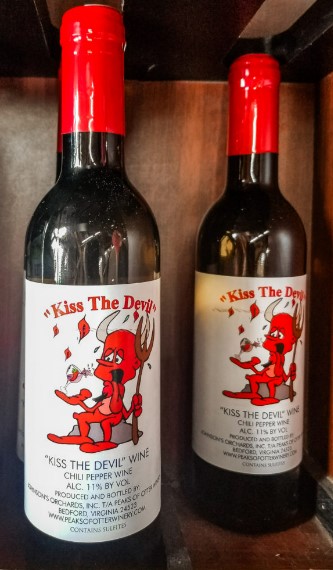
Other than mulled wine, are any wines truly spicy? The short answer is ‘yes’ but there are great differences in individual interpretation. To listen to or read some reviewers impressions you would be led to believe drinking some wines would be similar to eating a chili pepper. For example, “You can taste a red wine and suddenly discover your mouth is sizzling – that spicy red wine has a whole world of delicious, zesty compounds that light up your palate and senses.”
Photo credit: lovicarious.com
Wine can, however, have a certain amount of spiciness to it, though it is much more subtle than the above quote would suggest. There are several reasons for this.
Some wines do have the aroma of freshly ground black or white pepper. Wines made from Syrah grapes have a high level of pepperiness. This is because the grapes actually have one of the same compounds in the skin as is found in black peppercorns, a compound called Rotundone. However, one in five people are unable to detect the smell of Rotundone and thus do not find Syrah or Shiraz to be peppery.
Some red wines, such as Italian Chianti Classico, will provide a warming or burning sensation when they are drunk. This is a result of a high level of acidity in the wine. The same type of sensation may occur when drinking a wine with an alcohol content of around 15% or greater. Amarone is an example of such a wine.
There are wines with the aroma of spices such as vanilla, cloves or baking spices. A California Zinfandel or South African Pinotage will have the aroma of these types of spices. Part of this is due to the wine being aged in oak barrels. Lactones from the barrels create a coconut smell, and vanilla flavours come from vanillin. Spicy, toasted and clove aromas are generated by eugenol and guaiacol respectively, which are also found in the oak barrels.
There are some white wines as well that have flavours and aromas of spice; for example, a Gewürztraminer from Alsace. Grüner Veltliner from Austria can also be spicy as it, like Syrah, has Rotundone in its skin. As a result, it can have a peppery character.
So, although there are some peppery and spicy wines to be found on the shelves of your local wine store, I truly doubt that any of them will leave you fanning your mouth from the intensity of the flavour.
Given the severe winter storm that is expected to arrive later today and the power outages that are anticipated to accompany it, I am publishing the blog earlier this week.
The world of wine can be intimidating, appear complicated and very mysterious. Understanding the flavours of the large number of grape varieties and complicated regional appellations can be somewhat daunting.
Photo credit: theundergroundbottleshop.com
If you’ve been firmly staying within your comfort zone and continually drinking the same type of wine, it’s time for a change. Although it’s great to have a safe choice or two, it is good to explore new horizons. There is an exciting world of wine ready to be discovered.
If you insist on staying with the same grape variety, then try wines from different regions and styles. For example, if you normally drink a California Chardonnay, try an Australian one or a French Chablis. If an Australian Shiraz is your preference, sample a French Syrah. For great Merlot, consider lesser-known varieties with similar flavour profiles, such as Spanish Mencía or Saperavi, an ancient red grape from Georgia. Pinot Noir enthusiasts should explore those wines of Burgundy France, Oregon, New Zealand, Australia or Argentina. Region can have a great influence on character and flavour.
The total experience, from purchase to consumption, can affect your perception of the wine you are drinking. Grocery stores are great for picking up a few cans or bottles of your favourite coolers or beer, but not a great option when purchasing wine. To best ensure that you have a good buying experience, always go to a good quality liquor store or specialty wine shop that has knowledgeable staff. You can ask for advice and receive suggestions, especially if you become a regular at a place with experienced and well-trained employees.
To help you select a good bottle, don’t be afraid to ask about new products or releases, innovative winemakers and local wines, or ask for pairing suggestions for an upcoming dinner. You can help the staff understand your likes by revealing your favourite varieties and styles. One thing to remember is that there are good wines in every price range so don’t be intimidated by wanting to stay within a specific price range.
Regarding price, it is one of the most common misconceptions about wine. People often have the perception that more expensive wines taste better. Purchasing wine varietals that you like from less familiar locations can save you money. Instead of buying wine from the most popular regions, discover reasonably priced quality wines from new, smaller or less popular regions. For example, Chardonnay (Chablis) from France or California tends to be more costly than a wine of the same varietal from Australia or South Africa.
When reading the label on the bottle, resist the urge to simply purchase one with an attractive label or an intriguing name. Neither of these are an indicator of the quality and character of the wine.
The label will tell you whether it is an Old World or New World wine. Old World wines are from Europe whereas New World wines are from anywhere but Europe. New World wine labels will generally identify the actual varietal or varietals that the wine consists of. In contrast, Old World European wines indicate the regional appellation where it was produced. Examples would include Bordeaux or Burgundy from France, Chianti from Italy or Rioja from Spain. However, there are many more appellations. Back in the blog archives are posts on the various wine regions of France, Italy, Spain, Portugal, etc. that identify which grape varietals are produced in each region.
Recognizing the name of the wine producer or importer may give you a hint about the quality of the wine, but location and grape variety will provide the best idea of what to expect in a bottle.
The labels will also display the vintage, which indicates the year the grapes were harvested. When purchasing a wine to be enjoyed in the immediate or near future, the vintage doesn’t reveal much about quality. There is a common misconception that older wines are always better. Though this applies to some bold wines that need time to rest before reaching their full potential, it represents only about ten percent of wines produced.
Whether a wine bottle has a cork stopper or screw cap is not an indicator of a wine’s quality. Though cork has been the traditional method for sealing bottles, it is not necessarily the best way. There are both pros and cons to both methods and neither comes out as a clear winner. My blog, Cork versus Screw Cap from January 8, 2022, presents the arguments for both.
Lastly, when selecting a wine at a restaurant, don’t be afraid to ask the wine steward or sommelier for advice. These are typically well-informed individuals who are there to share their knowledge so take advantage of their presence to receive expert advice. They will help you select a wine that will both suit your palate and complement the food.
Mulled Wine is a must-have on many holiday cocktail recipe lists but what is it? A traditional mulled wine recipe is made most often with red wine, though white is sometimes used, heated with a mixture of whole warming spices and other optional ingredients like apple cider, citrus and brandy.
Photo credit: thelondoneconomic.com
Spiced wine tastes like a big, fruity red wine crossed with a spicy batch of apple cider, with a touch of spirit.
Mulled wine is known by many names such as spiced wine, hot wine, glögg, glühwein, and vin chaud. They all essentially refer to the same drink, although the spices and liquor of choice may vary.
Depending on personal preference, individual recipes will contain varying amounts of spice, sweetness and warmth. The best wine for mulled wine is dry and full-bodied, such as Merlot, Cabernet Sauvignon, Grenache, Zinfandel, or Syrah/Shiraz. These will stand up to the other flavors and ensure the spiced wine won’t be too sweet. Since other flavours will be added, select a budget-friendly bottle. Don’t go bottom shelf, but don’t use the super good stuff either. Those wines are best appreciated on their own.
At this time of year you will see several brands selling pre-mixed spiced wine in bottles. Don’t be tempted. These wines tend to be overly sweet and contain artificial flavours. They are nowhere close to being of equal quality as the homemade versions.
It doesn’t require a great investment of your time to prepare a steaming pot of mulled wine. It takes about 5 minutes to prepare and can be made either on the stovetop or in a slow cooker. It’s totally customizable with your favourite spices and liqueurs. It will make your home smell wonderful and warm everyone up on a cold winter night.
In addition to your bottle of wine, it is suggested to include the following:
Brandy or other liqueur such as Cointreau (or another orange liqueur) or tawny port
Fresh oranges; one that has been peeled and sliced to mull in the wine; and one to slice and use as a garnish
Cinnamon sticks
Mulling spices, which may include one or more of whole cloves, star anise, a few cardamom pods, nutmeg and ginger
Sweetener such as sugar, honey, apple cider, apple juice or maple syrup.
To make it, combine all the ingredients in a saucepan and give them a quick stir. Heat until the wine almost reaches a simmer over medium-high heat but don’t let it bubble, otherwise the alcohol will begin to vaporize and the wine will begin to evaporate. Reduce heat to low, cover completely, and let the wine simmer for at least 15 minutes or up to 3 hours.
Using a fine mesh strainer, remove and discard the mulling spices. Give the wine a taste and stir in the desired amount of extra sweetener if needed.
Serve warm in heatproof mugs topped with your favorite garnishes.
As an alternative to a saucepan, a slow cooker can be used. The slow cooker keeps the stove top free and the spiced wine warm, and it’s easy for guests to access for refills.
The WineAlign National Wine Awards of Canada (NWAC) is Canada’s largest and most respected competition for wines which are one hundred percent grown and produced in Canada. Niagara Falls, Ontario was the host of this year’s event, which took place from June 19th to 23rd, with results published on July 29th.
This year’s awards were the first to be conducted since 2019 without the influence or restrictions from the pandemic.
There were 24 judges who tasted 1,890 entries from more than 250 wineries. The entries came from British Columbia, Ontario, Quebec, Nova Scotia, New Brunswick, Alberta, Manitoba and Saskatchewan.
The wines were all served blind; producer, origin, and price were not revealed to the judges. The top medalists were tasted in multiple rounds by many different judges.
The top ten wineries are presented below, along with a listing of their Platinum and Gold medal wines. For a complete listing of all the winning wines please see the Canadian Wine Awards website, at www.winealign.com/awards.
The 2022 winery of the year is CedarCreek Estate Winery, located in East Kelowna, British Columbia. The winery first opened in 1980, then known as Uniacke Wines. In 1986 it was purchased by the Fitzpatrick family, who changed the name to CedarCreek, and began planting some of the earliest pinot noir vines in the valley.
Over five years ago CedarCreek embarked on a massive refit converting the family-owned Estate vineyards to organic farming that encompasses every aspect of the winery, from regenerative farming and sustainable viticulture to farm-to-bottle craftsmanship in their wine cellar. As of 2021, all vineyards were Ecocert certified.
CedarCreek has partnered with local environmentalists to collect native plant seeds from the property – the seeds are used for fundraising, for native plant re-establishment on other sites, and at the boundaries of new vineyards to support biodiversity.
The estate is the home of five Scottish Highland Cows, a flock of chickens, beehives, worm farms and cover crops to create a thriving ecosystem.
CedarCreek was awarded two Platinum Medals, four Gold, eight Silver and five Bronze.
Platinum Medal
CedarCreek Platinum Jagged Rock Syrah 2020, Okanagan Valley
CedarCreek Aspect Collection Block 5 Chardonnay 2019, Okanagan Valley
Gold Medal
CedarCreek Platinum Jagged Rock Chardonnay 2020, Okanagan Valley
CedarCreek Aspect Collection Block 3 Riesling 2020, Okanagan Valley
CedarCreek Pinot Noir Rose 2021, Okanagan Valley
CedarCreek Platinum Home Block Riesling 2021, Okanagan Valley
Rounding out the top ten producers for 2022 were the following wineries:
The second-place finisher was Ontario’s 13th Street Winery, who was awarded 2 Platinum, 2 Gold, 7 Silver and 9 Bronze medals.
Platinum Medal
13th Street Reserve Syrah 2020, Niagara Peninsula
13th Street Premier Cuvee 2015, Niagara Peninsula
Gold Medal
13th Street Gamay 2020, Niagara Peninsula
13th Street Blanc De Blanc 2019, Niagara Peninsula
Third was British Columbia’s SpearHead Winery that had 1 Platinum, 7 Gold, 3 Silver and 5 Bronze medals.
Platinum Medal
Spearhead Coyote Vineyard Pinot Noir 2019, Okanagan Valley
Gold Medal
Spearhead Botrytis Affected Late Harvest Riesling 2019, Okanagan Valley (375ml)
Spearhead Pinot Noir Cuvée 2019, Okanagan Valley
Spearhead Golden Retreat Pinot Noir 2019, Okanagan Valley
Spearhead Pinot Gris Golden Retreat Vineyard 2020, Okanagan Valley
In fourth position was British Columbia’s Mission Hill Family Estate which earned 1 Platinum, 4 Gold and 9 Silver medals.
Platinum Medal
Mission Hill Terroir Collection Jagged Rock Syrah 2020, Okanagan Valley
Gold Medal
Mission Hill Reserve Riesling 2021, Okanagan Valley
Mission Hill Perpetua Chardonnay 2020, Okanagan Valley
Mission Hill Reserve Cabernet Sauvignon 2020, Okanagan Valley
Mission Hill Reserve Merlot 2020, Okanagan Valley
The fifth-place winery was British Columbia’s La Frenz Estate Winery which won 1 Platinum, 9 Gold and 8 Silver medals.
Platinum Medal
La Frenz Syrah Rockyfeller Vineyard 2019, Okanagan Valley
Gold Medal
La Frenz Malbec Rockyfeller Vineyard 2019, Okanagan Valley
La Frenz Grand Total Reserve 2019, Okanagan Valley
La Frenz Aster Brut 2018, Okanagan Valley
La Frenz Reserve Vivant 2020, Okanagan Valley
La Frenz Pinot Noir Desperation Hill Vineyard 2020, Okanagan Valley
La Frenz Semillon Knorr Vineyard 2021, Okanagan Valley
La Frenz Riesling Cl. 49 Rockyfeller Vineyard 2021, Okanagan Valley
La Frenz Cabernets Rockyfeller Vineyard 2019, Okanagan Valley
La Frenz Liqueur Muscat, Okanagan Valley (375ml)
The sixth-place finisher was Ontario’s Vieni Estates which had 1 Platinum, 4 Gold, 2 Silver and 9 Bronze medals.
Platinum Medal
Vieni Riesling 2020, Vinemount Ridge
Gold Medal
Vieni Cabernet Franc 2018, Vinemount Ridge
Vieni Cabernet Franc Reserve 2017, Vinemount Ridge
Vieni Pinot Grigio 2021, Vinemount Ridge
Vieni Unoaked Chardonnay 2019, Vinemount Ridge
In seventh position was British Columbia’s Black Hills Estate Winery, with a record of 1 Platinum, 5 Gold, 3 Silver and 3 Bronze medals.
Platinum Medal
Black Hills Ipso Facto 2020, Okanagan Valley
Gold Medal
Black Hills Per Se 2020, Okanagan Valley
Black Hills Chardonnay 2020, Okanagan Valley
Black Hills Roussanne 2020, Okanagan Valley
Black Hills Addendum 2020, BC VQA Okanagan Valley
Black Hills Alibi 2021, Okanagan Valley
The eighth spot went to British Columbia’s Fort Berens Estate Winery which earned 1 Platinum, 3 Gold, 2 Silver and 6 Bronze medals.
Platinum Medal
Fort Berens Pinot Noir 2020
Gold Medal
Fort Berens Small Lot Grüner Veltliner 2021, Lillooet
Fort Berens Merlot Reserve 2019, Lillooet
Fort Berens Merlot 2019
The ninth-place position went to British Columbia’s Bordertown Vineyards & Estate Winery which had 1 Platinum, 3 Gold, 3 Silver and 3 Bronze medals.
Platinum Medal
Bordertown Cabernet Sauvignon 2019, Okanagan Valley
Gold Medal
Bordertown Cabernet Franc 2019, BC VQA Okanagan Valley
Bordertown Malbec 2019, Okanagan Valley
Bordertown Syrah 2019, Okanagan Valley
Earning the tenth spot was Ontario’s Thirty Bench Wine Makers with 6 Gold, 7 Silver and 1 Bronze medal.
Gold Medal
Thirty Bench Winemaker’s Blend Cabernet Franc 2020, Niagara Peninsula
Thirty Bench Special Select Late Harvest 2019 (375ml)
Thirty Bench Small Lot Riesling Wood Post Vineyard 2019, VQA Beamsville Bench
Thirty Bench Small Lot Riesling Steel Post Vineyard 2020, VQA Beamsville Bench
Thirty Bench Small Lot Pinot Noir 2020, VQA Beamsville Bench
Thirty Bench Small Lot Riesling Triangle Vineyard 2019, VQA Beamsville Bench
The best performing small winery award goes to the winery with a production of 10,000 cases or less that chalked up the highest aggregate score for its five top-scoring wines. This year the award was presented to the Okanagan Valley’s SpearHead Winery. SpearHead 2019 Coyote Vineyard Pinot Noir took a coveted Platinum Medal. In addition to this, SpearHead wines received seven Gold, three Silver and five Bronze medals.
Ontario is internationally acclaimed for its Ice Wine (also spelled Icewine). However, it is said to have been discovered by accident in Franken, Germany in 1794 by farmers trying to save their grape harvest after a sudden frost. Winemakers that year had to create a product from the grapes available for harvest. The resulting wines had an unusually high sugar content, along with great flavour. As a result, this new technique became popular in Germany and by the mid-1800s, the Rheingau region was making what the Germans called Eiswein.
Photo credit: TheDrinksBusiness.com
In the 1980s, Ontario’s vintners recognized that their cold winters would provide the perfect conditions for producing exceptional Ice Wine. In 1984, Niagara’s Inniskillin winery was the first Canadian winery to produce Ice Wine for commercial purposes. This wine was made from Vidal grapes and was labelled “Eiswein”. Canadian Ice Wine soon became popular and more Canadian producers picked up the idea. The international breakthrough of Canadian Ice Wine came in 1991, when Inniskillin’s 1989 Vidal ice wine won the Grand Prix d’Honneur at VinExpo in Bordeaux, France. By the early 2000s, Canada was established as the largest producer of ice wine in the world. In 2001, the EU recognized Canada’s high standard for producing Ice Wine and began allowing its importation.
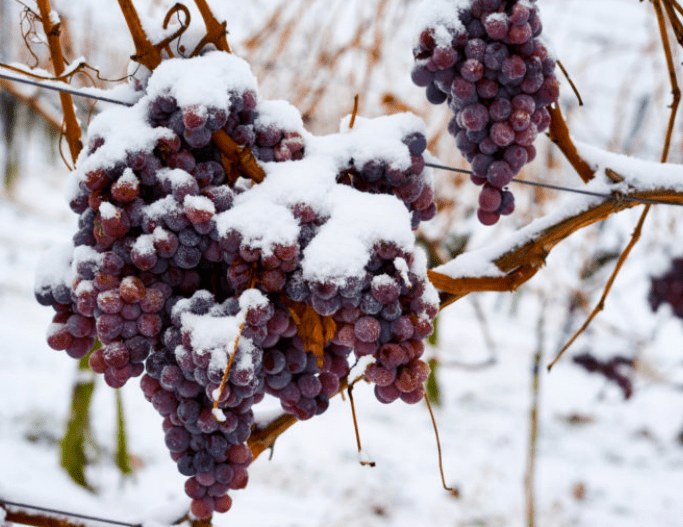
At the normal fall harvest time, producers leave select vineyards unharvested and wait for winter to set in. Being left on the vine, the grapes are vulnerable to rot, high winds, hail, hungry birds and animals. The grapes are harvested in the middle of the night at temperatures below -8°C. The grapes are picked by hand and must be pressed immediately while they are still frozen.
Only about 10 to 20% of the liquid in these frozen grapes is used for Ice Wine. The juice is so sweet that it can take from 3 to 6 months to make ice wine. When it’s all done, wines have around 10% alcohol by volume (ABV) and a range of sweetness from around 160 to 220 grams/litre of residual sugar, which is two times the sweetness of Coca-Cola.
Grapes that grow well in cold climates make the best ice wines. These include Cabernet Franc, Merlot, Gewürztraminer, Riesling, Grüner Veltliner, Chenin Blanc, Chardonnay and Vidal Blanc.
To produce Ice Wine, summers must be hot and winters must be cold. Of all the wine-producing regions in the world, only Ontario has a winter climate consistently cold enough to produce Ice Wine every year. Even Germany cannot produce an Ice Wine every vintage.
Regulations in Canada, Germany, Austria, and the U.S. prohibit dessert wines from being labeled as ice wine if grapes are commercially frozen. Instead, these products are usually labeled as “iced wine” or simply “dessert wine.” So, if you’re looking for true ice wine, be a wary shopper and read the labels or look up the production information.
Ice Wine is not just a dessert wine, but if you do serve it along side dessert, make sure the dessert is less sweet than the Ice Wine. Pairing suggestions include fruit cobbler or pie or cheesecake. White Ice Wine goes well with apple pie, cheesecake, vanilla pound cake, ice cream, fresh fruit panna cotta, fruit compote, crème brûlée and white chocolate mousse.
If you are serving dark chocolate, it pairs well with Cabernet Franc or other red Ice Wine. White chocolate goes well with a Riesling or Vidal Ice Wine.
White Ice Wine pairs well with savoury dishes, such as chicken liver pâté, oysters or foie gras. These salty foods enhance the wine’s sweetness. The acidity of the Ice Wine cleanses the palate between bites.
Spicy foods, such as spicy chicken or Thai curry will pair well because the sweetness of the wine will control the heat of the food while maintaining the flavours of the spices.
White Ice Wine pairs well with snack foods such as soft cheeses or blue cheeses. Red Ice Wine goes well with nuts such as almonds, hazelnuts, walnuts and pecans.
Ice Wine should always be chilled, whether that be for 15 minutes in an ice bucket or 2 hours in the fridge before enjoying. It can be served in an Ice Wine glass, which is a narrow, tulip-shaped long-stemmed glass or it can be simply served in a white wine glass. A standard serving is about 1.5 ounces or 45 ml per person.
Once opened, unlike other wines, Ice Wine will keep in the fridge for several weeks.