The Douro Valley is the oldest established wine region in the world, dating back to 1756. It was first renown for its Port production. However, from a tourism perspective, it has only been popular for the past couple of decades, after being declared as a UNESCO World Heritage site in 2001.
Photo credit: portugalbywine.com
The Douro Valley region is no longer just know for its Port, but also for an increasing number of dry red wines often made from the same native grape varieties. A much smaller number of quality white wines are also now produced.
The viticultural zone covers the steep slopes along the banks of the lower ranges of the Douro River. The river flows from northern Spain, where it is called the Duero. The river finally reaches the Atlantic Ocean at Oporto. The vineyards stretch up the steep, dry slopes on either side of the river.
There are three subregions in the Douro, each covering its own section of the river. Of these, the Douro Superior region is the furthest inland. It is covered in terraced vineyards and takes up about 20 percent of available vineyard land in Douro.
The central part of the Douro region, centered around the village of Pinhão, is the Cima Corgo region. It is where most of the prestigious Vintage Port originates from.
Cima Corgo is the largest subregion, accounting for almost half of the valley’s total wine production. The vineyards are steep with the vines nearer the river generally ripening much earlier than those at higher elevations. For this reason, the harvest is often completed in multiple sweeps of the same vineyard.
Nearest Oporto and the coast is the Baixo Corgo subregion. This area is best suited to produce table wines. The area is cooler and wetter than the other regions and more accessible, easily enabling bulk-wine operations to function.
Both the Douro’s still and fortified wines can be made from more than 80 different grape varieties. However, the vineyards are dominated by five key varieties: Touriga Nacional, Touriga Franca, Tinta Barroca, Tinto Cao and Tinta Roriz (Tempranillo). Of these, aromatic Touriga Nacional is the most highly regarded, but Touriga Franca is the most planted.
As recently as twenty years ago, Portugal produced very little quality still wine. However, since then it has become world renowned not only for Port but also for its DOC Douro still wines
There are several international varieties of grapes grown in the Douro valley, particularly to produce table wines. The most common of these are Cabernet Sauvignon, Sauvignon Blanc and Gewürztraminer.
I tried to post this week’s blog from Paris France this morning, but I was unable to due to a software glitch. I will release the post on Monday after I return home.
Here’s some information that may be of help on trivia night or for those of you who simply have an enquiring mind. Below are 2022’s wine production statistics measured in million hectolitres. I have included production numbers for the top 30 countries; however, the complete list is available at http://www.visualcapitalist.com. A hectolitre contains 100 litres. The information was gathered by the International Organization of Vine and Wine (OIV).
Rank
Country
Continent
Quantity (million hl)
% of Total Production
1
Italy
Europe
49.8
19.3
2
France
Europe
45.6
17.7
3
Spain
Europe
35.7
13.8
4
United States
North America
22.4
8.7
5
Australia
Oceana
12.7
4.9
6
Chile
South America
12.4
4.8
7
Argentina
South America
11.5
4.4
8
South Africa
Africa
10.2
3.9
9
Germany
Europe
8.9
3.5
10
Portugal
Europe
6.8
2.6
11
Russia
Europe
4.7
1.8
12
China
Asia
4.2
1.6
13
New Zealand
Oceana
3.8
1.5
14
Romania
Europe
3.8
1.5
15
Brazil
South America
3.2
1.2
16
Hungary
Europe
2.9
1.1
17
Austria
Europe
2.5
1.0
18
Georga
Europe
2.1
0.8
19
Greece
Europe
2.1
0.8
20
Moldova
Europe
1.4
0.5
21
Switzerland
Europe
1.0
0.4
22
North Macedonia
Europe
0.9
0.4
23
Japan
Asia
0.8
0.3
24
Peru
South America
0.8
0.3
25
Uruguay
South America
0.8
0.3
26
Bulgaria
Europe
0.7
0.3
27
Canada
North America
0.7
0.3
28
Ukraine
Europe
0.7
0.3
29
Türkiye
Europe
0.6
0.2
30
Czech Republic
Europe
0.6
0.2
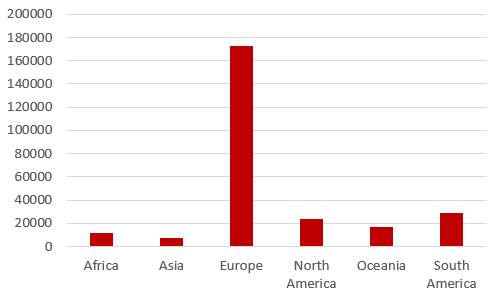
Just for fun I did some number crunching to determine the ratio of world production by continent. Because I rounded the individual country totals the overall total percentage added up to 101%, not 100. However, the continental totals will give you a fairly accurate perspective of world wine production.
Rank
Continent
Quantity (million hl)
% of Total Production
1
Europe
172,706
67
2
South America
28,661
11
3
North America
23,473
9
4
Oceana
16,575
6
5
Africa
11,136
4
6
Asia
7,307
3
2022 wine production by continent
It is incredible that Europe controls two thirds of the world’s wine production. I was surprised to see that overall, North America’s wine production was greater than Oceana (Australia and New Zealand),and was very surprised to see that Canada’s production was ranked as only 27th. I imagined it would be somewhere closer to that of Hungary and Greece. However, quality outranks quantity. It would be interesting to know whether a quality scale could ever be devised to compare countries..
The Lowlands whisky region dates back to the late 1700s when it was first defined as part of the 1784 Wash Act. The distillers often used a triple distillation process instead of the double distillation process used in the rest of Scotland. To me, the adaption of a triple distillation process is an indication of the region’s Celtic influence as Irish Whiskey is also traditionally made using a triple distillation process.
Generally, the more times the whisky is distilled, the more elements that are removed, or in other words the purer the alcohol becomes. However, it is those elements that give the whisky its character and there are those who will argue that triple distillation removes much of the whisky’s character and complexity. Today almost all Scotch malt whisky is double distilled.
Many of the Lowland distillers also used coal rather than peat in the malting process. The combination of the two created what would become known as the traditional Lowlands character of light, soft and smooth malts that offer a gentle palate with hints of grass, honeysuckle, cream, ginger, toffee, toast and cinnamon.
The Lowlands region includes traditional Scottish counties like Ayrshire, Berwickshire, Dumfriesshire, East Lothian, Mid-Lothian, West Lothian, Fife and Wigtownshire. In a broader sense, many Scots consider anything that is not in the Highlands as part of the Lowlands.
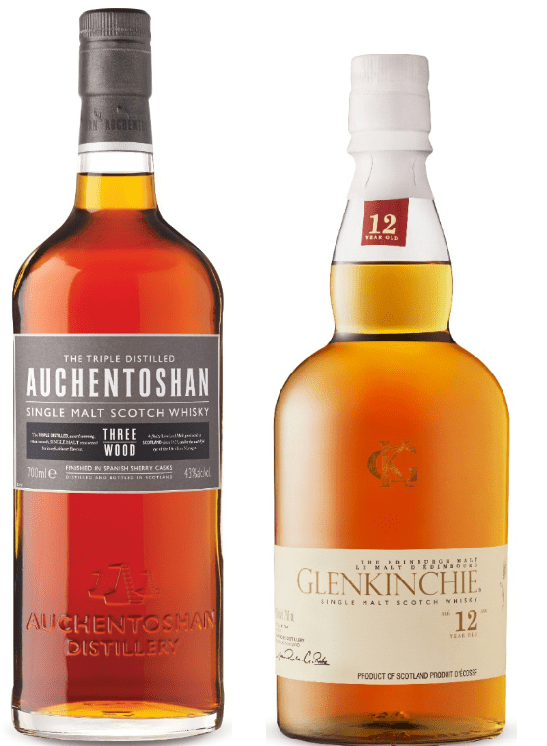
At one point there were over 100 producers in the Scottish Lowlands but that number had dwindled to only three by the year 2000. Auchentoshan, Glenkinchie and Bladnoch were the last remaining distilleries. The combination of competition from the newer Speyside region, World War I and Prohibition took their toll resulting in the distilleries closing.
However, the fortunes of the Lowlands whisky region changed dramatically after 2010 as there are now 13 distilleries in operation with several more in the planning and development stages. Being the most populous and urban area of Scotland, the distilleries have the opportunity to take advantage of a high volume of tourist traffic. Most of the tourism centres around Scotland’s two largest cities, Edinburgh and Glasgow, both of which are located in the Lowlands. Many of the distilleries are located between Glasgow and Edinburgh.
In addition to producing malt whiskies, they also provide whiskies suitable for creating whisky blends. Most of Scotland’s grain whisky is also produced in the Lowlands.
Below is a list of operating Lowlands distilleries. Those highlighted in blue occasionally have whiskies available in Canadian liquor stores.
In the warmer weather, salads are more prominent on lunch and dinner menus. When serving a leafy salad, it is generally the dressing, not the contents of the salad, that determines which wine will best compliment it.
Photo credit: brumate.com
Vinaigrette Dressing
Tart, acidic dressings go best with tart wines such as Sauvignon Blanc. The higher acidity in the salad dominates the palate and has the effect of making the wine taste fruitier and less acidic.
Ranch-Style or Caesar Dressing
For creamy dressings such as ranch or Caesar, the wine needs to have body and acidity to offset the richness of the dressing. If not, the wine will taste flat.
Raspberry Balsamic Dressing
Valpolicella Ripasso is a well-balanced, fruity wine that with its dark fruity flavour matches well with the berry flavour in the salad. As well, it’s strong enough for the vinaigrette without drowning the more subtle flavors of the leafy greens.
Sweet Dressing
A sweet-spicy ginger-sesame, or other sweet dressing will make light sweet wines taste less so or make dry wines taste somewhat bitter. A French Vouvray, which is made using Chenin Blanc grapes, or an off-dry Riesling will pair well in this situation.
Bleu Cheese Dressing
Portugal’s Vinho Verde is a tropical fruit-powered delight that has a slight hint of sweetness that brings out the creamy factor in bleu cheese, making the salad pop. Pinot Gris or Pino Grigio will also pair well.
British Columbia had 148 wineries entered in this year’s National Wine Awards competition; the highest of any province. With such a strong field of competitors, earning a position in the top 10 is truly an accomplishment.
The wines were all served to the judges without displaying the producer, origin or price. The wines were identified and organized by grape variety or style. The top medalists were tasted in multiple rounds by many different judges.
The wineries identified in green periodically have their wines available for sale beyond British Columbia. The award winning wines identified in blue are available in Ontario through the LCBO.
1. La Frenz Estate Winery, Penticton, B.C. (2nd overall) In addition to being the top B.C. winery, La Frenz was declared the Best Performing Small Winery of the Year. They previously received the title in 2017. This year they earned 2 Platinum, 6 Gold and 5 Silver medals. La Frenz wines are available online from their web site www.lafrenzwinery.com.
Platinum Award Winners
N/V Liqueur Muscat – Category: Fortified Wine -$22.00
2019 Reserve Ensemble – Category: White Blend – $29.00
2019 Reserve Vivant – Category: White Blend – $29.00
2019 Vintage Port Style – Category: Other Fortified
2. Blasted Church Vineyards, Okanagan Falls, B.C. (3rd overall) Blasted Church received 2 Platinum, 6 Gold, 5 Silver and 11 Bronze medals. There wines are available from their website at www.blastedchurch.com. Platinum Award Winners
2019 Big Bang Theory – Category: Red Blend – $24.00
2019 Cabernet Franc – Category: Cabernet Franc – $36.90
Gold Award Winners
2017 Nectar of the Gods – Category: Red Blend – $75.00
2017 Holy Moly Petit Verdot – Category: Petit Verdot – $50.00
2018 Cabernet Merlot – Category: Red Blend – $34.00
2018 Small Blessings Malbec – Category: Malbec – $40.00
4. Quails’ Gate Estate Winery, West Kelowna, B.C. (7th overall)
Quails’ Gate Estate Winery received 1 Platinum, 3 Gold, 9 Silver and 4 Bronze medals. Their wines are available from their website at www.quailsgate.com.
Italy and France are two of the world’s finest wine producing countries, for both quality and quantity. Italy has made wines longer and is a larger producer of wine, but France is more renowned for its creation of premium wines. So does one rein superior to the other? I really don’t believe so but here are some of the facts to help you to decide for yourself.
Traditional Sparkling Wine
To begin the France Italy showdown are sparkling wines that are produced using the traditional method – Champagne versus Franciacorta. Both wines utilize a second fermentation that occurs in the bottle. It is the most labour intensive process that creates the most complex textured wines.
Champagne is considered the home of traditionally prepared sparkling wine and has the most stringent regulations for production. These rules dictate both blending practices and aging requirements.
Franciacorta, though less famous than Champagne, uses the same type of grapes and may even have a longer aging process. Given the warmer climate, the grapes are riper but do not have the same vibrancy as the French wine. However, it is worth considering that a Franciacorta sparkler will have a more favourable price point than a similar one from Champagne.
Great-Value Sparkling Wine
Both France’s Crémant and Italy’s Prosecco share the versatility provided by the more expensive traditional sparkling wines but at a much gentler price.
Crémant wines are produced using the traditional method but with less restrictions than Champagne.
Prosecco is produced using the Charmat method which conducts the second fermentation in a tank rather than in the bottle. Some of the finer Proseccos are aged several years to create a more complex flavorful wine.
The price of both the French and Italian versions is comparable.
Notable Styles
France’s Châteauneuf-Du-Pape and Italy’s Amarone are premium wines from their respective regions and are considered to be among the finest wines in the world. They are both full-bodied and smooth.
The wines from Châteauneuf-Du-Pape are a blend which has the Grenache grape as the principal grape. The balance of the wine often consists of a combination of Mourvèdre, Counoise, Vaccarèse, and Muscardine.
The region produces intense, powerful wines with great body. Many of these offerings may be drunk when released or retained for quite a few years.
Italy’s Amarone wines are made from grapes from the most mature vines which are harvested late to ensure ripeness. The grapes are then dried on racks or hooks for about 120 days in order to obtain a higher concentration of sugar and flavour. During this process 30% to 40% of the grapes’ weight is lost which is part of the reason for this wine selling at a higher price.
Though the cost of both of these wines can run over $100, the average price is in the $50 range. Whether one wine is preferred over the other will depend on your personal taste.
Challenging Grapes
France’s gentle flavoured Pinot Noir and Italy’s bold Nebbiolo grape share two things in common; they are both very difficult grapes to grow; and they are among the most sought after grapes in the world.
The majority of France’s Pinot Noir grapes are grown in Burgundy.
The Italian Nebbiolo grape is grown exclusively in Piedmont and is used in the creation of Barolo wine.
The two types of wine, apart from both being red, are vastly different in intensity, richness, and flavour. It would not be fair to try and compare or rate one against the other. They each stand on their own merits.
Notable Regions
The most recognized wine region within each country is France’s Bordeaux and Italy’s Tuscany. These regions are home to some of the world’s most expensive sought after wines. However, they also offer an enticing array of wines at a wide range of price points.
The wines of Bordeaux consist of a blend of Cabernet Sauvignon and Merlot. The region is divided into 2 sectors – the left bank and the right bank – by the Dordogne, Garonne and Gironde rivers. The left bank wines will contain a higher concentration of Cabernet Sauvignon while the right bank wines contain a greater proportion of Merlot.
The wines of Bordeaux have extraordinary consistency of balance and structure, irrelevant of the price point.
The signature grape of Tuscany is the Sangiovese, which is the basis of 3 of Italy’s most famous wines, Chianti, Vino Nobile di Montepulciano and Brunello. There are also other wines consisting of a combination of Cabernet Sauvignon and Merlot.
There are a great variety of styles , flavours, techniques and price points, all containing the definitive Tuscan identity.
There is no winner or loser in this comparison. It comes down to a matter of personal taste.
The White Pinot
France’s Pinot Gris and Italy’s Pinot Grigio are the same grape but are produced in different styles. The Pinot Gris is produced in the Alsace region of France whereas Pinot Grigio is associated with northern Italy.
Pinot Gris is produced in a range of styles ranging from dry to sweet. They contain a distinct richness, weight, spiciness, and complexity that is said not to exist in the Italian version. The French version of the grape has more potential for aging as well.
The Italian Pinot Grigio is light and zesty and makes a great sipping wine. It is said to have subtle floral and fruit aromas and flavours.
Aromatic Whites
Aromatic whites are typically those wines producing the aroma of flowers and herbs. Such wines are normally not aged in oak barrels.
France’s Sauvignon Blanc is the noted white wine grape of Bordeaux and the Loire. It is renowned for the hint of lime, green apple, peach and tropical fruit, as well as its herb and grassy notes.
Italy’s Vermentino wine is light and refreshing. It is also complex and layered displaying fruit tones, mineral and herbal notes.
As I stated earlier, I don’t believe there is a winner or a loser. Both countries provide their own uniqueness and distinct flavours through their wine offerings. There are no comparisons for a French Bordeaux or Châteauneuf-Du-Pape but the same can be said for an Italian Borolo or Chianti. Whether a French wine is preferred over an Italian wine or vice versa is a matter of personal taste.
To simply say that one country is superior to the other and ignore the offerings of the other would be a travesty. Such a person would be denying her/himself the opportunity to indulge in some great tasting wines.
Let me begin my first post by confessing
what I am not. I am not a vintner,
sommelier, restauranteur, or involved with any profession associated with the
wine, spirits, or food industry. I do
not pretend to know anything about the growing of grapes or the creation of
wine. I am simply an individual with a
passion for wine and one who appreciates the skill and artistry of those who
create it.
I began taking more than a casual interest
in wine in 2003, after listening to a presentation by a sommelier associated
with one of the wineries in Niagara. This individual can be credited or blamed, for
what has become a passion and thirst (pardon the pun) for knowledge and of course,
good wines.
The inspiration for this blog came from
encouragement and prodding from friends and family, who for some reason like to
hear me babble on about this wine or that wine and have been subjected to me
sticking this wine or that wine under their noses and down their throats wanting
their reaction to what I have presented to them. My wife is one of this group and as my
retirement draws closer, I think from her perspective, it will give me
something to do and keep me out of her hair.
I have read lots of wine reviews from the
various experts and find them helpful when deciding on which new wines I would
like to explore. You may find that you
share a similar palette of one reviewer or another. If you do, then that individual may provide
you with great insight as to selections you may enjoy and which ones to avoid.
On the other hand, you may be like me;
someone who does not consistently share the same tastes or opinions of any particular
reviewer and thus have to draw your own conclusions based on the vintner and
reviewer notes. Possibly you simply do what my wife does and make your
selections based on whether or not you like the label. Surprisingly, she has discovered some great
wines this way.
Ultimately, what is
important is that you discover wines that you enjoy. Don’t allow a prestigious reviewer likes or
dislikes intimidate your own personal taste.
What is important is that you discover wines that you enjoy.



 A Layman's Wine Musings