The Beaujolais Wine District

My wife and I recently returned from an excursion to France, which included exploration of several wine regions including the Beaujolais district of Burgundy. Beaujolais is a French Appellation d’Origine Contrôlée (AOC) wine, generally made from Gamay grapes.  The grapes are thin skinned and are low in tannins.

The soil (terroir) consists of granite, schist, clay and sandstone. The vines are pruned using the goblet method, which is mainly practiced in the Mediterranean regions because having a foot close to the ground shelters the vine from the wind and the falling vegetation protects the grapes from the sun. This method of pruning only allows 3 to 5 branches to be kept on the vine. The branches end with a spur of 3 or 4 buds.

Goblet pruning is a drought-resistant and berry-protected method but prohibits the use of mechanized harvesting methods. Economically, the reduction in yields can be significant. The cost of production can be high due to an increased need for labour and the drop in production.

Climate change has been presenting a variety of challenges during recent years. Netting has had to be installed to protect the grapes from summertime hailstorms that have been regularly occurring since 2007. Very wet spring seasons, like this year, are threatening to delay the start of the growing season, thus reducing the yield potential and increasing the risk of mold on the vines.

The wines produced in the Beaujolais district include Beaujolais, Beaujolais Villages, cru Beaujolais and Beaujolais Nouveau. The region also produces a small amount of Chardonnay (about 4%) but none of that wine is sold outside of France.

Isabelle Brossard

We visited Château de Pravins, a 12th century winery. The current owners acquired the winery in 1941. The purchaser was Joseph Mathieu, whose descendant, Isabelle Brossard, operates the winery today. It is a biodynamic winery (uses organic processes) that expands across 26 hectares. The grapes are still crushed by feet, but pipes and pumps are also now used. One kilo of grapes is required to produce a single bottle of wine.  The AOC limits the Beaujolais wineries from producing any more than 6,000 litres of wine per hectare and allows only cement vats to be used in the production process.

While there we sampled three red wines, l’argile ardente No 2, les moraines, and l’argile ardente. I found all tree wines to be as equally as nice.

Based on the slow soggy start to the 2024 growing season, don’t be surprised if the 2024 vintage of Beaujolais wine is limited and thus more expensive than some previous years.

Sláinte mhaith

Ancient Roman Grapes

Historically, the Romans are famous for their love of wine.  It is ironic that the wine Roman Emperors consumed was nothing like the wonderfully delicious wines that the world enjoys today.  During Roman times, what was referred to as wine was actually vinegar with honey and spices added, or sometimes garlic. Despite this, it was considered very good compared to other wines of the time.

Photo credit: disholicioussite.blog

Recently, three historic, yet little-known indigenous grape varieties, Bellone, Nero Buono and Cesanese are making a comeback in Italy’s ever changing wine market.

Bellone

Bellone is an ancient white grape variety that is referred to as ‘uva pantastica or pane d’uva’, meaning a ‘grape as good as bread’ or a ‘grape that goes well with bread’, depending on the source. The white grape often brings bright, fruity characteristics of stone fruit, melon and citrus fruits. Some bottles also have flavours of herbs, tropical fruits and toast.  It still grows on the original roots of ancient times.

Casale del Giglio wine estate, located 50 kilometres south of Rome, has spent years reintroducing the native grapes of Lazio. In 2022, its work was recognized by Gambero Rosso magazine when the winery’s Anthium Bellone, which is produced using ungrafted vines, was awarded the coveted Italian award for wine excellence, Tre Bicchieri.

Nero Buono

The black or red grape variety, Nero Buono, almost exclusively grows in the volcanic soil of Monte Lepini. Insects do not thrive in its cool, windy climate, thus alleviating one risk to this finicky grape. The deeply coloured wine brings flavours of dark-skinned fruits, rhubarb and black pepper.

Nero Buono is difficult to grow so there are no clones. It is very wild and produces many leaves which must be thinned out several times per year.  The berries are tight and close together making the vines susceptible to disease.

Producers are committed to supporting native grape production, even when there is minimal demand for the grapes.  Winemaker Marco Carpineti now makes wine only with sustainably grown fruit that is native to the area. Today Carpineti is one of the best-known winemakers of Lazio. He devotes 25 percent of his production to Nero Buono and Bellone-based sparkling wine made in the traditional method.

Cesanese

Originally called Latium, the Lazio region of Italy borders Tuscany to the north, Abruzzo to the east, Umbria to the northeast and Campania to the south. Rome is in this region, making it the primary winemaking region of the Roman Empire.

Cesanese is the signature red wine of Lazio.  Cesanese refers to one of two sub-varieties: Cesanese Comune or Cesanese di Affile. Both are used to make high-quality wines, which were highly prized in ancient times. There are three Cesanese appellations which include Cesanese del Piglio DOCG, Cesanese di Olevano Romano DOC and Cesanese di Affile DOC. All are within a 50-kilometer vicinity.

Cesanese is a red wine that contains flavours of dark-skinned berries, herbs, cedar and cooking spices. It’s ruby in colour and has high acidity and tannin, with the ability to age for a long time.

The Campania Region

Modern winemaking in Campania, a southern region referred to as ‘the ankle of the boot’, is closely identified with the Mastroberardino family, specialists in the wines of ancient times. The family’s involvement in winemaking can be traced back to the late 1500s.  However, today, brothers Antonio and Walter, along with sons Piero and Carlo, run the winery which is 60 kilometres northeast of Naples.

The family’s extensive library of ancient viticulture books has enabled the Mastroberardinos to grow grapes that were popular centuries ago.

Sláinte mhaith

Barbaresco vs. Barolo

I recently enjoyed a bottle of Barolo with dinner one night followed by a Barbaresco the following night. Having the two bottles back-to-back reminded me how different the two wines are despite being made from the same Nebbiolo grapes and being produced in the Piedmont region of Italy.

Photo credit: pinterest.co.kr

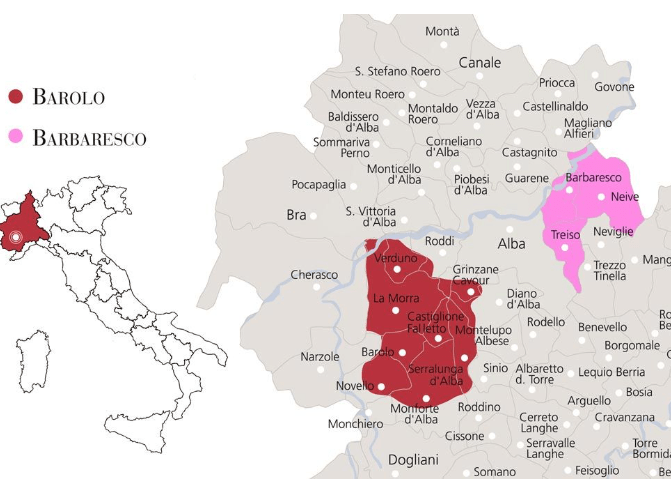
Production of both Barolo and Barbaresco occur in the Langhe hills near the town of Alba. The Barbaresco zone is northeast and the Barolo zone is southeast of the town.  In accordance with Italy’s governing body, the DOCG (denominazione di origine protetta or Denomination of Controlled Origin.) Barolo may only be produced in the comuni or townships of La Morra, Castiglione Falletto, Serralunga d’Alba, Barolo and Monforte d’Alba. Barbaresco wine is produced in Treiso, Neive, San Rocco Seno d’Elvio and Barbaresco.

There are differences in the two sub-regions. The Barolo area is located at a slightly higher altitude and has more south-facing vineyard exposures. This results in slower ripening grapes than those of the Barbaresco area to the north. The northern region it is warmer, due to the lower altitudes and warm sea winds. As a result, the grapes ripen faster.

The soils of the two area are different as well. The soils of Barbaresco are slightly sandier, less compact, and have more nutrients. As a result, the wines have a softer character. The firmer soils of Barolo create bolder, more tannic wines.

According to DOCG regulations, Barbaresco must be aged a minimum of 26 months, with at least 9 of those months in oak. Barbaresco Riserva must be aged a minimum of 50 months with at least 9 months in oak.

Barolo wines are aged a minimum of 38 months, with 18 months being in oak. Barolo Riserva needs to age 60 months with 18 months in oak. The longer aging requirements are necessary because of the more intense tannins that are in Barolo wines.

When it comes to flavour, Barolo is the bigger, bolder and more structured. It may have an array of aromas of plums, sour cherries, tobacco or truffles.

Barbaresco is generally a lighter wine with flavours of ripe fruit. Barbaresco is strongly influenced by the soil, vineyard location and the winemaker’s techniques.

As to which wine is better, that is up to you to decide.  Personally, I like both equally. My preference is determined in the moment, whether it be a dinner pairing or simply my mood.

Sláinte mhaith

Pinot Gris or Pinot Grigio

Pinot Gris and Pinot Grigio are made from the same grape and are obviously both white wines, but it can be argued that the similarity ends there.

Photo credit: vinomofo.com

Pinot Gris originates in France and is believed to be a mutation of Pinot Noir. It’s mainly grown in the Alsace region of France. The grape is thought to have reached Italy during the 1300s where the variety was called Pinot Grigio.  The Italian version is primarily grown in the Alto Adige region of northwestern Italy.

Gris is the French word for gray and grigio is gray in Italian. The gray describes the grayish-purple skin of the grapes.

Both Pinot Gris and Pinot Grigio will appear on wines produced in countries other than France or Italy. There is an abundance of Pinot Gris grapes produced in countries such as Canada, the United States, Australia and New Zealand.

So what determines why some are labelled Pinot Gris while others are referred to as Pinot Grigio? Winemakers have the choice of selecting which name they use. There is no hard and fast rule, however most will base the name on the style of the wine they produce. You can usually tell the style by the colour. Pinot Gris style wines are typically darker and more yellow in colour, whereas Pinot Grigio wines are very light yellow, almost clear.

Pinot Gris wines are rich, full-bodied and accompanied by higher alcohol content. Made with fully ripe grapes that are occasionally barrel fermented, Pinot Gris often has extra sweetness and a creamy feel. The darker grape skins tend to produce a golden colour.

By contrast, Pinot Grigio is harvested early, resulting in a light-bodied, crisper wine with a lower level of alcohol. The aromas are primarily of fresh fruit and florals.

Pinot Gris embodies complex flavours such as cinnamon and lemon, with a tingly aftertaste. Late harvest French-style Pinot Gris is a rather sweet wine. This is due to noble rot, which creates honeylike undertones.

Pinot Grigio tends to be a lighter, crisp, dry style of wine with flavours of citrus and green apple, pear, lime and lemon, with a refreshing spark of acidity. Some Italian-style Grigio wines also have a floral aroma of honeysuckle.

The Pinot Gris style pairs well with roast pork, creamy pasta, and dense cheeses like Comté or Gruyère, seared scallops, or creamy mushroom risotto. Off-dry versions go well with spicy Asian or Indian dishes like chicken tikka masala or Thai green curry.

The lighter Pinot Grigio is a great apéritif but, also goes well with grilled shrimp, salads or fruit platters and sushi.

Now it is up to you to decide whether you prefer Pinot Gris or Pinot Grigio.

Sláinte mhaith

Sauternes Wine

Sauternes is a sweet wine from France’s Bordeaux region.  It is made from Sémillon, Sauvignon Blanc and Muscadelle grapes that have been affected by Botrytis cinerea, also known as noble rot. Sauternes is one of the few wine regions where infection with noble rot is a frequent occurrence. The noble rot causes the grapes to partially shrivel like raisins, resulting in concentrated and distinctively flavoured wines.

Sauternes is a full-bodied, sweet, late-harvest white wine that is an exceptional dessert wine. It is well complimented by aging in oak barrels and will keep for several decades.

Wine production is not consistent from one year to the next as harvests vary widely.  The wines produced from Sauternes can be very expensive, largely due to the very high cost of production.

Sauternes are characterized by sweetness with the zest of acidity. Some common flavour notes include apricot, butterscotch, caramel, coconut, mango, marmalade and citrus, as well as honeysuckle and toasted baking spices. The finish may remain on the palate for several minutes. A Sauternes typically starts out with a golden yellow colour that darkens as it ages.

Most Sauternes are sold in half bottles of 375 ml. The wines are typically served chilled at 10 °C, but wines older than 15 years are often served a few degrees warmer.

Sauternes is a great dessert wine but it may also be served with several food pairings. Consider cheesecake of all kinds, almond tart, lemon tart, meringues and custards. As well, it may be served along side something savory such as Roquefort or Livarot cheese and foie gras or terrine with caramelized onions.  Mains such as herb-roasted poultry or spicy Asian fare are recommended as well.

Sláinte mhaith

Right and Left Bank Bordeaux Wines

Bordeaux; most people have heard of this French wine region, which is one of the most famous Old World wine regions, but many people don’t understand it. To begin with, Bordeaux is divided into two sections, referred to as the Left Bank and the Right Bank. The banks refer to the left (west)and right (east) bank of the Gironde Estuary and Garonne River.

The Left and Right banks have significantly different terroirs. A terroir is the natural environment in which a particular wine is produced, including factors such as the soil, topography, and climate.  

The soil is rockier on the Left Bank. It is packed with gravel and deep deposits of limestone which serves to provide more character and potential quality in the wine. This is why Left Bank wines are considered prime candidates for aging, while Right Bank wines are generally thought to be smoother and more drinkable at the time they are released for sale.

This is not to suggest that Right Bank wines are simple and boring. With limestone closer to the surface and less gravel for the vine roots to contend with, the wines of the Right Bank don’t lack character; it’s just that they possess a different kind of character.

When it comes to the grape varietals grown, because of the differences in the terroir between the Left and Right Bank, each supports its own type of grape. As a result, this is often the best way to distinguish between a Left and Right Bank Bordeaux, as the label will not often tell you. Left Bank wines are mostly Cabernet Sauvignon with a smaller portion of Merlot. The Right Bank wines are dominated by Merlot balanced by a smaller proportion of Cabernet.

The Cabernet dominated Left Bank wines tend to be higher in tannin, thus the reason why they age well. Aging the wine helps to mellow out the tannins and integrate the flavors of the wine. Merlot-based Right Bank wines are generally smoother, with softer fruit flavours as tannins are not as dominating.

The last comparison is between the wineries or chateaux themselves. These are the castle-like structures that appear on many of the Bordeaux wine labels.  Generally, the Left Bank chateaux have larger vineyards than those of the Right Bank. Left Bank vineyards are on average 5o to 80 hectares in size versus those of the Right Bank, which only have a maximum of about 30 hectares. However, this is only a fun-fact as vineyard size really has no impact on the quality or character of the wine. Arguably the most renown chateaux include Chateau Margaux, Lafite, and Mouton Rothschild on the Left Bank and Petrus and Cheval Blanc from the Right Bank.

So, which wines are better?  Neither. If you are looking for a wine to enjoy with dinner tonight, a Right Bank wine is probably the better choice, whereas if you are looking for a wine to age and appreciate in the future, you will find that a Left Bank wine will improve with age and provide a delightfully satisfying experience when it is uncorked in a few years’ time.

Sláinte mhaith

Wine and Pasta

Wine and Pasta

Winter is a time for comfort food and one of my favourite comfort foods is pasta. When it comes to pairing a wine with pasta, the deciding factor should be the accompanying sauce, not the pasta itself because after all, pasta by itself does not have a great deal of flavour.

Photo credit: finewinemaster.com

Tomato-Based Pasta

Tomato-based sauces are high in acid and are often blended with beef or pork. Because of the acidity in tomatoes, a dry, medium-bodied red wine is recommended. Examples of red, medium-weight wines include:

  • Chianti
  • Grenache
  • Nero d’Avola
  • Primitivo
  • Rhône Blends
  • Sangiovese
  • Zinfandel

Cheese Pasta

There are a wide range of red as well as white wines that will pair well with cheese sauces. You shouldn’t feel restricted to serving just white wine with white cheese pasta. An oaked white wine will have a buttery character that will compliment the creamy sauce. Examples include an oaked Trebbiano or Chardonnay. Here are a couple of white wine options to consider:

  • Oaked Chardonnay
  • Oaked Trebbiano

Also, lighter more floral red wines will also pair well with intense hard-cheese pasta, especially if there are mushrooms or root vegetables in the sauce.   Red wine options include:

  • Chianti
  • Nebbiolo
  • Pinot Noir
  • Sangiovese

Seafood Pasta

Light-bodied white wines are the preferred pairing choice for seafood pasta. These wines will be relatively acidic, thus a good balance for creamy white sauces and fatty seafood, such as scallops, shrimp, oysters or mussels. White wine options include:

  • Chenin Blanc
  • Grenache Blanc
  • Pinot Gris / Pinot Grigio
  • Riesling
  • Sauvignon Blanc

For seafood pasta that is cooked in a tomato-based sauce, light body red wines or Rosé are a good option. Red wine options include:

  • Pinot Noir
  • Malbec

Pesto Pasta

Whether you are serving the traditional pine nut and basil pesto or another type of pesto, the focus should be on matching the green, whether it be parsley, cilantro, mint, etc. which is the centerpiece of the dish. For the most part, herbaceous wines are said to be best suited when serving pesto pasta. Herbaceous wines are those wines that have aromas and flavours like herbs such as mint, vegetables such as asparagus, freshly cut grass or tomato leaves. Wines considered to be herbaceous include:

  • Grüner Veltliner
  • Sauvignon Blanc
  • Cabernet Sauvignon

Primavera (Vegetable) Pasta

Spring onions, garlic ramps, artichoke hearts and broccolini are among the choices on which to base primavera. The objective is to highlight the springy freshness of the vegetables; thus, it is often best paired with a light-bodied white wine with lemony and floral notes. However, if the pasta has major vegetable intensity, it needs to be matched with an equally savory white wine. White sauce wine options include:

  • Pinot Gris / Pinot Grigio
  • Riesling
  • Sauvignon Blanc
  • Vermentino

If tomatoes are a major component of the primavera, a light-bodied acidic red wine would be a better choice. Tomato sauce wine options include:

  • Cabernet Franc
  • Pinot Noir
  • Rosé

No matter which type of pasta you fancy, one of the corresponding wine options will compliment your meal.

Sláinte mhaith

The Wines of Armenia

Armenia is a wine region that I was unaware of until I saw an Armenian wine advertised recently in a wine catalogue. That enticed me to do some research and here is what I learned.

The bulk of wine grapes indigenous to Armenia are not very well known in North America. Hindering Armenia’s ability to familiarize the rest of the world with its wines are the ongoing conflicts surrounding its borders. Armenia is situated between Georgia, Iran, Azerbaijan and Turkey. Armenia’s rivers and high plateaus are surrounded by the Caucasus Mountains.

The country’s wine history is ancient. The region of Vayots Dzor claims to be home to the oldest winery in the world, in operation since some 6,100 years ago.

As with some other Eastern European countries, the progression of Armenian wine ended when the Soviet Red Army invaded in 1920. In 1922 the country was merged into the Transcaucasian Soviet Federated Socialist Republic. Then, in 1936 it became the Armenian Soviet Socialist Republic or Soviet Armenia.

Innovation stopped with the elimination of private enterprise. The Soviets converted wineries into processing plants and vineyards turned over fruit for brandy distillation or bulk wine production.  Some vineyards were planted in unfavorable locations, while others went neglected or abandoned.

In 1991, after the demise of the Soviet Union, Armenia regained its sovereignty. Young Armenians and those with investment money began to embrace the region’s ancient wine-making techniques and wine culture. As a result, Armenia has become the youngest oldest wine industry in the world.

During the Soviet years a great deal of information was lost, including knowledge of the traits of many indigenous grape varieties, understanding soil suitability, sun preference, as well as how much maceration and aging of the grapes is best. Regaining this knowledge requires years of experimentation.

A few producers work with international grapes mainly for the Russian and other former Soviet republic markets. However, new quality-driven wineries focus on local varieties. Much of the post Soviet revival has included using a combination of modern technology and traditional techniques, such as aging the wine in terracotta jars called karasi.

The drive to produce quality wines has helped winemakers find export partners. Being a landlocked country, Armenia cannot produce low-cost wines. It must become part of the higher-priced market segment.

Armenia contains four main wine regions. The best known is the south-central region of Vayots Dzor, a long, narrow plateau which stands out for its highest elevation vineyards, some which reach almost 6,000 feet above sea level.

The Aragatsotn region is situated at slightly lower elevation. The remaining regions include Ararat, which is located on a sunny plateau, and Armavir, which is a mountainous area in the southwest.

Grape varietals include Areni Noir, which produces medium-bodied red wines with fruits like cherry and strawberry laced with black pepper aromas. It compares in its freshness, silkiness and transparency to Pinot Noir.

Voskehat is Armenia’s signature white grape. The wine has light to medium body. It has floral and stone fruit aromas with notes of herbs and citrus.

Khndoghni, or Sireni, is a red grape that gives black fruit flavors, deep colour, good tannins and the potential to age.

To sum it up, Armenia is small, landlocked and poor. However, it appears to have resilience, an ability to adapt, and a desire to show the world its world-class wines. Many experts feel that there is a future for quality Armenian wines.

Sláinte mhaith

Rhine River Cruise

My wife and I recently returned from a Rhine River cruise where we had the opportunity to sample wines from Switzerland, France and Germany during our travels. I was most anxious to try some Swiss wines as I had never had the opportunity of tasting any. These wines are not often available outside of Switzerland (see The Wines of Switzerland from May 1, 2021). 

The first Swiss wine we tried was a 2022 Weinbau Ottiger Pinot Noir. The wine is very similar in character to a French Pinot Noir.  The second sampling was a red blend from Château Constellation sa 1950 Sion, called “Humagne Rouge”.  It has a spicy bouquet characterized by notes of pine and cinnamon. It has accents of black fruit aromas balanced by silky tannins. It was very enjoyable.

We ventured through Strasbourg, France and the Alsace wine region. World-renowned for its viticulture, Alsace has a dry mild climate, favourable soils and ideal exposure to the sun for its vineyards. The white wines produced here rival the Rieslings created in neighbouring Germany.

While in Breisach, Germany, the tour offered a wine tasting at Domaine Albert Seltz, Alsatian Vineyards.  There they follow a rigorous process to preserve the authenticity of their wines, respecting traditional techniques while integrating the most recent advances in technology. Sustainable viticultural practices are followed that promote biodiversity and respect for nature.

The area surrounding Breisach, the capital of Alsatian wines, has the third largest wine co-op in the world, following California and South Africa. Twelve million litres of wine are produced there each year, taking advantage of being the sunniest place in all of Germany.

We also visited Rüdesheim, which is a German winemaking town in the Rhine Gorge, and part of the UNESCO World Heritage Site. It is in the heart of the Rheingau wine region.

Close to Speyer, Germany lies the Roter Hang wine area.  It is considered to be one of the most important vineyard sites in the world, sitting to the south of Mainz, not far from Nierstein and Nackenheim. The soil is red, the result of red slate that exists throughout the region, providing the perfect conditions for outstanding wines that are characterised by unmistakeable flavour.

Further north at the intersection of the Rhine and Moselle Rivers is the town of Koblenz.  Koblenz is a principal seat of the Mosel and Rhenish wine trade. Mosel is best known for growing some of the finest Riesling grapes in the world. 

The vineyards are found tiered along the hillsides of the Moselle River. The steepest vineyard slopes in all of Europe are found here. Some of the grape vines are planted in vertical rows while others are in horizontal rows. The grapes planted vertically are machine groomed vines while those planted horizontally are generally on the steepest slopes and are maintained totally by manual labour.

Along the Moselle River in Winningen we visited the Weingut Rüdiger Kröber winery where we sampled four different Riesling wines ranging from dry to sweet; the 2022 “Kröber Weingut Steinig Riesling” dry, the 2022 “Kröber Weingut Uhlen Laubach” dry, the 2022 “Kröber Weingut Winninger Brückstück Riesling Feinherb” semi dry and the 2021 “Kröber Weingut Winninger Röttgen Kahimer Riesling Alte Reben” sweet. I found the Uhlen Laubach to be my favourite as it was robust with character and full of flavour.

The winery’s vineyards are up to 28 terraces in height along the slope of the hills. Weingut Rüdiger Kröber grows 90% Riesling, 5% Pinot Blanc and 5% Pinot Noir varietals. The vines range from 50 to 80 years in age.  The winery produces 60,000 bottles of wine per year and like many of the wineries in the region, it is all sold locally to individuals and restaurants.

Now that we have returned home from the Rhine, my wife and I are in the midst of planning our next wine excursion, which will be along the Rhone River in France during the spring of 2024.

Sláinte mhaith

Italy’s Hidden Gems

Italy is the largest wine-producing nation in the world and has 20 wine regions.  Unlike other countries where grape growing is largely restricted to specific geographical areas, Italian wine is produced nearly everywhere from the top of the boot to the tip of the toe. 

Most serious wine drinkers are well acquainted with Tuscany’s Chiantis and Piedmont’s Barolos and Barbarescos. However, with so many wine regions, each having its own unique terroir, and with over a thousand indigenous grapes, there are many great quality, lesser known Italian wines.

The next time you are at your favourite wine store, try a bottle from one of these lesser-known wine regions.

Abruzzo

This southern region is referred to as ‘the green lung of Italy’. Historically, the area was known for the bulk wine production of Montepulciano and Trebbiano, but wineries are working on changing that.  There is a native light-skinned white grape varietal called Pecorino, that was once thought to be extinct, but is now gaining popularity thanks to its ability to produce ripe and refreshing wines.       

Calabria

Calabria, which is situated at the toe of the boot, has been producing wine for more than 2,500 years. It’s best known for a regional style called Ciro Rosso, made from the Gaglioppo grape.  It is a powerful, flavourful red with earthy notes and persistent fragrance.

Campania

Located in southern Italy, east of Naples, Campania is primarily home to the Aglianico varietal. It has very high acidity and tannins, similar to Piedmont’s Nebbiolo grape.  Thus, Campania is sometimes referred to as the ‘Nebbiolo of the south’. It produces an earthy, hearty red wine that goes well with fatty meats and spicy sauces, and like its Piedmont counterpart, has tremendous aging potential.

Emilia-Romagna

Emilia-Romagna is one of the oldest wine-producing regions and spans most of central Italy. It’s known for Lambrusco, a sparkling red wine made from the grape of the same name. The wine ranges from dry to sweet, depending on the producer. It has high acidity and notes of berry.

Friuli

Friuli is situated in northeastern Italy between the Alps and the Adriatic Sea.  The region was historically known for its white wines, many of which were created from the area’s Friulano grapes.  However, it is now receiving international attention for its red wines, which are composed of international varietals such as Merlot.

Lake Garda

Lake Garda

Garda, the largest lake in Italy, is in the alpine foothills, midway between Venice and Milan.  There are several small wine regions scattered along its shores, each with its own specialty.  For example, the Bardolino region produces wines from Corvina, Molinara and Rondinella varietals, similar to those grapes of the Valpolicella region.

The Lugana region has developed a reputation for bold complex white wines from locally grown Trebbiano grapes.

Langhe

The Langhe region is found between the Barolo and Barbaresco appellations in the Piedmont region of northwestern Italy.  Just like Barolo and Barbaresco, Langhe makes its most acclaimed wines from local Nebbiolo grapes.

Liguria

Liguria is in north-west Italy to the south of Piemonte. The eastern half of the region is home to the famous wine-producing Cinque Terre area, while the western side, Riveria Ligure di Ponente, is known for several highly distinctive wines. Rossese is unique, said to be unlike any other Italian red. It’s been likened to both Dolcetto and Valpolicella and yet boasts its own unique complex character.

Sardinia

Sardinia is the second largest island in the Mediterranean Sea.  There are several underrated indigenous wine varietals found there such as Vermentino, Cannonau and Mirto. Wines made from the white grape Vermentino are crisp, acidic and fruity.

The island’s dominant red variety is Cannonau, which is very similar to France’s Chateauneuf-du-Pape.  It has robust fruit and earthy flavours.

Sicily

Sicily is an island off the coast of the tip of Italy’s boot.  Its finest red wines are made from  Nero d’Avola grapes which grow in arid vineyards and produce rich wines with intense flavour.  Similar to Syrah, it has the ability to produce a hearty, fruity and sometimes tannic wine. There are also reds that are produced from the Nerello Mascalese varietal that create elegant, expressive wines.          

Taurasi

In western Italy, south of Umbria is the town of Taurasi.  The local vineyards contain Aglianico, Nebbiolo and Sangiovese grapes which are Italy’s three most distinguished varieties.

Umbria

Umbria is located in the middle of central mainland Italy.  It is bordered by Tuscany to the north and west, Marche to the west and Lazio to the south.  According to some experts, Umbria is home to some of the most undervalued wines in Italy, ranging from crisp, dry Grechetto to bold, ruby red Sagrantino.  Sangiovese grapes are also popular in Umbria.

Sláinte mhaith