The Loire Valley is referred to as “the garden of France”. It is as famous for its castles as it is for its wines. This picturesque place is the home of Sauvignon Blanc, and it’s from here that the grape has spread around the world.
In addition to Sauvignon Blanc there are refreshing rosés, reds that favour fruit over force, and sumptuous sweet and sparkling wines that even rival the neighbouring region of Champagne. There are a high proportion of small-scale winemakers devoted to farming organically and an expanding list of excellent winemakers.
The Loire Valley begins not too far west of Paris, and extends all the way to the Atlantic Ocean. It is a cool-climate region, which means that the reds tend to be on the lighter side and lower in alcohol. While regions like Burgundy, Bordeaux, and Alsace have long been renowned for their Grand Cru sites, the Loire Valley has been considered to be much more humble. However, in the 1990’s younger producers began stepping up quality, converting their vineyards to organic and devoting themselves to discovering the potential of their land. The result is super-tasty wine that’s far more affordable than France’s more famed regions.
There is a wonderful food food-friendly nature to the wines, as well as a modest price tag on most bottles.
Here is a quick rundown on some of the appellations.
SANCERRE / POUILLY-FUMÉ / MENETOU-SALON / QUINCY
Main grapes: Sauvignon Blanc, Pinot Noir
One of the more famous of the Loire appellations is Sancerre, which is known for its elegant and expensive Sauvignon Blanc wines. The neighbouring appellations of Pouilly-Fumé and Menetou-Salon also provide wonderful Sauvignons but often at a much more affordable price.
There is a small amount of Pinot Noir grown in these appellations, and it has a wonderful, light quality with notes of crushed strawberries and soft tannins.
CHEVERNY / COUR-CHEVERNY
Main grapes: Romorantin, Gamay, Sauvignon Blanc
Odds are that none of us will ever come across a bottle of wine from these two small appellations without travelling to the region. But if you do ever have the opportunity to taste a Cour-Cheverny wine, I have heard that it is a wonderful experience.
The wine consists of the incredible rare, ancestral variety Romorantin grape. Only about 60 hectares are left in France. Romorantin carries aromas of white peaches and honeysuckle, yet delivers a refreshing tartness.
There are also great red and white blends and rosés from Cheverny that are affordable and pair well with food.
TOURAINE
Main grapes: Sauvignon Blanc, Gamay, Pineau d’Aunis, Côt, Menu Pineau
Along with Romorantin, the ancestral Pineau d’Aunis grape is one to look for from the Loire Valley. There are about 400 hectares left in France and it produces light, peppery reds and delicious berry-hued rosés.
Overall, Touraine offers great value. Its Gamay wines are very good, with just a hint of tannins.
VOUVRAY
Main grape: Chenin Blanc
Vouvray is where Chenin Blanc is grown. Vouvray is perhaps as well-known as Sancerre, although its wines haven’t yet become as expensive. In Vouvray, only Chenin Blanc is produced, and it delivers a special minerality. There are also some delicious sparkling crémant wines made of Chenin Blanc in Vouvray.
In Anjou, a much larger neighbouring appellation, the Chenin Blanc tend to be smoky and mineral but also somewhat full-bodied. The whites are usually 100 percent Chenin, but some have a small portion of Sauvignon blended in.
Red wines from Anjou are nicely balanced, with just enough roundness to complement the minerality. If you are a fan of sweet wines, the Coteaux du Layon appellation, located within Anjou produces a late-harvest wine made from Chenin.
SAVENNIÈRES
Main grape: Chenin Blanc
This tiny appellation produces only Chenin Blanc grapes. It’s a highly regarded area whose wines tend to age very well.
CHINON / BOURGEUIL / SAUMUR / SAUMUR CHAMPIGNY
Main grapes: Cabernet Franc, Cabernet Sauvignon, Chenin Blanc
Cabernet Franc is a beautiful, elegant, and sometimes powerful red grape that defines these neighboring appellations. The style here is to not let oak overpower the wine. There are light and fresh Cabernet Franc that’s perfect to toss in the fridge and then sip on the patio or pair with pizza, as well as serious, aged Cabernet Franc that deserves a decanter and contemplation.
MUSCADET
Main grape: Melon de Bourgogne
The unique white variety known as Melon de Bourgogne is mainly found in this coastal region. “Muscadet” is a nickname that developed to refer specifically to this white wine from this region. It is always dry, floral, easy to drink, and well-priced. It pairs well with oysters, seafood, or linguini with clams.
Final Thoughts
Personally, prior to the COVID-19 pandemic, I was investigating opportunities to take a river cruise through the Loire Valley and experience the region firsthand. Hopefully, once life returns to “normal” I will get to visit one day.
Although the Rhône region produces white wines, it is better known for its reds. The wines of the Rhône will satisfy all tastes and budgets, whether you are looking for easy-to-enjoy, immediately accessible wines or cellar worthy, collectible wines. As I have mentioned in the past, my favourite French wines are produced in the Rhône.
The wines are divided into four levels of quality:
Côtes du Rhône AOC
The Côtes du Rhône appellation was established in 1937, and its wines are among the most popular in all of France. It accounts for 50% of the valley’s production and is considered as the ‘entry level’ classification. Most are red blends based on Grenache or Syrah and the vineyards are planted on a variety of different soils. Production rules are not as strict as other levels but wines must have a minimum of 11% alcohol and be made from the 21 sanctioned grape varieties.
These wines are easy drinking, and pair well with a variety of different foods so are perfect for every day. The white blends and rosés are equally delicious but may be harder to find.
Côtes du Rhône Villages AOC
The Côtes du Rhône-Villages appellation was created in 1966 and represents the next tier on the quality ladder. Wines from here have more body and a spiced red-fruit character.
The village wines are a bit more complex with lower yields and slightly higher alcohol. These wines are great for aging.
Côtes du Rhône (named) Villages AOC
Twenty-one villages are allowed to indicate their village name on the label. In order to include the village name, the winery must comply with stricter requirements than for the Côtes du Rhône Villages. Those villages are:
Chusclan
Gadagne
Laudun
Massif d’Uchaux
Plan de Dieu
Puyméras
Roaix
Rochegude
Rousset-les-Vignes
Sablet
Sainte-Cécile
Saint-Gervais
Séguret
Sinargues
St-Maurice-sur-Eygues
St-Pantaléon-les-Vignes
Suze-la-Rousse
Vaison la Romaine
Valréas
Vinsobres
Visan
Châteauneuf-du-Pape
Châteauneuf-du-Pape is the most famous Rhône region and one of the oldest in France. It was established in 1936, but its official boundaries were drawn up in 1919.
The wines of Châteauneuf-du-Pape display great fruit freshness, black pepper, spice, earth and garrigue (a French term for the wild hillside vegetation of the Mediterranean Coast).
The vineyards are planted with 14 varietals at four levels of altitude as the land rises up from the Rhone River.
The most plentiful reds include Grenache and Cinsault, with Mourvedre, Syrah and other sanctioned reds producing wines that are full and aromatic with spicy dark fruits balanced with acidity and minerality.
Whites make up only 6% of production but are worth trying. They speak of the warm southern climate – honeysuckle, stone fruits and melon, backed with refreshing minerality.
Châteauneuf-du-Pape wines are usually pricier than other Rhône wines, with prices starting in the $50 range. However, there are some much less expensive Rhône wines that are equally as enjoyable. But if you are seeking a more collectable or cellarable wine, Châteauneuf-du-Pape provides some great choices.
During the Middle Ages, Benedictine and Cistercian monks, whose responsibility it was to produce wine for the Church, began to recognize subtle variations in the wines from different areas. They began to map the vineyards in terms of quality and as a result, Burgundy’s famous, complex cru system began to emerge.
Burgundy (aka “Bourgogne”) is small in size but its influence is huge in the world of wine. It is home to some of the most expensive wines but there are tasty and affordable ones as well.
Chardonnay and Pinot Noir are the two primary grapes of Bourgogne (Burgundy) white and red wines. However, Aligoté, Pinot Gris, Gamay, and Sauvignon Blanc are grown as well.
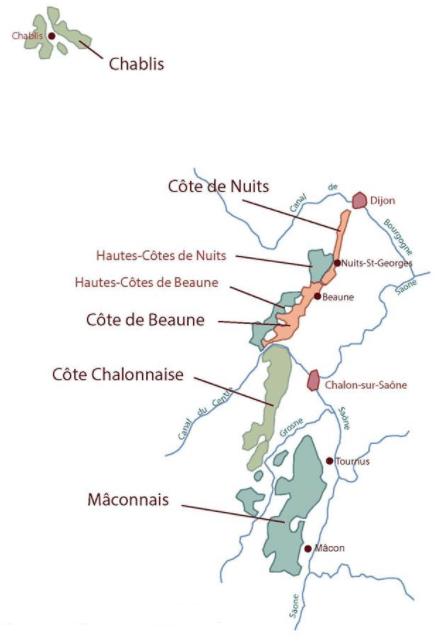
Burgundy has 5 primary wine growing areas:
Chablis
Côte de Nuits
Côte de Beaune
Côte Chalonnaise
Mâconnais
Chablis
Chablis is the growing region located furthest north and is geographically set apart from the rest of Burgundy. The river Serein (Serene) flows through the area, moderating the climate, and the grapes have been grown here since the Cistercian monks first started the vineyards in the 12th century.
All the wines are white and made with Chardonnay grapes.
Côte de Nuits
The Côte de Nuits is home to 24 Grand Cru vineyards and some of the world’s most expensive vineyard real estate. The area begins just south of Dijon and ends at the village of Corgoloin. 80% of the wines produced here are Pinot Noir and the remaining 20% are either Chardonnay or Rosé.
Côte de Beaune
The Côte de Beaune is named after the medieval village that is the heart of wine commerce in Burgundy. The wine from this region is quite different from that of its neighbor to the north. Chardonnay plays a more important role with 7 of the 8 Grand Cru vineyards producing white wine, but there are many amazing red wines produced in this region as well.
Côte Chalonnaise
Côte Chalonnaise is situated between the towns of Chagny and Saint-Vallerin. Here there are no Grand Cru vineyards.
The first village in the northern part of the region is Bouzeron, the only appellation devoted to the white grape, Aligoté. This is a perfect summer sipper or choice for fish and shellfish. Aligoté is floral, with notes of citrus and flint, and perhaps a touch of honey.
Another village that does something a bit different is Rully, a vibrant center of Cremant de Bourgogne production since the 19th century. These white and rosé sparklers are made in the traditional method, just as in Champagne.
The wines from this area are good value. They range from smooth Chardonnays with subtle oak influences and ripe tree fruits to more rustic Pinot Noirs.
Mâconnais
Mâconnais is the most southerly region, and Burgundy’s largest. Located between the town of Tournus and St. Veran, it lies at the crossroads between Northern and Southern France. The warmer climate is evident in the well-structured Chardonnays, with notes of ripe stone fruits, honeysuckle, citrus peel, and wild herbs.
Burgundy Wine Classifications
There are four levels of quality for Burgundy wines:
1% Grand Cru – Wines from Burgundy’s top plots (called climats). There are 33 Grand Crus in the Côte d’Or and about 60% of the production is dedicated to Pinot Noir.
10% Premier Cru – Wines from exceptional climats in Burgundy. There are 640 Premier Cru plots in Burgundy.
37% Village Wines – Wines from a village or commune of Burgundy. There are 44 villages including Chablis, Nuits-St-Georges, and Mâcon-Villages.
52% Regional Wines – Wines from overarching Bourgogne appellations.
Regional Wines
Regional Wines can be made from grapes grown anywhere in Burgundy and tend to be fresh, light, and lively. You will find them labeled “Bourgogne Rouge” (red) or “Bourgogne Blanc (white).
Village Wines
The next step-up is the “Village” wines, named after the towns near to where the grapes are sourced. These wines are still fresh and fruity, with little to no oak.
Premier Cru Burgundy
“Premier Cru” wines are from special vineyard areas within a village. They produce wines that are slightly more intense than the regular old Village wines. Premier Crus are affordable and make marvelous food wines. The label will say “Premier Cru” or “1er Cru.”
Grand Cru Burgundy
The “Grand Cru” wines account for just over 1% of Burgundy’s annual production. Bold, powerful, complex and made for cellaring, they are the epitome of both Pinot Noir and Chardonnay. There are a total of 33 Grand Cru vineyards in Burgundy.
Chablis Classification System
There is a separate ranking system for Chardonnay:
Petit Chablis
Petit Chablis is produced from grapes grown surrounding the village, which are higher in acidity and have lots of light citrus character.
Chablis
The majority of the wines found on wine store shelves are in this category. These wines are a bit rounder and more minerally with grapes sourced from the limestone slopes near the village of Chablis.
Premier Cru Chablis
Premier Cru Chablis make up about 15% of annual production. These wines are more elegant coming from vineyards filled with Kimmeridgian limestone marl, giving them a distinctive character.
Grand Cru Chablis:
These vineyards are located north of the town of Chablis, where the steep slopes face south-southwest. There is technically only one Grand Cru, but there are 7 “climats” inside that Grand Cru, and their names will be on the label: Blanchot, Bougros, Les Clos, Grenouilles, Presuses, Valmur, and Vaudésir. Many of the Grand Cru wines in Chablis are aged in oak.
Final Thoughts
Whatever your pleasure, make a point of trying some of the wines of the Burgundy region. You can’t go wrong and you don’t need to spend a fortune to find a nice one.
Bordeaux is one of the most iconic wine regions of not only France, but all of Europe. The wines produced in Bordeaux have become a benchmark for wine producers all around the world.
Bordeaux was first loved for its sweet white wines from the sub-region of Sauternes. The wine had prestigious clientele during an era when sweet white wines were more popular than dry red ones. There was also a rosé popular in the 1700’s, particularly with the English, who called it “claret” due to the wines translucent red color.
It wasn’t until the mid-1800’s that Bordeaux red wines became more well-known. The dramatic moment of this transformation was an official decree that classified the top producers of the day. The classification, now deemed the “1855 Classification”, identified the best producers in the region and ranked them 1 through 5. The classification basically hasn’t changed even though there are many more producers in the region making outstanding wines.
Bordeaux is one of the world’s oldest and most prestigious wine regions. Bordeaux is synonymous with quality and refinement. While the legendary wines of Château Margaux or Pétrus command prices that place them out of reach of the average consumer, Bordeaux’s true greatness lies in the fact that wines with elegance, sophistication and balance can be found at all price points.
Red wines from Bordeaux are medium to full-bodied with aromas of black currant, plums, and earthy notes. Cabernet Sauvignon and Merlot vines originated in Bordeaux. The tannins in these wines are often high enough that wines will age for several decades.
One of the most important things to know about Bordeaux wines is that they are a blend of grape varieties. The red Bordeaux Blend is one of the most copied around the world and it includes Cabernet Sauvignon, Merlot, Cabernet Franc, Petit Verdot, Malbec and a small amount of Carménère.
When serving Red Bordeaux, it should be slightly below room temperature (around 65 °F / 18 °C) and decanted for at least 30 minutes. All red wines should be stored below 65 °F / 18 °C.
You should expect to spend around $25–$30 for a great bottle of Red Bordeaux.
Suitable food pairings for Bordeaux include,
Meat
Black Pepper Steak
Roast Pork
Filet Mignon
Beef Brisket
Buffalo Burgers
Chicken Liver
Pot Roast
Venison
Duck
Goose
Dark Meat Turkey
Cheese
Ossau Iraty
Basque Cheeses
Manchego
Swiss Cheese
Comté
White Cheddar
Provolone
Pepper Jack
Herb/Spice
Black Pepper
White Pepper
Oregano
Rosemary
Mustard Seed
Cumin
Coriander Seed
Anise
Vegetable
Roast Potatoes
Lentils
Mushrooms
Onion
Green Onion
Green Bean Casserole
The Bordeaux region is separated into two sub-regions, the “Left Bank”, referred to as Médoc and Graves, and the “Right Bank”, known as Libournais.
The Left Bank (Médoc and Graves)
This area is known for its gravelly soils and graphite-driven red wines with a dominance of Cabernet Sauvignon in the blend. The most prestigious sub-regions in the Médoc include Pauillac, Saint-Julien, Saint–Estephe, Margaux and Pessac-Leognan (the areas first classified in 1855). The wines from Médoc are some of the boldest and most tannic of Bordeaux, perfect for aging or matching with red meat.
Left bank Bordeaux blends, in order of proportion are:
Cabernet Sauvignon
Merlot
Cabernet Franc
Malbec
Petit Verdot
The Right Bank (Libournais)
This area in Bordeaux is known for its red clay soils that produce bold plummy red wines with a dominance of Merlot. The most well-known and sought after sub-regions including Pomerol and Saint-Emilion. The wines from around Libourne are still moderately bold, but generally have softer, more refined tannins. For this reason, right bank wines are a great way to get introduced to the region. Here is a typical example of a Libournais Bordeaux blend in order of importance:
Merlot
Cabernet Franc
Cabernet Sauvignon
Entre-Deux-Mers “Between 2 Tides”
The area between the 2 major rivers of Bordeaux, the Garonne and the Dordogne, is called Entre-Deux-Mers. This area produces both red (predominantly Merlot) and white wines but is perhaps more well-known for its white wines, which are a blend of Sauvignon Blanc, Sémillon and the rare Muscadelle. Wines have grapefruit and citrus notes with zippy acidity–a perfect wine for summer and fish.
Sauternais Sweet Wines
Sauternes and its surrounding regions of Barsac and Cadillac, are along a particularly dank portion of the Garonne River. Morning fog causes the white grapes growing in the area to develop a certain type of fungus called Botrytis. The fungus causes the grapes to shrivel and sweeten making one of the sweetest white wines in the world.
White Bordeaux
Only a small part of Bordeaux’s wine production is dedicated to white wines. These wines are made with Sauvignon Blanc and Sémillon and range from zippy and fresh from places like Entre-Deux-Mers to creamy and lemon curd-like from places like Pessac-Leognan.
Last Word
Bordeaux is a region that has been a source of inspiration to many of today’s most popular wines. If you are a fan of red wine and have never tried a French Bordeaux, I recommend purchasing a bottle. Better yet, try both a left bank and a right bank wine and see which you prefer.
Argentina is one of the most important wine-producing countries in the New World, and though the second largest country in South America, it is the largest wine producer. The high-altitude deserts of the eastern Andes have given rise to a high-quality wine industry and the terroir here is well suited to Argentina’s adopted grape variety, the ubiquitous Malbec. Originally from Bordeaux, this is now responsible for some of Argentina’s most famous wines, which are characteristically bright and intense, with floral notes and flavors of dark fruit.
Wine has been produced in Argentina since the 1500s, initially by Spanish missionaries and later Italian settlers. Argentina only began exporting wines in the 1990’s. Until then their wines were strictly domestic and based mostly on the high-yielding Criolla Grande and Cereza grape varieties. Over the past 25 years the country’s wine producers have raised quality levels and successfully consolidated an international export market. Argentina has risen to become the fifth-most-prominent wine-producing country in the world, following France, Italy, Spain and the USA.
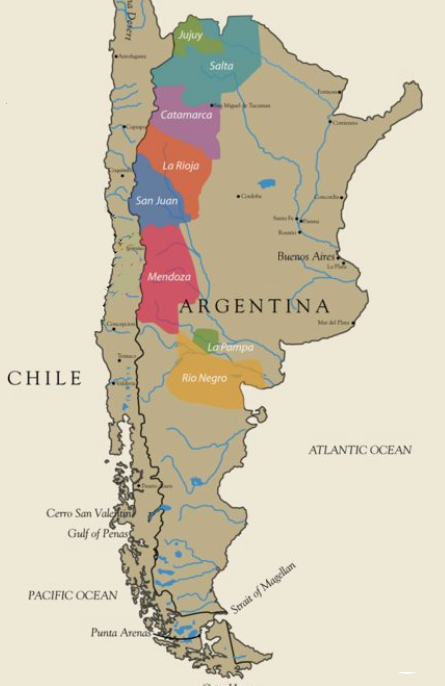
Most viticulture in Argentina occurs in the foothills of the Andes and most famously in Mendoza, where desert landscapes and high altitudes combine to make a terroir that gives rise to aromatic, intensely flavored red wines. Vineyards in Mendoza reach as high as 5000 ft (1500m) above sea level. Here, increased levels of solar radiation and a high diurnal temperature variation make for a long, slow ripening period, leading to balanced sugars and acidity in the grapes.
Nearly three-quarters of Argentinian wine production takes place in Mendoza, and in addition to Malbec, there are significant amounts of Cabernet Sauvignon, Chardonnay and Bonarda.
Further north, the regions of Salta and Catamarca are at higher elevations. There Argentina’s signature white grape, Torrontes, is grown, making an aromatic, floral white wine.
There is a wine region closer to the Atlantic coast, Rio Negro. The cooler conditions there suited to creating wines made from Pinot Noir.
Catamarca
Catamarca is a wine-producing region in the north-west of Argentina in the midst of the Andes mountain range. Quality and commercial focus are rapidly increasing here as they are elsewhere in Argentina. Torrontes, Syrah and Malbec vines are increasing throughout the region.
Jujuy
Jujuy is the northernmost viticultural area of Argentina. It is a relatively small wine region and is less commercially established than some of the other regions. Very little of Jujuy’s wine is marketed internationally. Torrontes is the most successful and best known of Jujuy’s grape varieties.
La Rioja
The La Rioja wine region is located in the foothills of the Andes Mountains in western Argentina, north of Mendoza and San Juan. The mountainous terroir of the region is particularly suited to the white-grape variety Torrontes, which produces crisp, aromatic white wines.
La Rioja was named for the northern Spanish region of the same name by Juan Ramirez de Velasco, a Spaniard from Rioja itself. This has caused some animosity between Argentina and Spain. The matter was settled, at least in legal terms, in 2011 when the Argentinian province won a court case allowing it to continue to label its wines as ‘La Rioja Argentina’.
La Rioja is best known for its white wines but Bonarda, Syrah and Malbec can also be found growing throughout the region.
Mendoza
Mendoza is by far the largest wine region in Argentina, producing about 70% of the country’s annual wine production. The French grape variety Malbec has its New World home in the vineyards of Mendoza, producing red wines of great concentration and intensity.
While Malbec is undoubtedly the main varietal produced in the region, there are also extensive plantings of Cabernet Sauvignon, Chardonnay, Syrah, Torrontes and Sauvignon Blanc. Mendoza is also becoming a producer of sparkling wine.
Rio Negro
Rio Negro is South America’s southernmost wine-producing region. Despite being one of the world’s least-obvious places for quality viticulture, this desert region produces elegant Pinot Noir and Malbec wines.
While Malbec is a mainstay in Rio Negro wines, Pinot Noir has become the region’s iconic grape variety. However, there are also great Chardonnay, Sauvignon Blanc and Riesling wines produced here.
Salta
Salta, in the far north of Argentina, is home to some of the world’s most extreme vineyard sites. Many sit at both lower latitudes and higher altitudes than anywhere else in the world. Cabernet Sauvignon, Malbec, Merlot and Tannat are the most prominent red-wine varieties in Salta, while Chardonnay and Torrontes are the region’s most respected white wines.
San Juan
San Juan is an important Argentinean wine-producing area, creating wines of increasing quality using traditional European grape varieties. Syrah and the ever-present Malbec are the most important of these.
Bonarda, Cabernet Franc, Cabernet Sauvignon, Malbec, Merlot and Syrah varietals are produced for red wines, and Chardonnay, Sauvignon Blanc, Torrontes and Viognier grapes are grown for white wines. Large quantity of Criolla and Cereza grapes are also produced and used to make cheaper, slightly sweet wines. The region also produces sherry-style wines and provides most of the base for Argentina’s brandy and vermouth.
In Closing
Grape varietals grown in Argentina will often be warmer and spicier than their European counterparts, and very similar in flavour to the wines of neighbouring Chile. However, I have often found that the price of comparable Argentinian and Chilean wines will be slightly more favourable to Argentina.
If you have never tried Argentinian wine it is well worth the endeavour. A good assortment of reds and whites at varying price points should be readily available at your local merchant.
Chile is one of South America’s most important wine-producing countries. It is home to a wide range of terroirs, and an equally wide range of wine styles.
The Chilean viticultural industry is often associated in export markets with consistent, good-value wines, but some world-class reds are also made, commanding high prices. For red wines the initial export mainstays have been Bordeaux varieties of Cabernet Sauvignon and Merlot.
Like many New World countries Chile has adopted a signature grape variety. In this case it is Carmenère, which was once widely grown in Bordeaux, France. The French variety was virtually wiped out following the European phylloxera outbreaks of the 19th Century. However, it was rediscovered in Chile in the 1990s.
Pinot Noir from the cooler parts of Chile is beginning to make an impression and Syrah is increasing in popularity in many regions offering a wide variety of styles. Other varietals grown in Chile include Petit Verdot, Cabernet Franc and Malbec.
White wine varietals include Chardonnay, and Sauvignon Blanc. Viognier, Riesling and Semillon are among those varieties grown on a smaller scale.
Chile has been producing wine since the first European settlers arrived in the mid-16th Century. However, it wasn’t until the 19th Century that viticulture began to expand in Chile, mainly due to the spread of wealth associated with mining. European trends started to infiltrate.
Throughout the 20th Century, Chilean wine was limited to a domestic market, but a push toward quality in the latter half of the century saw an uptake in the international market. Whereas Chilean winemakers had traditionally used tanks and barrels made of beech wood, in the 1980s stainless-steel tanks and oak barrels were introduced, marking the start of a technology-driven era.
Aconcagua Valley
Cabernet Sauvignon, Syrah and Merlot are grown in this region. ‘Sena’, a wine produced as a joint venture between Vina Errazuriz and Robert Mondavi, came to the region in 2004.
Atacama
The Atacama wine region in Chile’s far north produces large quantities of table grapes and other fruit. However wine production is on a smaller scale. Red wine grapes cultivated here include Pinot Noir and Syrah. White wine is made mainly from Chardonnay and Sauvignon Blanc grapes. Corporate giant, Viña Ventisquero, is the major player here.
The region also produces Pisco, the Chilean eau-de-vie. This is a brandy-like spirit which has been distilled in Chile since the arrival of the Spanish conquistadors in the 16th Century.
Bío Bío Valley
This region has enjoyed a dramatic rise to fame since the year 2000. There is an international appetite for its crisp, aromatic wine styles. Bío Bío has provided an excellent place for Chilean winegrowers to work with varieties such as Riesling, Gewurztraminer and Viognier.
Cachapoal Valley
Cachapoal Valley is a central wine zone in Chile that forms the northern half of the Rapel Valley region. The most noteworthy wines from the region are made from Cabernet Sauvignon and Carmenère. However, Merlot, Syrah and Chardonnay are also grown there.
One of Chile’s up-and-coming wine districts, Peumo, is located in Cachapoal Valley. Peumo wines now include some of the country’s finest Carmenère wines.
Casablanca Valley
This wine-growing region of Chile is best known for its crisp white wines, most notably Sauvignon Blanc and Chardonnay. It has attracted considerable investment from wine companies based in other regions and from other countries.
The region is relatively new by Chilean standards as the Casablanca Valley’s first vineyards were planted in the 1980s during the revitalization of the Chilean wine industry.
It is the region’s cooler climate that makes Casablanca’s white wines stand out from their local rivals. With a longer ripening period, the white grapes have more time to develop greater flavor complexity, while maintaining sugars and acids in balance.
The difference between Casablanca’s climate and that of Chile’s more southerly regions led the prestigious Casa Lapostolle to choose the valley as the exclusive source of grapes for its Cuvée Alexandre Chardonnay. The region is now growing a wide range of white grapes, notably aromatics such as Viognier, Gewurztraminer and Riesling, and is at the heart of Chile’s efforts to prove that it is able to excel at more than just red wines.
Central Valley
The Central Valley (El Valle Central) of Chile is one of the most important wine-producing areas in South America in terms of volume. It is also one of the largest wine regions, stretching from the Maipo Valley, just south of the capital of Santiago, to the southern end of the Maule Valley.
The Central Valley is home to a variety of grapes, but is dominated by the internationally popular Cabernet Sauvignon, Merlot, Syrah, Chardonnay and Sauvignon Blanc. Chile’s ‘icon’ grape, Carmenère, is also of importance here. The cooler corners of the Central Valley are being increasingly developed, as winemakers experiment with varieties such as Viognier, Riesling and Gewürztraminer.
A wide variety of wine styles and quality can be found in this large area, including the fashionable, and relatively expensive Bordeaux-style wines.
Because the area covered is so large and the terrain so varied, the name ‘Central Valley’ on a label is unlikely to communicate anything specific about the style of wine in the bottle. Also, with a number of independently recognized sub-regions now in place, such as Colchagua and Cachapoal, most wines of any quality are able to specify their sub-region of origin rather than the generic Central Valley. As a result, the Central Valley title is mostly used for mass-produced wines made from a range of sources.
Choapa Valley
Choapa Valley is one of Chile’s newest wine regions, located north of Santiago in the narrowest part of the country. Syrah and Cabernet Sauvignon have proved well suited to the terroir here, producing smoky, elegant wines with characters of dark fruit.
One of Chile’s largest commercial producers, De Martino, has helped put the region on the map by producing a Choapa Valley Syrah that has already garnered international attention.
Colchagua Valley
This region in central Chile is one of South America’s most promising wine regions. Some of Chile’s finest red wines are made in the valley, mostly from Cabernet Sauvignon, Carmenère and Syrah grapes.
The dominance of Cabernet Sauvignon, Carmenère, Malbec and Merlot in the warmer east is mirrored by that of Chardonnay and Sauvignon Blanc in the ocean-cooled west.
Curico Valley
Curico Valley is a wine-producing region in central Chile, located roughly 185 km south of the capital, Santiago. It is divided into two sub-regions: Teno in the north and Lontue in the south. The valley is known for its reliable, good-value everyday wines, particularly the reds made from Cabernet Sauvignon and Sauvignon Blanc.
Curico’s vineyards are planted with more varieties than anywhere else in Chile. However, the dominant grapes are Cabernet Sauvignon and Sauvignon Blanc. Curico may have yet to produce a Cabernet Sauvignon to rival Maipo’s red wines and its Sauvignon Blanc still does not match the fresh, complex style found in Casablanca, but the valley is one of Chile’s workhorse regions and its output is consistent and reliable.
Elqui Valley
The Elqui Valley wine region is located 400 km north of Santiago, at the very southern edge of the Atacama Desert. It is Chile’s northernmost wine region. Traditionally the region focused exclusively on producing Chile’s trademark brandy, Pisco, but today Elqui Valley vineyards are producing bright, intensely aromatic wines, most notably from Sauvignon Blanc and Syrah grapes.
Alongside Sauvignon and Syrah, the Elqui Valley is also home to plantings of Chardonnay, Carmenere and Pedro Ximenez. It is one of Chile’s up-and-coming regions, and its wines are attracting attention from international critics and consumers alike.
Itata Valley
Itata Valley is a wine region in the southern end of Chile’s long, thin wine producing zone. This historical, cool-climate region is dominated by plantings of Carignan, Muscat of Alexandria and Pais (aka Mission, aimed more at domestic consumption), although producers are beginning to plant more modern grape varieties like Cabernet Sauvignon, Cabernet Franc, Pinot Noir and Chardonnay.
The first vines are said to have arrived in the Itata Valley the 1550s, potentially making the region one of the first to be planted with vines in Chile. By the 20th Century, the region was associated with the production of bulk wine, which is evidenced by the large amounts of Pais and Muscat of Alexandria vines still planted here. The region became unfashionable in the 1980s as Chilean producers started to put quality before quantity. It is now beginning to make a comeback with plantings of more internationally accepted varietals.
Leyda Valley
Leyda Valley is a small sub-region of the San Antonio Valley wine region in Chile, located just 90 km west Santiago. This cool-climate region produces bright, vibrant wines made from Pinot Noir and Chardonnay. The region is also provides some excellent Sauvignon Blanc and Syrah.
Limari Valley
Limarí Valley is one of the northernmost winegrowing regions in Chile, located 320 km north of Santiago.
Chardonnay is the mainstay in Limari Valley wines, producing wines with a certain minerality thanks to the relatively cool climate and the limestone content in the soil. Syrah is also successful here, producing savory styles in the cooler, coastal vineyards and fuller, fruit-driven styles in warmer, inland sites. Cabernet Sauvignon and Merlot – Chile’s most successful varieties, also feature alongside the Chilean signature grape, Carmenère.
Historically, the grapes grown in Limarí’s vineyards were either eaten as table grapes or were distilled into Chile’s trademark brandy, Pisco. Even today, as winemakers continue to seek out new spots within the valley, less than 20 percent of the region’s grape output is used for quality wine production.
Maipo Valley
Maipo Valley is one of Chile’s most important wine-producing regions. Located just south of Santiago, Maipo Valley is home to some of the country’s most prestigious wines. It is often described as the ‘Bordeaux of South America’, and rich, fruit-driven Cabernet Sauvignon is the most celebrated wine style.
The region can be roughly separated into three broad areas: Alto Maipo, Central Maipo and Maipo Bajo.
Alto Maipo
The vineyards of Alto Maipo run along the eastern edge of the Andes Mountains which encompasses the sub-regions of Puente Alto and Pirque, and is the most prestigious of Maipo’s viticultural areas. It is here that the vineyards of Don Melchor, Almaviva and Vinedo Chadwick can be found.
Central Maipo
Central Maipo is the lower-lying ground just to the west of Alto Maipo, surrounding the towns of Buin and Paine. Cabernet Sauvignon is still the most-grown grape variety, but there are also substantial plantings of Carmenère vines, as the warmer climate is well suited to this iconic Chilean grape variety.
Maipo Bajo
Maipo Bajo centres on the towns of Isla de Maipo and Talagante. The wine industry here is more concerned with winemaking than viticulture, and while there are a few vineyards, there are many wineries. Undurraga and De Martino are just two of the names that can be found in this part of Chile, making wines with grapes from all over the country.
Along with Cabernet Sauvignon and Carmenère, a wide range of grape varieties are planted in the Maipo Valley including Merlot, Syrah, Chardonnay and Sauvignon Blanc.
Malleco Valley
Malleco Valley is a southern wine-growing region in Chile, some 540 km south of Santiago. Crisp, fresh wines are produced here including Chardonnay, Sauvignon Blanc and Pinot Noir.
The wine industry in Malleco Valley is still in its infancy with less than 100 acres being grown here.
Maule Valley
Maule Valley is the largest wine-producing region in Chile other than the Central Valley, of which it is a part. It has 75,000 acres of vineyards, and has traditionally been associated with quantity rather than quality. But this is rapidly changing – the bulk-producing Pais vine is gradually being replaced with more international varieties such as Cabernet Sauvignon and Carmenère, and careful winemaking practices are being employed to make some world-class red wines from old-vine Carignan.
It has only been in the past 20 years that Maule has made a move toward quality, pioneered by the Kendall-Jackson empire of California, which set up a winery here in the mid-1990s.
Rapel Valley
Rapel Valley is a large wine-producing region in Chile’s Central Valley. The area produces roughly a quarter of all Chilean wine. The warm, dry region makes a wide range of wine styles, ranging from everyday wines to some of Chile’s most expensive and prestigious offerings.
Cabernet Sauvignon, Syrah and Carmenère are the most important grape varieties planted here. In general terms, Rapel Valley wines are produced primarily from red varieties, but there are some Chardonnay and Sauvignon Blanc. Malbec production is also on the rise.
San Antonio Valley
This is a small wine region in Chile, located to the west of Santiago. A new addition to the Chilean national vineyard, the region stands out as being able to produce quality Pinot Noir along with internationally respected white wines including Sauvignon Blanc and Chardonnay.
The San Antonio Valley also produces quality Pinot Noir and Chardonnay balanced in sugar and acids, as well as aromatic white varieties.
San Antonio valley is small when compared to the sprawling regions at the center of Chilean wine growing. It is home to a limited number of producers.
Final Thoughts
Not taking anything away from the other varietals, but my personal preference is for the Malbec wines, which are found in Colchagua Valley and to a lesser extent in Rapel Valley. I find them flavourful, but not overpowering. Malbec , like many of the Chilean reds, is warm and comforting, particularly during the winter months when it is cold and blustery outside.
My wife has a strong dislike for Chardonnay but a fond love for Chardonnay Musqué. This raised the question in my mind, what makes Chardonnay Musqué different from Chardonnay? Is there truly a discernible difference? My wife argues that absolutely there is.
I set forth on a research expedition to determine if there is a difference, and if so, why.
What I learned is that Chardonnay Musqué is an aromatic mutation of the Chardonnay grape. It is grown principally in the vineyards of Canada’s Niagara Peninsula and New York’s Finger Lakes.
The typical Chardonnay Musqué wine is off-dry, medium bodied, and has the distinctive, grapey, Muscat-like aroma. Depending on the region and producer, other flavours and aromas might range from tropical fruit to cinnamon-tinged lemon sorbet.
There are over 40 different clones of Chardonnay, but only two of these can be called “Musqué” due to their aromatic qualities. For you techies they are Clone 77 and Clone 809. These wines are generally unoaked in order to preserve the fresh and fragrant aromas natural to the grape. This is the reason why my wife likes it so much (she has a real aversion to any oaked white wine)
Several Ontario vineyards are now planted with musqué clones and the grapes may be used as either part of a blend or bottled on their own.
Generally these wines are best when consumed relatively young. The aromas of Chardonnay Musqué are reminiscent of Viognier or even Torrontes, and it can be made in a range of styles from dry to a little sweet to quite sweet, sometimes even with a slight spritz.
Chardonnay Musqué can be enjoyed on its own on a warm spring or summer day, or paired with mild curries, sushi, salads, grilled salmon, or seafood.
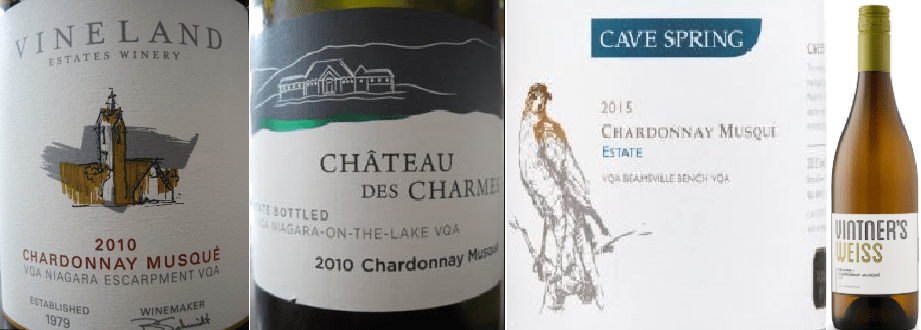
There are several Ontario wineries using one or both Chardonnay Musqué clones in their wines. Trail Vintner’s Weiss uses Chardonnay Musqué as part of a Riesling Chardonnay Musqué blend, while other producers, such as Chateau des Charmes, Cave Spring Cellars, and Vineland Estates, prefer to bottle the clone on its own.
A few Ontario Chardonnay Musqués:
Chateau des Charmes
Paul Bosc, founder of Chateau des Charmes, chose the particularly fragrant and interesting Clone 809 for his Chardonnay Musqué. Only about 500 cases are bottled by the winery annually. The 2015 vintage is available from the winery or online for $14.95.
Cave Spring Cellars
Cave Spring Cellars 2016 Chardonnay Musqué is made from 100% Chardonnay Musqué Clone 77. This wine is fermented in stainless steel and unoaked so as to maintain every nuance of the delightful aromatics of the Chardonnay Musqué grape. It’s a wine of refinement and class. Floral, yes, but it also offers bright citrus, tropical fruit, peach and a hint of vanilla aromas. Try it with green salads or shrimp Pad Thai. It is available from the LCBO for $17.95.
Vineland Estates
Their 2016 Chardonnay Musqué is available from the winery or online for $17.95. The wine is described as having an abundance of warm summer melon, lime zest and tangerine aromas that roll in the glass while the welcomed edge of acidity focuses and the perfect trace of a bitter finish.
Trail Vintner’s Weiss
The 2017 Riesling Chardonnay Musqué blend is available at the LCBO for $19.95. According to Natalie MacLean it is a delightful, vibrant white wine blend of Riesling and Chardonnay Musqué grapes form Prince Edward County. It has aromas of daisies, lychee, apple blossom and white peach, and is balanced with racy acidity for shellfish and vegetarian dishes.
If you are a fan of Chardonnay, and unoaked Chardonnay in particular, trying Chardonnay Musqué would be well worth your while; just ask my wife.
Personally, I find Portuguese wines a bit of a mystery. Although there are some excellent creations being produced, they don’t seem to receive the same notoriety as wines from Italy, Spain or France.
Because Portugal’s wine culture developed in relative isolation, there are many grape varieties that do not grow anywhere else in the world. There are over 250 indigenous varieties and a few imports that have adapted well to the Portuguese landscape. According to many wine experts, Portugal is the last frontier of wine in Western Europe explored. So with all the excitement this region offers, let’s take a look at what there is to know about the major wines and the regions.
DOC (or DOP) – DOC stands for Denominação de Origem Controlada and means the wine comes from a strictly defined geographical area with recommended and permitted grapes and maximum vine yields (to control quality). Technically there are 31 DOCs in Portugal although 3 of them overlap, making it seem more like 28.
Vinho Regional (or IGP) – Portugal is divided into 14 regional wine areas which have less strict rules for controlling which types of grapes are used, as well as maximum vine yields. While this implies that the wines will not be as high quality, many producers in Portugal use the Vinho Regional designation to create excellent wines using grapes or blends not allowed in DOC.
Vinho (Wine): The most basic classification of Portuguese table wine. These wines are generally not distributed outside of Portugal.
Each region is managed by a regional “Wine and Vine” commission, the Comissão Vitivinícola Regional (CVR). Each CVR supervises and controls the quality regulations in order to ensure quality and to maintain each region’s individual character.
Portuguese Wine Terms
Vinho Tinto – Red Wine
Vinho Branco – White Wine
Quinta – Wine farm. You’ll often find this word as part of a winery’s name on the label of wines.
The Wine Regions
Douro Region
Port is the most famous, and most copied, wine from Portugal and it grows in the Douro Valley.
Wines of Douro
Port – Fortified sweet wines; specifically LBV Port, Tawny Port, and Vintage Port wines which are the best and made by blending “port grapes” which include Touriga Franca, Touriga Nacional, Tinta Roriz (Tempranillo), Tinta Barrocca and Tinto Cão among many others.
White Port and Pink Port – Beyond the red Port there are also Port wines made with the rare white wine varieties in the region. Rosé Port is relatively new.
Tinto Douro – Full-bodied red wines. The same red grapes of Port wine are used to create full-bodied, tannic, age-worthy red wines.
Douro Branco – Light-bodied white wines. Douro Branco are crisp, minerally white wines with very little fruity flavour, subtle flinty notes and salinity, and high acidity. Douro white wines are a little harder to find and include the white Port varieties of Rabigato, Viosinho, Gouveio, and Folgazão.
Terras de Cister (Távora e Varosa) Region
Terras de Cister – Sparkling wines
This area produces wines with much more elegance and acidity than Douro, making it ideal for sparkling wines. There are a growing number of Chardonnay and Pinot Noir vineyards being planted along with the regional varieties of Malvasia Fina (aromatic white), Cerceal (light white), Gouveio (light white), Aragonês (aka Tempranillo), Tinta Barroca (red) and Touriga Franca (red) among others.
Transmontano (Trás-Os-Montes) Region
Tinto Transmontano – Full-bodied red blends
The most common wine from this area is Transmontano, which is a regional red blend. Wines are full-bodied, punchy, with higher alcohol levels.
Minho (Vinho Verde) Region
Vinho Verde wines are best served young when the wine is at its peak of aromatics and crisp acidity.
Wines of Minho
Branco Vinho Verde – Light-bodied white wines. Wines often have a slight spritz and fruity, lemonade-like flavors with notes of melon, gooseberry and chalky texture. White Vinho Verde wines are made with a blend of several grape varieties including Arinto, Azal, Trajadura, Loureiro and Alvarinho (a.k.a Albariño).
Rosado Vinho Verde – Rosé. The Rosado wines offer red berry flavors with quenching acidity like lemonade. The reds/rosés of Vinho Verde are found primarily in the southern part of Minho in the sub-regions of Amarante and Paiva. Red grape varieties include Alvarelhão, Amaral, Borraçal, Espadeiro, Padeiro (quite rare).
Alentejo Region
The Alentejo region contains many progressive and modern wineries making red wines that offer generous fruit and mocha flavors with refined tannins from careful wood aging strategies. White wines from the Alentejo range from medium-bodied refreshers to full-bodied in a style similar to Chardonnay.
Wines of Alentejo
Tinto Alentejo – Full-bodied red wines that are typically blends made with Aragonês (Tempranillo), Trincadeira, Castelão, Alfrocheiro and Alicante Bouschet.
Branco Alentejo – Light-bodied and full-bodied white wines made with Arinto (fuller in style), Antão Vaz (fuller in style), Roupeiro and Fernão Pires (an aromatic white variety).
Alentejano (IGP/Vinho Regional) – Full-bodied red and white wines from a larger encompassing region that may include non-indigenous grape varieties (Viognier and Syrah are growing in popularity here).
Lisboa Region
There are many wines from the various regions in Lisboa (Alenquer, Bucelas) that are already making their way into stores internationally. While there is great quality found in Lisboa (Bucelas, Colares, Alenquer, Arruda) most of the wines you’ll find available are great for everyday drinking.
Wines of Lisboa
Alenquer – Concentrated, high tannin red wines made with Castelão, Alfrocheiro, Aragonês (Tempranillo) and Touriga Nacional
Bucelas – Light-bodied, citrus and beeswax-driven, age-worthy white wines made with Arinto. .
Arruda – Full-bodied red wines that often include international grape varieties like Cabernet Sauvignon and Syrah
Colares – Very rare find. Golden colored, full-bodied white wines in an oxidative style made with Malvasia Fina
Óbidos and Lourinhã – Light-bodied aromatic white wines particularly with Fernão Pires
Torres Vedras – simple, low-alcohol refreshing white wines.
Setúbal Region
The region of Setúbal is famous for a fantastic rich, deep gold colored dessert wine called Moscatel de Setúbal
Dão Region
Wines from the Dão are lighter in style than in the Douro but have shown to age very well because of the tannin and acidity development from growing in high altitude areas with rugged soils of decomposing granite and schist (similar to Douro and Priorat).
Wines of Dão
Dão Alfrocheiro – Medium-bodied red wine with red berry flavors, licorice and spice notes
Dão Jaen (a.k.a. Mencía) – Full-bodied red wine. Raspberry and black cherry flavors with moderately high acidity and mouth-drying tannin.
Dão Touriga Nacional – Full-bodied red wine. Deep black fruit flavors with chocolate and mocha with refined tannins and medium plus acidity
Terras do Dão and Terras de Lafões – The Vinho Regional wines of the Dão with more experimentation and blends that include international varieties (Indi blends)
Tejo Region
Tejo plants all kinds of grapes, from Alvarinho (the grape of Vinho Verde) to the full-bodied blackish Alicante Bouschet. This is a good region for getting super value from Portugal.
Wines of Tejo
Red “Indi” Blends – Blends consisting of Cabernet Sauvignon, Syrah, Touriga Nacional, Trincadeira and Castalão
White “Indi” Blends – Consists of blends with Fernão Pires (an aromatic white wine), Arinto, Sauvignon Blanc and Chardonnay
Beira Atlântico (Bairrada) Region
Baga is the highly productive red grape of Beira, grown in Bairrada. From the aromatic and delightfully pink sparkling wines by Luis Pato to the soft, structured light-bodied red wines by Niepoort, this area is one of the new frontiers of winemaking for the Portuguese.
Wines of Beira Atlântico
Tinto Bairrada – Made from Baga and ranging from dense, tar-like, high acid reds to delicate, red fruit-driven wines with finely textured tannins and the ability to age.
Branco Bairrada – Made from the aromatic Fernão Pires (called Maria Gomes here), Bical and Arinto
Sparkling “Brut” Bairrada – Delicious beeswax-driven sparkling wines made with early picked Baga and Fernão Pires.
The Beira Interior
The most mountainous region in Portugal has one of the most challenging climates to produce grapes. With a shorter growing season the reds have red-fruit driven flavors with herbaceous smoky notes and a juicy finish while the white wines tend to be lean with chalky minerality. There are many old vines here as well as producers using native yeasts and organic viticulture.
Wines of the Beira
Tinto Beira – Red fruit-driven wines of Murufo, Bastardo, Alfrocheiro, Trincadeira and Touriga Nacional
Branco Beira – Lean, chalky white wines of Síria, Arinto, Malvasia
Madeira & Pico Island (Azores)
Verdelho is the main regional white wine grape. Wine from Pico is golden, viscous liquid that is hauntingly sweet, tart and somewhat salty with a smokiness from the volcanic landscape. Madeira, on the other hand, has the most collected and appreciated fortified wines in the world.
Algarve Region
There are nearly 2500 acres / 1000 hectares of grapes in the Algarve. The wines aren’t designed to age, but there is hope in particular for red wines with Alicante Bouschet, Syrah and Aragonês (Tempranillo). These drought-climate varieties still manage to have juicy acidity and create more smoky sweet, dusty notes on the finish somewhat reminiscent to South Australia.
The wines of Portugal are well worth a try. The wines are both good and available at a favourable price point.
The vineyards of Australia cover 170,000 hectares in different wine regions in New South Wales (NSW), South Australia, Victoria, Western Australia, Tasmania and part of Queensland.
Australia has become the 7th biggest wine producing country having about 1,200 million litres of wine produced each year. With the country’s own consumption representing less than 40% of the production, Australia is the 4th largest wine exporter.
Australia has spent millions of dollars to build a brand around Shiraz (Australia’s word for Syrah). As a result Australia wine production has tripled since 1990. However, despite this success, Australian wines have suffered some serious drawbacks in the media. Wine critics often disregard most Aussie wine as “Critter Wines”, referring to the cute animal designs that adorn many of the wine labels.
Australia’s main grape varietals are Shiraz followed by Chardonnay. The two varieties make up 44% of the total wine production. However, Australia is working toward diversification. The balance of production comes from Cabernet Sauvignon, Merlot, Sauvignon Blanc, Sémillon, Riesling, Viognier, Pinot Noir, Grenache, Sangiovese, Mourvèdre and Pinot Gris.
The Wine Regions
Margaret River (Western Australia) produces Cabernet Sauvignon, Merlot, Sémillon, Sauvignon Blanc, Chenin Blanc, Chardonnay, and Shiraz.
Barossa (South Australia) produces Shiraz.
Coonawara (South Australia) produces Cabernet Sauvignon, Chardonnay, Malbec, and Merlot.
Adelaide Hills (South Australia) produces Chardonnay, Riesling and Pinot Gris.
McLaren Vale (South Australia) produces Shiraz, Cabernet Sauvignon, Merlot and Chardonnay.
Clare Valley (South Australia) produces Chardonnay, Sémillon, and Riesling.
Hunter Valley (New South Wales) produces Sémillon, Chardonnay and Cabernet Sauvignon.
Yarra Valley (Victoria) produces Chardonnay and Pinot Noir.
Rutherglen (Victoria) produces Shiraz and Durif.
Heathcode (Victoria) produces Shiraz and Cabernet Sauvignon.
Mornington Peninsula (Victoria) produces Pinot Gris, Pinot Noir and Chardonnay.
Tasmania produces Riesling and Pinot Noir.
The grape varietals produced in Australia are bolder than the same varietals grown in the northern hemisphere, in places like France, Germany, or Canada. However, if you prefer the bolder spicier flavours, Australian wines may be right for you.
The impact on the wine industry from the wild fires currently raging in Australia remains to be seen. More than 3.4 million hectares of land have already been destroyed. Previously the most land burned during an entire fire season was only 280,000 hectares.
Vines not destroyed by the fires could still be impacted by the smoke. Bushfire smoke can permeate the skin of the grapes as they ripen, causing wine to have an unpleasant smoky characteristic. It is worse in red wine, when the skins are used to create colour.
Experts say it is still too early to determine what the extent of the fires will have on the 2020 harvest.
Grape growers are facing a second problem; record high temperatures which have reached the upper 40’s Celsius. Extreme heat can cause leaves to droop or even drop off, leaving grapes exposed to sunburn. This causes discolouration and affects the flavour profile of the wine.
The effect of heat can be managed provided vineyards still have access to enough water – which they don’t in many areas across South Australia, central and northern Victoria, and NSW.
As we prepare to enter 2020, no one seems to face more challenges than the Australians. I fear that some of the Australian wines the world enjoys today may soon disappear forever. A sobering thought to close out 2019.
Spain seems to fly under the radar compared
to neighbouring France when it comes to wine notoriety. Spain is actually the
third largest wine producer in the world and has the most land dedicated to
vineyards, having over a million acres. Spanish wines range from great value to
the highly prestigious.
There are over 60 different regional districts
producing everything from light and zesty Albariño to inky black Monastrell.
Spain consists of 7 distinct climate regions
which are described as follows:
Northwest
“Green” Spain
Galicia is the only sub-region where lush
green valleys are plentiful and the common cuisine includes lots of fresh fish.
Albariño is the champion grape of the sub-region called Rias Baixas (REE-us
BYE-shus), which skirts the coast. The area specializes in zesty white wines
and a few aromatic red wines made with Mencía (men-THI-yah) grapes.
Mediterranean
Coast
The coast is a very diverse macro-region
that contains the sub-regions of Valencia, Catalonia and Murcia. Catalonia is
known for Cava (Spanish sparkling wine) and a highly acclaimed red wine
sub-zone, Priorat. Valencia and Murcia are warmer growing regions that produce
a bulk of value wines from deep red Monastrell to aromatic white Malvasia and
the widely planted Airén.
Ebro
River Valley
The sub regions of La Rioja and Navarra are found in the Ebro River Valley. Here, Tempranillo is king and long-standing bodegas such as Lopez de Heredia and Marques de Murrieta make age-worthy wines. Navarra is known mostly for rosado (rosé) wine made with the Garnacha (aka Grenache) grape. The region also produces oak-aged white wines of Viura (Macabeo). In Basque country, zesty white wines called Txakoli (pronounced “CHAK-o-li”) are common.
Duero
River Valley
The Duero River is the same river as the
Douro in Portugal. This region is notable for the minerally white wine,
Verdejo, of Rueda and the bold red wines of Toro, Ribera del Duero and Leon.
The wine grape of this region is Tempranillo and in Toro it’s called Tinta de
Toro, where it is considered to be a slight mutation of the Tempranillo grape.
Central
Plateau
The central plateau or Meseta Central is the
inner plateau of Spain which is home to the capital city, Madrid. Some of the
best value red wines of Spain can be found here made of Garnacha, Tempranillo
and even the rare, Petit Verdot.
Andalucía
Andalucía is a very hot and dry region famous for Sherry. The even hotter, Montilla-Moriles produces fortified dessert wines that are called PX. An aged PX, such as those from Bodegas Toro Abala, have similar nutty-date flavors like Tawny Port.
The
Islands (includes The Canary Islands)
The Islands of Spain offer a wide range of
wines from Listan Negro-based reds to dessert wines made with Moscatel. The
volcanic soils of the Canary Islands add a gritty taste of rustic minerality.
Currently, there are very few exporters of the limited wines of the Islands of
Spain although you can find a few from places like Tenerife.
My personal favourite Spanish wines include
the red wines of Rioja, which are typically developed from the Tempranillo
grape and primarily blended with the Garnacha grape.
Rioja wines are classified by the amount of
time spent aging in barrels and bottles before they are offered for sale. The classifications are legal terms that
indicate the quality level and aging requirements.
Crianza wines are aged in oak barrels for a
minimum of one year. They then must be
bottled a few months before being available for sale.
A Reserva
wine must be oaked for a minimum of a year followed by at least 2 years in the
bottle before being sold.
Lastly, Gran
Reserva wines are made only with the best grapes, which have been
hand-picked. These wines must spend a minimum
of 2 years in an oak barrel with an additional 3 years in the bottle before
being sold.
Generally speaking, Rioja wines have a much better price point than similar quality wines from other countries. Spain produces excellent wines at an affordable price and are well worth considering the next time you are shopping for wine.






 A Layman's Wine Musings