Whisky Different Ways

Scotch Whisky can be a difficult drink for us North Americans to get into.  When I was younger (how I long for those days) I perceived Scotch being a drink for mature whisky connoisseurs.  Where rye and rum were often served as mixed drinks with cola or ginger ale, Scotch was not. If it was mixed with anything it was only water or maybe soda water.  Many people like myself interpreted this to mean that Scotch Whisky was not for the faint of heart and you must be prepared for a strong flavoured throat-burning drink.

Another intimidating factor is the hard to pronounce names.  With names such as Bruichladdich (Brook laddie), Craigellachie (Craig alecky), Glenmorangie (Glen maw ruhn jee) and Laphroaig (Luh froig), it can be very intimidating to try and pronounce them for fear of stumbling over the names or mispronouncing them entirely.

Though an acquired taste, Scotch is a very simple straightforward drink that is usually served in any of four ways

  • Neat
  • With water
  • With ice
  • In a cocktail

Neat

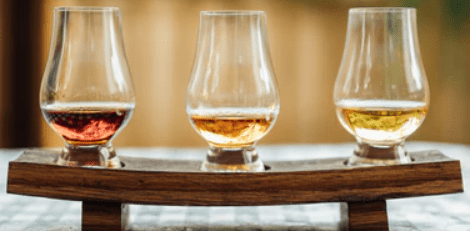
Drinking Scotch neat means drinking it with nothing added.  To get the most benefit, the Scotch should be served in a whisky snifter at room temperature.  A whisky snifter has a large bottom that tapers toward the top like a tulip to trap the whisky aromas in the glass and concentrate them all in one place.

Single malts or blends can be drunk in this manner.

With Water

Adding a splash of water will unleash new whisky flavours while decreasing the intensity of the alcohol. Water chemically suppresses ethanol molecules (alcohol) as well as the flavours extracted from the wood barrels. Water decreases the effects of less desirable, immature aromas.

Cask strength or barrel proof whisky will generally have a higher level of alcohol by volume.  In such situations, by adding a couple drops of water, the flavour can be improved and more enjoyable.

Depending on how the whisky was filtered water may give the whisky appear hazy. However, there is nothing wrong with a hazy whisky and it won’t change the drinking experience.

With Ice / On the Rocks

There are those whisky enthusiasts who will scoff at the idea of chilling your Scotch and diluting it with melting ice. However, for those still developing a taste for whisky, ice can be very beneficial.  Cooling a dram depresses dominant alcohol flavours and aromas, making the drink more palatable for some. However, it will also lessen some of the flavours that make Scotch taste like Scotch. The increased flavours from adding water are lost as the low temperature nullifies any flavour gains.

If you use ice be sure to use large cubes that will slowly melt and take up the majority of space in the rocks glass. That way you get the chill without diluting it so much that it becomes unrecognizable as Scotch.

In a Cocktail

The classic example of a Scotch Whisky cocktail is the Rob Roy, which is essentially a Manhattan that substitutes Scotch Whisky for Rye Whiskey. The cocktail was invented around 1900 in New York’s Waldorf-Astoria.

According to mixologists, Scotch may be used in place of other whiskeys in cocktails such as the Boulevardier, Old Fashioned, or Mint Julep.  Who knew?

Sláinte mhaith

The Best Irish Whiskeys Of 2023

At the end of November, The Irish Whiskey Association announced the 2023 Irish Whiskey Awards winners. Now having over 40 distilleries, Ireland has reemerged as a powerhouse in the international whiskey industry and is now the fastest-growing whiskey making country in the world.

Whiskey tastings were conducted throughout Ireland with members of the Irish Whiskey Society. Events took place in Dublin, Dingle, Cork, Waterford, Kilkenny, Ennis, Carlow and Belfast. There was also a select group of international whiskey judges.

The Best Irish Whiskey of the Year prize was awarded to Connacht Irish Whiskey Distillery, Exclusive Cask Strength, Single Malt Irish Whiskey, 47% ABV, 750 ml.

Connacht’s single malt whiskey is a triple-distilled whiskey produced at their distillery in Ballina, County Mayo. The distillery was founded by Master Distiller Robert Cassell in 2016, along with a team of Irish whiskey entrepreneurs who saw the potential of northwest Ireland’s unique climate to produce an iconic Irish whiskey. The region is characterized by dramatic swings in atmospheric pressure that contributes to producing a flavourful, heavily extracted whiskey. The use of custom-designed stills further enhances the unique character of the whiskey.

Other winners included:

Single Pot Still 11 Years and Under

  • Winner: Drumshanbo Single Pot Still Irish Whiskey Pinot Noir Cask
  • Gold: Jameson Single Pot Still
  • Gold: Powers Three Swallows

Single Pot Still 12 Years and Over

  • Winner: Red Spot 15 Year Old
  • Gold: Yellow Spot 12 Year Old
  • Gold: Redbreast 15 Year Old

Single Malt 11 Years and Younger

  • Winner: Jack Ryan Whiskey 5-Year-Old Oloroso Finish Cask Strength
  • Gold: Dunville’s 10 Year Old Pedro Ximenez Cask
  • Gold: The Irishman Legacy

Single Malt 12 – 15 Year Old

  • Winner: Tullamore DEW 14 Year Old
  • Gold: Knappogue Castle 12 Year Old
  • Gold: The Irishman 12 Year Old

Single Malt 16 Years & Older

  • Winner: The Irishman 17 Year Old
  • Gold: Dunville’s 21-Year-Old Palo Cortado Cask
  • Gold: McConnell’s Irish Whisky 20 Year Old Port Finish Single Cask

Blended No Age Statement

  • Winner: Writers’ Tears Double Oak
  • Gold: Jameson Crested
  • Gold: Powers Gold Label

Blended Age Statement

  • Winner: McConnell’s Irish Whisky Sherry Cask (5 years)
  • Gold: The Dead Rabbit Irish Whiskey
  • Gold: Clan Colla 13 Year Old

Blended Limited Release

  • Winner: Writers’ Tears Japanese Cask Finish
  • Gold: Dunville’s 1808 “Casked in Bond” Dick Mack’s Honey & Hemp IPA Cask, Cask No. 1451
  • Gold: Writer’s Tears Inniskillin Ice Wine

Peated Irish Whiskey

  • Winner: Micil Single Cask Release with Garavan’s Bar
  • Gold: Killowen Barántúil Single Cask KD202
  • Gold: Celtic Cask 47 Daichead a Seacht 2016 Peated Oloroso

Single Cask 11 Years & Younger

  • Winner: Celtic Cask 44 Daichead a Ceathair 2014 PX Cask Finish
  • Gold: Dunville’s PX 11 Year Old Single Malt Cask Strength
  • Gold: Dunville’s 11 Year Old Palo Cortado Cask Strength

Single Cask 12 Years & Older

  • Winner: Dunville’s 22 Year Old Palo Cortado Cask No. 1204
  • Gold: Dunville’s 20 Year Old Oloroso Cask Strength Cask No. 990 56.2% ABV
  • Gold: Dunville’s 21 Year Old PX Sherry Cask Finish – James J. Fox Single Cask

Cask Strength

  • Winner: Connacht Distillery Exclusive Cask Strength
  • Gold: Redbreast 12 Year Old Cask Strength
  • Gold: Dunville’s 20 Year Old PX Cask Strength, Cask 1644, 55% ABV

Single Grain

  • Winner: The Bridge – Galey Bay
  • Gold: The Bridge – Inny Bay
  • Gold: Method and Madness Single Grain

New Irish Whiskey

  • Winner: Pearse Genesis Irish Whiskey
  • Gold: Fercullen Single Malt
  • Gold: Fercullen Estate Series ‘The Gates’

Many of the award winners are available in the U.S. and Canada. They can also be ordered directly from the Celtic Whiskey Shop in Dublin, Ireland.

Happy New Year!

Sláinte mhaith

The Whiskey Capital Booms Again

At the dawn of the twentieth century, Ireland was the hub of the world of whiskey with Bushmills being the oldest licensed whiskey distiller in the world.  Jameson was one of the most recognized names and Dublin, the centre of it all having one of every three workers involved in some way with the whiskey industry.  At that time about three quarters of the world’s whiskey came from Ireland.

Photo credit: forbes.com

However, the events of history were not kind to the Irish whiskey trade.  Two world wars, the Irish War of Independence, Prohibition and the rise of the Scotch Whisky industry all played a part in its demise.  By the 1960s the industry was on the verge of extinction with only one percent of the world market share.

By the 1970s there were only two operational distilleries in all of Ireland; Midleton, who produces many well-known Whiskey brands including Midleton, Jameson, Powers, Redbreast, Writers Tears, The Irishman, Green Spot, Yellow Spot, Red Spot, Blue Spot amongst other labels, and Bushmills, who at the time was also then owned by the same company.

For several decades there were no working distilleries in Dublin (Midleton was located in County Cork and Bushmill was in County Antrim, Northern Ireland) but today there is a resurgence throughout Ireland, including Dublin.  In 2015 the redevelopment began in Dublin with the launch of Teeling Distillery.  Since then there have been others who set up shop including Roe & Co, Pearse Lyons and the Dublin Liberties.

Today the Irish Whiskey industry is healthier than it has been for over 120 years.   According to the Irish Whiskey Association, as of December 2019 there were 32 distilleries in operation in Ireland.

If you are planning to visit Ireland here are some of the best distilleries to visit:

DUBLIN

Pearse Lyons Distillery – Founded by the late Pearse Lyons in the Liberties district of Dublin, this boutique distillery is a unique spot to learn about the brewing and distilling processes.  It is located in the restored St James’ Church on James St.

Tullamore D.E.W. Distillery – Created in 1829 and later prospering under general manager Daniel E Williams (hence D.E.W. in the name), Tullamore D.E.W is the second largest selling brand of Irish Whiskey globally.

Teeling Whiskey Distillery – The first new distillery in Dublin for 125 years, it is located in Dublin’s historic distilling district.

Roe & Co Distillery – Named after legendary 19th-century whiskey pioneer George Roe, Roe & Co opened their doors in 2019 at the Guinness Power House.

The Dublin Liberties Distillery – Set in the district from which it takes its name, it is a modern, state-of-the-art distillery on Mill St.  You can hear the tales of trade, conflict and debauchery about the Liberties district, stretching back hundreds of years to when it was outside of the official Dublin city limits.

Jameson Distillery, Bow St. – Ireland’s most famous whiskey opened in 1780 by John Jameson.  The distillery on Bow St in Smithfield has been a staple in Dublin for over two centuries.  Although since 1971 it has operated only as a visitors’ centre.

MIDLETON

Jameson Distillery, Midleton – Midleton, in County Cork, is where the bulk of Jameson operations have taken place since 1975.

COUNTY CARLOW

Royal Oak Distillery is the first to distill all three styles of Irish whiskey: pot still, malt and grain, all under one roof.  It’s also the largest non-automated distillery in Ireland.

COUNTY CORK

Clonakilty Distillery – Single pot still whiskey is Clonakilty’s specialty. They also will explain how different woods change the character of the whiskey as it matures.

DINGLE PENINSULA

Dingle Distillery – Since 2012, the Dingle Whiskey Distillery has been distilling some excellent single pot still whiskey.

COUNTY KILKENNY

The Ballykeefe Distillery – Though only in operation since 2017, the distillery is situated on land that has a distilling heritage going back hundreds of years.  They follow the family farm traditions and have a strong commitment to sustainability.

With records of distilling going back to 1324, it’s claimed that Kilkenny is the birthplace of Irish whiskey.

COUNTY MEATH

Slane Irish Whiskey Distillery – Located 50 minutes outside of Dublin, the distillery is located in in the 250-year-old stables of Slane Castle.

WATERFORD

Waterford Distillery – Distilling since 2015, Waterford Distillery’s state-of-the-art facility is on the banks of the river Suir.

COUNTY WESTMEATH

Kilbeggan Distilling Co. – Established in 1757, it claims to be Ireland’s oldest licenced distillery and after battling through a painful closure in 1953, it was revived by locals in the 1980s who have maintained it ever since.

COUNTY WICKLOW

Powerscourt Distillery – At the foot of the Wicklow Mountains, Powerscourt Distillery is located a short drive south of Dublin. Set in The Old Mill House, the distillery was once at the heart of the local farming community.

COUNTY ANTRIM, NORTHERN IRELAND

The Old Bushmills Distillery – On the wild north coast of Ireland, the Bushmills Distillery has been in operation for over 400 years, making it one of the oldest whiskey distilleries in Ireland. Established in 1608, it claims to be the oldest licensed distillery in the world.

Sláinte mhaith

Storing Your Whiskies

With the price of whisky ever increasing, ranging from $50 to $500 or more for a standard bottle to well into the thousands of dollars for rarer offerings, it is becoming more important to be sure that the whisky does not deteriorate after you purchase it.  There are a variety of factors to take into consideration when storing whisky; heat, evaporation and alcoholic content.

Photo credit: liquor.com

Rare collectable whiskies are best stored in a cold storage facility.  However, for most whiskies, storing it in a cool location in your house is often sufficient.  This will help to ensure that no evaporation occurs. 

Unlike wine, whisky bottles should be stored in an upright position. If a bottle is stored on its side, the high alcohol content will weaken the cork, resulting in the whisky leaking out of the bottle.  Be sure to keep an eye on the condition of the cork. Constant contact with the high strength alcohol can degrade the cork, causing it to disintegrate or transfer unpleasant flavours into the whisky. Turn the bottles upside down a couple times a year to help ensure the cork does not dry out or oxidate.

It’s best to keep the whisky in a consistently cool, but not cold location.  If the liquid becomes too cold, it can cause it to become cloudy. Experts recommend storing whisky at a temperature of between 15° and20° Celsius (59° to 68° Fahrenheit). If you’re collecting both whisky and wine, like I do, you may not want to store them together, as the ideal temperature for keeping whisky is higher than for wine, which is 13° to 14° Celsius (55° to 57° Fahrenheit).

Like wine, the bottles should be kept away from sunlight as the sun can affect the delicate flavours and desired colour of the spirit, as well as cause evaporation.   Darkness will also help preserve the labels from fading, maintaining them in mint condition.

It is important to maintain consistent temperature and humidity. Fluctuating temperatures and humidity can cause the liquid to expand and contract, destabilizing it. Excess humidity can cause damage to the labels and degrade the cork.

Sláinte mhaith

From One Passion to the Other

People sometimes look at me funny when I tell them I periodically write about whiskey in my wine blog.  However, here is an excellent example of how the world of one is in many ways very similar to that of the other.

Photo credit: thedrinksbusiness.com

Raimonds Tomsons, who is from Latvia, won the ASI (Association de la Sommellerie Internationale) Best Sommelier of the World competition earlier this year in Paris, France.  Prior to winning the championship, Tomsons had already made a name for himself due to his work in wine, being a board member of the Latvian Sommelier Association and having worked with several high-end restaurants and importers in Latvia.

He is now going to be the global brand ambassador for The Craft Irish Whiskey Co. of Dublin, Ireland.  Tomsons will now be applying his expertly trained nose and palate in his new role.  He sees this new endeavor as giving him the opportunity to further enhance his learning by exploring the diverse world of spirits and other beverages.

Tomsons sees that by joining Jay Bradley and his team at The Craft Irish Whiskey Co., he will have an opportunity to explore fine Irish whiskey in depth, and work on innovative whiskey and food pairings.  Bradley feels that Tomsons’’ knowledge and ability to detect nuances and layers of flavour compliments the way he makes whiskeys, each bottle of which offers a unique complexity of flavours.

The Craft Irish Whiskey Co. was founded by Bradley in 2018.  The distillery creates rare and ultra-rare Irish whiskeys, including The Emerald Isle, worth an incredible $2 million US, making it one of the most expensive whiskeys in the world.

Craft Irish Whiskey is made only in a pot still and with hand-selected barrels.  They craft whiskey as it was once made before the rise of blends and mass-production techniques. They are proud to be reviving the art of crafting whiskey.  The Craft Irish Whiskey Co.  considers themselves as being rooted in tradition but with an eye on the future, a modern expression of a historic craft.

It is now also a marriage between the world of wine and that of whiskey.

Sláinte mhaith

Whisky Tasting

Whisky can be enjoyed in many ways, whether it be on the rocks, with a splash of water, soda water, a mixer or in a cocktail. However, there are those of us who, on occasion, feel it’s important to appreciate the spirit in its simplest state. This is particularly true when trying a whisky you have not had before. Here is a simple guide for conducting a whisky tasting.

Photo credit: http://www.lcbo.com

The process is very similar to the way a wine tasting is conducted.  After all, they are both a savoured, complex drink.  As with a wine tasting, it is fun and beneficial to do this with company.  It is both entertaining and educational to see how your interpretations compare to those of your friends.  The beauty lies in the senses of the beholder and there are no right or wrong interpretations.

There is a set of simple steps to follow that will help ensure you have the best possible whisky tasting experience.  It is recommended to use tasting glassware such as tulip-shaped International Standards Organization (ISO) vessels or Glencairn footed glasses.  Pour half an ounce or less into each glass, just enough for a few sips.

The first step is to examine the whisky in your glass. The colour can indicate what kind of cask the whisky was matured in and how long it aged. The older the whisky, the darker the colour. Also, the newer the cask, the darker the colour.  The more a cask has been used, the lighter the colour of the whisky. However, in many places including Canada and Scotland, it’s legal and common to add artificial colouring. Most whiskies are in a range of gold to amber.

Avoid swirling whisky as you might wine; the higher alcohol content in spirits can prickle your senses, burning your nose and palate.  Bring your nose to the glass slowly.  Many whiskies can be over 50% alcohol by volume (ABV) and thus too intense if your nose isn’t accustomed. Get in close to the glass, take your time, and start sniffing. Some experts recommend frequent, small sniffs, while others say long, soft sniffs are better. People often recognize one or more of floral, fruity, spicy, toasty, nutty, caramel, toffee, butterscotch or vanilla aromas.

Take a small sip and then another. As with the aromas, focus on flavours that immediately pop into your head. Spend a few minutes sipping slowly, moving the whisky around your mouth and identifying the flavours.  Then add a few drops of water to the whisky; this will lower the alcohol percentage, allowing more aromas and flavours to be identified.   Consider how long they linger on the finish.

Also consider the whisky’s texture; whether it is rough and hot, oily and silky or intense and sharp. Note the flavours you taste, and how long they linger on the finish.

All that is left now is to gather a couple of fellow whisky enthusiasts together, along with a favourite bottle, and let the exploration begin.

Sláinte mhaith

An Introduction to Irish Whiskey

Since the 1990’s Irish Whiskey has been gaining ever increasing popularity among liquor drinkers and thus, there are more people than ever trying Irish whiskey.  As a result, there are now more selections on the market than ever before.

Irish Whiskey has a much more silky or smooth finish than other whiskeys, which is one major reason for its increasing popularity.  There is less alcohol burn when drinking than with other types of whiskey.

Each Irish whiskey has its own unique flavour and may be produced in several different ways (see The Styles of Irish Whiskey from March 12th).  How do you decide which whiskey is best for you?  Below are some suggestions based on my own experiences to help get you started.  In this list are whiskeys that are commonly available in liquor stores with a price point under $100. However, discovering your ultimate favourite will require you trying several different ones in order to find your preference of style and flavour. 

Jameson Irish Whiskey ($42 CDN)

Like many, this was my introduction to Irish Whiskey.

The aroma has floral notes, such as honeyed fruits and cut grass. The taste contains hints of fresh fruit such as pears and apples. The finish has hints of honey and spices.

Jameson may be enjoyed with a few drops of water or mixed with a bit of lemon juice.

Bushmills 10 Year Old ($57 CDN)

Bushmills is one of the most prominent distilleries in the Emerald Isle, specifically Northern Ireland. Bushmills 10 Year Old, uses 100% malted barley.

The nose contains hints of banana skins and butter mint with lots of sugar and vanilla. The palate has a lot of fruity notes.

Writers Tears Copper Pot ($55 CDN)

Writers Tears is a smooth and easy-to-drink whiskey. It is made using a combination of single malt and single pot still which produces a variety of fruity notes.  There are flavours of honey, vanilla, and fruit.

Green Spot ($85 CDN)

Produced by Mitchell & Son, alongside Yellow Spot and Red Spot, this pot still whiskey is my personal favourite. This Irish pot still whiskey is an easy-to-drink spirit, made using both unmalted barley and malted barley.

The nose has hints of apples with tastes of butterscotch, vanilla, and honey on the finish and is aged in a blend of first and second-fill Bourbon casks and sherry casks.

The Sexton Single Malt ($50 CDN)

This whiskey is crafted using 100% Irish malted barley and aged four years in sherry casks for a uniquely smooth finish. There are notes of dried fruit, nuts and honeycomb.

The Sexton is a bright golden spirit with aromas of toffee, marzipan, citrus, allspice and hints of dark chocolate. The taste has notes of dried fruit, a direct result of ageing in Oloroso Sherry casks.  The finish is smooth and supple with a hint of sweetness.

Final Thoughts

Although any of these whiskeys provide a good starting point there are many other great ones out there waiting for you to discover.

Sláinte mhaith

The World of Ultra-Rare Scotch Whisky

Over the past few years whisky makers have released a variety of very rare and expensive Scotch whiskies to the marketplace.  The price of these rare offerings is determined by what the market will bear, or in other words, the amount the investor is willing to pay.  It appears that the price has little to do with the cost and time required to produce the bottle but more about who is interested in purchasing it. What has been happening is that there are a number of avid whisky enthusiasts who are willing to part with large sums of cash to claim one of these rare items as their own.

Photo credit: harpers.co.uk

The participants in this market consists of collectors, investors and high-end consumers.  Individuals may take on only one or even all three of these roles.  For example, the same person may try to acquire two bottles, one to keep and maybe sell later, and the other to drink.

Ironically, with the recent surge in whisky’s popularity, distillers have been creating and promoting no-age statement whiskies. Older whiskies are more valuable, but the industry is far from claiming that older is necessarily better.  The older the vintage, the fewer bottles there are available, making it more desirable to those who can afford it, as well as more collectible.

Marketing whisky is about the quality of the whisky and the stories it allows the producers to tell about their brand’s legacy and history.

The media seems to have become infatuated by the so-called investment potential of these expensive bottles and casks.  However, whisky producers shy away from considering them as an investment.  There are people collecting simply for the happiness gained from the achievement of getting hold of a particular brand or vintage item.  However, encouraging people to invest for profit is risky business.  A large outlay of cash doesn’t necessarily provide the opportunity for resale for an increased amount later.

In the same way the price of fine wine will fluctuate up and down, so, too will Scotch whisky.  But just like wine, most people don’t consider it an investment vehicle similar to stocks or bonds.

When it comes to distillers setting a price for their rare releases, the only reference point seems to be the auction houses. If the price is set too high they will be accused of having delusions of grandeur. If the price is too low, the whisky will be quickly purchased and resold.

If you find yourself in the possession of a bottle of Scotch from one of the distilleries that no longer exists, you may have something of great value without realizing it. This list of distilleries includes Brora, Imperial, Littlemill, Port Ellen and Rosebank.

Revenues from the sale of rare whisky is minuscule in comparison to the profit made from the sale of the distilleries’ standard fare.  That is one reason why every distillery doesn’t take part in this niche market. Another being that any of the newer distilleries haven’t existed long enough to have any casks that have aged long enough to enable them to provide such a rare offering.

A certain amount of snobbery exists in the ultra-rare whisky market.  There are those who believe that distilleries, such as Macallan, should not have luxury status because their whiskies are available through grocery retailers in Britain.  Apparently in the view of some, if a distiller makes their product easily accessible to consumers, it raises doubts about its luxury status.

Thankfully, this is not an opinion shared by everyone and that whisky is judged and valued by its quality and flavour.  Proof in point, a bottle of Macallan’s 1926 sold at Sotheby’s for £1.5 million or $2.325 million dollars CDN!

Sláinte mhaith

Misstated Scotch Whisky Names

The western half of Scotland has its roots based in the Gaelic language and given that many whisky distilleries are situated in Gaelic lands, it should be no surprise that their names are often Gaelic as well.  Even some of us who were raised with a Scottish Gaelic parent have difficulty deciphering and pronouncing the names correctly.

I have come up with a list of the distilleries that sport Gaelic names and export their whisky regularly to the Canadian marketplace.  The list is presented in alphabetical order.

AnCnoc Distillery

AnCnoc Distillery, founded in 1894, is situated in Knock, Aberdeenshire. It was originally known as Knocdu (“nock-doo”) from the Gaelic Cnoc Dubh which means ‘black hill’. It later became AnCnoc which simply means ‘the hill’. And is pronounced “ah-nock”.

Auchentoshan Distillery

Auchentoshan Distillery was established in 1823 and is located at the foot of the Kilpatrick hills, close to Clydebank. In Gaelic its name translates to ‘Achadh an Oisein’ which means ‘corner of the field’. It is pronounced as “ock-un-tosh-un”.  The distillery’s motto is “Challenging to say, easy to drink”.

Bruichladdich Distillery

Bruichladdich is located on the wild Rhinns, located on the west side of the Isle of Islay.  It was originally founded in 1881. The name is derived from the Gaelic words ‘brudhach’ and ‘chalddich’ which together translate to ‘brae by the shore’. The name is pronounced as “broo-ick-laddie”.

Bunnahabhain

Bunnahabhain Distillery, founded in 1881, is located near Port Askaig, on the north side of the Island of Islay. Its name is derived from the Scottish Gaelic for ‘mouth of the river’, Bun na h-Abhainn.  It is pronounced “bu-na-ha-venn”.

Caol Ila Distillery

Caol Ila Distillery is located on the northeastern shore of Islay. It was founded in 1846. The name derives from the Gaelic ‘Caol Ìle’ which means ‘sound of Islay’ and is pronounced as “cull – eela”.

Cragganmore Distillery

Cragganmore is in the Speyside region near the village of Ballindalloch.  It has been in existence since 1869. The Gaelic form of its name is creagan mór, which translates as ‘great rock’. Cragganmore is pronounced as “kra-guhn-more”.

Glenfiddich Distillery

Glenfiddich was founded in 1886, in the Highland community of Dufftown, Banffshire.  Glenfiddich is Gaelic for valley of the deer and is pronounced “glen-fidd- ick”.

Glenmorangie Distillery

Established in 1843, Glenmorangie is located in the Highlands, about 60 kilometres north of Inverness. There is debate as to whether the name was derived from Gleann Mòr na Sìth, which means ‘valley of tranquility’ or Gleann Mór-innse, which refers to ‘valley of big meadows’. In either event, Glenmorangie is pronounced “glen-muh-ran-jee”.

Lagavulin Distillery

Lagavulin, founded in 1816, is located at Laguvulin Bay on Islay. Its name is an anglicization of the Gaelic lag a’mhuilin which means ‘hollow by the mill’. Lagavulin is pronounced “lagga-voolin”.

Laphroaig Distillery

The name Laphroaig means ‘beautiful hollow by the broad bay’, which makes sense as the distillery, which was founded in 1815, is situated along the south shoreline on Islay.  Laphroaig is pronounced as “la-froyg”

Tamdhu Distillery

Established in 1897, Tamdhu Distillery is located in the Highlands in the village of Knockando. Its Scottish Gaelic name translates to ‘little dark hill’ and is simply pronounced “tam – doo”.

Tomintoul Distillery

Tomintoul Distillery is located in the Speyside whisky region, inside the Glenlivet estate. The distillery is named after the nearby village of Tomintoul, which is the highest village in the Highlands of Scotland.  Tomintoul is by far the youngest distillery in the group, established in 1964. The Gaelic translation of its name means ‘the hill of the barn’ and is pronounce “tom-in-towel”.

In Closing

I think I now have a better understanding as to why my father always drank Glenlivet; it was very easy to pronounce, even for a Scotsman!

Sláinte mhaith

Peated Whisky

Though popular with many enthusiasts today, peated whisky hasn’t always been. Rich and full of deep, smoky flavours, it is very complex. Admittedly, peated whisky is an acquired taste, but for those of us who enjoy its earthy tone and charred smoky taste, it is divine.

The intensity and flavour vary greatly depending on the region. Generally, the flavour covers a broad range, including intense aromas and flavours of sulfur, saline, diesel, leather, meat, moss, pine and charred wood.

Peat consists of a mixture of decayed vegetation that has developed over thousands of years.  It is commonly found in swamps and bogs.  It has a high carbon content which is why it has historically been used as a fossil fuel.

Scotland has a large, accessible quantity of peat which was used to fuel the nation’s distilleries, which initially used it to fire pot stills.  However, today peat is used less for fuel and more for flavour. The peaty, smokiness infuses the whisky during the malting stage of production. Barley is dried using a peat-fired kiln to end the malting process. Flavours from the peated smoke seep into the grain and then carry through mashing, fermentation and distillation, to maturation and finally into the bottle.

Peated whisky in Scotland varies by region.  In The Highlands, peated whiskies are the minority even though it is the largest whisky region. Some peated variations to try from this region are Oban 14 and several styles from Highland Park.

The Speyside region is home to over half of the active distilleries in Scotland. Whiskies from this area tend to have fruit-forward flavours with only scents of smoke. BenRiach The Smoky Twelve offers a subtle smokiness.

In Campbeltown, peated whiskies tend to have a delicate smoke profile, with subtle mineral notes and robust character.

Islay is where the majority of peated whisky is made. Islay is the largest of the Hebridean Islands. It is home to nine working distilleries and is among the most recognizable locations for peated whisky in the world.  Legacy brands such as Laphroaig, Lagavulin, Ardbeg, and Bowmore are all on Islay. Laphroaig, Lagavulin and Ardbeg are collectively known as the Kildalton Distilleries because of their adjacent locations. The famed Islay distilleries produce some of the most heavily peated whiskies in the world, including Laphroaig and Octomore by Bruichladdich.

The level of peat in a whisky is measured in phenol parts per million (ppm). Most whiskies will be categorized in one of the following styles: lightly peated, measuring 15 ppm or less; mildly peated, averaging around the 20 ppm range; and heavily peated, a level of 30 ppm and above. Knowing the ppm of your whisky options can help you determine how smoky the flavour may be.

In recent years a couple of distilleries have been experimenting with making even smokier whiskies.  Most notable of these are Bruichladdich and Ardbeg.  They have created whiskies with PPM levels in excess of 100.

The aging process impacts the smokiness of the whisky.  The longer the aging period the more the intensity of the smokiness decreases.

So, in the world of peat, let’s see how the various whiskies compare:

  • Talisker (30 PPM)
  • Bruichladdich’s Port Charlotte (40 PPM)
  • Bowmore (40 to 50 PPM)
  • Caol Ila (40 to 50 PPM)
  • Lagavulin (40 to 50 PPM)
  • Laphroaig (40 to 50 PPM)
  • Kilchoman (50 PPM)
  • Ardbeg (55 PPM)
  • Bruichladdich’s Octomore (80+ PPM)
  • Ardbeg’s Supernova (100 PPM)

Over the years I have sampled all but Talisker, Port Charlotte, Kilchoman, and the two with PPM in excess of 80.  Bowmore and Lagavulin are my personal favourites but my brother tells me Port Charlotte is also well worth trying.

Sláinte mhaith