Misstated Scotch Whisky Names

The western half of Scotland has its roots based in the Gaelic language and given that many whisky distilleries are situated in Gaelic lands, it should be no surprise that their names are often Gaelic as well.  Even some of us who were raised with a Scottish Gaelic parent have difficulty deciphering and pronouncing the names correctly.

I have come up with a list of the distilleries that sport Gaelic names and export their whisky regularly to the Canadian marketplace.  The list is presented in alphabetical order.

AnCnoc Distillery

AnCnoc Distillery, founded in 1894, is situated in Knock, Aberdeenshire. It was originally known as Knocdu (“nock-doo”) from the Gaelic Cnoc Dubh which means ‘black hill’. It later became AnCnoc which simply means ‘the hill’. And is pronounced “ah-nock”.

Auchentoshan Distillery

Auchentoshan Distillery was established in 1823 and is located at the foot of the Kilpatrick hills, close to Clydebank. In Gaelic its name translates to ‘Achadh an Oisein’ which means ‘corner of the field’. It is pronounced as “ock-un-tosh-un”.  The distillery’s motto is “Challenging to say, easy to drink”.

Bruichladdich Distillery

Bruichladdich is located on the wild Rhinns, located on the west side of the Isle of Islay.  It was originally founded in 1881. The name is derived from the Gaelic words ‘brudhach’ and ‘chalddich’ which together translate to ‘brae by the shore’. The name is pronounced as “broo-ick-laddie”.

Bunnahabhain

Bunnahabhain Distillery, founded in 1881, is located near Port Askaig, on the north side of the Island of Islay. Its name is derived from the Scottish Gaelic for ‘mouth of the river’, Bun na h-Abhainn.  It is pronounced “bu-na-ha-venn”.

Caol Ila Distillery

Caol Ila Distillery is located on the northeastern shore of Islay. It was founded in 1846. The name derives from the Gaelic ‘Caol Ìle’ which means ‘sound of Islay’ and is pronounced as “cull – eela”.

Cragganmore Distillery

Cragganmore is in the Speyside region near the village of Ballindalloch.  It has been in existence since 1869. The Gaelic form of its name is creagan mór, which translates as ‘great rock’. Cragganmore is pronounced as “kra-guhn-more”.

Glenfiddich Distillery

Glenfiddich was founded in 1886, in the Highland community of Dufftown, Banffshire.  Glenfiddich is Gaelic for valley of the deer and is pronounced “glen-fidd- ick”.

Glenmorangie Distillery

Established in 1843, Glenmorangie is located in the Highlands, about 60 kilometres north of Inverness. There is debate as to whether the name was derived from Gleann Mòr na Sìth, which means ‘valley of tranquility’ or Gleann Mór-innse, which refers to ‘valley of big meadows’. In either event, Glenmorangie is pronounced “glen-muh-ran-jee”.

Lagavulin Distillery

Lagavulin, founded in 1816, is located at Laguvulin Bay on Islay. Its name is an anglicization of the Gaelic lag a’mhuilin which means ‘hollow by the mill’. Lagavulin is pronounced “lagga-voolin”.

Laphroaig Distillery

The name Laphroaig means ‘beautiful hollow by the broad bay’, which makes sense as the distillery, which was founded in 1815, is situated along the south shoreline on Islay.  Laphroaig is pronounced as “la-froyg”

Tamdhu Distillery

Established in 1897, Tamdhu Distillery is located in the Highlands in the village of Knockando. Its Scottish Gaelic name translates to ‘little dark hill’ and is simply pronounced “tam – doo”.

Tomintoul Distillery

Tomintoul Distillery is located in the Speyside whisky region, inside the Glenlivet estate. The distillery is named after the nearby village of Tomintoul, which is the highest village in the Highlands of Scotland.  Tomintoul is by far the youngest distillery in the group, established in 1964. The Gaelic translation of its name means ‘the hill of the barn’ and is pronounce “tom-in-towel”.

In Closing

I think I now have a better understanding as to why my father always drank Glenlivet; it was very easy to pronounce, even for a Scotsman!

Sláinte mhaith

Peated Whisky

Though popular with many enthusiasts today, peated whisky hasn’t always been. Rich and full of deep, smoky flavours, it is very complex. Admittedly, peated whisky is an acquired taste, but for those of us who enjoy its earthy tone and charred smoky taste, it is divine.

The intensity and flavour vary greatly depending on the region. Generally, the flavour covers a broad range, including intense aromas and flavours of sulfur, saline, diesel, leather, meat, moss, pine and charred wood.

Peat consists of a mixture of decayed vegetation that has developed over thousands of years.  It is commonly found in swamps and bogs.  It has a high carbon content which is why it has historically been used as a fossil fuel.

Scotland has a large, accessible quantity of peat which was used to fuel the nation’s distilleries, which initially used it to fire pot stills.  However, today peat is used less for fuel and more for flavour. The peaty, smokiness infuses the whisky during the malting stage of production. Barley is dried using a peat-fired kiln to end the malting process. Flavours from the peated smoke seep into the grain and then carry through mashing, fermentation and distillation, to maturation and finally into the bottle.

Peated whisky in Scotland varies by region.  In The Highlands, peated whiskies are the minority even though it is the largest whisky region. Some peated variations to try from this region are Oban 14 and several styles from Highland Park.

The Speyside region is home to over half of the active distilleries in Scotland. Whiskies from this area tend to have fruit-forward flavours with only scents of smoke. BenRiach The Smoky Twelve offers a subtle smokiness.

In Campbeltown, peated whiskies tend to have a delicate smoke profile, with subtle mineral notes and robust character.

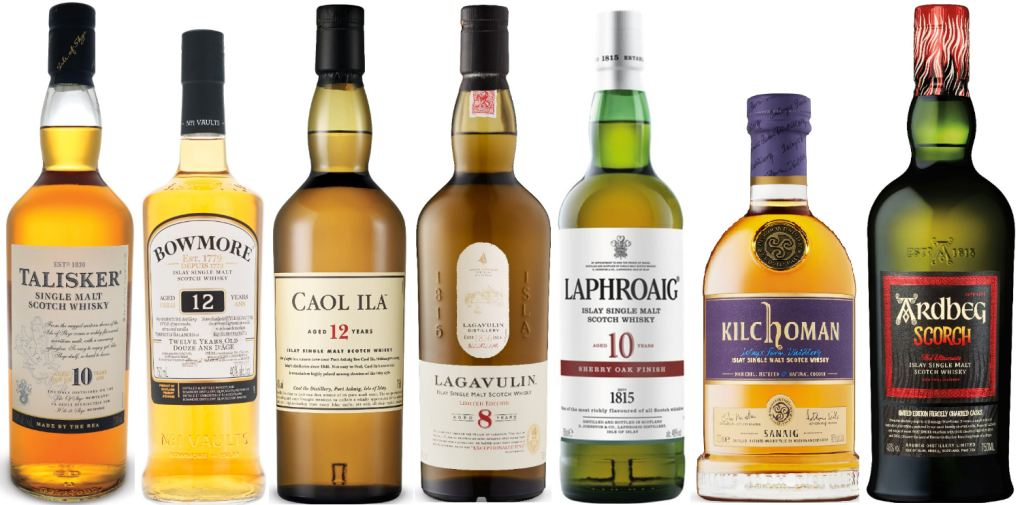
Islay is where the majority of peated whisky is made. Islay is the largest of the Hebridean Islands. It is home to nine working distilleries and is among the most recognizable locations for peated whisky in the world.  Legacy brands such as Laphroaig, Lagavulin, Ardbeg, and Bowmore are all on Islay. Laphroaig, Lagavulin and Ardbeg are collectively known as the Kildalton Distilleries because of their adjacent locations. The famed Islay distilleries produce some of the most heavily peated whiskies in the world, including Laphroaig and Octomore by Bruichladdich.

The level of peat in a whisky is measured in phenol parts per million (ppm). Most whiskies will be categorized in one of the following styles: lightly peated, measuring 15 ppm or less; mildly peated, averaging around the 20 ppm range; and heavily peated, a level of 30 ppm and above. Knowing the ppm of your whisky options can help you determine how smoky the flavour may be.

In recent years a couple of distilleries have been experimenting with making even smokier whiskies.  Most notable of these are Bruichladdich and Ardbeg.  They have created whiskies with PPM levels in excess of 100.

The aging process impacts the smokiness of the whisky.  The longer the aging period the more the intensity of the smokiness decreases.

So, in the world of peat, let’s see how the various whiskies compare:

  • Talisker (30 PPM)
  • Bruichladdich’s Port Charlotte (40 PPM)
  • Bowmore (40 to 50 PPM)
  • Caol Ila (40 to 50 PPM)
  • Lagavulin (40 to 50 PPM)
  • Laphroaig (40 to 50 PPM)
  • Kilchoman (50 PPM)
  • Ardbeg (55 PPM)
  • Bruichladdich’s Octomore (80+ PPM)
  • Ardbeg’s Supernova (100 PPM)

Over the years I have sampled all but Talisker, Port Charlotte, Kilchoman, and the two with PPM in excess of 80.  Bowmore and Lagavulin are my personal favourites but my brother tells me Port Charlotte is also well worth trying.

Sláinte mhaith

The Serious Whisky/Whiskey Drinkers

Whisky and whiskey sales are booming as these beverages have steadily been increasing in popularity since the 1990s.  Both the quality and variety of products and styles have peaked consumer interest and demand.

Photo credit: comptoir-irlandais.com

This increase in popularity made me think, and ask the question, “Who are the largest consumers of whisky/whiskey?”  Well, the answer will change depending on whether you are talking about consumption per capita, volume or market share.  The latter two categories are related to a nation’s overall population size and are rather predictable.  Therefore, I decided to investigate consumption per person on an annual basis.

The information presented is based on statistical information completed by Euromonitor, an international market research and analysis company, together with Quartz, a global business news organization.  The information is presented in litres consumed per inhabitant per year.

  1. France – 2.15 litres per person
  2. Uruguay – 1.77 litres per person
  3. United States – 1.41 litres per person
  4. Australia – 1.3 litres per person
  5. Spain – 1.29 litres per person
  6. United Arab Emirates – 1.27 litres per person
  7. United Kingdom – 1.25 litres per person
  8. Ireland – 1.24 litres per person
  9. India – 1.24 litres per person
  10. Canada – 1.19 litres per person

I found some of the results surprising, such as France as number 1. I always considered the French only as great wine enthusiasts. On the other hand, based on reputation, I would have thought Ireland to have been ranked much higher.  Who knew?

Sláinte mhaith

An Introduction to Scotch Whisky

Scotch whisky is produced in over 130 distilleries and comes in a wide variety of flavours, types and price points.  It can be overwhelming to be surrounded by similar-looking bottles, only to find that they are very different from each other, particularly in how they taste.  The flavour will be dependent on a variety of factors such as whether the scotch is peated or non-peated; the type of barrel used during the distilling process, whether that be a plain oak cask, sherry cask, bourbon cask, etc.; or whether the Scotch is a malt, blend or single grain.

I have congregated my list of suggestions and recommendations based on my own research acquired from visiting a number of Islay, Highland and Speyside distilleries, as well as from trying a variety of assorted whiskies.

I recommend starting with a less expensive malt or blend but at the same time not the cheapest one on the liquor store shelf.  Keep in mind that you get what you pay for.  Also, I suggest starting with a non-peated Scotch, as the flavour will be less intense and less smoky.

Not all varieties are available all the time.  Some whiskies, especially those from smaller distilleries or special batches, are only available outside of Scotland in limited quantities a few times each year. Therefore, to avoid disappointment when starting off, it may be best to try those whiskies that are more consistently available.

Based on all these criteria, here are my suggestions of whiskies to try when first exploring the world of Scotch:

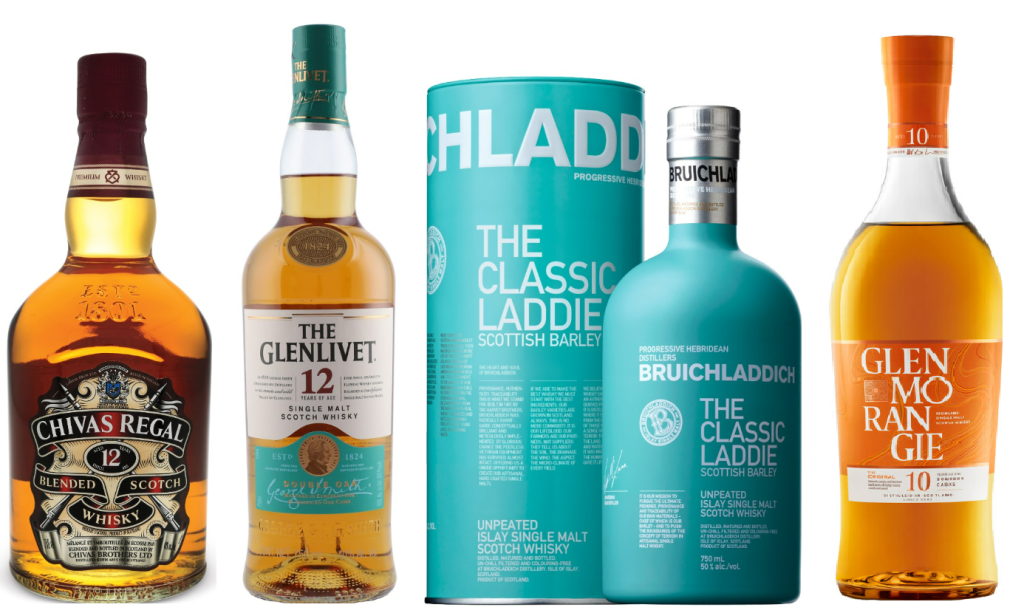
  1. The Glenlivet 14 Year Old Single Malt ($80 CDN)
  2. Bruichladdich (pronounced “Brook law dee”) The Classic Laddie Scottish Barley ($86 CDN)
  3. Glenmorangie Original Highland Single Malt ($73 CDN)
  4. The Glenlivet 12 Year Old Single Malt ($70 CDN)
  5. Tomatin 12 Year Old Single Malt ($70 CDN)
  6. Glenfiddich (pronounced Glen fiddick) 12 Year Old Single Malt ($70 CDN)
  7. Chivas Regal 12 Year Old blend ($83 CDN)
  8. Johnny Walker Black Label blend ($70 CDN)

As with wine, to enjoy the optimum tasting experience, the whisky should be served in the correct glass.  If drinking your whisky neat or with a splash of water, a tulip-shaped whisky glass is ideal. If you elect to enjoy your whisky with ice, then a rocks glass is optimal.

Have fun exploring the whiskies of Scotland!

Sláinte mhaith

Hot Toddy

The recipes for a Hot Toddy seem to be as numerous as the legends telling the tale from which it originated.  One suggestion is that it began in Edinburgh, Scotland where pubs began mixing Scotch whisky with a splash of hot water.  The water was said to have come from the largest well in the area, Tod’s Well, thus supposedly giving the drink its name. This form of Toddy was very popular during the 18th century when it was often used to help counter the cold weather.

Photo credit: marthastewart.com

The English from the times of Charles Dickens also seem to lay claim to the origins of the Hot Toddy, with images of cozy firelit parlors in Dickensian London, as well as flu remedies being conjured up by little old grandmothers in shawls.

Yet another theory is that the Toddy was invented by an Irishman, Dr. Robert Bentley Todd, who, according to legend, had a cheerful view of medicine, prescribing his patients a mixture of hot brandy, water, cinnamon and sugar as a general cure-all.  If nothing else, his patients were most likely a happy lot.

Although these all make for great stories, the history of the toddy can be traced to India and a 17th-century Hindi drink called “taddy” that is made from fermented palm sap. The oldest record of the recipe is from 1786, where it was described as liquor mixed with hot water, spices and sugar.  British Food History suggests that taddy was used by British officials in India to water down expensive imported English beer. Over time, spirits, sugar, ginger and lime were adapted into the mix. The recipe then seems to have traveled to Scotland and England, ever changing along the way.

Today there are many versions of the Hot Toddy.  Here are a couple to consider:

Traditional Hot Toddy

  • Hot water
  • 2 ounces whisky or rum
  • ½ teaspoon sugar (or more or less to taste)
  • Scrape of nutmeg (optional)

Heat water to boiling.. Measure whisky into a tall mug. Fill to the top with hot water and spoon in sugar, stirring to blend. Grate some nutmeg on top if desired. Drink hot.

Classic Hot Toddy

  • 1 shot (25-30 ml) whisky (or rum or brandy)
  • 2 tsp honey or sugar
  • Juice of quarter of a lemon
  • 75-100 ml hot water (or tea)
  • 1 cinnamon stick (optional)
  • 1 slice of lemon
  • Freshly grated nutmeg (optional)

Put whiskey, honey or sugar, lemon juice and most of the hot water, or tea, into a small glass or coffee cup. Stir with a cinnamon stick or a spoon to dissolve the honey.

Taste and see if you need to add more water.

Garnish with a lemon slice, the cinnamon stick and a few rasps of freshly grated nutmeg.

Enjoy!

Sláinte mhaith

The Best Scotch for 2023

Today I present to you the amalgamated thoughts of ten different sources – Liquor, VinePair, Gear Patrol, Forbes, Esquire, Punch Drink, Elle, GQ, Men’s Health and Delish – as to what are the Top 5 Scotch Whisky recommendations for 2023.  The results were compiled by the organization StudyFinds.

However, before presenting the list, there are some things to keep in mind.  There are a large number of Scotch Whiskies produced, many of which are not available for purchase outside of Scotland. Therefore, this list just contains those whiskies that have benefited from international exposure and have, in return, received the most attention and the largest number of recommendations from writers and critics.

So, without further ado here is the list.

1. Talisker 10-Year-Old Single Malt Scotch Whisky ($139.95 CDN)

Talisker is created by the oldest distillery on the Isle of Skye.  It is aged in ex-bourbon casks for a minimum of 10 years.  It boasts a rich gold colour.  With a powerful peat-smoke on the nose with just a hint of the sea-water salt of fresh oysters and citrus sweetness, this full, rich-bodied single malt has a rich dried-fruit sweetness on the palate, with smoke and strong barley malt flavours. It has a finish that is long and warm, with an appealing sweetness.

Bartenders favour Talisker 10-Year-Old Single Malt because of its salty, smoky and spicy flavour.  They find it an excellent choice when making stirred drinks and highballs because of its oily texture and weight.

2. Glenfarclas 15-Year-Old ($109.50 CDN)

Glenfarclas is one of the few remaining family owned and operated distilleries in Scotland.

The Glenfarclas 15 is bold and very smooth with aromas of port and sherry followed by a little smoke and leather.  There are flavours of a bit of jalapeno and a little anise and a little smoke, ending with a pepper spicy finish.

3. Ardbeg Corryvreckan ($201.40 CDN)

This one has been getting a lot of press lately.  It was included in my holiday gift suggestion list for the Scotch drinker in December.

In 2010 it was awarded The World’s Best Single Malt by the World Whiskies Awards.  It is an intense, non-chill-filtered whisky with flavours of peat and pepper.  It is aged in virgin French Limousin oak.  At 57.1 percent ABV, Ardbeg makes a great option for a slow sipping Scotch, full of flavour and punch.  It tastes of rich, peaty tobacco with a medicinal herbaceous quality with hints of sweet spice and citrus peel.

4. The Macallan Double Cask 18 Years Old ($470.00 CDN)

Although rather pricy, the experts agree that The Macallan Double Cask 18 Years Old is one of the best luxury Scotch whiskies.  It is aged in oloroso-seasoned American and European oak casks.   There are aromas of golden raisins, ginger, caramel and orange and tastes of dried fruit, citrus and nuts.  The finish is warm with hints of oak spice, ginger and sweet orange.

5. Lagavulin 16-Year-Old ($175.95 CDN)

If you’re looking for a Scotch that’s both high quality and available at most liquor stores, including mine in Gananoque, ON, Lagavulin 16-Year-Old is a good one.  It is one of my personal favourites.  I will always be grateful for having been introduced to it by my wife’s uncle during a trip to Islay several years ago.

Reviewers love this Scotch for its well-balanced, yet complex flavours.  Earth and smoke define its profile, as well as an attractive array of fruit, light caramel and vanilla flavours. Spice lingers on its finish, leaving smoke behind as a pleasant and surprisingly subtle afterthought.

All the best for the New Year.

Sláinte mhaith

Whisky Related Gifts

Looking for the perfect gift for a Scotch or Irish whiskey-loving relative or friend?  Here are some suggestions that should satisfy the enthusiast on your shopping lists.

The Laphroaig distillery on Islay has a couple of suggestions.  First there is Laphroaig Cairdeas 2022, which is a limited-edition crafted spirit honouring the iconic Warehouse 1. It has the classic Laphroaig flavours of peat, smoke and salt, as well as sweet vanilla, nutty and medicinal notes. It has a peaty, spicy and floral finish.  It comes at a price of $144.95 CDN.

The second Laphroaig offering is Laphroaig Ian Hunter – Chapter 3.  With a price tag of $2,499.95 CDN, this 33-year-old bottling celebrates its legendary owner, Ian Hunter. Aged exclusively in ex-bourbon casks, this whisky is deep copper in colour with pear, peach, honey and rose petal notes. It has a creamy licorice finish.

The Teeling Small Batch Spirit of Dublin Gift Pack contains the Awarded Best Blended Irish Whiskey at the 2018 Irish Whiskey Awards. Aged in hand-picked casks and finished in rum barrels, it is a brilliant yellow gold colour and is light, smooth and sweet on the palate, with notes of burnt sugar, tropical fruit, vanilla and spice.  It comes with a pair of whiskey glasses bearing the Teeling emblem and name.  The price tag on this item is $51.95 CDN.

Glenfiddich Gran Reserva 21 Year Old Single Malt Scotch Whisky is finished in rum casks for added richness. It has notes of buttered rum, banana and prune along with flavours of fig, vanilla toffee, brown spices, ginger and molasses. The finish is long and spicy with notes of ginger and brown spice.  It is package in its own fancy box with a price of $399.95 CDN.

The Macallan Rare Cask, at a price of $500.25 CDN, offers a nose of opulent vanilla and raisin aroma, that gives way to apple and citrus. The flavour is balanced by a spicy mix of ginger, cinnamon, vanilla and chocolate leading to a light citrus zest finish.

For fans of sherry cask-matured single malt scotch whisky, the GlenDronach Revival 15 Year Highland Scotch is matured in Oloroso and Pedro Ximenez sherry casks. Revival, the 15-year-old expression, is hard to beat at a price of $108.25.

For fans of peated whisky, Ardbeg is an Islay distillery known for its extremely peated whisky, having three core expressions.  First is the 10 Year Old ($112.45 CDN), with its balanced smoke and fruit character. It has aromas of lemon, smoke, peat and brine. On the palate, it is warm and smoky with bold, yet balanced flavours that resonate with the aromas. The finish is long sweet and smoky. Serve neat or with a few drops of pure water.

Ardbeg Corryvreckan ($201.40 CDN) is named after a tidal whirlpool that lies to the north of Islay. It was created with the input of the Ardbeg Committee, which is a group of 120,000 Ardbeg whisky lovers from all over the world. It has an intense nose of cedar, brine, creosote, with caramel, smoky bacon, vanilla and clove. The palate is also intense but it is round and finely balanced with outstanding length. The lingering finish shows smoky black, tarry coffee with chocolate. It is not intended for the fainthearted but a true Ardbeg fan will have an appreciation of this dram.

If you can find the Ardbeg 25 Year Old ($1,395.40 CDN), the whisky collector in your family will thank you. The briny smoke integrates with sweet bakery aromas of vanilla, streusel, ginger-spiced pound cake, cinnamon and allspice, studded with nuts and dried apple. The palate’s silky texture is an ideal base for warm vanilla, toasted nuts, toffee and milk chocolate, swirling with iodine, peat and gentle gingerbread spices. The finish is complex, compelling and quite lengthy with ginger, white pepper, allspice, saline, coffee grounds, dried apple and lingering smoke.

Gift options that don’t come in a bottle include cocktail books such as Death & Co: Modern Classic Cocktails, Cocktail Codex and Death & Co: Welcome Home. These books contain hundreds of recipes of exciting drinks that are complex but still manageable enough to be made at home.

Lastly, the experience of drinking whisky/whiskey can be greatly enhanced by the glass it is served in. The proper vessel allows the enthusiast to fully enjoy the flavours and aromas of any whiskey and the glasses are even nice to look at.  Prices range greatly; starting around $12 and climbing up into the triple digits, depending on whether the vessel is made of glass or varying levels of crystal.         

Happy holidays!

Sláinte mhaith

Scotland’s Campbeltown Whisky Region

During Victorian times Campbeltown was the most famous whisky-producing region in the world.   Campbeltown is the main town in the remote Kintyre Peninsula in west Argyll; situated between the isles of Islay and Arran.  There were more than 30 distilleries and Campbeltown itself was often referred to as “Whisky City” and “The Whisky Capital of the World.”  However, over time Speyside and Lowlands distilleries became more prominent and as blended Scotch whisky became a consumer favorite, there was a notable decline in the demand for Campbeltown whisky, as popular opinion soured and the whisky was considered to be heavy, oily and smoky.

Greed also began to play a factor in Campbeltown’s decline as distillers began to focus more on the quantity of whisky produced rather than on the quality.

Since the 1930s, only the Springbank and Glen Scotia distilleries remained. While the two distilleries closed during certain periods of time, neither closed permanently. They have become a testament to Campbeltown’s resilience. Together with the new Glengyle distillery, they have revitalized the whisky industry even though their combined whisky output accounts for less than 1 percent of total production in Scotland.  Despite this, Campbeltown remains one of the five official regions in Scotland for malt whisky production.  Even though this remote seaside village is lacking in the number of distilleries it more than makes up for it in history and pride.

The Springbank Distillery has been on the same site since 1828 and is the only distillery in Scotland to complete the entire production process on site.  It has been owned by the Mitchell family for over 180 years.

The Glen Scotia distillery was originally just the Scotia Distillery.  It was built in 1832.  It is said to be haunted by its former owner, Duncan MacCallum who died in 1930. Workers today are said to avoid certain areas of the distillery after dark.

The Glengyle Distillery restarted production in 2004 after being closed for almost eighty years. The distillery is owned by J & A Mitchell & Co, the same company that owns and operates Springbank. However, the whisky made at Glengyle is named Kilkerran.

Campbeltown does not have a distinctive regional style as the other whisky regions do. The use of peat and casks for infusing flavours into the malts varies by distillery. Overall, the distilleries produce a style similar to elements found in the Lowland and Islay.  Campbeltown has gained a cult status among whisky enthusiasts. While it will likely never grow to the heights of centuries past, the town has at least partially reclaimed its heritage.

The offerings of all three distilleries are occasionally available for sale in Canada’s liquor stores.

Sláinte mhaith

Highlands Scotch

The Scottish Highlands are one of the most sparsely populated regions of Europe, making the role of the Scotch whisky industry a major lifeline for small communities in the region.  The distilleries primarily produce single malt whisky, made from 100% malted barley. The whisky is usually made in a pot still, which preserves more of the flavourful constituents giving it more distinctive character.

Note that although Speyside is geographically situated in the Highlands, it is considered to be a separate whisky region because there are more than 60 distilleries in Speyside alone.

Highland whiskies are generally described as being bold, rich, sweet, full-bodied, and sometimes peaty.  However, due to the size and variations of the region, the characteristics of the single malts differ significantly.  Because of this, the Highlands region is often categorized into four subregions based on the four compass points.  

The north produces some big bodied single malts, containing sweetness and richness, for example The Dalmore. In the south there are lighter, fruitier whiskies that are characterized by a definitive dryness, such as Aberfeldy. In the east there are some full-bodied, dry whiskies with lots of fruit flavour, as well as some pungency; Glen Garioch is a good example. Finally, the west part of the Highlands contain full bodied whiskies with peaty, smoky overtones, while closer to the coast there are some more maritime flavoured whiskies including malts from Clynelish and Pulteney.

Below I have identified 34 distilleries in the Highlands.  The ones highlighted in blue periodically have their whiskies available in Canadian liquor stores.

AnCnocAberfeldyArdmore
BalblairBen NevisBlair Athol
ClynelishDalmoreDalwhinnie
DeanstonDrumguishEdradour
GlencadamGlen DeveronGlen Eden
GlendronachGlenfoyleGlen Garioch
GlengoyneGlenmorangieSingleton of Glen Ord
GlenturretKnockdhuLoch Lomond
Loch MorarMacphailMcClelland
MillburnObanOld Fettercairn
Old PulteneyRoyal BracklaRoyal Lochnagar
Tomatin  

Sláinte mhaith

Speyside Scotch

Speyside produces some of my favourite Scotch whiskies.  It is a sub-region of the Highlands, taking its name from the River Spey which meanders through the region.  It includes the Highlands to the west, Aberdeenshire to the east and the Cairngorms National Park to the north. 

Speyside has the most distilleries of any of Scotland’s whisky regions, containing about half of all of Scotland’s distilleries.  According to at least one so-called expert, Speyside is as close as most whisky lovers will ever come to the center of the single malt universe.

Speyside whiskies are generally not peaty as many of Islay’s and the Western Island regions are.  Instead they tend to have a fruity flavour, sweet and nutty, sometimes with hints of apple, caramel, honey and vanilla.

There are a number of world class whiskies that hale from Speyside including Aberlour, Balvenie, Glenfarclas, Glenfiddich, Glenlivet, and The Macallan.

The distilleries

Speyside’s distilleries are listed below with those highlighted in orange having whiskies available for sale in Canada.

AberlourAllt-A-BhainneAuchroiskAultmore
BalmenachBalvenieBenRiachBenrinnes
BenromachBraevalCardhuCragganmore
CraigellachieDailuaineDalmunachDalwhinnie
DufftownGlen ElginGlen GrantGlen Keith
Glen MorayGlen SpeyGlenallachieGlenburgie
GlendullanGlenfarclasGlenfiddichGlenlivet
GlenlossieGlenrothesGlentauchersInchgower
KinnvieKnockandoKnockdhuLinkwood
LongmornMacallanMannochmoreMiltonduff
MortlachRoseisleSpeyburnSpeyside
StrathislaStrathmillTamdhuTamnavulin
TomintoulTormore  

In addition to single malts that are sold under the distilleries’ names, brands associated with Speyside include Allt-á-Bhainne, Casg Annamh, Glen Turner, Lismore, McClelland’s Single Malt, and Tlàth.

The oldest working distillery in Speyside is Strathisla Distillery.  Even though Strathisla single malt is not well known outside of Scotland, their whiskies are included in popular blended Scotch, such as Chivas Regal and Royal Salute.

Speyside’s style of whisky has helped popularize Scotch throughout the world. Their craftsmanship dates back a few hundred years with skills being passed down from one generation to the next.  The distillers continue to find new innovations to keep improving the appeal of their whiskies.

There is ongoing experimentation with distilling processes.  One such example is at Glenfiddich where they are finishing a 21 year old whisky in Canadian ice wine barrels from Niagara’s Peller Estates Winery.  Fruity flavourful Speyside whisky accented by sweet ice wine is a match made in heaven.

With Speyside distilleries continuing to develop and rediscover themselves, the future of Scotch whisky is looking very bright.

If you haven’t tried a Speyside scotch, do yourself a favour and try the 18 year old Glenlivet, one of my ultimate favourites!

Sláinte mhaith