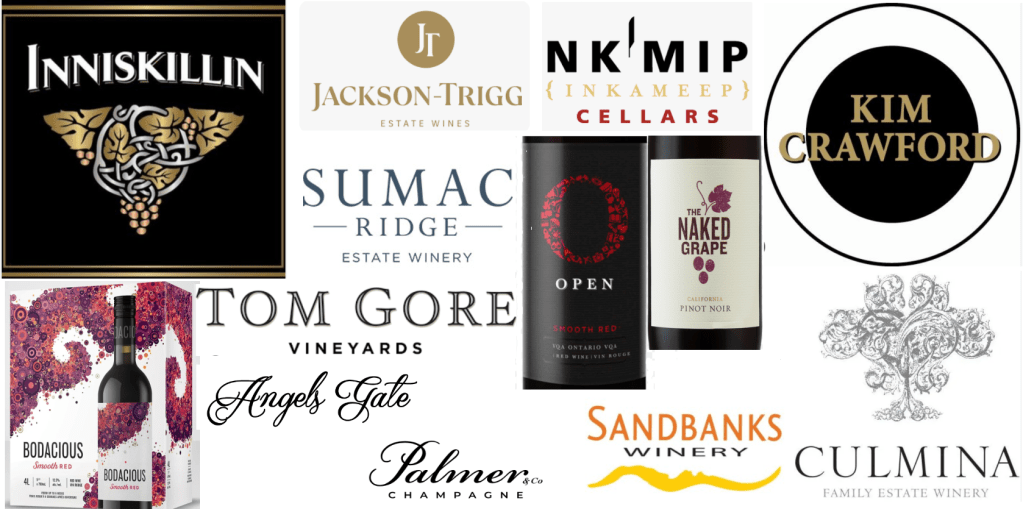
The name Arterra Wines has come up in discussion in a couple of my blog posts in the past regarding their acquisitions within the wine industry. So, it seems to be a good time to investigate and find out more about Arterra Wines.
According to the Arterra Wines Canada website, their mission is, “To build wine brands people love”. Their origins date back to 1874 when the Niagara Falls Wine Company was founded. In 1994 they became known as Vincor International. In 2006, Vincor was acquired by Constellation Brands, a U.S.-based company that is both a leading international producer and marketer of beer, wine and spirits. Finally, in 2016, the Canadian branch of Constellation Brands was acquired by the Ontario Teachers’ Pension Plan and became Arterra Wines Canada.
With many iconic and recognized wine brands, Arterra is developing and expanding their wine portfolio to provide Canadians from coast-to-coast with the opportunity to enjoy and experience wines made both in Canada and from renowned wine-making regions around the world.
Arterra owns and operates Wine Rack retail stores in Ontario, as well as sells wine kits and products for winemaking at RJS Craft Winemaking.
Here is the timeline of important events that have taken place throughout the life of Arterra Wines:
1874
Niagara Falls Wine Company was founded.
1911
Niagara Falls Wine Company renamed T.G. Bright & Co. Limited.
1975
Inniskillin is given the first Canadian winery license since 1929 in Ontario, making it the first estate winery in Canada.
Don Triggs and Alan Jackson, with a group of employees and investors, purchase Cartier Wines from John Labatt Limited.
1992
Cartier Wines acquires Inniskillin.
1993
Jackson-Triggs brand launches.
1994
T.G. Bright & Co. changes its name to become Vincor International Inc.
2000
Acquisition of Sumac Ridge, one of B.C.’s first wineries, and See Ya Later Ranch (formerly Hawthorne Mountain Vineyards) in the Okanagan, B.C.
2001
NK’Mip Cellars Inc. in B.C. becomes first Aboriginal winery thanks to the joint venture with Osoyoos Indian Band and Vincor International.
Jackson-Triggs Niagara Estate Winery opens.
2003
Acquisition of Kim Crawford Wines of Auckland, New Zealand.
2005
Naked Grape brand launches.
2006
Vincor International is acquired by Constellation Brands.
2009
Open Wine brand launches in Ontario (and later in B.C. in 2011).
2012
Vincor International starts operating under the Constellation Brands name.
2013
Bodacious brand wine launches.
2016
Constellation Brands is acquired by the Ontario Teachers’ Pension Plan.
2017
The name is changed to Arterra Wines Canada.
2019
Acquisition of Culmina Family Estate Winery in B.C.s Okanagan Valley.
After stopping production in 2016, Jordan, Ontario’s Le Clos Jordanne wines were re-established.
2020
Acquisition of Sandbanks Winery, Prince Edward County, Ontario (see March 8, 2020 post, The Shifting of Sandbanks).
Acquisition of Tom Gore Vineyards and the trademark rights to Paso Creek, Revolution, Vintage Ink and R.H. Phillips.
2021
Acquisition of Vin First, a Canadian canning and Tetra™ packaging company, specializing in the beverage alcohol industry.
2023
New location for Le Clos Jordanne on Niagara’s Beamsville Bench.
Acquisition of Angels Gate Winery and Kew Winery, Niagara, Ontario.
Acquisition of Champagne Palmer of Champagne, France.
How long Arterra Wines remains under the control of the Ontario Teachers’ Pension Plan and a Canadian corporation remains to be seen. Should ownership become non-Canadian in the future, a significant portion of the Canadian wine industry will hang precariously in the balance; a sobering thought.
Millesime was a sparkling wine company in Niagara that was originally established by Frenchman Alain Girerd. He saw Niagara’s potential as a wine producing region and developed his export business from France to service Canadian winemaker’s needs. Millesime provided comprehensive solutions for traditional method sparkling wine production services such as consulting, riddling, disgorging, and packaging.
Len Pennachetti, Harald Thiel, and Philip Dowell
In December 2023, Millesime was purchased by two of the Niagara’s key winery owners and a veteran winemaker. Hidden Bench Winery owner Harald Thiel, Cave Spring co-founder Len Pennachetti and winemaker Philip Dowell purchased Millesime and have renamed it Niagara Sparkling Wine Service.
By acquiring Millesime and providing Ontario craft winemakers with a scalable traditional method for producing sparkling wine, they feel they can ensure and expand the growth of premium sparkling wine production in Ontario. Winemaker Dowell, the operating partner of Niagara Sparkling Wine Service, has been crafting benchmark traditional method sparkling wine for more than 20 years and provides sparkling wine consulting services to the industry on an as needed basis. Dowell was most recently the winemaker at Kew Vineyards and Angels Gate prior to their being purchased by Arterra Wines Canada.
Millesime was originally sold by its founder, Alain Girerd to John Young, who was then president at Angels Gate Winery. Dowell and Young operated the company as the full-service facility as it was envisioned by Girerd until Arterra purchased Angels Gate Winery and left Millesime dormant. The purchase by Thiel, Pennachetti and Dowell from Young got the idle sparkling wine production facility back in operation to the relief of wineries who had their wines tied up during the transition.
People sometimes look at me funny when I tell them I periodically write about whiskey in my wine blog. However, here is an excellent example of how the world of one is in many ways very similar to that of the other.
Photo credit: thedrinksbusiness.com
Raimonds Tomsons, who is from Latvia, won the ASI (Association de la Sommellerie Internationale) Best Sommelier of the World competition earlier this year in Paris, France. Prior to winning the championship, Tomsons had already made a name for himself due to his work in wine, being a board member of the Latvian Sommelier Association and having worked with several high-end restaurants and importers in Latvia.
He is now going to be the global brand ambassador for The Craft Irish Whiskey Co. of Dublin, Ireland. Tomsons will now be applying his expertly trained nose and palate in his new role. He sees this new endeavor as giving him the opportunity to further enhance his learning by exploring the diverse world of spirits and other beverages.
Tomsons sees that by joining Jay Bradley and his team at The Craft Irish Whiskey Co., he will have an opportunity to explore fine Irish whiskey in depth, and work on innovative whiskey and food pairings. Bradley feels that Tomsons’’ knowledge and ability to detect nuances and layers of flavour compliments the way he makes whiskeys, each bottle of which offers a unique complexity of flavours.
The Craft Irish Whiskey Co. was founded by Bradley in 2018. The distillery creates rare and ultra-rare Irish whiskeys, including The Emerald Isle, worth an incredible $2 million US, making it one of the most expensive whiskeys in the world.
Craft Irish Whiskey is made only in a pot still and with hand-selected barrels. They craft whiskey as it was once made before the rise of blends and mass-production techniques. They are proud to be reviving the art of crafting whiskey. The Craft Irish Whiskey Co. considers themselves as being rooted in tradition but with an eye on the future, a modern expression of a historic craft.
It is now also a marriage between the world of wine and that of whiskey.
In June, Séverine Pinte, French born viticulturist and managing partner at both LaStella and Le Vieux Pin wineries, was awarded the Knight of the Order of Agricultural Merit. The award was presented in Oliver, British Columbia by the Consul General of France, Nicolas Baudouin.
Photo credit: en.wikipedia.org
The Order of Agricultural Merit (Ordre du Mérite agricole) is presented by France for outstanding contributions to agriculture. It is the highest distinction given in France to individuals, both French and foreign, who have made significant contributions in the fields of agriculture and the food and wine industry, whether in public duties or in the practice of agriculture. It also rewards people who have distinguished themselves in scientific research or in related publications.
Severine Pinte came to LaStella and Le Vieux Pin in 2010 with 14 harvests of international winemaking experience along with 8 years of vineyard management. She is a graduate of the infamous ENSAM (Ecole National Superior Agronomic of Montpellier) where she acquired her Masters in viticulture and oenology, and her National Diploma of Oenology. After graduating from ENSAM she apprenticed at the Cave de Tecou in the AOC Gaillac before coming for the first time to British Columbia to work for Domaine de Chaberton as an assistant winemaker. In 1999 she returned to France and worked a year in Bordeaux under the direction of Andre Lurton in Pessac-Leognan. For nine years Severine was head winemaker and viticultural council for ‘Le Vignoble des 2 terres’ in the Terrasse du Larzac terroir.
In 2003 Severine worked at Frankland Estate winery in Australia and learned about the Australian way of making Cabernet Sauvignon and other Bordeaux originated varieties. Curiosity and the pursuit of new challenges lured Severine to British Columbia’s Okanagan.
Severine is an active member of British Columbia’s wine industry as a board member of the B.C. Wine Grape Council. She is a leading advocate of sustainable viticulture practices and was instrumental in launching the Sustainable Winegrowing B.C. certification program.
She has proven to be a true steward of the land, making some of the finest, most sought-after wines in B.C. at both Le Vieux Pin and LaStella wineries. The wines produced by the two wineries may be purchased online through their respective websites, www.levieuxpin.ca and www.lastella.ca .
The 2023 Canadian wine award season began in early June with the Ontario Wine Awards. There were 558 entries from 77 Ontario wineries.
Receiving the honour of the Winemaker of the Year was Peller Estates Winery’s Katie Dickieson. She earned more gold medals than any other winemaker in Ontario.
The Niagara region’s Domaine Queylus attained the Red Wine of the Year award for its 2020 Cabernet Franc Tradition. This wine is only available directly from the winery but at a very affordable price of $33.50 CDN.
The White Wine of the Year award was presented to Prince Edward County’s Norman Hardie for their 2017 Semi-Dry Riesling. This wine comes at a price of $21.00 CDN and is available from either the winery or select LCBO stores.
This year Gold medals were awarded in the following categories:
Sparkling Wine Award (Traditional Method)
Gold medals were presented to:
Malivoire Wine Bisous Rose NV
Megalomaniac Bubblehead Limited Edition Brut NV
Niagara College Teaching Winery, Balance Brut NV
Thirty Bench Wine Makers, Sparkling Riesling NV
Trius Winery, Showcase Blanc de Blancs NV
Sparkling Wine Award (Cuve Close)
The gold medal was awarded to Greenlane Estate Winery for their Saffron Sparkling Rose 2021
Riesling Award (Semi-Dry)
The gold medal was awarded to Megalomaniac Winery for their Narcissist Riesling 2021
During a recent 16-day springtime excursion to Italy as part of a tour group, I discovered passionate people, their food and their wine. I enjoyed homemade soups, pasta, olives and olive oil, mozzarella and parmigiana reggiano cheese, prosciutto, seafood, pizza, risotto, gelato, tiramisu, limoncello and a variety of amazing coffees.
Aperol Spritz
Italy is the home of the “Dolce Vita” sweet life of physical pleasure and self-indulgence. It has the subliminal charm of fine leathers, renaissance art, classical music and of course, great food and wine.
My wife Valerie and I had the wonderful opportunity to travel by bus through the regions of Veneto, Emilia-Romagna, Tuscany, Lazio and Campania where we enjoyed the regional cuisine and wines.
We began our excursion in Veneto, the home of the cities of Venice and Verona where the white sparkling wine Prosecco is enjoyed in numerous cocktails; most notably Aperol Spritz and Bellini. Aperol Spritz consists of 3 parts Prosecco, 2 parts Aperol and 1 part soda. It is then garnished with an orange slice before serving.
A classic Bellini consists of 1 1/2 oz. of peach puree, topped off with chilled Prosecco. It is served in a champagne glass and garnished with a peach slice. Both drinks are refreshing on a warm sunny day.
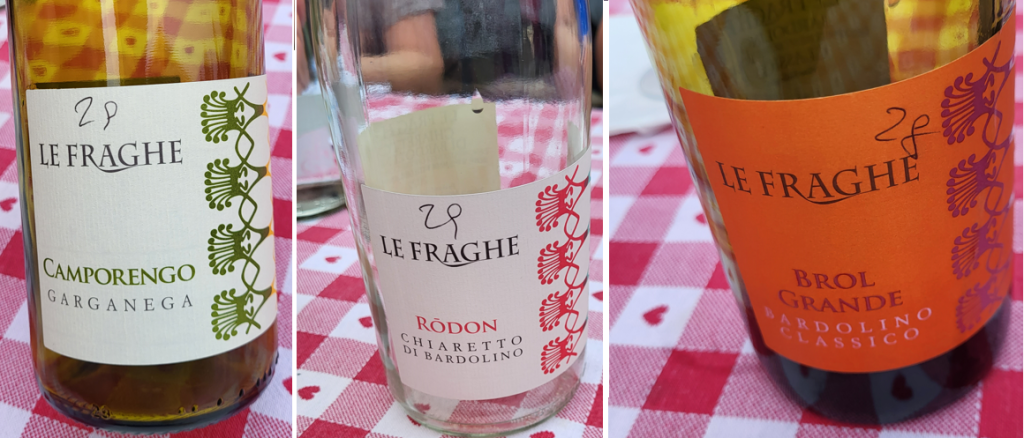
The first winery we visited was the Le Fraghe winery near Verona, where we sampled several of their wines. First was Camporengo Garganega, which is straw yellow in colour. It has a balanced bouquet of floral hints of acacia and mimosa with peach and apple. It has full body flavour.
The second wine, Ròdon Chiaretto di Bardolino, consists of red Corvina and Rondinella grapes. Cherry red with rich purple highlights, Ròdon has fragrant aromas. Notes of wild rose are the first to emerge, followed by nuances of wild strawberry and redcurrant. The wine is crisp and full bodied. It also had excellent tannins and acidity with a lengthy finish.
Brol Grande Bardolino Classico consists of Corvina and Rondinella grapes. Brol Grande is a purple-tinged ruby red of medium intensity. Its bouquet is the result of a blend of the fruity essences of sweet-sour cherry and blueberry, along with spicy nuances of cinnamon and black pepper. The one-year barrel time helps the development of the wine. It has a long and slightly salted finish.
All three wines contain Italy’s DOC designation. They are occasionally available in wine stores in Ontario and Quebec.
Veneto is also the home of Valpolicella and Amarone wines. Unfortunately we did not have the opportunity to visit one of these wineries.
The second winery we visited was the Fattoria Poggio Alloro winery, in San Gimignano, Tuscany. The name Poggio Alloro means Bay Leaf Hill, and it refers to the bay laurel bushes that grow on the property. The farm is a family business. At the present time it consists of one hundred hectares and it is completely organic. The grape varietals include Vernaccia di San Gimignano (a local grape that grows only in this town), Sangiovese (to produce the famous Chianti wine), Canaiolo, Colorino, Malvasia and Trebbiano, Chardonnay, Cabernet, and Merlot.
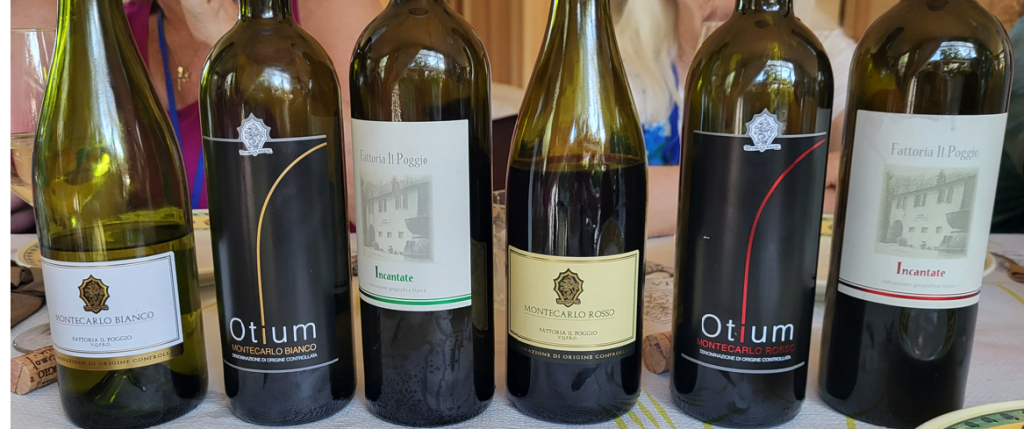
We sampled six wines while we were there, three white and three red. The white wines included Montecarlo Bianco, which is a blend of 50% Vermentino Toscano and the balance consisting of Vermentino, Roussanne, Sauvignon and Pinot Bianco. This combination produces a light, clear wine with a straw yellow colour. The aroma is delicate while the taste is dry, delicate and well-balanced. Montecarlo Bianco has the DOC designation.
The second white was Montecarlo Bianco Otium, which consists of 40% Trebbiano Toscano, 20% Vermentino, 20% Roussanne, 10% Sauvignon and 10% Pinot Bianco. This wine also contained the DOC designation.
The final white was Incantate Bianco IGT Toscana, which was made totally of Chardonnay grapes. The flavour is tropical and the wine is well balanced.
The first red wine presented was Montecarlo Rosso, which was a blend consisting of 60% Sangiovese, Syrah, Canaiolo, Malvasia and Merlot. It is a light red wine with an aroma that is intense, and the taste is delightfully smooth and dry. It contains the DOC designation.
The second red was Montecarlo Rosso Otium, a DOC designated wine consisting of 50% Sangiovese, 30% Syrah, 10% Cabernet and 10% Merlot. It was aged in oak barrels for four months.
The final wine was Incantate Rosso Toscana which was a bold and structured blend of 60% Merlot and 40% Syrah.
There are also 1,500 olive trees on the farm that are utilized to produce extra-virgin olive oil. The olives are completely hand picked each November and then cold pressed to guarantee the superior quality of this product.
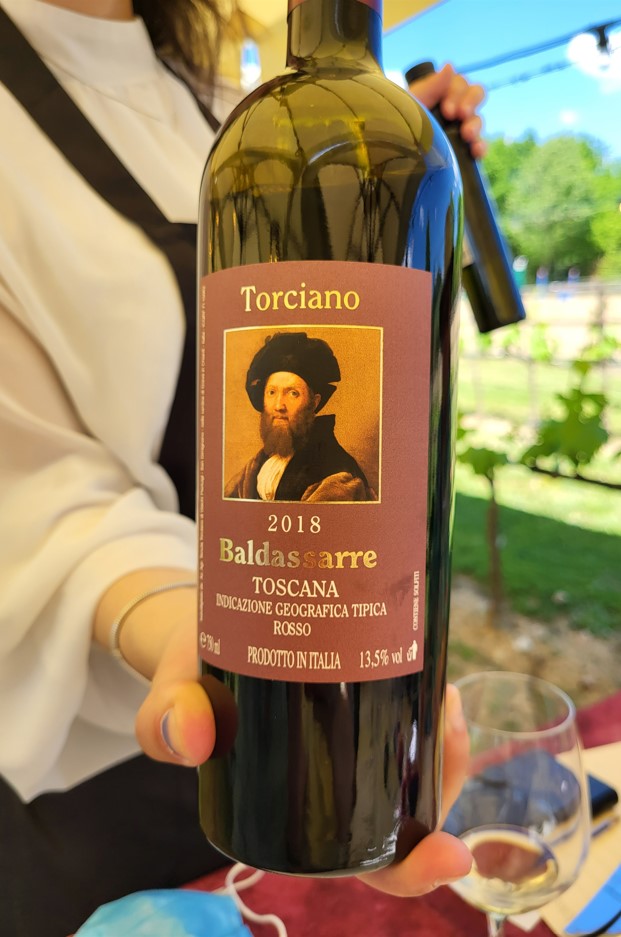
The final winery that we attended was the Tenuta Torciano winery, also in the San Gimignano area. The winery provided a wonderful lunch to accompany the wine tasting but unfortunately the staff did not display the labels of the wines or describe the wines in any detail. The wines are available to be ordered online but they did not say whether any could be purchased from wine stores within Canada.
One wine that we sampled was Tenuta Torciano Baldassarre “IGT Toscana”. This wine is a blend of Sangiovese Grosso, Cabernet and Merlot. It had a deep ruby red colour which transitions to garnet as it ages. It has an elegant bouquet. Hints of wood can be perceived amidst the typical herbaceous notes. Its flavour is dry, full and smooth.
Chianti Classico “Doge” DOCG red wine is produced with Sangiovese grapes, which are harvested by hand and then aged for 12 months.
Doge is characterized by an intense ruby red color. The nose contains hints of violet, then enriched with nuances of ripe red fruit, licorice and vanilla. The taste is full and harmonious, with soft tannins.
Tenuta Torciano Chianti Classico Riserva “Godenzio” is made from Sangiovese and Canaiolo grapes. It has a deep ruby red colour with a penetrating bouquet and full and smooth taste.
Overall, many wines produced in Italy are not intended for export but to be consumed as table wine within Italy itself. These wines are released and drank at a young age, have an abundance of fruit flavour and a slightly lower alcohol level. Examples of these wines include Dolcetto, Montepulciano, Nero d’Avola, Aglianico and Negroamaro.
Unfortunately, being part of a tour, we were at the mercy of the tour company as to which wineries we visited. On the other hand, we had the opportunity to travel to two cheese factories, a couple of olive farms, a Prosciutto farm and a limoncello producer where we enjoyed experiences we otherwise wouldn’t have.
Earlier this month it was announced that, after 16 years, British Columbia’s Harper’s Trail Winery will be closing by June of this year. Owners Ed and Vicki Collett will open their tasting room in May for one final month before retiring and moving on to the next stage of their lives. Along with the current vintage, Harper’s Trail will now be releasing an exclusive collection of library wines.
Having previously visited both Australia and Chile’s wine regions and seeing how similar their climates are to that of the Thompson River Valley, Ed recognized the possible success of starting a vineyard in the Kamloops area.
The Colletts were the first participants in the development of the Thompson River Valley wine region, even though they had no previous vineyard or winemaking experience. The couple relied on advice from several industry veterans who helped set them on the right path. As a result, the Thompson Valley wine industry emerged and developed into an official wine appellation.
The Colletts purchased the property in 2007, planted the first vineyard block in 2008, and opened Harper’s Trail, which was Kamloops’ first winery, in 2012. Since then, Harper’s Trail has become a 5,000-case producing winery that generates 100% estate grown wines on the vineyard’s 25.5 acres. The winery has earned many top honours in prominent national and international wine competitions. Most recently, at the 2022 National Wine Awards, Harper’s Trail won a gold medal for its 2019 Chardonnay Sparkling and a silver medal for their 2020 Silver Mane Block Riesling. At this past year’s All Canadian Wine Awards, Harper’s Trail received gold for their 2019 Chardonnay and silver for their Field Blend White.
In preparation for their pending retirement, the Colletts hope to find a successor to purchase the winery and further enhance it. In case you have a desire for taking on such a challenge, the winery is listed with realtors Cushman & Wakefield.
Here is my list of who I consider to be the Ontario wineries of notoriety for 2022. My opinions are based on several factors: the winery’s performance at both the National Wine Awards and the All Canadian Wine Championships, environmental and sustainability practices of each winery, and my own personal impressions.
By far these are not the only good wineries in the province, they are merely the ones that especially caught my attention this year.
I have listed my choices in alphabetical order and have included several of each winery’s 2022 award winning wines.
Hidden Bench Vineyards and Winery (Ranked 17th at National Wine Awards)
Since 2010, Hidden Bench has followed organic practices, and since 2013, all their estate vineyards have been certified as organic.
At Hidden Bench they believe that the highest quality of grapes and wine can only be achieved by avoiding the use of systemic chemical insecticides and fungicides. Since 2015 they have extended their organic certification into the winemaking processes and as of 2016, most wines carry the Pro-cert certification on their labels. Although becoming an organic certified winery has raised costs significantly, they believe the peace of mind and health of those who enjoy the wines and vineyard is well worth the additional costs they embrace.
Part of their philosophy is to have the smallest impact possible on the environment. They have instituted several initiatives to help reduce the footprint and assist with the recovery of the environment.
Hidden Bench uses geothermal energy to provide heating and cooling for both their building and winemaking processes. They have also installed a 105 panel/23.5kW solar array on the storage building which reduces their reliance on the electrical grid and works to be energy cost neutral on an annual basis.
Recycled materials are used in product packaging wherever possible. They also only package their wines at the point of sale to reduce the associated environmental impact.
Hidden Bench’s 2022 award winning wines include the following:
Hidden Bench last appeared on my annual list in 2020.
Malivoire Wine Company (15th at National Wine Awards)
Malivoire was named Winery of the Year at last year’s National Wine Awards and earned 6 Gold, 6 Silver and 8 Bronze medals at this year’s event.
For over 20 years Malivoire has become a base for innovation, creativity and sustainability. They are proud to be Certified under Ontario’s Sustainable Winemaking Program. They promote biodiversity and a healthy living vineyard that protects wildlife habitat. They conserve water and energy in both the vineyard and winery, recognizing the vital importance of natural resources.
While always receptive to new practices or tools to improve their wine, Malivoire recognizes that as a quality-of-life product, wine’s traditions are treasured by many as essential to their fullest enjoyment of the experience. Malivoire has evaluated emerging farm, vinification and bottling techniques, while remaining dedicated to the concept of wine as a natural product.
Malivoire chooses not to use quick-fix chemical solutions to vineyard challenges. Experience has shown that synthetic treatments, while effective in the short term, can cause long-term complications. Natural obstacles can be remedied effectively with natural solutions so the vineyards will thrive without causing deterioration to their surrounding habitat.
Malivoire’s 2022 award winning wines include:
Malivoire 2021 Farmstead Gamay
Malivoire 2021 Gamay Concrete
Malivoire 2021 Le Coeur Gamay
Malivoire N/V Bisous Brut
Malivoire NV Bisous Rose
Peller Estate Winery (14th at National Wine Awards)
Peller Estates consistently produces fine quality wines. They earned 7 Gold, 4 Silver and 3 Bronze medals at this year’s National Wine Awards. Their wine portfolio features four collections: Andrew Peller Signature Series, Private Reserve, Family Series and French Cross.
This year’s award winners include:
Peller Estates Winery 2018 Cabernet Franc Icewine
Peller Estates Winery 2018 Signature Series Vidal Blanc Icewine
Peller Estates Winery 2019 Oak Aged Vidal Blanc Icewine
Peller Estates Winery 2019 Signature Series Riesling
Peller Estates Winery 2020 Signature Series Sauvignon Blanc
Peller Estates Winery Signature Series Sur Lie Chardonnay
Potter Settlement Artisan Winery
Potter Settlement is very small but it has been making great strides to create high-end, quality wines. They produce more than a dozen different wines, most of which are made with grapes grown on the Tweed property. The winery only purchases grape varieties that can’t be grown onsite (because of the cool climate) and they never buy finished wine. If the grapes are not grown on site, the wine label will indicate where they were grown.
It is one of the northernmost vineyards in Canada, where the temperature is known to drop to -27o C during the winter. However, being further north has its benefits, as the soil is rich in minerals.
Potter Settlement is a marriage of rustic, old-world charm with up-to-date winemaking techniques. They respect tradition but strive for progression when creating their wines. The winery promotes organic farming, as well as the use of solar and geothermal energy. They strive to be considerate and respectful of their surroundings. Potter Settlement consists of 10 planted acres of vinifera, hybrid, and VQA-recognized grapes.
Several of Potter Settlement wines are uniquely crafted adhering to historic processes, specific European yeast, or barrels made of uncommon woods.
This year’s award winners include:
Potter Settlement 2019 Cabernet Franc
Potter Settlement 2020 Cordova
Potter Settlement 2017 Marquette
Potter Settlement 2017 Pinot Noir
Potter Settlement 2020 Pinot Noir Rosé
Redstone Winery (18th at National Wine Awards)
Redstone is a new addition to my Movers and Shakers list. They earned a Platinum, 2 Gold, 3 Silver and 4 Bronze medals at this year’s National Wine Awards.
In 2009, Moray Tawse, owner of Tawse Winery, purchased what was formerly the Thomas and Vaughan Estate Winery. Redstone got its name from the red clay soil and large stones that exists throughout the vineyard.
The 38-acre estate vineyard is farmed organically and is perfect for maturing late-ripening varietals including Merlot, Cabernet Franc, Cabernet Sauvignon and Syrah. There is also Pinot Gris on the property. Riesling, Sauvignon Blanc, and Chardonnay varietals are grown on the recently acquired Limestone vineyard.
Fostering the health of their vines and the soil they grow on requires a labour-intensive and hands-on approach. The yields are kept low by cluster thinning to ensure that all the energy of the vine is focused in fewer grape clusters which then become more concentrated in flavour. The grapes are hand-picked to select the very best fruit.
They practice organic farming, which feeds the vines and controls diseases without the use of synthetic insecticides, fungicides and fertilizers. They have chickens that feed on bugs, sheep that eat the lower vine leaves to expose the grapes to the ripening sun and use horses instead of tractors whenever possible to help prevent soil compaction.
Redstone’s list of award-winning wines for 2022 include:
Redstone 2018 Cabernet Franc Redstone Vineyard
Redstone 2019 Bistro Gamay Noir
Redstone 2019 Bistro Riesling
Redstone 2019 Brickyard Riesling
Redstone 2019 The Club Riesling
Thirty Bench Wine Makers (10th at National Wine Awards)
Thirty Bench Wines was awarded Best White Wine of the Year at the All Canadian Wine Awards for their 2019 Small Lot Riesling Triangle Vineyard wine. At the National Wine Awards they received 6 Gold, 7 Silver and 1 Bronze medal.
The vineyard’s location beneath the Niagara Escarpment provides a longer season that allows grapes more time to ripen and cooler nights that help intensify flavours. All Thirty Bench wines are made exclusively with grapes from their own vineyards. Their vines are hand cropped and thinned to produce very low yields to create exceptional quality and an intensity of fruit flavour.
The commitment to “Small Lot” winemaking means many of their wines are made in extremely limited numbers.
2022 award winners include the following wines:
Thirty Bench 2019 Small Lot Riesling Triangle Vineyard
Thirty Bench 2019 Small Lot Riesling Wild Cask ($32.00)
Thirty Bench 2019 Small Lot Riesling Wood Post Vineyard
Thirty Bench 2019 Special Select Late Harvest
Thirty Bench 2020 Small Lot Pinot Noir
Thirty Bench 2020 Small Lot Riesling Steel Post Vineyard
Thirty Bench 2020 Winemaker’s Blend Cabernet Franc
Thirty Bench 2020 Winemaker’s Blend Riesling
Thirty Bench 2021 Winemaker’s Blend Rosé
Next week I will present this year’s list for British Columbia wineries.
It’s no longer uncommon to see cans of red wines, white wines, rosé wines, and sparkling wines on wine store shelves. Canned wine is increasing in popularity but sales still lag well behind bottled wine.
Canned wine offers several conveniences over wine from a bottle, such as increased portability, ease of access, zip top versus corkscrew, pre-measured servings, less weightiness and a lower price point than many bottled wines.
But is canned wine of equal quality to bottled wine? In a word, “Yes”. Wineries make canned wine in the same manner that they make bottled wine. The main difference is that the final product is placed inside an aluminum can instead of a glass bottle. The key is to look for products made by trusted brands and winemakers that produce high-quality wines.
There are a wide variety of wines offered in cans, including sweet and dry whites, reds and rosés. Wine spritzers, which typically have a lower alcohol content, are also available.
It can be argued that aluminum cans are more environmentally friendly than glass bottles. Being lighter in weight, transportation requires less of a carbon footprint. On average, aluminum cans are composed of three times more recycled material than glass bottles.
Canned wines come in many of the same varieties as bottled wines. The canning process doesn’t take away any of the wine’s quality. Many wineries can the same wine that they put in bottles. The quality and taste are the same and the can doesn’t alter the taste of the wine.
Canned wine can be drunk directly from the can, but in order to aerate it and experience the bouquet, it may be better served in a glass. Canned wine will not last as long as a comparable bottled wine might. The average shelf life for canned wine is 12 to 18 months. Canned wines can expire and aren’t intended to be collected and aged in the same way as some bottled wines are.
Store unopened canned wine similar to how you would bottled wine. The only difference is that there is no benefit from laying canned wine on its side.
If you open a can of wine and don’t finish it in the same sitting, you can store the can in the fridge for two to four days. Plastic wrap or aluminum foil will help prevent air from spoiling your wine. A better option may be to transfer the contents of the can to a sealable, reusable water bottle.
Canned wine provides flexibility, especially when adventuring outdoors. Bottled wines can be a hassle when you want an easy and portable beverage. Canned wine is the perfect drink to enjoy poolside, at the beach on a hike.
This can be the perfect time to explore the world of canned wine as the quality of these products has seen significant improvement over the past decade. However, in my own opinion, though canned wine provides a good portable travel alternative, it will not replace bottled wines.
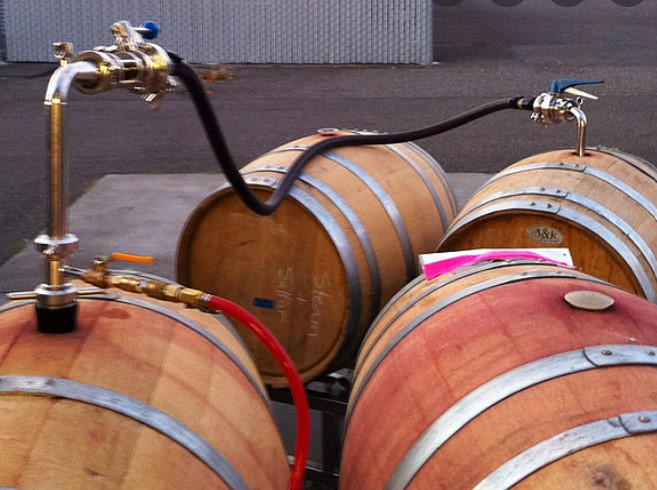
Racking, which is often referred to as Soutirage or Soutirage traditionnel, filtering or fining, is the process of moving wine from one container to another using gravity. A pump is never used as it can be disruptive to the wine.
Photo credit: en.wikipedia.org
There are two main reasons why winemakers rack their wines. The first is to remove sediment. An initial racking is done after malolactic fermentation is complete. Malolactic fermentation, also referred to as malo or MLF, is a process where tart malic acid in wine converts to softer, creamier lactic acid, the same acid found in milk. The process reduces acidity in wine and also releases some carbon dioxide. The dead yeast cells and other solids, referred to as gross lees, accumulate during fermentation that settle over time.
After the first racking, winemakers might then rack additional times to remove what is referred to as fine lees.
The second reason to rack is to provide oxygen to the wine. This impacts its maturation process, managing the tannin in the wine. Oxygenating the wine can also get rid of reductive aromas. These unwanted aromas, often perceived as rotten eggs or tire rubber, can occur when the wine is deprived of oxygen.
The racking process involves the insertion of a stainless steel, wand-shaped device into the barrel. The wine is then siphoned out. The winemaker then uses a sight glass to observe and halt the process when the siphon starts to pull up sediment. The wine continues on through a hose to a tank.
After the wine has been removed the barrel is cleaned. Then the process is completed in reverse returning the wine to the barrel. If the winemaker wants the wine to receive more oxygen, the wand is placed at the top of the barrel so there’s a splashing, aerating effect. If they want it to receive less oxygen, the barrel is filled from the bottom.
The number of times winemakers rack varies. Generally, the more tannic a grape variety, vineyard or vintage, the more times a wine might be racked. Some may rack their wines only once after malolactic fermentation is complete and then again just before bottling. Others might do it every quarter. The winemaker’s vision for the wine is also taken into consideration. A wine that is to be available for consumption early will probably be racked more often than one that is intended to be more age worthy that people are going to cellar for a long time.
All these decisions will impact the wine that ends up in your glass. Who knew?