Peated Whisky

Though popular with many enthusiasts today, peated whisky hasn’t always been. Rich and full of deep, smoky flavours, it is very complex. Admittedly, peated whisky is an acquired taste, but for those of us who enjoy its earthy tone and charred smoky taste, it is divine.

The intensity and flavour vary greatly depending on the region. Generally, the flavour covers a broad range, including intense aromas and flavours of sulfur, saline, diesel, leather, meat, moss, pine and charred wood.

Peat consists of a mixture of decayed vegetation that has developed over thousands of years.  It is commonly found in swamps and bogs.  It has a high carbon content which is why it has historically been used as a fossil fuel.

Scotland has a large, accessible quantity of peat which was used to fuel the nation’s distilleries, which initially used it to fire pot stills.  However, today peat is used less for fuel and more for flavour. The peaty, smokiness infuses the whisky during the malting stage of production. Barley is dried using a peat-fired kiln to end the malting process. Flavours from the peated smoke seep into the grain and then carry through mashing, fermentation and distillation, to maturation and finally into the bottle.

Peated whisky in Scotland varies by region.  In The Highlands, peated whiskies are the minority even though it is the largest whisky region. Some peated variations to try from this region are Oban 14 and several styles from Highland Park.

The Speyside region is home to over half of the active distilleries in Scotland. Whiskies from this area tend to have fruit-forward flavours with only scents of smoke. BenRiach The Smoky Twelve offers a subtle smokiness.

In Campbeltown, peated whiskies tend to have a delicate smoke profile, with subtle mineral notes and robust character.

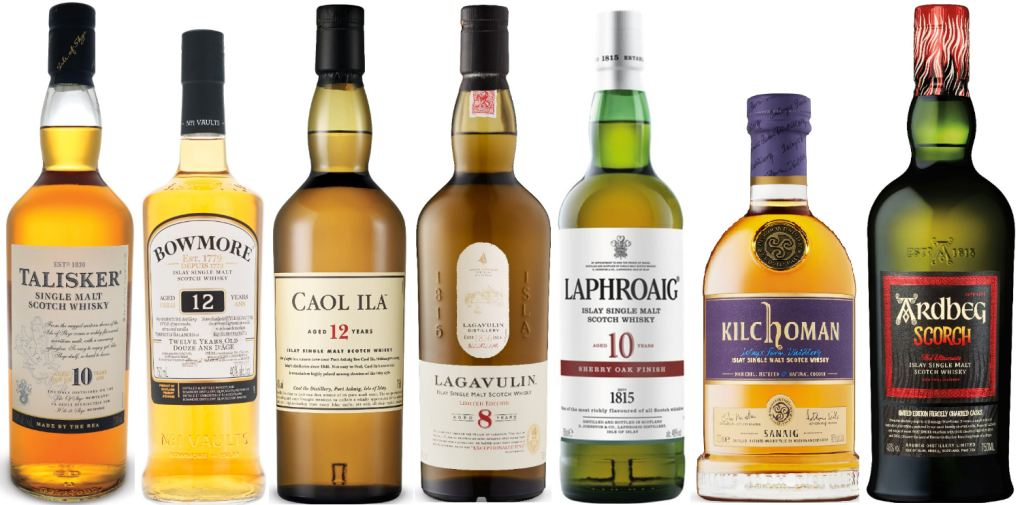
Islay is where the majority of peated whisky is made. Islay is the largest of the Hebridean Islands. It is home to nine working distilleries and is among the most recognizable locations for peated whisky in the world.  Legacy brands such as Laphroaig, Lagavulin, Ardbeg, and Bowmore are all on Islay. Laphroaig, Lagavulin and Ardbeg are collectively known as the Kildalton Distilleries because of their adjacent locations. The famed Islay distilleries produce some of the most heavily peated whiskies in the world, including Laphroaig and Octomore by Bruichladdich.

The level of peat in a whisky is measured in phenol parts per million (ppm). Most whiskies will be categorized in one of the following styles: lightly peated, measuring 15 ppm or less; mildly peated, averaging around the 20 ppm range; and heavily peated, a level of 30 ppm and above. Knowing the ppm of your whisky options can help you determine how smoky the flavour may be.

In recent years a couple of distilleries have been experimenting with making even smokier whiskies.  Most notable of these are Bruichladdich and Ardbeg.  They have created whiskies with PPM levels in excess of 100.

The aging process impacts the smokiness of the whisky.  The longer the aging period the more the intensity of the smokiness decreases.

So, in the world of peat, let’s see how the various whiskies compare:

  • Talisker (30 PPM)
  • Bruichladdich’s Port Charlotte (40 PPM)
  • Bowmore (40 to 50 PPM)
  • Caol Ila (40 to 50 PPM)
  • Lagavulin (40 to 50 PPM)
  • Laphroaig (40 to 50 PPM)
  • Kilchoman (50 PPM)
  • Ardbeg (55 PPM)
  • Bruichladdich’s Octomore (80+ PPM)
  • Ardbeg’s Supernova (100 PPM)

Over the years I have sampled all but Talisker, Port Charlotte, Kilchoman, and the two with PPM in excess of 80.  Bowmore and Lagavulin are my personal favourites but my brother tells me Port Charlotte is also well worth trying.

Sláinte mhaith

Spicy Wines

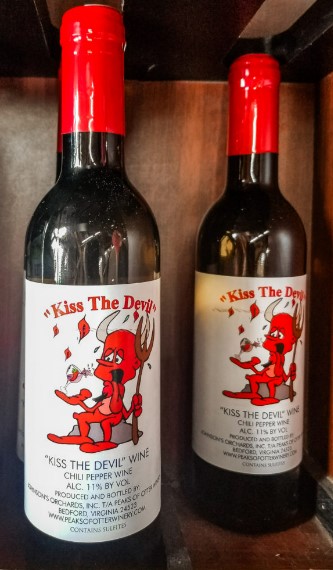
Other than mulled wine, are any wines truly spicy?  The short answer is ‘yes’ but there are great differences in individual interpretation.  To listen to or read some reviewers impressions you would be led to believe drinking some wines would be similar to eating a chili pepper.  For example, “You can taste a red wine and suddenly discover your mouth is sizzling – that spicy red wine has a whole world of delicious, zesty compounds that light up your palate and senses.”

Photo credit: lovicarious.com

Wine can, however, have a certain amount of spiciness to it, though it is much more subtle than the above quote would suggest.  There are several reasons for this.

Some wines do have the aroma of freshly ground black or white pepper.  Wines made from Syrah grapes have a high level of pepperiness.  This is because the grapes actually have one of the same compounds in the skin as is found in black peppercorns, a compound called Rotundone.  However, one in five people are unable to detect the smell of Rotundone and thus do not find Syrah or Shiraz to be peppery.

Some red wines, such as Italian Chianti Classico, will provide a warming or burning sensation when they are drunk.  This is a result of a high level of acidity in the wine.  The same type of sensation may occur when drinking a wine with an alcohol content of around 15% or greater.  Amarone is an example of such a wine.

There are wines with the aroma of spices such as vanilla, cloves or baking spices.  A California Zinfandel or South African Pinotage will have the aroma of these types of spices.  Part of this is due to the wine being aged in oak barrels.  Lactones from the barrels create a coconut smell, and vanilla flavours come from vanillin.  Spicy, toasted and clove aromas are generated by eugenol and guaiacol respectively, which are also found in the oak barrels.

There are some white wines as well that have flavours and aromas of spice;  for example, a Gewürztraminer from Alsace. Grüner Veltliner from Austria can also be spicy as it, like Syrah, has Rotundone in its skin. As a result, it can have a peppery character.

So, although there are some peppery and spicy wines to be found on the shelves of your local wine store, I truly doubt that any of them will leave you fanning your mouth from the intensity of the flavour.

Sláinte mhaith

Acidity in Wine

What is it?  Can you taste it?  How much acid is in wine? Is it necessary to have acidity? These are many of the commonly asked questions about acidity in wine.  Understanding acidity helps us to identify which wines we like and to better be able to pair wines with our favourite foods.

Photo credit: winefolly.com

If you taste a wine that you find to be refreshing yet slightly tart, this is the result of dominant or prevalent acidity.  When someone says a wine is crisp, bright or fresh, it means the wine has great acidity.  Although these terms are most commonly referred to when discussing white wines, some red wines can be crisp, bright and fresh as well.

The common misconception is that some wines have acidity while others don’t, but all wines have acidity. Even in a wine such as Cabernet Sauvignon, which is normally thought of as deep and mellow, acidity helps blend all the other flavours of the wine. If a wine has no acidity at all, it tastes dull and flat. It is acidity that makes the wine appeal to your taste buds and enable you to recognize all the various flavours.

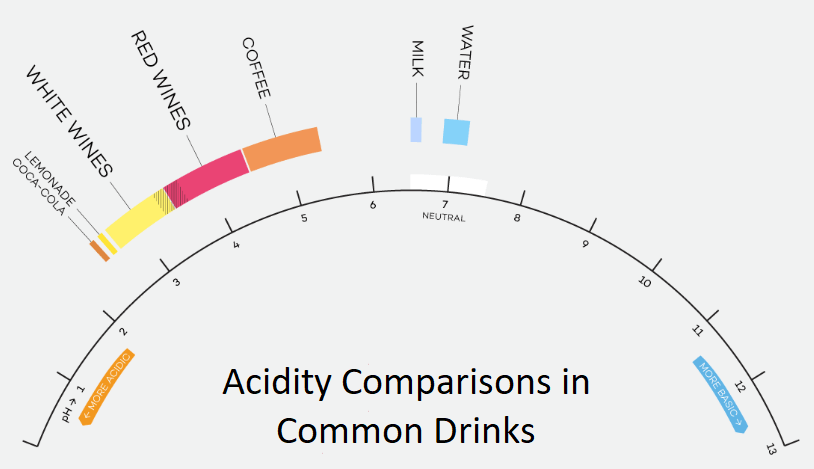
Acids are one of the four fundamental traits in wine; the others are tannin, alcohol and natural sugar. Acidity gives a wine its tartness. The amount of acidity varies depending on the type of wine.  Most range from 2.5 pH to about 4.5 pH on the acidity scale.  The lower the acidity the higher the pH level.

There are several different types of acids found in wine. The most prevalent acids are tartaric acid, malic acid and citric acid.  The amount of these acids in your wine will determine how much of a puckering sensation you experience in your mouth.

In wine tasting, “acidity” refers to the fresh, tart and sour elements of the wine which are evaluated in relation to how well the acidity balances out the sweetness and bitter components such as tannins.

The natural sugar content in a wine can disguise the acidity, making the wine seem smoother with a reduced puckering sensation.  An extreme example of this would be to compare the juice of a lemon with a glass of Coca-Cola.  Both have a pH acidity level of 2.5 but the intense puckering sensation of the lemon is not felt at all when you take a sip of the cola.

Acidity acts as a buffer to preserve the wine longer so high acid wines are more likely to improve with age. The stability of high acid/low pH wines helps during aging. Conversely, high pH wines are more prone to contamination. Microbes or other unstable components can make high pH wines appear hazy.

The type of acid present in a wine can also affect our perception of sourness and the puckering sensation. During the aging process, a wine’s malic acid is often converted to lactic acid, which results in a smoother, less tart-tasting wine.

Another facet of wine that can be confusing is a wine’s total acidity. This is something that’s often noted on a wine tech sheet or in the wine maker’s notes.  Total acidity tells us the concentration of acids present in wine, whereas the pH level tells us how intense those acids taste. For example, if you have a wine with 6 grams per litre total acidity and a pH of 3.2, it will taste more acidic than a wine with 4 grams per litre total acidity with the same pH level.

A higher acid white wine will be lemonier in flavour, making your mouth water and pucker a little.  Red wines with higher acidity are more likely to be a bright ruby colour, as the lower pH gives them a red hue. Higher pH, less-acidic red wines can take on a blue or purple hue. Wines with lower acidity can also take on a brown colour because they’re more prone to oxidation. It may not be as noticeable in red wines but can be off-putting in young white wines.

Unripe grapes have high acid levels that decreases as they ripen. Grapes grown in cooler climates usually contain higher acidity because there’s less warmth and sunshine available to increase grapes’ sugar and pH levels.

When pairing wine with food it’s helpful to consider the tastes found in a dish, whether it be sweet, sour, bitter, salty, fatty, etc. With a wine having a higher level of acidity, you’ll notice that sweetness, saltiness and fat balance the sour taste of the acidity.

Sláinte mhaith

Wine from the Netherlands

When you think of wine regions of the world it is unlikely that the Netherlands immediately comes to mind.  Wine has been produced in The Netherlands for centuries but the winemaking industry has been working hard to reinvented itself over the past few decades.  The quality of wines made in the Netherlands has increased immensely and as a result, it is slowly but surely becoming a true wine country.

Photo credit: Google

The improvements are the result of the development of new grape varieties that are better suited to the Dutch climate. These new grapes have served to increase vineyard acreage 10-fold.  Also, the Dutch vintners are becoming more experienced, thus improving the quality of Dutch wines.

There are about 170 commercial vineyards in The Netherlands with a combined vineyard acreage of about 320 hectares. Most of the vineyards are in the south of Limburg, the warmest region in The Netherlands and traditionally the best place to grow grapes.  The majority of the grapes are white varietals due to the cool climate, although there is some Pinot Noir grown as well.

Traditional grape varietals include whites such as:

  • Auxerois
  • Chardonnay
  • Müller-Thurgau
  • Pinot Blanc
  • Pinot Gris

Since 2000, several new grape varieties better suited to the Dutch climate have been added. There are more red grapes among these new varieties.

White varietals include:

  • Johanitter
  • Muscaris
  • Solaris
  • Souvigner Gris

Red varietals include:

  • Regent
  • Cabernet Cortis
  • Rondo

I have never had the opportunity to try wine from The Netherlands but I am hopeful that I will have that chance when I visit there later this year.  Unfortunately, these wines do not seem to be available in any of the wine or liquor store that I have access to.  Hopefully one day …

Sláinte mhaith

The Serious Whisky/Whiskey Drinkers

Whisky and whiskey sales are booming as these beverages have steadily been increasing in popularity since the 1990s.  Both the quality and variety of products and styles have peaked consumer interest and demand.

Photo credit: comptoir-irlandais.com

This increase in popularity made me think, and ask the question, “Who are the largest consumers of whisky/whiskey?”  Well, the answer will change depending on whether you are talking about consumption per capita, volume or market share.  The latter two categories are related to a nation’s overall population size and are rather predictable.  Therefore, I decided to investigate consumption per person on an annual basis.

The information presented is based on statistical information completed by Euromonitor, an international market research and analysis company, together with Quartz, a global business news organization.  The information is presented in litres consumed per inhabitant per year.

  1. France – 2.15 litres per person
  2. Uruguay – 1.77 litres per person
  3. United States – 1.41 litres per person
  4. Australia – 1.3 litres per person
  5. Spain – 1.29 litres per person
  6. United Arab Emirates – 1.27 litres per person
  7. United Kingdom – 1.25 litres per person
  8. Ireland – 1.24 litres per person
  9. India – 1.24 litres per person
  10. Canada – 1.19 litres per person

I found some of the results surprising, such as France as number 1. I always considered the French only as great wine enthusiasts. On the other hand, based on reputation, I would have thought Ireland to have been ranked much higher.  Who knew?

Sláinte mhaith

The Aromas of Wine

The aromas of wine, which are also referred to as the nose or bouquet, range from simple to very complex, depending on the wine.  The best way to release the aromas is to swirl the liquid around the bowl of the glass.  This will expose the liquid to the air, thus releasing all of the smells.

Photo credit: finedininglovers.com

When you go to smell the wine don’t be bashful; stick your nose as far as you can into the glass and close your eyes. You will notice a lot more scents this way.  Then breathe in deep. As you do, think about what aromas you’re picking up.

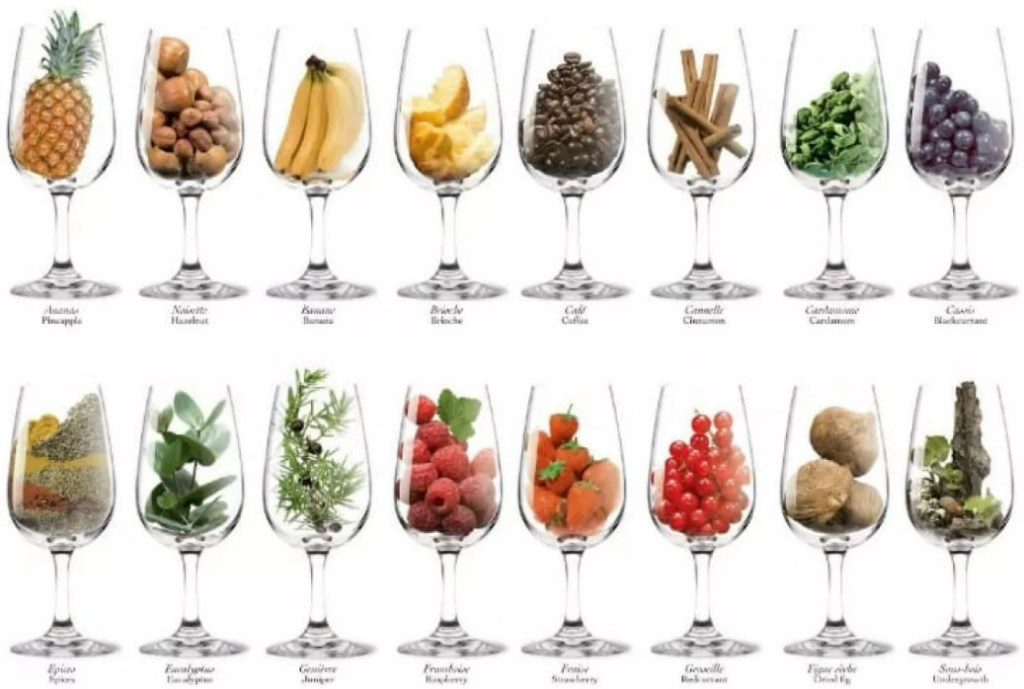
If it’s a white wine, you may be reminded of bananas, lemon rind or pineapple. If it’s a red wine, you may smell prunes, cherries, strawberries, peppers, plums or tobacco. Sometimes you may just smell grapes. Your brain will only pick up scents that you are familiar with and have smelled before. Thus, you and I could smell the same wine at the same time and relate a totally different experience.  The aroma is in the brain of the beholder.

When identifying the aromas, the experts will consider them at three levels referred to as primary, secondary and tertiary.  Primary aromas come from the grapes or are created during the fermentation process. A simple wine may show a very limited number of primary aromas whereas a more complex wine may display many more primary aromas.

White wines will display fruity aromas such as lemon, lime, grapefruit, apricot, peach or plum.  Red wines tend to present smells of strawberry, raspberry, blackcurrant or cherry.  There may also be floral, herbaceous scents in both white and red wines.

The secondary aromas in wine are created by the post-fermentation process. The most obvious of these are extracted from the oak that the wine barrels are made of.  Oak is often used when making wines such as Chardonnay, Cabernet Franc, Cabernet Sauvignon and Shiraz.  The oak can create hints of vanilla, cloves, coconut, cedar, chocolate, coffee or smoke.  Non-oak aromas may include cream, butter, cheese, toasted bread or biscuits.

Tertiary aromas occur as the wine ages in the bottle.  Only older mature wines will display these characteristics.  White wines may have aromas of orange marmalade, ginger, nutmeg, honey and stone fruits, such as peaches or plums.  Red wines may show hints of dried fruit, leather, mushroom, meat, tobacco or caramel.

There you have it; the aromas in wine are created at three different levels but how you interpret them will be as unique as you.

Sláinte mhaith

Bordeaux’s Left and Right Bank

The prestigious Bordeaux wine region is located on the western coast of France. The region is separated into two sub-regions, referred to as the Right Bank and the Left Bank. Each region has its own unique nuances that characterize it from the other.

Photo credit: Decanter.com

The banks refer to the two riverbanks, the land masses on either side of the Gironde Estuary, the place where a river meets the sea. The Gironde Estuary is fed by two rivers, the Dordogne and the Garonne. The Left Bank viticultural region is on the southwest side of the Gironde and the Right Bank is on the northeast side.

The prominent difference between the Left and Right banks is the grape varietal grown.  The Left Bank is famous for its Cabernet Sauvignon while the Right Bank is mainly Merlot, Cabernet Franc, Petit Verdot and Malbec.  The reason for the grape varieties being different is due to the type of soil. The Left Bank is characterized by gravelly soils while the Right Bank is mainly clay soils.

The varietals grown determines the difference in style of wine produced.  The Left Bank’s Cabernet Sauvignon-based blends tend to be more structured, powerful and have a higher presence of tannins, whereas the Right Bank’s Merlot-dominant blends tend to be softer and silkier.  Personally, I am a fan of the wines from the Right Bank.

The most complicated difference between the Left and Right Banks is the way in which the wine is classified. For a detailed explanation of the classification methods see my post, France’s Cru Levels from March 18th.

The most notable vineyards on the Left Bank include Château Latour, Château Margaux, Château Haut-Brion, Château Lafite, and Château Mouton Rothschild.  Estates on the Right Bank include Château Cheval Blanc, Château Angélus, Château Pavie and Pétrus.

Sláinte mhaith

France’s Cru Levels

As I have discussed in the past, French wine labels can be rather puzzling since they indicate the region where the wine was produced rather than the grape varietal contained inside the bottle.  Also, the label will often contain such words as “Grand”, “Premier” or “Cru”.  Even though premier means first in French, you will often find grand appearing on the better quality wines.

Photo credit: Decanter.com

The simple translation for cru is growth.  However, in the world of French wine its reference is for the geographic terrain, specifically the soil type, climate and altitude where the grapes are grown.  It gets complicated by the fact that cru is not applied in the same manner throughout all the wine regions of France.  Further complicating things is that the term cru is also used in Germany and Italy where there are additional variations in the meaning.

In the Burgundy region of France, the classification of cru is rather simple.  Cru designates a vineyard as being of a certain level of quality.  The classifications originate back to the 12th century and the Cistercian and Benedictine monks in the Côte d’Or.  Every vineyard in Burgundy is classified in the hierarchy where Grand Cru is at the top followed by Premier Cru and then “village” wines, with the generic Bourgogne category at the bottom.

There are 33 Grand Crus with each having its own appellation.  Only Pinot Noir and Chardonnay are grown here, but most appellations only permit one or the other varietal to be grown; very few allow both. Premier Cru wines are less expensive and are often a better value, though their long-term aging potential is typically less.

Chablis has one Grand Cru appellation that includes seven vineyards. These vineyards overlook the town of Chablis and benefit from a southwest exposure that helps ripen the grapes.

The Bordeaux region applies the term cru in a much different manner. Grand Cru Classé classification system forms the basis of the rating system and it’s tied to a specific chateau or estate, rather than adjacent vineyards. It was created in 1855 and is comprised of only left bank chateaus in Médoc, Graves and Sauternes, ranked from first to fifth growths, based on their value at that time. The first growths are called Premiers Crus, while second through fifth growth crus are called Crus Classes.

On the right bank Pomerol isn’t classified but Saint-Émilion is.  St.-Émilion has three chateau-based quality classifications. At the top is Premier Grands Crus Classés, of which there are 18, followed by Grands Crus Classés which contains 64 chateaus. The appellation’s third category is not tied to a specific ‘classed’ chateau or geographical subzone. Wines labeled “St.-Émilion Grand Cru” merely have more stringent production rules.

The Alsace region uses the term Grand Cru in similar fashion as the Burgundy region. Fifty-one vineyards have been designated superior, or Grand Cru, and wine from those vineyards can use the term on their label. There is a great deal of diversity in Alsace’s Grand Cru wines.  There are four grapes approved for use, as well as a wide variation in soils.

The Beaujolais region is where Gamay grapes are grown. Here cru is applied to villages rather than vineyards. There are 10 villages and the wine produced from these villages is called Cru Beaujolais.

The Champagne region also classifies entire villages as Grand Cru or Premier Cru. The Champenois created a system referred to as échelle des crus, or “ladder of the growths” in the early 20th century to fix grape prices for both farmers and buyers at Champagne houses.

At each harvest a price is set and growers with land in one of Champagne’s grand cru village receives 100% of that price. Grapes from the premier cru villages earns from 90% to 99% of the set price, while the rest receive from 80% to 89%.

There you have it; a little more of the puzzle of French wine resolved.

Sláinte mhaith

An Introduction to Scotch Whisky

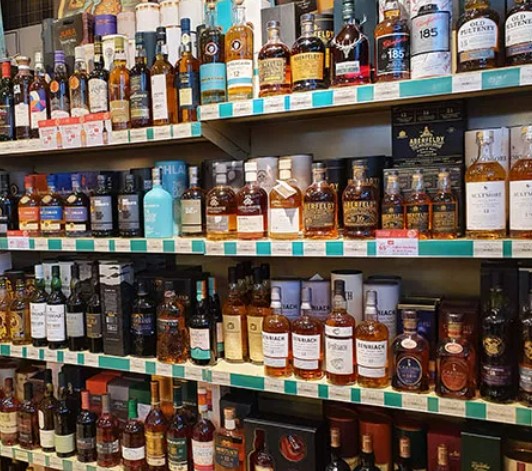
Scotch whisky is produced in over 130 distilleries and comes in a wide variety of flavours, types and price points.  It can be overwhelming to be surrounded by similar-looking bottles, only to find that they are very different from each other, particularly in how they taste.  The flavour will be dependent on a variety of factors such as whether the scotch is peated or non-peated; the type of barrel used during the distilling process, whether that be a plain oak cask, sherry cask, bourbon cask, etc.; or whether the Scotch is a malt, blend or single grain.

I have congregated my list of suggestions and recommendations based on my own research acquired from visiting a number of Islay, Highland and Speyside distilleries, as well as from trying a variety of assorted whiskies.

I recommend starting with a less expensive malt or blend but at the same time not the cheapest one on the liquor store shelf.  Keep in mind that you get what you pay for.  Also, I suggest starting with a non-peated Scotch, as the flavour will be less intense and less smoky.

Not all varieties are available all the time.  Some whiskies, especially those from smaller distilleries or special batches, are only available outside of Scotland in limited quantities a few times each year. Therefore, to avoid disappointment when starting off, it may be best to try those whiskies that are more consistently available.

Based on all these criteria, here are my suggestions of whiskies to try when first exploring the world of Scotch:

  1. The Glenlivet 14 Year Old Single Malt ($80 CDN)
  2. Bruichladdich (pronounced “Brook law dee”) The Classic Laddie Scottish Barley ($86 CDN)
  3. Glenmorangie Original Highland Single Malt ($73 CDN)
  4. The Glenlivet 12 Year Old Single Malt ($70 CDN)
  5. Tomatin 12 Year Old Single Malt ($70 CDN)
  6. Glenfiddich (pronounced Glen fiddick) 12 Year Old Single Malt ($70 CDN)
  7. Chivas Regal 12 Year Old blend ($83 CDN)
  8. Johnny Walker Black Label blend ($70 CDN)

As with wine, to enjoy the optimum tasting experience, the whisky should be served in the correct glass.  If drinking your whisky neat or with a splash of water, a tulip-shaped whisky glass is ideal. If you elect to enjoy your whisky with ice, then a rocks glass is optimal.

Have fun exploring the whiskies of Scotland!

Sláinte mhaith

Shining Those Wine Glasses

Streaks and water spots can make your stemware look dirty even when it’s not. It can be frustrating and difficult to get wine glasses clean and worse, if not done properly, odors can penetrate the crystal and interfere with the aroma and flavour of your wine.

Photo credit: AdvancedMixology.com

According to many experts it is perfectly safe to put your crystal stemware in the dishwasher.  They claim that the reason people fear doing it is because traditionally crystal often had a gold rim or other decorations that made it unsafe for machine washing and that reputation has stuck.  However, it is still important to remain cognizant of the length of any stems on your glasses.  Many a glass has been “de-stemmed” by either the machine’s rotating spray mechanism or the top of the dishwasher when the tray has been slid back in.

If you do elect to use the dishwasher it is suggested that you wash the stemware on its own to minimize the risk that a dish or utensil may shift during the wash and crack a glass.  Also use the air-dry setting as heat drying can dull glasses over time due to miniscule detergent particles that will be contained in the steam.

Those who oppose cleaning crystal stemware in the dishwasher claim dishwashers can cause hard water stains to appear on the glass.  They also say that some detergents can etch the surface of the glass.  Lastly, there is a possibility that vibration of the dishwasher can cause a piece to shatter.

If you wash your glasses by hand the experts recommend you hold each glass by the bowl, not by the stem, which is the most fragile part of the glass and may easily break.  Using hot water, swirl the water over the whole glass and use only a minuscule amount of dishwashing liquid on the outside, including the rim.  Then rinse inside and out with hot water to remove any soap. 

Once done, dry the glasses immediately in order to avoid water spots.  For best results it is recommended that you use microfibre towels, one in each hand.  This will void any spots, lint or finger marks being left on the glass.  Use two towels; hold onto the glass’s base with one towel-covered hand and the bottom of the glass’s bowl with the other. Then turn gently in one direction and rub lightly on any water spots.

No matter which method you choose for washing your glassware, immediately following use be sure to rinse the glassware in hot water to remove any leftover wine or sediment.

My own experience has been that wine glasses can get broken using either method.  My only word of caution is I would avoid putting any family heirlooms in the dishwasher.  Most of today’s crystal manufacturers will indicate whether their product is dishwasher safe.

Sláinte mhaith