Info Seminar or Infomercial?

An American wine club operator from Napa Valley, California had arranged for a group of his members to take part on our recent river cruise aboard the Scenic Sapphire, through the Burgundy and Rhône wine regions. The group excursion included the CEO of Cuvaison Estate Wines of Napa, California, Dan Zepponi.

While sailing down the Rhône River between ports, Zepponi treated the passengers to two seminars; the first was an exploration of Chardonnay wine. The presentation included tastings of two different Chardonnays from Cuvaison which were compared to two French Chardonnays that are regularly served as part of dinner service on the ship.

The tastings were conducted as a head-to-head comparison. First, his unoaked Methibiton Chardonnay, was compared to an unnamed, unoaked French wine. The second comparison was between two oaked Chardonnays, Coeurtina from his winery against a second unidentified French.
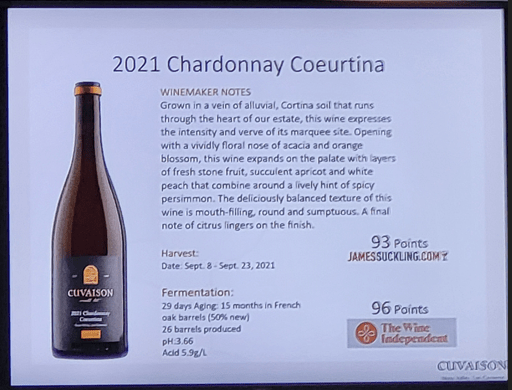
In each comparison I found the flavours of the Napa wines to be extremely close to the French, though to me the French was slightly more mellow and smoother. The Cuvaison wines are priced at $70 US each and are only available directly from the winery.  In comparison, the ships wines would have an equivalent price of approximately $15 – $20 US per bottle.

During the second seminar Zepponi discussed micro-lots as they pertain to the wine industry. When a winery wants to produce a type of wine but does not have enough of the varietal in their own vineyard they may purchase the varietal from another grape grower.   The purchased grapes are then used to make a specific wine exclusively from that purchased micro-lot. This allows the winemaker to better control the grapes being used and the wine produced, in a similar manner that would be done if the vintner was using their own estate grown grapes.

Two taste comparisons were conducted, the first was with Cuvaison’s 2022 En Cigar Chardonnay Blanc and the ship’s undisclosed Sauvignon Blanc house wine. The second comparison was conducted using their 2022 Fiddlestix Pinot Noir and an undescribed French Pinot Noir. I favoured the French Sauvignon Blanc over the Cuvaison but did find Cuvaison’s Pinot to be smoother and less fresh that the French Pinot. Once again though, the price between the American and French wines was significantly different – $70 US for both Cuvaison’s versus under $20 US for the French wines.

Unfortunately, the two seminars lacked substance and honesty as they were actually marketing presentations for Cuvaison wines. Zepponi would have had more credibility in my eyes if he had presented his talks as being an introduction to Cuvaison wines. There was no value in conducting taste comparisons with wines that are not even identified by name, let alone any information about where or how the wines were produced. He should have simply talked about how his wines are produced.

Based on information presented about the various Cuvaison wines, they are producing decent wines at a reasonable price point. However, the feeble attempt at conducting product comparisons was an insult to the intelligence of the ship’s passengers.

Sláinte mhaith

The Beaujolais Wine District

My wife and I recently returned from an excursion to France, which included exploration of several wine regions including the Beaujolais district of Burgundy. Beaujolais is a French Appellation d’Origine Contrôlée (AOC) wine, generally made from Gamay grapes.  The grapes are thin skinned and are low in tannins.

The soil (terroir) consists of granite, schist, clay and sandstone. The vines are pruned using the goblet method, which is mainly practiced in the Mediterranean regions because having a foot close to the ground shelters the vine from the wind and the falling vegetation protects the grapes from the sun. This method of pruning only allows 3 to 5 branches to be kept on the vine. The branches end with a spur of 3 or 4 buds.

Goblet pruning is a drought-resistant and berry-protected method but prohibits the use of mechanized harvesting methods. Economically, the reduction in yields can be significant. The cost of production can be high due to an increased need for labour and the drop in production.

Climate change has been presenting a variety of challenges during recent years. Netting has had to be installed to protect the grapes from summertime hailstorms that have been regularly occurring since 2007. Very wet spring seasons, like this year, are threatening to delay the start of the growing season, thus reducing the yield potential and increasing the risk of mold on the vines.

The wines produced in the Beaujolais district include Beaujolais, Beaujolais Villages, cru Beaujolais and Beaujolais Nouveau. The region also produces a small amount of Chardonnay (about 4%) but none of that wine is sold outside of France.

Isabelle Brossard

We visited Château de Pravins, a 12th century winery. The current owners acquired the winery in 1941. The purchaser was Joseph Mathieu, whose descendant, Isabelle Brossard, operates the winery today. It is a biodynamic winery (uses organic processes) that expands across 26 hectares. The grapes are still crushed by feet, but pipes and pumps are also now used. One kilo of grapes is required to produce a single bottle of wine.  The AOC limits the Beaujolais wineries from producing any more than 6,000 litres of wine per hectare and allows only cement vats to be used in the production process.

While there we sampled three red wines, l’argile ardente No 2, les moraines, and l’argile ardente. I found all tree wines to be as equally as nice.

Based on the slow soggy start to the 2024 growing season, don’t be surprised if the 2024 vintage of Beaujolais wine is limited and thus more expensive than some previous years.

Sláinte mhaith

Wine and Pasta

Wine and Pasta

Winter is a time for comfort food and one of my favourite comfort foods is pasta. When it comes to pairing a wine with pasta, the deciding factor should be the accompanying sauce, not the pasta itself because after all, pasta by itself does not have a great deal of flavour.

Photo credit: finewinemaster.com

Tomato-Based Pasta

Tomato-based sauces are high in acid and are often blended with beef or pork. Because of the acidity in tomatoes, a dry, medium-bodied red wine is recommended. Examples of red, medium-weight wines include:

  • Chianti
  • Grenache
  • Nero d’Avola
  • Primitivo
  • Rhône Blends
  • Sangiovese
  • Zinfandel

Cheese Pasta

There are a wide range of red as well as white wines that will pair well with cheese sauces. You shouldn’t feel restricted to serving just white wine with white cheese pasta. An oaked white wine will have a buttery character that will compliment the creamy sauce. Examples include an oaked Trebbiano or Chardonnay. Here are a couple of white wine options to consider:

  • Oaked Chardonnay
  • Oaked Trebbiano

Also, lighter more floral red wines will also pair well with intense hard-cheese pasta, especially if there are mushrooms or root vegetables in the sauce.   Red wine options include:

  • Chianti
  • Nebbiolo
  • Pinot Noir
  • Sangiovese

Seafood Pasta

Light-bodied white wines are the preferred pairing choice for seafood pasta. These wines will be relatively acidic, thus a good balance for creamy white sauces and fatty seafood, such as scallops, shrimp, oysters or mussels. White wine options include:

  • Chenin Blanc
  • Grenache Blanc
  • Pinot Gris / Pinot Grigio
  • Riesling
  • Sauvignon Blanc

For seafood pasta that is cooked in a tomato-based sauce, light body red wines or Rosé are a good option. Red wine options include:

  • Pinot Noir
  • Malbec

Pesto Pasta

Whether you are serving the traditional pine nut and basil pesto or another type of pesto, the focus should be on matching the green, whether it be parsley, cilantro, mint, etc. which is the centerpiece of the dish. For the most part, herbaceous wines are said to be best suited when serving pesto pasta. Herbaceous wines are those wines that have aromas and flavours like herbs such as mint, vegetables such as asparagus, freshly cut grass or tomato leaves. Wines considered to be herbaceous include:

  • Grüner Veltliner
  • Sauvignon Blanc
  • Cabernet Sauvignon

Primavera (Vegetable) Pasta

Spring onions, garlic ramps, artichoke hearts and broccolini are among the choices on which to base primavera. The objective is to highlight the springy freshness of the vegetables; thus, it is often best paired with a light-bodied white wine with lemony and floral notes. However, if the pasta has major vegetable intensity, it needs to be matched with an equally savory white wine. White sauce wine options include:

  • Pinot Gris / Pinot Grigio
  • Riesling
  • Sauvignon Blanc
  • Vermentino

If tomatoes are a major component of the primavera, a light-bodied acidic red wine would be a better choice. Tomato sauce wine options include:

  • Cabernet Franc
  • Pinot Noir
  • Rosé

No matter which type of pasta you fancy, one of the corresponding wine options will compliment your meal.

Sláinte mhaith

The Wines of Armenia

Armenia is a wine region that I was unaware of until I saw an Armenian wine advertised recently in a wine catalogue. That enticed me to do some research and here is what I learned.

The bulk of wine grapes indigenous to Armenia are not very well known in North America. Hindering Armenia’s ability to familiarize the rest of the world with its wines are the ongoing conflicts surrounding its borders. Armenia is situated between Georgia, Iran, Azerbaijan and Turkey. Armenia’s rivers and high plateaus are surrounded by the Caucasus Mountains.

The country’s wine history is ancient. The region of Vayots Dzor claims to be home to the oldest winery in the world, in operation since some 6,100 years ago.

As with some other Eastern European countries, the progression of Armenian wine ended when the Soviet Red Army invaded in 1920. In 1922 the country was merged into the Transcaucasian Soviet Federated Socialist Republic. Then, in 1936 it became the Armenian Soviet Socialist Republic or Soviet Armenia.

Innovation stopped with the elimination of private enterprise. The Soviets converted wineries into processing plants and vineyards turned over fruit for brandy distillation or bulk wine production.  Some vineyards were planted in unfavorable locations, while others went neglected or abandoned.

In 1991, after the demise of the Soviet Union, Armenia regained its sovereignty. Young Armenians and those with investment money began to embrace the region’s ancient wine-making techniques and wine culture. As a result, Armenia has become the youngest oldest wine industry in the world.

During the Soviet years a great deal of information was lost, including knowledge of the traits of many indigenous grape varieties, understanding soil suitability, sun preference, as well as how much maceration and aging of the grapes is best. Regaining this knowledge requires years of experimentation.

A few producers work with international grapes mainly for the Russian and other former Soviet republic markets. However, new quality-driven wineries focus on local varieties. Much of the post Soviet revival has included using a combination of modern technology and traditional techniques, such as aging the wine in terracotta jars called karasi.

The drive to produce quality wines has helped winemakers find export partners. Being a landlocked country, Armenia cannot produce low-cost wines. It must become part of the higher-priced market segment.

Armenia contains four main wine regions. The best known is the south-central region of Vayots Dzor, a long, narrow plateau which stands out for its highest elevation vineyards, some which reach almost 6,000 feet above sea level.

The Aragatsotn region is situated at slightly lower elevation. The remaining regions include Ararat, which is located on a sunny plateau, and Armavir, which is a mountainous area in the southwest.

Grape varietals include Areni Noir, which produces medium-bodied red wines with fruits like cherry and strawberry laced with black pepper aromas. It compares in its freshness, silkiness and transparency to Pinot Noir.

Voskehat is Armenia’s signature white grape. The wine has light to medium body. It has floral and stone fruit aromas with notes of herbs and citrus.

Khndoghni, or Sireni, is a red grape that gives black fruit flavors, deep colour, good tannins and the potential to age.

To sum it up, Armenia is small, landlocked and poor. However, it appears to have resilience, an ability to adapt, and a desire to show the world its world-class wines. Many experts feel that there is a future for quality Armenian wines.

Sláinte mhaith