De-alcoholized Wine

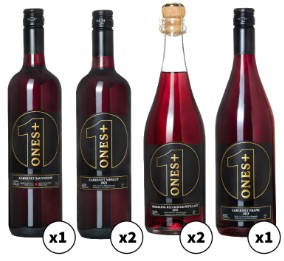
My wife recently came across an article about a non-alcoholic winery that has received endorsement on CBC’s Dragons’ Den television show. Based on their endorsement and our curiosity, we agreed we would purchase a boxed set of wines online, which included Cabernet Merlot, Cabernet Sauvignon, Cabernet Franc and a sparkling red.

Photo credit: drinkones.com

I read that before sampling any de-alcoholized wine it is important to keep in mind that these wines cannot be directly compared to wines containing alcohol and should not be considered as a substitute. Instead, according to one source, non-alcoholic wine should be deemed as complementary to regular wine. However, in my opinion, if this beverage is not to be compared to regular wine, then don’t call it wine. Give it a different name.

De-alcoholized wine will still contain some alcohol, but only an amount to a maximum of 0.5% alcohol by volume. Unfortunately, manipulation to remove alcohol can inadvertently remove the aromas and characteristics of the grape varietal.

When the wines arrived, we first tried the Cabernet Merlot, and following the food pairing suggestions on the label, served it with pork tenderloin. To say that we were underwhelmed would be an understatement. My wife described it best by summarizing it by saying that it tasted extremely watered down. The wine had basically no aroma.

The second wine we tried was the sparkling red. It proved to be a much better experience having more of a fuller, less acid taste. There was a sweetness to the wine that I suspected was artificially added but according to the label, no sugar had been added. Also, given the amount of fizz and the length of time that the bubbles remained in both the glass and the bottle, I suspect that the carbonation was added rather than occurring naturally through fermentation.

The third wine we explored was the Cabernet Franc, which we had with spaghetti and meatballs. Although this wine similarly lacked in flavour like the Cabernet Merlot, it did have a little more of a finish to it. One advantage this wine had over the first was that our tastebuds were prepared for the underwhelming flavour and lack of richness, thus making it more palatable and less of a shock.

The final wine selection was the Cabernet Sauvignon. I expected this wine to be the boldest of the group but other than having a slightly longer finish there was not much of a difference between this and either the Cabernet Franc or Cabernet Merlot. We paired the Cab Sauv with homemade pizza, but I don’t think any food pairing is going to make the wine more endearing.

The breweries seem to do a much better job of de-alcoholizing as I have had several brands and types of non-alcoholic beer that I have enjoyed. I found strong similarities to traditional beer. On the other hand, the wines were a big disappointment as they did not come anywhere close to mirroring the alcoholized version of the same varietal. However, once I knew what to expect, I was able to be more accepting of the wine and applaud the initiative to produce a non-alcoholic version. though further effort is needed to enrich the flavour.

The one similarity the de-alcoholized wine shares with regular wine is its appearance. Though the colour may be slightly less vibrant, it is unlikely that anyone at a social gathering could tell what type of wine was in your glass.

Sláinte mhaith

Bock Winery, Villany, Hungary

While on a recent Danube River cruise through some of the former Iron Curtain countries of eastern Europe, I visited the Bock Winery, which is located near Mohacs (“the mother of wine”), Hungary. It is a tenth-generation family winery that was established in 1850. It spreads out over 125 hectares or about 310 acres.

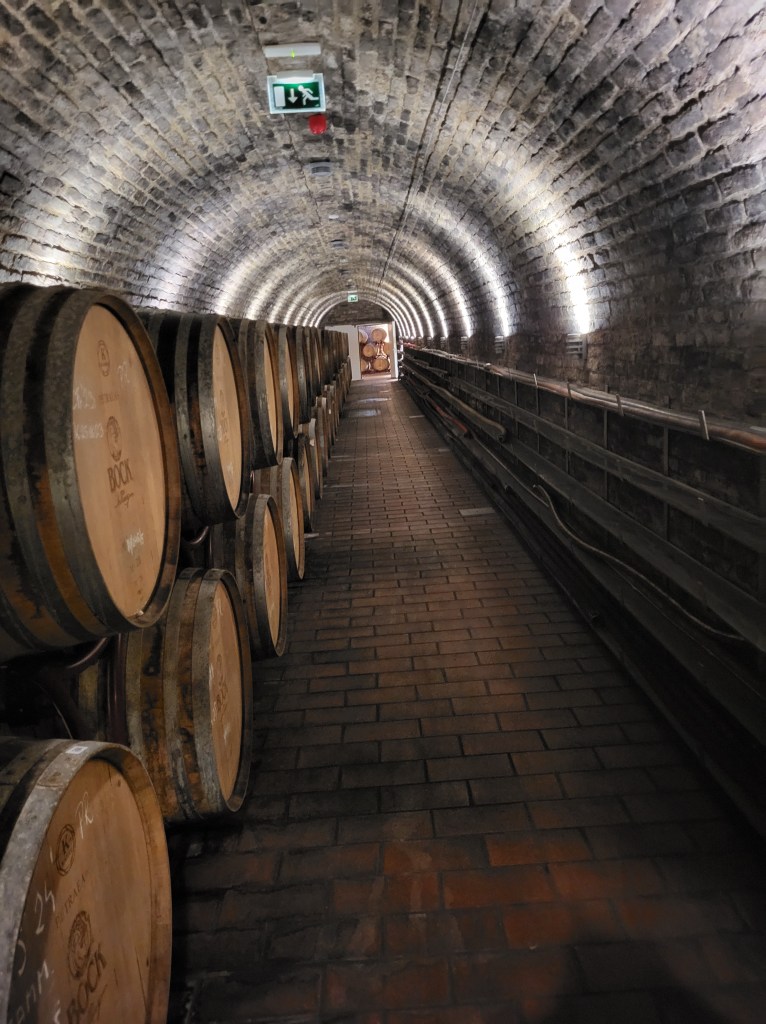
Bock’s cellars

Bock’s wines are aged in a combination of French, American and Hungarian oak barrels. The use of Hungarian oak introduces a flavour and nose that is slightly different than what would be experienced with most new world wines of Australia, North America or South America. The vintner also uses a combination of both new oak and old oak barrels, depending on the specific wine being produced.

In addition to wine, Bock also produces grape seed oil, grape seed tablets and grape seed flour. This is done to minimize the amount of waste resulting from the wine making process.

While there I had the opportunity to try four of Bock’s wines – a 2023 Villányi Hárslevelú, a 2024 Villányi Rosé Curvée, a 2017 Villányi Bock Curvée, and the 2022 Cabernet Franc.

2023 Villányi Hárslevelú

This is a fresh and fragrant white wine that is produced from a native Hungarian grape variety. It is made using overripe grapes grown on 40-year-old vines in the Göntér vineyard. Its colour is a medium-intensity, straw yellow. The aroma reveals linden blossom, combined with a slight citrus note, which is also reflected in the taste.

2024 Villányi Rosé Curvée

This is a fresh and fragrant wine produced from the virgin must of blue grape varieties from Bock’s vineyards. It has a medium colour with salmon-pink hues. The aroma and taste consist of strawberries, accompanied by satisfying acidity. The wine is enhanced with carbon dioxide before bottling.

2017 Villányi Bock Curvée

2017 Villányi Bock Curvée

This is Bock Winery’s flagship wine, produced from a blend of premium red grapes from several Bock vineyards which produce a full-bodied wine. It is a Bordeaux-type blend of Cabernet Sauvignon (60%), Cabernet Franc (30%) and Merlot (10%) that has developed in new, small oak barrels for 24 months and then in the bottle for an additional year. The wine is characterized by a deep, dark intensity and dark purplish red hue. It is a full-bodied wine, with a scent of ripe cherries and tobacco, and a taste of overripe fruits, chocolate and vanilla.

This was my personal favourite of the wines I sampled.

2022 Cabernet Franc

This is a medium-bodied red wine using grapes from several of Bock’s vineyards. After fermentation, the Cabernet Franc matures in large oak barrels for 12 months to produce a dark, intense, deep red wine with a large body. It has a complex aroma and taste, in which the fruitiness forms a unity with the aromas from the barrel.

Good news for Ontario residents, Bock Wines are periodically available liquor stores.

Sláinte mhaith

The 2025 National Wine Awards

Photo credit: winealign.com

This year Penticton, British Columbia hosted the 25th anniversary of the WineAlign National Wine Awards of Canada (NWAC). The NWAC is the country’s largest competition, involving only 100 percent Canadian-grown and produced wines.

This year a new category was introduced – Library Wines. This classification includes wines that are 5 years or older. These aged wines were not compared against each other but instead, each wine was independently assessed as to where it was in its lifecycle and how well it was ageing and tasting.

The Replacement wines or Crafted in B.C. wines were not included as part of The WineAlign National Wine Awards.

Winery of the Year

The 2025 Winery of the Year is Penticton, British Columbia’s Mission Hill Family Estate. This is the sixth time Anthony von Mandl has been awarded this prestigious honour.

This year, Mission Hill entered 11 top-tier wines, earning two Platinum medals, five Golds and one Silver medal.

The balance of the top 10 wineries are:

  • Laughing Stock Vineyards, Penticton, British Columbia
  • Meyer Family Vineyards, Okanagan Valley, British Columbia
  • SpearHead Winery, Kelowna, British Columbia
  • The Organized Crime Winery, Beamsville, Ontario
  • Quails’ Gate Winery, Kelowna, British Columbia
  • Peller Estates, Niagara-on-the-Lake, Ontario
  • Fielding Estate Winery, Lincoln, Ontario
  • Trius Winery, Niagara-on-the-Lake, Ontario
  • Tantalus Vineyards, Kelowna, British Columbia

Best Performing Small Winery

This year’s Best Performing Small Winery is Penticton, British Columbia’s Laughing Stock Vineyards. Laughing Stock earned eight medals at this year’s event: two Platinum, three Gold, one Silver, and two Bronze. 

When the winery was acquired by Arterra Wines in 2017, some experts had concerns as to whether Laughing Stock would maintain its boutique identity under its new corporate umbrella. However, the winery continues to operate with a small, focused team and remains fully independent in its winemaking approach.

The balance of the top 10 small wineries are:

  • Meyer Family Vineyards, Okanagan Valley, British Columbia
  • SpearHead Winery, Kelowna, British Columbia
  • The Organized Crime Winery, Beamsville, Ontario
  • Tantalus Vineyards, Kelowna, British Columbia
  • Township 7 Vineyards and Winery, Penticton, British Columbia
  • Stag’s Hollow Winery, Okanagan Falls, British Columbia
  • Moon Cruiser Vineyards, Osoyoos, British Columbia
  • Orofino Vineyards, Similkameen Valley, British Columbia
  • Thirty Bench Wine Makers, Beamsville, Ontario

Platinum Awards

A Platinum medal is the highest award possible. Less than 2% of the 1,700 wines and ciders entered received this award.

The award process involves a minimum of eight judges, three or four in the first round, and five or six in the second round. Each wine must have achieved an aggregate score of 93 points by five of those judges. 93 points or better is considered entering the realm of “outstanding.” Thus, not every judging category had a Platinum recipient.

This year’s Platinum Award winners are listed below:

Library Wines

  • Moon Curser 2020 Malbec, Okanagan Valley, British Columbia

Red Blends

  • Black Hills 2023 Bona Fide, Okanagan Valley, British Columbia
  • Laughing Stock 2022 Blind Trust Red, Okanagan Valley, British Columbia
  • Nomad at Hinterbrook Winery 2021 Wanderlust, Niagara Lakeshore, Niagara Peninsula, Ontario
  • Palatine Hills Ramblers 2024 Schmoozer Cabernet Merlot, Niagara Lakeshore, Niagara Peninsula, Ontario
  • The Organized Crime 2022 The Download, Beamsville Bench, Niagara Peninsula, Ontario
  • Trius 2022 Grand Red, Niagara-on-the-Lake, Niagara Peninsula, Ontario

Pinot Noir

  • 1 Mill Road 2022 Pinot Noir Home Block, Naramata Bench, Okanagan Valley, British Columbia
  • Lightning Rock Winery 2022 Pinot Noir Canyonview Vineyard, Okanagan Valley, British Columbia
  • Meyer 2022 Old Block Pinot Noir   McLean Creek Road Vineyard, Okanagan Falls, Okanagan Valley, British Columbia
  • SpearHead 2022 Okanagan Valley Pinot Noir, Okanagan Valley, British Columbia
  • SpearHead 2022 Pommard Clone Pinot Noir, Okanagan Valley, British Columbia

Chardonnay

  • 1 Mill Road 2023 Chardonnay, Naramata Bench, Okanagan Valley, British Columbia
  • Meyer 2022 Chardonnay McLean Creek Road Vineyard, Okanagan Falls, Okanagan Valley, British Columbia
  • Mission Hill Family Estate 2022 Perpetua, Okanagan Valley, British Columbia
  • Quails’ Gate Winery 2022 Rosemary’s Block Chardonnay, Okanagan Valley, British Columbia

Syrah

  • Laughing Stock 2022 Syrah, Okanagan Valley, British Columbia
  • Sandhill 2022 Syrah Terroir Driven Wine, British Columbia
  • Stag’s Hollow 2022 Syrah, Okanagan Valley, British Columbia

Riesling

  • CedarCreek 2022 Aspect Collection Riesling, Okanagan Valley, British Columbia
  • Peller Estates 2023 Signature Series Riesling, Niagara Peninsula, Ontario
  • Thirty Bench 2022 Small Lot Riesling, Triangle Vineyard, Beamsville Bench, Niagara Peninsula, Ontario Trius 2023 Showcase Riesling, Ghost Creek, Four Mile Creek, Niagara Peninsula, Ontario

Icewine and Late Harvest

  • Inniskillin 2023 Riesling Icewine Niagara Estate, Niagara Peninsula, Ontario
  • Byland 2023 Riesling Icewine, Niagara-on-the-Lake, Niagara Peninsula, Ontario

Cabernet Franc

  • Black Bank Hill 2022 Cabernet Franc, Lincoln Lakeshore, Niagara Peninsula, Ontario
  • Fielding 2023 Cabernet Franc, Niagara Peninsula, Ontario
  • Kismet 2022 Cabernet Franc Reserve, Okanagan Valley, British Columbia
  • Mission Hill Family Estate 2022 Terroir Cabernet Franc, Okanagan Valley, British Columbia
  • Niagara College Teaching Winery 2022 Dean’s List Cabernet Franc, St. David’s Bench, Niagara Peninsula, Ontario
  • Tinhorn Creek 2022 Cabernet Franc, Okanagan Valley, British Columbia
  • Merlot

The complete list of award winners can be found at www.winealign/awards.

Sláinte mhaith

The Left Bank’s Margaux Appellation

On my recent excursion to Bordeaux, France, I travelled to the Left Bank’s Margaux appellation where I visited Château Dauzac, which is a Margaux Grand Cru Classé according to the 1855 classification. Their vineyards span 49 hectares.

All the wines utilize gravity-flow vatting. Fermentation takes place in wooden vats with transparent double staves. The wine was aged in 100% French oak barrels (including 65% new barrels) for 15 months with racking based on tasting results.

Dedicated to the expression of terroir and dominated by Cabernet Sauvignon, Château Dauzac reveals a nicely complex bouquet that slowly unfolds during aeration. On the palate, it strikes a subtle balance between the richness of its tannins and the aromatic diversity of its supple fruits, emblematic of great wines for ageing.

Cabernet Sauvignon dominates with its complexity, elegance and minerality, while Merlot adds roundness and silkiness. Always deep in colour, Château Dauzac expresses a subtle balance where fruits, flowers and spices are combined, with a complex body and tannins ensuring an emotional tasting experience.

Like many of the wineries in the region, Château Dauzac is committed to reducing its carbon footprint. They have formed a partnership with Bioboon Agrology. Together they are working toward the ecological transition of agricultural activities that promote plant health while preserving the surrounding biodiversity.

They have also planted bamboo on the estate. The bamboo acts as an essential carbon sequestration mechanism, offsetting the residual emissions of their carbon-neutral wine. This initiative reduces the environmental impact of the winery’s activities.

Château Dauzac is also investing in research and development to fight against mildew. The aim is to use natural products free of heavy metals to preserve the health of their vines and the balance of the surrounding ecosystem.

The terroir is a clay-based soil that contains deep gravel outcrops. The vines have an average age of 35 to 40 years. The grape varietals consist of 69% Cabernet Sauvignon, 29% Merlot and 2% Petit-Verdot. The grapes are harvested by hand in small crates and sorted on tables before and after de-stemming.

The first wine that I sampled at Château Dauzac was the 2021 “Aurore de Dauzac Margaux”, which is a blend of 62% Cabernet Sauvignon, 37% Merlot and 1% Petit Verdot. It is bright red with ruby hues and a nose of red fruit with a slightly floral expression. The flavour displays a pleasant concentration with notes of black fruit.

The second wine I tasted was the 2019 Margaux Grande Cru Classé. Château Dauzac 2019 is a wine that expresses exceptional fruit vibrancy. It is very well-balanced and composed of dense tannins that exhibit finesse and elegance. It consists of a blend of 73% Cabernet Sauvignon and 27% Merlot.

I was surprised to see how much my wife enjoyed this wine as she usually prefers the Right Bank Merlot concentrated wines over the Left Bank Cabernet Sauvignon dominant wines. In fact, she enjoyed it so much that we decided to have some shipped home. When making the shipping arrangements we were told that the 2022 vintage would be more superior to the 2019, given the climate conditions that existed that year. The only caveat was that the 2022 would not reach its full potential for another 10 years.

We then decided that we would purchase some of the 2022 vintage as well to ship home. The 2022 wine consists of 63% Cabernet Sauvignon and 37 % Merlot. The overall yield was small due to the lack of water but the remarkable quality will make the 2022 vintage one of the greatest ever experienced in Bordeaux.

I was pleased to learn that Château Dauzac wines are occasionally available in Ontario liquor stores. I will be eagerly awaiting the next vintage to appear on store shelves.

Sláinte mhaith

The Blaye Côtes de Bordeaux Appellation

On the Right Bank, near the village of Bourg, I had the opportunity to visit Chateau Monconseil-Gazin, a third-generation family preserved estate winery owned by the Baudet family. The wines produced are part of the Blaye Côtes de Bordeaux appellation.

The vineyard’s hilly terrain benefits from a microclimate caused by the proximity of the estuary and the Atlantic Ocean. The clay-limestone soils rest on a soft rock substrate that is very favorable to the roots of the vines and perfect for drainage.

The 35 hectares of gentle slopes facing south and southwest predominantly grow the Merlot grape variety, complemented by Cabernet Sauvignon, Cabernet Franc and Malbec.

The first wine that I tasted was the 2023 “Blaye Côtes De Bordeaux”, a white Sauvignon. The vines are cultivated according to the sustainable agriculture charter for the development and protection of the terroir. No chemical fertilizers are used.

The wine consists of 100% Sauvignon Blanc that is aged on fine lees, which are the smaller, more gradual sediment that settles at the bottom of a fermentation vessel after winemaking. The fine lees age with the wine, adding complexity, texture, and flavour. The wine is bottled at the Château.

The terroir is a clay-limestone on stony subsoil, providing excellent drainage and deep roots. The slopes face south-southwest, ensuring optimal maturity of the grapes.

This wine’s aroma contains notes of citrus and flowers and has a smooth crisp palate. The finish is long, fresh and fruity.

The second wine I had was the “Blaye Côtes De Bordeaux – Blanc Prestige”, made of 80% Sauvignon Blanc and 20% Sémillon. This wine releases an elegant nose of lychee and citrus fruit complemented by a light oakiness. The palate is dense and smooth, with a freshness that lingers through to the finish.

The third wine I sampled was the 2020 “Blaye Côtes De Bordeaux” red. Once again, the vines are cultivated according to the sustainable agriculture charter for the development and protection of the terroir, using no chemical fertilizers.

The wine is produced from 70% Merlot, 20% Cabernet Sauvignon and 10% Malbec grapes. It is aged in French oak barrels for 12 months, then blended and lightly filtered before being bottled at the Château.

The terroir is clay-limestone hillsides on a stony subsoil, excellent for drainage and rooting.  The vineyard slopes are south/southwest facing, ensuring optimal maturity of the grapes.

The flavour has hints of woody and toasty accents accompanied by notes of violet, blackberry, crème de cassis, tobacco leaf and sage. There is an abundance of young fruit with tannins and acidity.

This wine has had more than twenty years of recognition by the most prestigious competitions in France and internationally: Mâcon, Paris, Aquitaine, Challenge International du Vin, Brussels and London.

The last wine I tasted was the 2019 “Grande Réserve”, which is made from 50% Merlot, 20% Cabernet Sauvignon, 20% Malbec and 10% Cabernet Franc. The wine was matured in French oak barrels (50% new) for 18 months, blended and lightly filtered and then bottled at the Château.

This wine offers ripe fruit and notes of mocha, toast and vanilla. The tannins are tight and the flavours are full.

This wine has been recognized by the most prestigious competitions and specialist magazines such as the HACHETTE Guide, the Revue des Vins de France, Decanter and In Vino Veritas.

My wife and I enjoyed this one enough that we purchased a bottle to drink after our day’s explorations. Unfortunately, Chateau Monconseil Gazin wines are not currently available in Ontario liquor stores.

Sláinte mhaith

The Médoc Area of Saint-Émilion

The first area I explored on my recent trip to France’s Bordeaux region was Médoc, which is situated on the Right Bank. The name Médoc is synonymous with exceptional wines. Considered as one of the world’s leading red wine producers, Médoc has been a winemaking region since the 18th century, with more than 16,000 hectares of vineyards across eight sub-appellations.

In Médoc, which is part of the Saint-Émilion appellation that has over 800 Chateaux, I visited the family-owned winery, Château Fleur Cardinale. The terroir consists of a mix of clay and limestone. Typical of Right Bank wineries, their wines consist of a blend of around 70% Merlot, 20% Cabernet Franc and 10% Cabernet Sauvignon. The blended portions vary slightly from year to year depending on the yield of each grape varietal.

La Maison Cardinale was established in 2001, when Dominique and Florence Decoster acquired Château Fleur Cardinale. In 2017, their son Ludovic and his wife Caroline took the reins of the family estate. In 2024, they created La Maison Cardinale, an entity that brings together Château Fleur Cardinale, a Saint-Émilion Grand Cru Classé, and Château Croix Cardinale, a Saint-Émilion Grand Cru.

They have two estates, Château Fleur Cardinale and Château Croix Cardinale. Château Fleur Cardinale covers 27.6 hectares on the northern slope, producing a Saint-Emilion Grand Cru Classé. The northern slope is also ideal to produce Fleur Cardinale white, in the Bordeaux appellation. Château Croix Cardinale covers 4 hectares on the southern slope, producing a Saint-Emilion Grand Cru.

While there I had the opportunity to sample 2023 “Cardinal Flower Intuition Saint-Emilion Grand Cru” and the 2019 “Grand Cru Classé, Saint-Emilion Grand Cru”. The Intuition had an intense aromatic profile of ripe black fruits. There were subtle tannins and a supple, fresh texture. The Grand Cru Classé had a sensation of fresh and intense fruit, both on the nose and in the mouth. In my opinion it was much smoother and better balanced than the Cardinal Flower Intuition.

The grapes for both wines are picked by hand. There are about 15,000 bottles of Cardinal Flower Intuition produced each year and 105,000 bottles of the Grand Cru Classé. About 80% of the wine is sold to wine agents for export with the balance being sold from the winery. Unfortunately, Château Fleur Cardinale wines do not appear to be available in Ontario liquor stores.

Sláinte mhaith

My Adventure to Bordeaux

I recently returned from a trip to the Bordeaux region of France where I took advantage of the opportunity to experience some of the finest wines in the world.

The effects of climate change are impacting the grape harvests there the same as they are in many other parts of the world. The region is facing increasing temperatures and drought conditions each year. Not helping matters is the governing regulation that prohibits vineyards to irrigate vines that are more than 3 years old.

To help try and offset the effects of climate change, I saw horses being used in place of tractors to till the weeds that were growing between the rows of grape vines, lessening the need for herbicides and reducing the generation of carbon monoxide.

The Bordeaux region is separated into 2 distinct areas: the Left Bank and the Right Bank. To help identify which is which, the city of Bordeaux is situated on the Left Bank.

Bordeaux’s wine areas are often categorized into five main zones, primarily based on their location in relation to the Gironde, Garonne, and Dordogne rivers. These zones are: The Médoc, Graves and Sauternais, The Libournais, Blaye and Bourg and Entre-Deux-Mers.  During our trip I visited wineries on both the Left Bank and Right Bank.

The Left Bank, often referred to as the Médoc and Graves, produces red wines, while the Right Bank, including Saint-Émilion and Pomerol, also focuses on red wines. Entre-Deux-Mers produces both red and white wines, and the Graves and Sauternais are known for their sweet white wines.

There are five Bordeaux wine classifications. These classifications serve as an expression of quality and prestige worldwide. The principle of the crus classés (“classified growths”) illustrates the synthesis of a terroir’s typical characteristics and dedicated human intervention over many generations to ensure quality. However, a wine or appellation can still be outstanding even if it is not a part of these classifications. The classifications are listed in order of seniority:

  • The 1855 classification
  • The Graves classification
  • The Saint-Émilion classification
  • The Crus Bourgeois du Médoc classification
  • The Crus Artisans classification

For a winery in Bordeaux to be referred to as a Château, the property must include a large house, vineyards and a place to make wine.

The age of the vines impacts the quality of the Bordeaux wine. The older the vine, the more expensive the wine. The roots on old vines extend much deeper and extend further int the soil. This adds minerality to the fruit, which in turn adds complexity to the flavour of the wine.

One thing I found interesting on this trip was how the various winery staff pronounced Cabernet Franc. I was always under the impression that Cabernet Franc was pronounced as the French do, with the ‘c’ in Franc being silent – ka·br·nay frong, but I now found out that it is acceptable to pronounce it in English as ka·br·nay frank.

Over the next few weeks I will describe my adventures through the region, as well as the wineries I had the opportunity to experience.

Sláinte mhaith

Wine Barrels

Is the best wine made using French oak barrels or American oak barrels? The answer depends on who is answering. I would be amiss if I didn’t mention that there are also Hungarian oak and Romanian oak but these oaks are seldomly used in making wine.

Photo credit: bodegaspaniza.com

Oak can play a crucial role in the winemaking process. It is a long-known fact that not just any wood will do when it comes to aging wine. Oak has been the choice for centuries. Due to the natural wood compounds, aging wine in oak barrels exposes complex flavours and textures that are crucial to the overall taste and structure of a wine. There are natural wood sugars in the oak that influence the wine’s flavour. The wine’s texture can be enhanced from tannins found in the oak.

French Oak is known by winemakers for its subtlety. These trees have tighter grains that deliver lower amounts of tannin that are more readily integrated into the wine. This wood is also more aromatic, producing delicate notes of dark chocolate, roasted coffee beans, vanilla and baking spices to the wine.

American Oak presents more robust flavour profiles introducing bold vanilla notes along with coconut, sweet spices and dill. The wider grain patterns of American oak also injects more tannins into the wine.

French Oak lets wine age gracefully over time. The wine will evaporate less from barrels of French oak than American oak, thus producing a naturally slower oxidation. On the other hand, American oak will often go through a more rapid oxidation process in the barrel.

When it comes to price, American oak is less expensive to purchase. This is due to it being more readily available than French oak. However, French oak produces a more luxurious wine, making it well worth the higher price tag.

So, which wines work best with French oak versus American oak? Chardonnay flourishes when aged in French oak barrels because the French oak releases delicate vanilla undertones into the flavour of the wine.

Pinot Noir also benefits from the use of French oak. This light-bodied red grape works well with the lower tannin content inherent to French oak. It allows for slow maturation without overwhelming Pinot Noir’s naturally elegant profile.

In contrast, bold reds such as Zinfandel often get paired with American oak. The intense notes of coconut and sweet spice from the American oak can complement the robust nature of these types of wine.

Wines such as Cabernet Sauvignon, Merlot or Syrah can work well with either French or American oak, depending on the winemaker’s desires. European winemakers tend to use French oak while American winemakers and some Australian vintners may use American oak. It all comes down to the desired style of the wine.

Many winemakers use both types of barrels or blend wines aged separately. It lets them control flavour profiles more precisely. The type of barrel used, or combination of barrels used will depend on the flavour notes the winemaker wants to achieve.

Sláinte mhaith

Maritimes Adventure

During a recent trip to the maritime provinces of Canada, I made a point of seeking out local wines to try. The first I came across while in St. Andrews by the Sea, New Brunswick; the second I found in North Rustico, Prince Edward Island and two while in Nova Scotia.

The first wine my wife and I tried was a 2019 Marquette from the Magnetic Hill Winery of Moncton, New Brunswick. It was a light bodied red wine similar to a Pinot Noir. It had aromas of cherries, blackcurrants and blackberries. The wine was a pleasure to drink and reasonably priced at $20.00 CDN.

The Marquette varietal is the cousin of the Frontenac varietal, which is a well-known French North American hybrid, and a descendant of Pinot Noir. This wine pairs well with pub foods such as cheeseburgers, bangers (sausages) and mash and chili con carne.

The second wine we tried was a $21.99 CDN Gamay from Matos Winery & Vineyards of St. Catherines, PEI. Until then I was not aware that there is a winery on PEI.

Matos Winery & Vineyards is a family-owned and run business that was initiated in 2007.  They utilize the French concept of terroir whereby they found a location where the combination of soil, slope, sun exposure and the peculiar weather patterns allow certain grape varieties to thrive.  They consulted with European vintners who visited PEI to provide their skill and knowledge.

Their Gamay has won a bronze medal at the National Wine Awards in 2016, 2014, 2012 and silver in 2011.

The first wine from Nova Scotia that we tried was the 2022 Baco Noir from Blomidon Estate Winery, of the Annapolis Valley, near Canning.

The 2022 Baco Noir has a nose of bright berry fruit accentuated by vanilla and notes of spice. Unfortunately for us, we found the wine to be slightly harsh and not quite as smooth and mellow as we have become accustomed to for Baco Noir. The price of this wine is $23.00 CDN.

Given the structure of this wine it would be best suited for pairing with barbecued beef or pork.

Blomidon Estate produces 100% Nova Scotia grown grapes and wines. Over the years they have earned several national and international awards.

The 2nd wine from Nova Scotia we experienced was Founders’ Red from Jost Winery, which is made from a blend of Leon Millot and Marechal Foch grapes. We experienced this wine during a quiet afternoon at our B&B outside of Cap-Pelé, New Brunswick. Like the day, this wine was very smooth and mellow. It had wonderful fruit flavours and was well worth the $17.19 CDN we paid for it. 

Founders’ Red is a well-balanced blend of Nova Scotian-grown grapes with deep colour and intensity. This wine pairs well with barbequed meats and roasted pork.

Sláinte mhaith

Vintage versus Non-vintage Wine

On the surface, the difference between vintage and non-vintage wines is simple. Vintage wines are made from grapes harvested during a single growing season, while non-vintage wines can blend a few different harvests. Non-vintage wine, sometimes referred to as stylized wine, is where the winemaker often aims to match the flavour of the wine to be the same as previous years. On the other hand, vintage wines are based on the characteristics of the vineyard and climate. Due to climatic conditions, some years produce wines that are considered better than others.

Photo credit: vinepair.com

Finding a bottle’s vintage is relatively straightforward. Simply look for the year printed on the label of the bottle. This tells you when the grapes were grown and the wine produced was made. Wine labels containing the description “single vintage” indicate that the wine was produced exclusively from grapes from a single harvest. Depending on the producing country, that ratio must be comprised of 75% to 95% of same-crop grapes. As long as a producer abides by that percentage, they can label their bottle as vintage.

The vintage is an indication of the quality of the wine. The wine flavours, textures, mouthfeel, aroma and bouquets are fundamentally determined by the weather and climate conditions during its specific growing season. Since vintage tells you what year those grapes were grown, you are provided with an accurate distinction between “good” crop years yielding delicious, balanced wines from “bad” crop years hindered by poor weather.

Non-vintage wines are wines created by blending grapes from multiple crops. As a result, they will not have a year printed on the label or will simply have “N.V.” to denote the fact its contents are not from a single harvest. Non-vintage wine quality will vary, as with vintage wines. Many are raved about for their consistency and cost-consciousness and represent good value for more casual wine drinking.

Which is better? The answer depends on what you are looking for from your drinking experience. There are wonderful single vintages and non-vintages available. Non-vintages will offer more diversity and flexibility, particularly when it comes to blends combining several complementary grape varietals. In contrast, vintages provide the opportunity to discover a specific wine region, a micro-climate and even a winemaker’s bottling skills and expertise in ways non-vintages cannot.

Sláinte mhaith