According to the most recent statistics, the following countries have the highest negative net exports for wine. Net exports are defined as the value of a country’s total exports minus the value of its total imports. Thus, the statistics below present the deficit between the value of each country’s wine import purchases and its wine exports (in U.S. dollars).
Photo credit: bkwine.com
United States: -$6.2 billion
United Kingdom: -$4.4 billion
Canada: -$2.2 billion
Japan: -$1.9 billion
Germany: -$1.8 billion
China: -$1.4 billion
Switzerland: -$1.2 billion
Netherlands: -$1 billion
Russia: -$882.3 million
Sweden: -$793.9 million
Belgium: -$750.2 million
Hong Kong: -$727.8 million
South Korea: -$581.1 million
Denmark: -$580.1 million
Norway: -$499.4 million
The combined North American deficit of $8.4 billion in international wine trade has a strong demand for both Old World and New World brands. In turn, this negative cashflow highlights North America’s strong competitive disadvantage for wine sales but also indicates opportunities for other wine-supplying countries to contribute toward satisfying North America’s consumer thirst and wide-ranging tastes for different types of wines.
The natural method of winemaking is the result of a series of biochemical transformations caused by the action of several enzymes. Many of these enzymes originate from the grapes themselves. However, the enzymes found in the grapes, yeasts and other microorganisms are often not sufficient so commercial enzymes are often added to supplement winemaking requirements.
Enzymes are used in winemaking to break down certain components in the grape juice, such as pectin and proteins, which help clarify the wine and improve its flavour, as well as improve the quality and efficiency of the fermentation process. Enzymes are also used to remove unwanted substances such as tannins.
To accomplish all this several different types of enzymes are used.
Pectinases are enzymes that break down pectin, which is a complex carbohydrate found in the cell walls of the plants. The result is simpler sugars that can be fermented by yeast.
Beta-glucanases break down beta-glucans, which are complex sugars found in the cell walls of yeast and can cause problems during fermentation.
Proteases are enzymes that break down proteins into smaller peptides and amino acids, which can also be utilized by yeast during fermentation.
Glucosidases help to release aromatic compounds from the grape juice, which can enhance the flavour and aroma of the wine. The selection of active yeast, fungal and bacterial glycosidases enhance the wine aroma.
Lipases are enzymes that break down fats and lipids, which can improve the clarity, filtration and stability of the wine. They also assist with improving the pressing efficiency and juice extraction.
Anthocyanins contribute greatly to red wines because these molecules and their interactions with other compounds are responsible for the colour and the stability of red wine during ageing.
Exogenous enzymes are often used to accelerate the extraction of anthocyanins from the berry skin increasing the colour intensity of the wine.
The diagram below demonstrates where enzymes may be injected into the wine making process. It is an excellent illustration as to why vintners require a strong biology or bio-chemical background.
The name Arterra Wines has come up in discussion in a couple of my blog posts in the past regarding their acquisitions within the wine industry. So, it seems to be a good time to investigate and find out more about Arterra Wines.
According to the Arterra Wines Canada website, their mission is, “To build wine brands people love”. Their origins date back to 1874 when the Niagara Falls Wine Company was founded. In 1994 they became known as Vincor International. In 2006, Vincor was acquired by Constellation Brands, a U.S.-based company that is both a leading international producer and marketer of beer, wine and spirits. Finally, in 2016, the Canadian branch of Constellation Brands was acquired by the Ontario Teachers’ Pension Plan and became Arterra Wines Canada.
With many iconic and recognized wine brands, Arterra is developing and expanding their wine portfolio to provide Canadians from coast-to-coast with the opportunity to enjoy and experience wines made both in Canada and from renowned wine-making regions around the world.
Arterra owns and operates Wine Rack retail stores in Ontario, as well as sells wine kits and products for winemaking at RJS Craft Winemaking.
Here is the timeline of important events that have taken place throughout the life of Arterra Wines:
1874
Niagara Falls Wine Company was founded.
1911
Niagara Falls Wine Company renamed T.G. Bright & Co. Limited.
1975
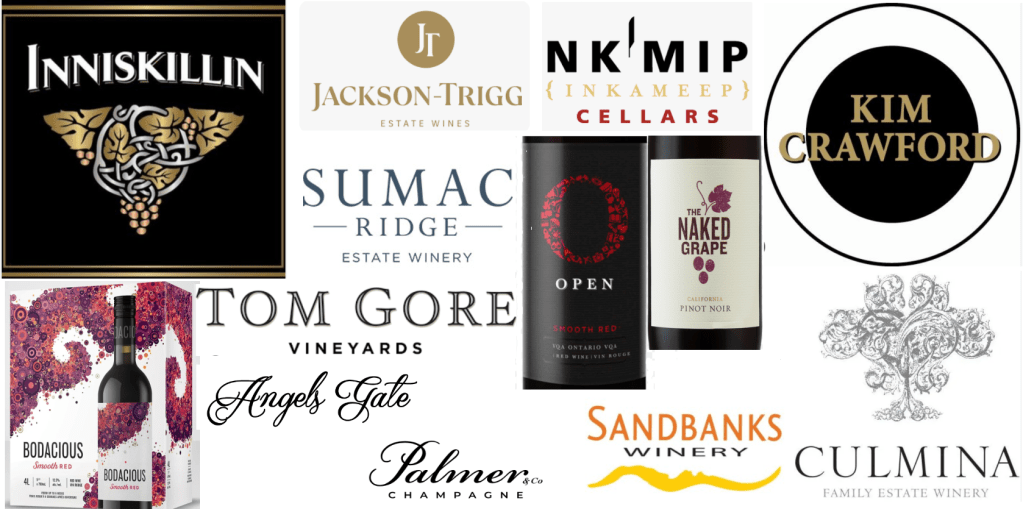
Inniskillin is given the first Canadian winery license since 1929 in Ontario, making it the first estate winery in Canada.
Don Triggs and Alan Jackson, with a group of employees and investors, purchase Cartier Wines from John Labatt Limited.
1992
Cartier Wines acquires Inniskillin.
1993
Jackson-Triggs brand launches.
1994
T.G. Bright & Co. changes its name to become Vincor International Inc.
2000
Acquisition of Sumac Ridge, one of B.C.’s first wineries, and See Ya Later Ranch (formerly Hawthorne Mountain Vineyards) in the Okanagan, B.C.
2001
NK’Mip Cellars Inc. in B.C. becomes first Aboriginal winery thanks to the joint venture with Osoyoos Indian Band and Vincor International.
Jackson-Triggs Niagara Estate Winery opens.
2003
Acquisition of Kim Crawford Wines of Auckland, New Zealand.
2005
Naked Grape brand launches.
2006
Vincor International is acquired by Constellation Brands.
2009
Open Wine brand launches in Ontario (and later in B.C. in 2011).
2012
Vincor International starts operating under the Constellation Brands name.
2013
Bodacious brand wine launches.
2016
Constellation Brands is acquired by the Ontario Teachers’ Pension Plan.
2017
The name is changed to Arterra Wines Canada.
2019
Acquisition of Culmina Family Estate Winery in B.C.s Okanagan Valley.
After stopping production in 2016, Jordan, Ontario’s Le Clos Jordanne wines were re-established.
2020
Acquisition of Sandbanks Winery, Prince Edward County, Ontario (see March 8, 2020 post, The Shifting of Sandbanks).
Acquisition of Tom Gore Vineyards and the trademark rights to Paso Creek, Revolution, Vintage Ink and R.H. Phillips.
2021
Acquisition of Vin First, a Canadian canning and Tetra™ packaging company, specializing in the beverage alcohol industry.
2023
New location for Le Clos Jordanne on Niagara’s Beamsville Bench.
Acquisition of Angels Gate Winery and Kew Winery, Niagara, Ontario.
Acquisition of Champagne Palmer of Champagne, France.
How long Arterra Wines remains under the control of the Ontario Teachers’ Pension Plan and a Canadian corporation remains to be seen. Should ownership become non-Canadian in the future, a significant portion of the Canadian wine industry will hang precariously in the balance; a sobering thought.
Millesime was a sparkling wine company in Niagara that was originally established by Frenchman Alain Girerd. He saw Niagara’s potential as a wine producing region and developed his export business from France to service Canadian winemaker’s needs. Millesime provided comprehensive solutions for traditional method sparkling wine production services such as consulting, riddling, disgorging, and packaging.
Len Pennachetti, Harald Thiel, and Philip Dowell
In December 2023, Millesime was purchased by two of the Niagara’s key winery owners and a veteran winemaker. Hidden Bench Winery owner Harald Thiel, Cave Spring co-founder Len Pennachetti and winemaker Philip Dowell purchased Millesime and have renamed it Niagara Sparkling Wine Service.
By acquiring Millesime and providing Ontario craft winemakers with a scalable traditional method for producing sparkling wine, they feel they can ensure and expand the growth of premium sparkling wine production in Ontario. Winemaker Dowell, the operating partner of Niagara Sparkling Wine Service, has been crafting benchmark traditional method sparkling wine for more than 20 years and provides sparkling wine consulting services to the industry on an as needed basis. Dowell was most recently the winemaker at Kew Vineyards and Angels Gate prior to their being purchased by Arterra Wines Canada.
Millesime was originally sold by its founder, Alain Girerd to John Young, who was then president at Angels Gate Winery. Dowell and Young operated the company as the full-service facility as it was envisioned by Girerd until Arterra purchased Angels Gate Winery and left Millesime dormant. The purchase by Thiel, Pennachetti and Dowell from Young got the idle sparkling wine production facility back in operation to the relief of wineries who had their wines tied up during the transition.
Historically, the Romans are famous for their love of wine. It is ironic that the wine Roman Emperors consumed was nothing like the wonderfully delicious wines that the world enjoys today. During Roman times, what was referred to as wine was actually vinegar with honey and spices added, or sometimes garlic. Despite this, it was considered very good compared to other wines of the time.
Photo credit: disholicioussite.blog
Recently, three historic, yet little-known indigenous grape varieties, Bellone, Nero Buono and Cesanese are making a comeback in Italy’s ever changing wine market.
Bellone
Bellone is an ancient white grape variety that is referred to as ‘uva pantastica or pane d’uva’, meaning a ‘grape as good as bread’ or a ‘grape that goes well with bread’, depending on the source. The white grape often brings bright, fruity characteristics of stone fruit, melon and citrus fruits. Some bottles also have flavours of herbs, tropical fruits and toast. It still grows on the original roots of ancient times.
Casale del Giglio wine estate, located 50 kilometres south of Rome, has spent years reintroducing the native grapes of Lazio. In 2022, its work was recognized by Gambero Rosso magazine when the winery’s Anthium Bellone, which is produced using ungrafted vines, was awarded the coveted Italian award for wine excellence, Tre Bicchieri.
Nero Buono
The black or red grape variety, Nero Buono, almost exclusively grows in the volcanic soil of Monte Lepini. Insects do not thrive in its cool, windy climate, thus alleviating one risk to this finicky grape. The deeply coloured wine brings flavours of dark-skinned fruits, rhubarb and black pepper.
Nero Buono is difficult to grow so there are no clones. It is very wild and produces many leaves which must be thinned out several times per year. The berries are tight and close together making the vines susceptible to disease.
Producers are committed to supporting native grape production, even when there is minimal demand for the grapes. Winemaker Marco Carpineti now makes wine only with sustainably grown fruit that is native to the area. Today Carpineti is one of the best-known winemakers of Lazio. He devotes 25 percent of his production to Nero Buono and Bellone-based sparkling wine made in the traditional method.
Cesanese
Originally called Latium, the Lazio region of Italy borders Tuscany to the north, Abruzzo to the east, Umbria to the northeast and Campania to the south. Rome is in this region, making it the primary winemaking region of the Roman Empire.
Cesanese is the signature red wine of Lazio. Cesanese refers to one of two sub-varieties: Cesanese Comune or Cesanese di Affile. Both are used to make high-quality wines, which were highly prized in ancient times. There are three Cesanese appellations which include Cesanese del Piglio DOCG, Cesanese di Olevano Romano DOC and Cesanese di Affile DOC. All are within a 50-kilometer vicinity.
Cesanese is a red wine that contains flavours of dark-skinned berries, herbs, cedar and cooking spices. It’s ruby in colour and has high acidity and tannin, with the ability to age for a long time.
The Campania Region
Modern winemaking in Campania, a southern region referred to as ‘the ankle of the boot’, is closely identified with the Mastroberardino family, specialists in the wines of ancient times. The family’s involvement in winemaking can be traced back to the late 1500s. However, today, brothers Antonio and Walter, along with sons Piero and Carlo, run the winery which is 60 kilometres northeast of Naples.
The family’s extensive library of ancient viticulture books has enabled the Mastroberardinos to grow grapes that were popular centuries ago.
Homemade pizza and wine are the standard Friday night fare at our house. The topping choices are numerous, ranging from veggies to savoury cured meats and cheese. The options seem to be only limited by the imagination.
Photo credit: vinointeriano.wordpress.com
No matter what type of pizza you enjoy there will be a suitable wine to complement it. Here are some suggestions to pair with your pizza whether you create it yourself or order it from your favourite restaurant.
Let’s start with the simple Cheese pizza. This straightforward pie goes well with a light red wine, such as Pinot Noir or Chianti.
Building on that foundation we progress to the Pepperoni pizza. Pepperoni is the culmination of cured meats and spices such as cayenne, anise and garlic. It pairs well with either two of my favourite wines, Cabernet Franc or Sangiovese. These bold, spicy reds complement the flavours of the pepperoni.
The combination of veggies and assorted meats creates an assortment of flavour found in the Supreme pizza. It may seem strange but Prosecco makes a great pairing as it won’t overpower the delicate flavours of the veggies but can still balance the taste of the savory ham, sausage and pepperoni.
Speaking of meat, the Meat Lovers pizza needs to be matched with a bold and robust wine, such as a Cabernet Sauvignon or Malbec. These wines have a bold richness, as well higher tannins and acidity to offset the fattiness of the meat.
Tangy, sweet BBQ Chicken pizza pairs well with a fruity Malbec or Pinot Noir. The wine will complement the tangy notes of the barbeque sauce in the pizza.
Heading in the opposite direction is the Veggie pizza. This type of colourful pizza needs a light, chilled red or full-bodied white to let the taste of the vegetables be revealed. A sparkling red wine, such as Lambrusco, or a Chenin Blanc or a Chardonnay would be a good match.
During my Italian adventure last year, I enjoyed a Margherita pizza on several occasions. A Margherita is a light pie consisting of tomato sauce, fresh mozzarella and fresh basil. It pairs well with a light wine, such as a dry Rosé or Prosecco.
If pineapple on pizza is your thing, then Hawaiian pizza is for you. The sweet and salty flavours will be complemented by a German Riesling or a New World Sauvignon Blanc. The wine’s acidity and sweetness will complement the sweetness of the pineapple.
No matter what your choice of pizza is, there is a wine to go along with it.
I recently enjoyed a bottle of Barolo with dinner one night followed by a Barbaresco the following night. Having the two bottles back-to-back reminded me how different the two wines are despite being made from the same Nebbiolo grapes and being produced in the Piedmont region of Italy.
Photo credit: pinterest.co.kr
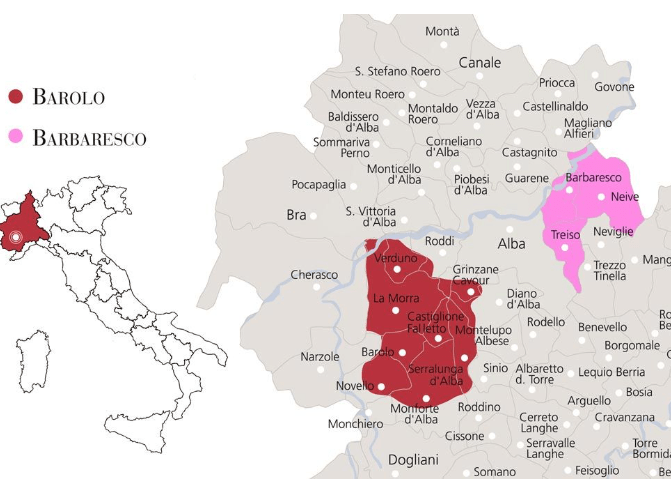
Production of both Barolo and Barbaresco occur in the Langhe hills near the town of Alba. The Barbaresco zone is northeast and the Barolo zone is southeast of the town. In accordance with Italy’s governing body, the DOCG (denominazione di origine protetta or Denomination of Controlled Origin.) Barolo may only be produced in the comuni or townships of La Morra, Castiglione Falletto, Serralunga d’Alba, Barolo and Monforte d’Alba. Barbaresco wine is produced in Treiso, Neive, San Rocco Seno d’Elvio and Barbaresco.
There are differences in the two sub-regions. The Barolo area is located at a slightly higher altitude and has more south-facing vineyard exposures. This results in slower ripening grapes than those of the Barbaresco area to the north. The northern region it is warmer, due to the lower altitudes and warm sea winds. As a result, the grapes ripen faster.
The soils of the two area are different as well. The soils of Barbaresco are slightly sandier, less compact, and have more nutrients. As a result, the wines have a softer character. The firmer soils of Barolo create bolder, more tannic wines.
According to DOCG regulations, Barbaresco must be aged a minimum of 26 months, with at least 9 of those months in oak. Barbaresco Riserva must be aged a minimum of 50 months with at least 9 months in oak.
Barolo wines are aged a minimum of 38 months, with 18 months being in oak. Barolo Riserva needs to age 60 months with 18 months in oak. The longer aging requirements are necessary because of the more intense tannins that are in Barolo wines.
When it comes to flavour, Barolo is the bigger, bolder and more structured. It may have an array of aromas of plums, sour cherries, tobacco or truffles.
Barbaresco is generally a lighter wine with flavours of ripe fruit. Barbaresco is strongly influenced by the soil, vineyard location and the winemaker’s techniques.
As to which wine is better, that is up to you to decide. Personally, I like both equally. My preference is determined in the moment, whether it be a dinner pairing or simply my mood.
Old vines or new vines; does it make a difference when it comes to making wine? The simple answer is yes, but there are some things to take into consideration. The main sticking point is finding common ground for the definition of ‘old’. The definition is not industry controlled so depending on where you ask, the meaning changes.
Photo credit: lastbottlewines.com
In France, New Zealand and Canada, ‘old’ can mean 30 years. In Australia, California and Spain, the vines are not considered ‘old’ until they are 50 or 60 years of age. A few Californian producers who have vines as old as 80 to 100 years have adopted the designation ‘ancient vines’. If 80 years is considered ancient then by comparison there are several Australian vineyards with vines of such an age they would be considered prehistoric, dating back more than 150 years, the upper limit of longevity. Without a true international standard for identifying the relative maturity of vines from one country to the next, the consumer must beware and take into consideration where the wine was produced.
The lifespan of a vine is determined by several factors. The vines of France and other European nations were destroyed during the 1800s and early 1900s by a sap-sucking root pest called phylloxera that destroyed the plants and necessitated replanting on resistant North American rootstocks. Also, in the relatively rainy parts of Europe, such as much of France, the vines die decades before they tend to in the hot dry regions of South Australia, California, Chile and much of Spain. Harsh winters in countries such as Canada led to vines having only a 30 to 35 year lifespan.
Young grape vines, though productive, deliver variable quality wine from year to year. When the sun shines, they grow a great amount of foliage which can produce bitter grapes. When it rains, these vines bloat with water. The vines require massive pruning to reduce the amount of foliage and encourage ripening. By contrast, old vines are constant, their reduced sap flow naturally yields smaller berries with a higher ratio of solids to liquid.
The deep roots of old vines are a big asset. They tap moisture in drought conditions and guard against bloating during rainy times. Old vines also tend to ripen earlier, a great benefit to growers in cooler climates where cool autumn temperatures reduce the growing season.
Old vine wines provide richness and more complex flavours that build rather than trail off after the up-front fruit fades away. Young vines produce nice, aromatic wines but lack the complexity of flavour of wine produced from older vines. Wines produced from old vines will often cellar longer than wines produced from young vines.
Wine produced by old vines is generally more expensive than similar young vine wines. Because of the rarity, lower yields and perceived enhancement of wine quality, old vines have become increasingly sought after and valued by both the wine industry and consumers. As a result, old vine grapes typically demand a higher price per tonne. This combined with consumer demand, has resulted in old vine wines being more expensive to purchase in the stores.
It has been said that the appreciation of an old vine wine can be a way to connect with the past and to celebrate an enduring art form, similar to listening to the music of a great composer, reading literature or observing at the art of past masters. Wine made from old vines can reveal the distinctive character of a specific historic place and the artistry of the vintner, both past and present.
Sauternes is a sweet wine from France’s Bordeaux region. It is made from Sémillon, Sauvignon Blanc and Muscadelle grapes that have been affected by Botrytis cinerea, also known as noble rot. Sauternes is one of the few wine regions where infection with noble rot is a frequent occurrence. The noble rot causes the grapes to partially shrivel like raisins, resulting in concentrated and distinctively flavoured wines.
Sauternes is a full-bodied, sweet, late-harvest white wine that is an exceptional dessert wine. It is well complimented by aging in oak barrels and will keep for several decades.
Wine production is not consistent from one year to the next as harvests vary widely. The wines produced from Sauternes can be very expensive, largely due to the very high cost of production.
Sauternes are characterized by sweetness with the zest of acidity. Some common flavour notes include apricot, butterscotch, caramel, coconut, mango, marmalade and citrus, as well as honeysuckle and toasted baking spices. The finish may remain on the palate for several minutes. A Sauternes typically starts out with a golden yellow colour that darkens as it ages.
Most Sauternes are sold in half bottles of 375 ml. The wines are typically served chilled at 10 °C, but wines older than 15 years are often served a few degrees warmer.
Sauternes is a great dessert wine but it may also be served with several food pairings. Consider cheesecake of all kinds, almond tart, lemon tart, meringues and custards. As well, it may be served along side something savory such as Roquefort or Livarot cheese and foie gras or terrine with caramelized onions. Mains such as herb-roasted poultry or spicy Asian fare are recommended as well.
Bordeaux; most people have heard of this French wine region, which is one of the most famous Old World wine regions, but many people don’t understand it. To begin with, Bordeaux is divided into two sections, referred to as the Left Bank and the Right Bank. The banks refer to the left (west)and right (east) bank of the Gironde Estuary and Garonne River.
The Left and Right banks have significantly different terroirs. A terroir is the natural environment in which a particular wine is produced, including factors such as the soil, topography, and climate.
The soil is rockier on the Left Bank. It is packed with gravel and deep deposits of limestone which serves to provide more character and potential quality in the wine. This is why Left Bank wines are considered prime candidates for aging, while Right Bank wines are generally thought to be smoother and more drinkable at the time they are released for sale.
This is not to suggest that Right Bank wines are simple and boring. With limestone closer to the surface and less gravel for the vine roots to contend with, the wines of the Right Bank don’t lack character; it’s just that they possess a different kind of character.
When it comes to the grape varietals grown, because of the differences in the terroir between the Left and Right Bank, each supports its own type of grape. As a result, this is often the best way to distinguish between a Left and Right Bank Bordeaux, as the label will not often tell you. Left Bank wines are mostly Cabernet Sauvignon with a smaller portion of Merlot. The Right Bank wines are dominated by Merlot balanced by a smaller proportion of Cabernet.
The Cabernet dominated Left Bank wines tend to be higher in tannin, thus the reason why they age well. Aging the wine helps to mellow out the tannins and integrate the flavors of the wine. Merlot-based Right Bank wines are generally smoother, with softer fruit flavours as tannins are not as dominating.
The last comparison is between the wineries or chateaux themselves. These are the castle-like structures that appear on many of the Bordeaux wine labels. Generally, the Left Bank chateaux have larger vineyards than those of the Right Bank. Left Bank vineyards are on average 5o to 80 hectares in size versus those of the Right Bank, which only have a maximum of about 30 hectares. However, this is only a fun-fact as vineyard size really has no impact on the quality or character of the wine. Arguably the most renown chateaux include Chateau Margaux, Lafite, and Mouton Rothschild on the Left Bank and Petrus and Cheval Blanc from the Right Bank.
So, which wines are better? Neither. If you are looking for a wine to enjoy with dinner tonight, a Right Bank wine is probably the better choice, whereas if you are looking for a wine to age and appreciate in the future, you will find that a Left Bank wine will improve with age and provide a delightfully satisfying experience when it is uncorked in a few years’ time.






 A Layman's Wine Musings