Why are there such variations in the price of wine? Does the price reflect the quality? Why are some types of wine more expensive than others? Here are some of the answers to help explain why there can be such variations in price.
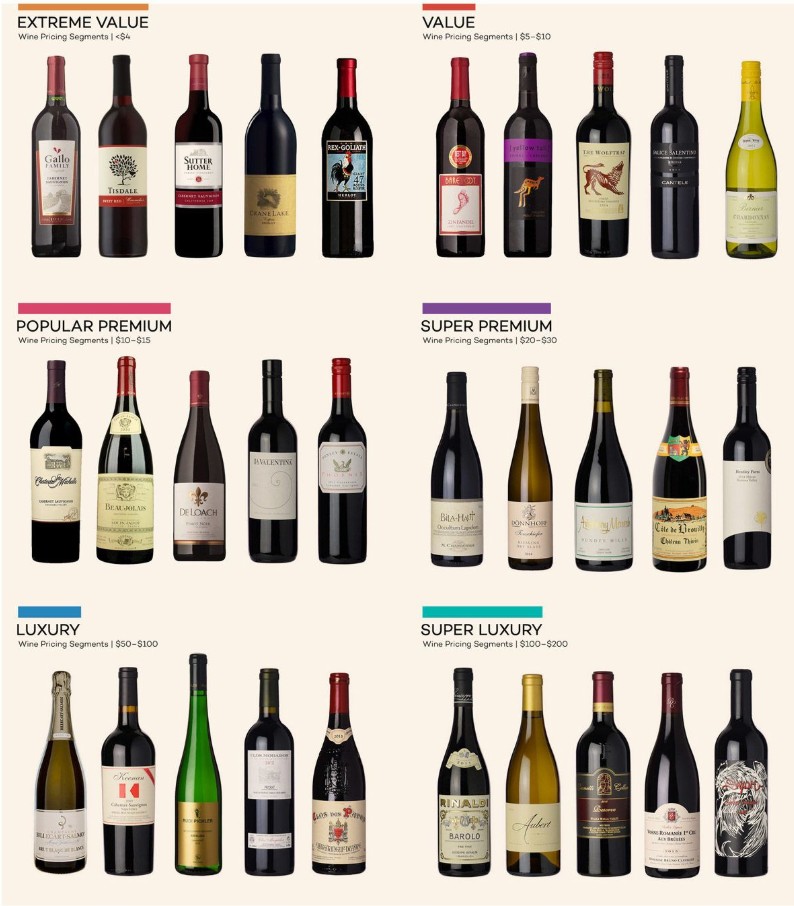
To begin with, location and climate can have a significant impact on price. Factors such as soil, weather, and region (terroir) can impact grape quality and rarity. Examples include Piedmont Italy’s Nebbiolo grape, which is used to make Barolo, or the production of Châteauneuf-du-Pape wine in the Rhone region of France.
The cost of the land that the vineyard occupies influences the price. For example, the price of a vineyard in Champagne, France is much more expensive than a similar piece of viticultural land in England.
The number of grapes available impacts price. Lower yields where there are fewer grapes on the vines produce less volume but more flavourful, concentrated and thus, more expensive wines.
Hand-harvesting helps ensure that only the best quality grapes make the wine, but the process is more expensive than using machine harvesting.
Wine produced using traditional methods is more costly than wines produced in modern, non-traditional ways. For example, French Champagne costs much more to produce than Italy’s Prosecco. However, the flavours and aromas of Champagne are much more complex than Prosecco.
The use of natural yeasts adds complexity to wine but also adds intricacy to the winemaking process and increases cost over commercially manufactured yeast. This is one reason why naturally produced wines demand a higher price than their mass-produced counterparts.
New, high-quality oak barrels add rich flavour to the wine but are quite costly, thus demanding a higher price than wines produced in old oak or without oak. Also, the longer the wine is aged in the oak the greater the impact of the cost of space and time.
Vineyard maintenance, harvesting, and winemaking labour are major expenses, especially for vineyards that produce natural wines. These are wines made with the least possible use of chemicals, additives and overly technological procedures; included are biodynamic, organic and vegan wines.
Once the wine is made, it must be packaged for shipping. This includes the cost for glass bottles and labels, shipping boxes and additional transportation labels.
Brand reputation can also impact how much a consumer is willing to pay for a bottle of wine. The perception of quality and taste of a particular label or varietal can make consumers willing to spend more money on certain products due to their trust in the quality and craftsmanship of those wines. Some of the most notable wineries include Château Mouton Rothschild (Bordeaux, France), Domaine Leroy (Burgundy, France), Egon Müller (Mosel, Germany) and Screaming Eagle (Napa Valley, USA).
Finally, distributors, importers, and retailers must all get their share before you see the final product on liquor store shelves.
In conclusion, determining the price of a bottle of wine can be complex and multi-faceted. However, as the saying goes, you get what you are willing to pay for.
Sláinte mhaith
 A Layman's Wine Musings