The Beaujolais Wine District

My wife and I recently returned from an excursion to France, which included exploration of several wine regions including the Beaujolais district of Burgundy. Beaujolais is a French Appellation d’Origine Contrôlée (AOC) wine, generally made from Gamay grapes.  The grapes are thin skinned and are low in tannins.

The soil (terroir) consists of granite, schist, clay and sandstone. The vines are pruned using the goblet method, which is mainly practiced in the Mediterranean regions because having a foot close to the ground shelters the vine from the wind and the falling vegetation protects the grapes from the sun. This method of pruning only allows 3 to 5 branches to be kept on the vine. The branches end with a spur of 3 or 4 buds.

Goblet pruning is a drought-resistant and berry-protected method but prohibits the use of mechanized harvesting methods. Economically, the reduction in yields can be significant. The cost of production can be high due to an increased need for labour and the drop in production.

Climate change has been presenting a variety of challenges during recent years. Netting has had to be installed to protect the grapes from summertime hailstorms that have been regularly occurring since 2007. Very wet spring seasons, like this year, are threatening to delay the start of the growing season, thus reducing the yield potential and increasing the risk of mold on the vines.

The wines produced in the Beaujolais district include Beaujolais, Beaujolais Villages, cru Beaujolais and Beaujolais Nouveau. The region also produces a small amount of Chardonnay (about 4%) but none of that wine is sold outside of France.

Isabelle Brossard

We visited Château de Pravins, a 12th century winery. The current owners acquired the winery in 1941. The purchaser was Joseph Mathieu, whose descendant, Isabelle Brossard, operates the winery today. It is a biodynamic winery (uses organic processes) that expands across 26 hectares. The grapes are still crushed by feet, but pipes and pumps are also now used. One kilo of grapes is required to produce a single bottle of wine.  The AOC limits the Beaujolais wineries from producing any more than 6,000 litres of wine per hectare and allows only cement vats to be used in the production process.

While there we sampled three red wines, l’argile ardente No 2, les moraines, and l’argile ardente. I found all tree wines to be as equally as nice.

Based on the slow soggy start to the 2024 growing season, don’t be surprised if the 2024 vintage of Beaujolais wine is limited and thus more expensive than some previous years.

Sláinte mhaith

Pinot Gris or Pinot Grigio

Pinot Gris and Pinot Grigio are made from the same grape and are obviously both white wines, but it can be argued that the similarity ends there.

Photo credit: vinomofo.com

Pinot Gris originates in France and is believed to be a mutation of Pinot Noir. It’s mainly grown in the Alsace region of France. The grape is thought to have reached Italy during the 1300s where the variety was called Pinot Grigio.  The Italian version is primarily grown in the Alto Adige region of northwestern Italy.

Gris is the French word for gray and grigio is gray in Italian. The gray describes the grayish-purple skin of the grapes.

Both Pinot Gris and Pinot Grigio will appear on wines produced in countries other than France or Italy. There is an abundance of Pinot Gris grapes produced in countries such as Canada, the United States, Australia and New Zealand.

So what determines why some are labelled Pinot Gris while others are referred to as Pinot Grigio? Winemakers have the choice of selecting which name they use. There is no hard and fast rule, however most will base the name on the style of the wine they produce. You can usually tell the style by the colour. Pinot Gris style wines are typically darker and more yellow in colour, whereas Pinot Grigio wines are very light yellow, almost clear.

Pinot Gris wines are rich, full-bodied and accompanied by higher alcohol content. Made with fully ripe grapes that are occasionally barrel fermented, Pinot Gris often has extra sweetness and a creamy feel. The darker grape skins tend to produce a golden colour.

By contrast, Pinot Grigio is harvested early, resulting in a light-bodied, crisper wine with a lower level of alcohol. The aromas are primarily of fresh fruit and florals.

Pinot Gris embodies complex flavours such as cinnamon and lemon, with a tingly aftertaste. Late harvest French-style Pinot Gris is a rather sweet wine. This is due to noble rot, which creates honeylike undertones.

Pinot Grigio tends to be a lighter, crisp, dry style of wine with flavours of citrus and green apple, pear, lime and lemon, with a refreshing spark of acidity. Some Italian-style Grigio wines also have a floral aroma of honeysuckle.

The Pinot Gris style pairs well with roast pork, creamy pasta, and dense cheeses like Comté or Gruyère, seared scallops, or creamy mushroom risotto. Off-dry versions go well with spicy Asian or Indian dishes like chicken tikka masala or Thai green curry.

The lighter Pinot Grigio is a great apéritif but, also goes well with grilled shrimp, salads or fruit platters and sushi.

Now it is up to you to decide whether you prefer Pinot Gris or Pinot Grigio.

Sláinte mhaith

Sauternes Wine

Sauternes is a sweet wine from France’s Bordeaux region.  It is made from Sémillon, Sauvignon Blanc and Muscadelle grapes that have been affected by Botrytis cinerea, also known as noble rot. Sauternes is one of the few wine regions where infection with noble rot is a frequent occurrence. The noble rot causes the grapes to partially shrivel like raisins, resulting in concentrated and distinctively flavoured wines.

Sauternes is a full-bodied, sweet, late-harvest white wine that is an exceptional dessert wine. It is well complimented by aging in oak barrels and will keep for several decades.

Wine production is not consistent from one year to the next as harvests vary widely.  The wines produced from Sauternes can be very expensive, largely due to the very high cost of production.

Sauternes are characterized by sweetness with the zest of acidity. Some common flavour notes include apricot, butterscotch, caramel, coconut, mango, marmalade and citrus, as well as honeysuckle and toasted baking spices. The finish may remain on the palate for several minutes. A Sauternes typically starts out with a golden yellow colour that darkens as it ages.

Most Sauternes are sold in half bottles of 375 ml. The wines are typically served chilled at 10 °C, but wines older than 15 years are often served a few degrees warmer.

Sauternes is a great dessert wine but it may also be served with several food pairings. Consider cheesecake of all kinds, almond tart, lemon tart, meringues and custards. As well, it may be served along side something savory such as Roquefort or Livarot cheese and foie gras or terrine with caramelized onions.  Mains such as herb-roasted poultry or spicy Asian fare are recommended as well.

Sláinte mhaith

Right and Left Bank Bordeaux Wines

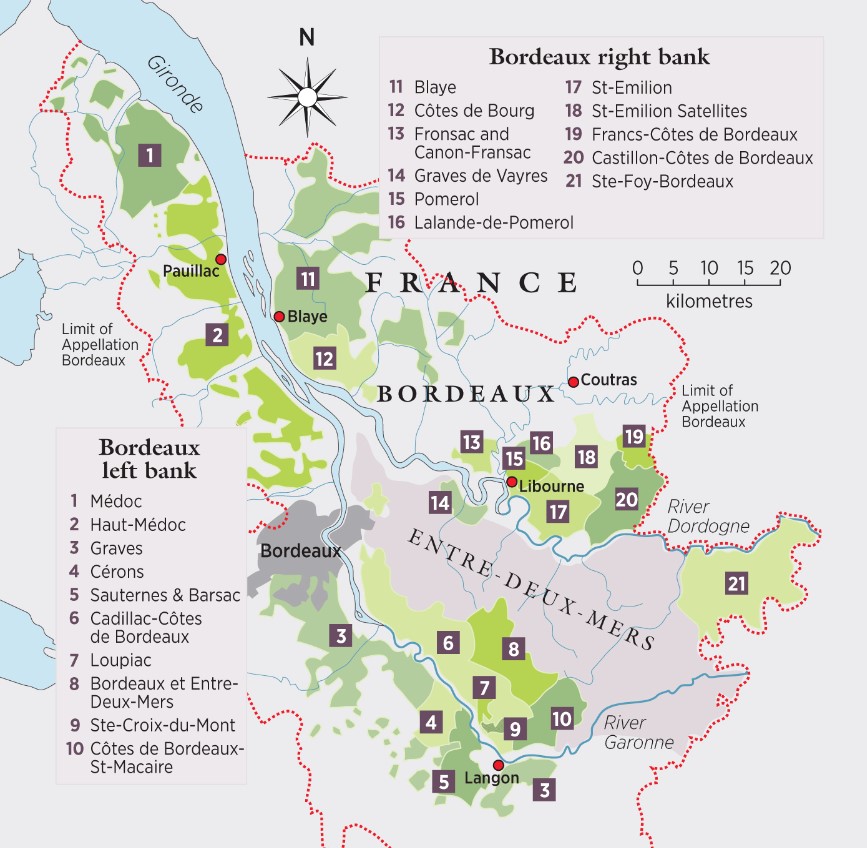
Bordeaux; most people have heard of this French wine region, which is one of the most famous Old World wine regions, but many people don’t understand it. To begin with, Bordeaux is divided into two sections, referred to as the Left Bank and the Right Bank. The banks refer to the left (west)and right (east) bank of the Gironde Estuary and Garonne River.

The Left and Right banks have significantly different terroirs. A terroir is the natural environment in which a particular wine is produced, including factors such as the soil, topography, and climate.  

The soil is rockier on the Left Bank. It is packed with gravel and deep deposits of limestone which serves to provide more character and potential quality in the wine. This is why Left Bank wines are considered prime candidates for aging, while Right Bank wines are generally thought to be smoother and more drinkable at the time they are released for sale.

This is not to suggest that Right Bank wines are simple and boring. With limestone closer to the surface and less gravel for the vine roots to contend with, the wines of the Right Bank don’t lack character; it’s just that they possess a different kind of character.

When it comes to the grape varietals grown, because of the differences in the terroir between the Left and Right Bank, each supports its own type of grape. As a result, this is often the best way to distinguish between a Left and Right Bank Bordeaux, as the label will not often tell you. Left Bank wines are mostly Cabernet Sauvignon with a smaller portion of Merlot. The Right Bank wines are dominated by Merlot balanced by a smaller proportion of Cabernet.

The Cabernet dominated Left Bank wines tend to be higher in tannin, thus the reason why they age well. Aging the wine helps to mellow out the tannins and integrate the flavors of the wine. Merlot-based Right Bank wines are generally smoother, with softer fruit flavours as tannins are not as dominating.

The last comparison is between the wineries or chateaux themselves. These are the castle-like structures that appear on many of the Bordeaux wine labels.  Generally, the Left Bank chateaux have larger vineyards than those of the Right Bank. Left Bank vineyards are on average 5o to 80 hectares in size versus those of the Right Bank, which only have a maximum of about 30 hectares. However, this is only a fun-fact as vineyard size really has no impact on the quality or character of the wine. Arguably the most renown chateaux include Chateau Margaux, Lafite, and Mouton Rothschild on the Left Bank and Petrus and Cheval Blanc from the Right Bank.

So, which wines are better?  Neither. If you are looking for a wine to enjoy with dinner tonight, a Right Bank wine is probably the better choice, whereas if you are looking for a wine to age and appreciate in the future, you will find that a Left Bank wine will improve with age and provide a delightfully satisfying experience when it is uncorked in a few years’ time.

Sláinte mhaith

Rhine River Cruise

My wife and I recently returned from a Rhine River cruise where we had the opportunity to sample wines from Switzerland, France and Germany during our travels. I was most anxious to try some Swiss wines as I had never had the opportunity of tasting any. These wines are not often available outside of Switzerland (see The Wines of Switzerland from May 1, 2021). 

The first Swiss wine we tried was a 2022 Weinbau Ottiger Pinot Noir. The wine is very similar in character to a French Pinot Noir.  The second sampling was a red blend from Château Constellation sa 1950 Sion, called “Humagne Rouge”.  It has a spicy bouquet characterized by notes of pine and cinnamon. It has accents of black fruit aromas balanced by silky tannins. It was very enjoyable.

We ventured through Strasbourg, France and the Alsace wine region. World-renowned for its viticulture, Alsace has a dry mild climate, favourable soils and ideal exposure to the sun for its vineyards. The white wines produced here rival the Rieslings created in neighbouring Germany.

While in Breisach, Germany, the tour offered a wine tasting at Domaine Albert Seltz, Alsatian Vineyards.  There they follow a rigorous process to preserve the authenticity of their wines, respecting traditional techniques while integrating the most recent advances in technology. Sustainable viticultural practices are followed that promote biodiversity and respect for nature.

The area surrounding Breisach, the capital of Alsatian wines, has the third largest wine co-op in the world, following California and South Africa. Twelve million litres of wine are produced there each year, taking advantage of being the sunniest place in all of Germany.

We also visited Rüdesheim, which is a German winemaking town in the Rhine Gorge, and part of the UNESCO World Heritage Site. It is in the heart of the Rheingau wine region.

Close to Speyer, Germany lies the Roter Hang wine area.  It is considered to be one of the most important vineyard sites in the world, sitting to the south of Mainz, not far from Nierstein and Nackenheim. The soil is red, the result of red slate that exists throughout the region, providing the perfect conditions for outstanding wines that are characterised by unmistakeable flavour.

Further north at the intersection of the Rhine and Moselle Rivers is the town of Koblenz.  Koblenz is a principal seat of the Mosel and Rhenish wine trade. Mosel is best known for growing some of the finest Riesling grapes in the world. 

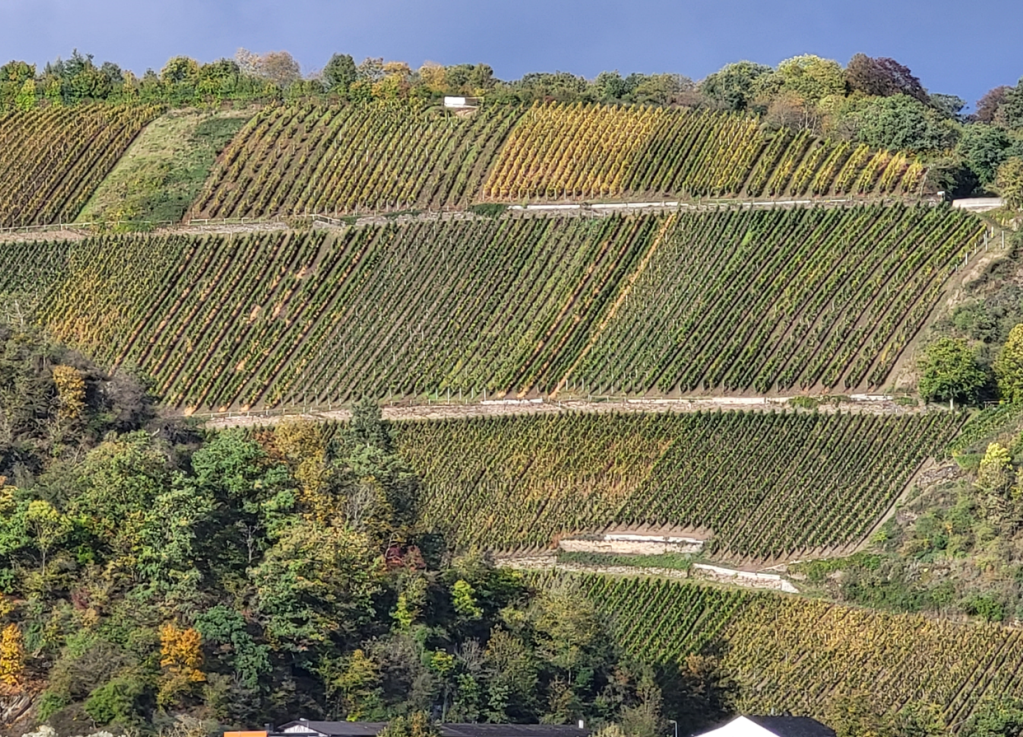
The vineyards are found tiered along the hillsides of the Moselle River. The steepest vineyard slopes in all of Europe are found here. Some of the grape vines are planted in vertical rows while others are in horizontal rows. The grapes planted vertically are machine groomed vines while those planted horizontally are generally on the steepest slopes and are maintained totally by manual labour.

Along the Moselle River in Winningen we visited the Weingut Rüdiger Kröber winery where we sampled four different Riesling wines ranging from dry to sweet; the 2022 “Kröber Weingut Steinig Riesling” dry, the 2022 “Kröber Weingut Uhlen Laubach” dry, the 2022 “Kröber Weingut Winninger Brückstück Riesling Feinherb” semi dry and the 2021 “Kröber Weingut Winninger Röttgen Kahimer Riesling Alte Reben” sweet. I found the Uhlen Laubach to be my favourite as it was robust with character and full of flavour.

The winery’s vineyards are up to 28 terraces in height along the slope of the hills. Weingut Rüdiger Kröber grows 90% Riesling, 5% Pinot Blanc and 5% Pinot Noir varietals. The vines range from 50 to 80 years in age.  The winery produces 60,000 bottles of wine per year and like many of the wineries in the region, it is all sold locally to individuals and restaurants.

Now that we have returned home from the Rhine, my wife and I are in the midst of planning our next wine excursion, which will be along the Rhone River in France during the spring of 2024.

Sláinte mhaith

From One Passion to the Other

People sometimes look at me funny when I tell them I periodically write about whiskey in my wine blog.  However, here is an excellent example of how the world of one is in many ways very similar to that of the other.

Photo credit: thedrinksbusiness.com

Raimonds Tomsons, who is from Latvia, won the ASI (Association de la Sommellerie Internationale) Best Sommelier of the World competition earlier this year in Paris, France.  Prior to winning the championship, Tomsons had already made a name for himself due to his work in wine, being a board member of the Latvian Sommelier Association and having worked with several high-end restaurants and importers in Latvia.

He is now going to be the global brand ambassador for The Craft Irish Whiskey Co. of Dublin, Ireland.  Tomsons will now be applying his expertly trained nose and palate in his new role.  He sees this new endeavor as giving him the opportunity to further enhance his learning by exploring the diverse world of spirits and other beverages.

Tomsons sees that by joining Jay Bradley and his team at The Craft Irish Whiskey Co., he will have an opportunity to explore fine Irish whiskey in depth, and work on innovative whiskey and food pairings.  Bradley feels that Tomsons’’ knowledge and ability to detect nuances and layers of flavour compliments the way he makes whiskeys, each bottle of which offers a unique complexity of flavours.

The Craft Irish Whiskey Co. was founded by Bradley in 2018.  The distillery creates rare and ultra-rare Irish whiskeys, including The Emerald Isle, worth an incredible $2 million US, making it one of the most expensive whiskeys in the world.

Craft Irish Whiskey is made only in a pot still and with hand-selected barrels.  They craft whiskey as it was once made before the rise of blends and mass-production techniques. They are proud to be reviving the art of crafting whiskey.  The Craft Irish Whiskey Co.  considers themselves as being rooted in tradition but with an eye on the future, a modern expression of a historic craft.

It is now also a marriage between the world of wine and that of whiskey.

Sláinte mhaith

The Effects of Climate Change in Bordeaux

Rising summer temperatures are impacting grape growers around the world, however today I will focus on France’s Bordeaux region.  Temperatures are expected to rise between 0.3°C and 1.7°C over the next 20 years. At this point global warming has benefited Bordeaux but that is about to change, especially if the grape crop is not somewhat modified. 

Photo credit: foodandwine.com

Growers are going to need to reconsider their mix of grapes as temperatures continue to rise.  The future of white varietals from the region may become non-existent while the existing proportion of reds, where 60% to 70% is currently Merlot, is already too great an amount.  Merlot is ideal in cooler regions where there is a shorter growing season. However, with temperatures increasing and the growing season getting longer, Merlot now ripens too quickly.  Many of these vines will need to be replaced with varietals such as Cabernet Sauvignon, which perform better in hotter climates with a longer growing season.

At least until now the increase in temperature and the resulting riper fruit have not had a detrimental effect on the quality of the wine. Instead, higher temperatures have made wine quality more consistently better. However, if warming continues the quality of the wine will begin to deteriorate.

It is well known that high temperatures can have harmful effects on grape composition, such as a decrease in anthocyanins (the pigmented molecules that give red wine its colour), as well as other molecules, that could cause unpredictable aromas.  The grape skins are also negatively impacted by higher temperatures.

Growers, scientists, and wine professionals all speculate that continued increases in temperature will negatively impact fruit and wine quality in the future. However, to date Bordeaux has successfully adapted to the quickly changing climate, but experts fear that the danger point is swiftly approaching.

Sláinte mhaith

Challenges for France’s Bordeaux Region

This summer has proven to be especially bad for the grape harvest in France’s Bordeaux region.  The perfect combination of meteorological conditions has led to an alarming spread of mildew throughout the region. The combination of warm weather and rain has resulted in new plant growth being left unprotected as the wet weather has hindered the application of herbicides.

Photo credit: vivino.com

The mildew has been having the greatest impact on the red grape varietals, most notably Merlot.  So far this year the region has been impacted by two separate waves of mildew.   It remains to be seen whether the disease will progress onto the stalks of bunches and if it can be ultimately contained.

Some growers have lost their entire harvest.  As a result, a helpline has been established to help growers cope with the devastation.  Some grape growers are even considering their careers because of the mildew.  It has been quite traumatic for those trying to control it.

This is the second consecutive year where Bordeaux growers have been impacted by the weather.  The 2022 harvest was about 11% less than the ten-year average.

Grape growers are hoping that the region will soon see a return to more uninterruptedly dry, hot weather.  If the dry heat returns, Bordeaux may see the 2023 harvest being within the top three earliest harvests in the past decade.  However, given the devastation caused by the mildew, the harvest yield will be much lower than in previous years.  This will no doubt impact the price when the 2023 vintage of Bordeaux reaches store shelves in a few years’ time.

Sláinte mhaith

Bordeaux’s Left and Right Bank

The prestigious Bordeaux wine region is located on the western coast of France. The region is separated into two sub-regions, referred to as the Right Bank and the Left Bank. Each region has its own unique nuances that characterize it from the other.

Photo credit: Decanter.com

The banks refer to the two riverbanks, the land masses on either side of the Gironde Estuary, the place where a river meets the sea. The Gironde Estuary is fed by two rivers, the Dordogne and the Garonne. The Left Bank viticultural region is on the southwest side of the Gironde and the Right Bank is on the northeast side.

The prominent difference between the Left and Right banks is the grape varietal grown.  The Left Bank is famous for its Cabernet Sauvignon while the Right Bank is mainly Merlot, Cabernet Franc, Petit Verdot and Malbec.  The reason for the grape varieties being different is due to the type of soil. The Left Bank is characterized by gravelly soils while the Right Bank is mainly clay soils.

The varietals grown determines the difference in style of wine produced.  The Left Bank’s Cabernet Sauvignon-based blends tend to be more structured, powerful and have a higher presence of tannins, whereas the Right Bank’s Merlot-dominant blends tend to be softer and silkier.  Personally, I am a fan of the wines from the Right Bank.

The most complicated difference between the Left and Right Banks is the way in which the wine is classified. For a detailed explanation of the classification methods see my post, France’s Cru Levels from March 18th.

The most notable vineyards on the Left Bank include Château Latour, Château Margaux, Château Haut-Brion, Château Lafite, and Château Mouton Rothschild.  Estates on the Right Bank include Château Cheval Blanc, Château Angélus, Château Pavie and Pétrus.

Sláinte mhaith

France’s Cru Levels

As I have discussed in the past, French wine labels can be rather puzzling since they indicate the region where the wine was produced rather than the grape varietal contained inside the bottle.  Also, the label will often contain such words as “Grand”, “Premier” or “Cru”.  Even though premier means first in French, you will often find grand appearing on the better quality wines.

Photo credit: Decanter.com

The simple translation for cru is growth.  However, in the world of French wine its reference is for the geographic terrain, specifically the soil type, climate and altitude where the grapes are grown.  It gets complicated by the fact that cru is not applied in the same manner throughout all the wine regions of France.  Further complicating things is that the term cru is also used in Germany and Italy where there are additional variations in the meaning.

In the Burgundy region of France, the classification of cru is rather simple.  Cru designates a vineyard as being of a certain level of quality.  The classifications originate back to the 12th century and the Cistercian and Benedictine monks in the Côte d’Or.  Every vineyard in Burgundy is classified in the hierarchy where Grand Cru is at the top followed by Premier Cru and then “village” wines, with the generic Bourgogne category at the bottom.

There are 33 Grand Crus with each having its own appellation.  Only Pinot Noir and Chardonnay are grown here, but most appellations only permit one or the other varietal to be grown; very few allow both. Premier Cru wines are less expensive and are often a better value, though their long-term aging potential is typically less.

Chablis has one Grand Cru appellation that includes seven vineyards. These vineyards overlook the town of Chablis and benefit from a southwest exposure that helps ripen the grapes.

The Bordeaux region applies the term cru in a much different manner. Grand Cru Classé classification system forms the basis of the rating system and it’s tied to a specific chateau or estate, rather than adjacent vineyards. It was created in 1855 and is comprised of only left bank chateaus in Médoc, Graves and Sauternes, ranked from first to fifth growths, based on their value at that time. The first growths are called Premiers Crus, while second through fifth growth crus are called Crus Classes.

On the right bank Pomerol isn’t classified but Saint-Émilion is.  St.-Émilion has three chateau-based quality classifications. At the top is Premier Grands Crus Classés, of which there are 18, followed by Grands Crus Classés which contains 64 chateaus. The appellation’s third category is not tied to a specific ‘classed’ chateau or geographical subzone. Wines labeled “St.-Émilion Grand Cru” merely have more stringent production rules.

The Alsace region uses the term Grand Cru in similar fashion as the Burgundy region. Fifty-one vineyards have been designated superior, or Grand Cru, and wine from those vineyards can use the term on their label. There is a great deal of diversity in Alsace’s Grand Cru wines.  There are four grapes approved for use, as well as a wide variation in soils.

The Beaujolais region is where Gamay grapes are grown. Here cru is applied to villages rather than vineyards. There are 10 villages and the wine produced from these villages is called Cru Beaujolais.

The Champagne region also classifies entire villages as Grand Cru or Premier Cru. The Champenois created a system referred to as échelle des crus, or “ladder of the growths” in the early 20th century to fix grape prices for both farmers and buyers at Champagne houses.

At each harvest a price is set and growers with land in one of Champagne’s grand cru village receives 100% of that price. Grapes from the premier cru villages earns from 90% to 99% of the set price, while the rest receive from 80% to 89%.

There you have it; a little more of the puzzle of French wine resolved.

Sláinte mhaith