An American wine club operator from Napa Valley, California had arranged for a group of his members to take part on our recent river cruise aboard the Scenic Sapphire, through the Burgundy and Rhône wine regions. The group excursion included the CEO of Cuvaison Estate Wines of Napa, California, Dan Zepponi.
While sailing down the Rhône River between ports, Zepponi treated the passengers to two seminars; the first was an exploration of Chardonnay wine. The presentation included tastings of two different Chardonnays from Cuvaison which were compared to two French Chardonnays that are regularly served as part of dinner service on the ship.

The tastings were conducted as a head-to-head comparison. First, his unoaked Methibiton Chardonnay, was compared to an unnamed, unoaked French wine. The second comparison was between two oaked Chardonnays, Coeurtina from his winery against a second unidentified French.
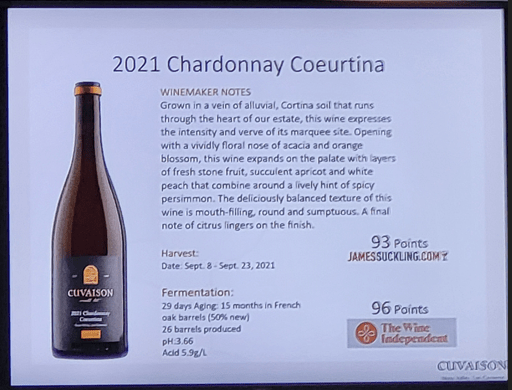
In each comparison I found the flavours of the Napa wines to be extremely close to the French, though to me the French was slightly more mellow and smoother. The Cuvaison wines are priced at $70 US each and are only available directly from the winery. In comparison, the ships wines would have an equivalent price of approximately $15 – $20 US per bottle.
During the second seminar Zepponi discussed micro-lots as they pertain to the wine industry. When a winery wants to produce a type of wine but does not have enough of the varietal in their own vineyard they may purchase the varietal from another grape grower. The purchased grapes are then used to make a specific wine exclusively from that purchased micro-lot. This allows the winemaker to better control the grapes being used and the wine produced, in a similar manner that would be done if the vintner was using their own estate grown grapes.
Two taste comparisons were conducted, the first was with Cuvaison’s 2022 En Cigar Chardonnay Blanc and the ship’s undisclosed Sauvignon Blanc house wine. The second comparison was conducted using their 2022 Fiddlestix Pinot Noir and an undescribed French Pinot Noir. I favoured the French Sauvignon Blanc over the Cuvaison but did find Cuvaison’s Pinot to be smoother and less fresh that the French Pinot. Once again though, the price between the American and French wines was significantly different – $70 US for both Cuvaison’s versus under $20 US for the French wines.
Unfortunately, the two seminars lacked substance and honesty as they were actually marketing presentations for Cuvaison wines. Zepponi would have had more credibility in my eyes if he had presented his talks as being an introduction to Cuvaison wines. There was no value in conducting taste comparisons with wines that are not even identified by name, let alone any information about where or how the wines were produced. He should have simply talked about how his wines are produced.
Based on information presented about the various Cuvaison wines, they are producing decent wines at a reasonable price point. However, the feeble attempt at conducting product comparisons was an insult to the intelligence of the ship’s passengers.
Sláinte mhaith
 A Layman's Wine Musings