England is known for its Gin and Tonic (G&T) and its bitters (beer), but did you know that the English also produce fine wine? The United Kingdom ranks 6th in the world for wine consumption, but over the past 15 to 20 years England has been making a name for itself as an up-and-coming wine producer. Most notable are its sparkling wines, which are made in the traditional way. They are finishing ahead of major Champagne houses in competitions and earning recognition around the world.
Sparkling wines represent 65% of England’s wine production. Still white wines represent about 20% of production and reds and Rosé make up the remaining 15%.
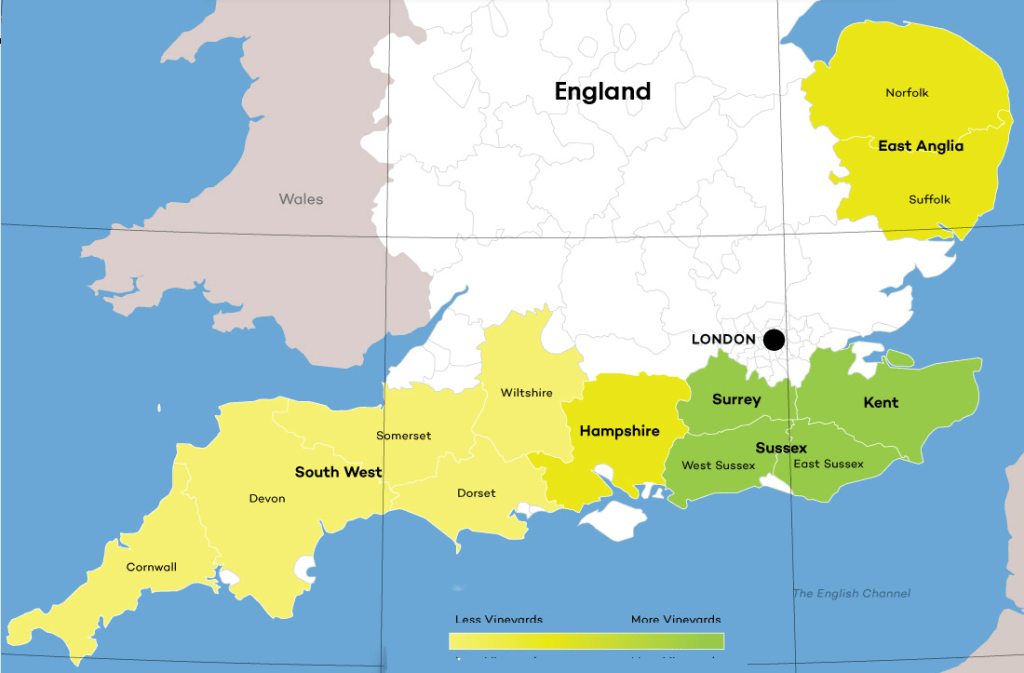
The last official count suggested that there are about 450 wineries in England, producing around 3.2 million bottles of wine each year. Many of the wineries and vineyards are situated along the southern strip of England’s coast from Cornwall to Kent, where the climate is slightly warmer and dryer than elsewhere in the country. This area includes the counties of Kent, Surrey and Sussex.
Sussex is situated alongside of the English Channel and is one of the sunniest regions in England. It benefits from the same soil characteristics as that found in France’s Champagne region. The grapes grown there include the classic Champagne grapes, Chardonnay, Pinot Noir and Pinot Meunier, as well as Bacchus, which is a cross of the German white grapes Silvaner, Riesling and Müller.
The county of Kent is located to the east of Sussex along the English Channel. The viticulture includes Chardonnay, Pinot Noir, Bacchus and Ortega. The Champagne house Taittinger purchased land in Kent and planted Chardonnay, Pinot Noir and Pinot Meunier in its English vineyard.
Kent has also drawn attention from a second French Champagne house. Pommery joined forces with England’s Hattingley Valley creating Louis Pommery England.
Each year the number of wineries continue to increase to satisfy the growing demand for English wine, in particular sparkling wine. Due to climate change, viticulture is now expanding beyond the traditional three counties right across England and even into Wales. Global temperatures have increased to the point where the temperature in England is now nearing that of the Champagne region of France during the prime of Champagne production, before the challenges brought on by climate change.
As a result, consumers can anticipate more English wines becoming available in global markets. As the prices for land in England are drastically lower than in Champagne, producers can afford to sell their wines at more consumer-friendly prices. Also, because of the similar soil composition as found in Champagne, the flavour is much closer to Champagne than either Spain’s Cava or Italy’s Prosecco.
Cheers to the future of English wine.
Sláinte mhaith
 A Layman's Wine Musings